Midnight in Paris – a film

We went out to the flicks tonight, the first time I’ve been to see a film for absolutely yonks. Of course, Midnight in Paris is a Woody Allen film and his films are not to everyone’s taste. They aren’t always great but more often than not I really enjoy them.

Midnight in Paris was a bit like a big advert for Paris, if you haven’t been able to visit then you’ll probably find the whole thing interesting just as a way of seeing the place.

Gil is a successful Hollywood screenwriter, and he’s in Paris with his fiancee Inez and her ghastly parents. At first I thought it was going to be a difficult film to like because none of the characters were at all likeable, but it wasn’t long before lots of wonderful artistic people from the past made their entrances. Gil mentions that he would have loved to have lived in Paris in the 1920s and it isn’t long before he is whisked into the past and meets up with Scott Fitzgerald and Zelda, Hemingway, Gertrude Stein, Picasso, Dali, Man Ray – to name a few. I suppose it’s a hackneyed sort of a fantasy, but still very watchable.

A flick with vintage cars, flapper dresses and Paris added up to a good night out. They do say that the only thing wrong with Paris is that it’s full of French people! I couldn’t possibly comment.

It has taken about nine months for Midnight in Paris to reach the Adam Smith Theatre in Kirkcaldy and it’s only on for one more night – February, 14th – today. It’s worthwhile going out on a dark, cold night to see it!

Soda Bread

Soda bread

Soda Bread: heat the oven to 400F/200C/Gas 6

6oz/170g self-raising wholemeal flour.
6oz/170g plain flour.
half a teaspoon of salt.
half a teaspoon of bicarbonate of soda.
290 ml/ half a pint of buttermilk.

1. Tip the flours, salt and bicarbonate of soda into a large bowl and mix together.
2. Make a well in the centre and pour in the buttermilk, mixing quickly with a large fork to form a soft dough. Depending on the absorbency of the flour you may have to add a wee bit more ordinary milk, if the dough seems a bit stiff, but it shouldn’t be too wet or sticky.
3. Turn onto a lightly floured surface and knead briefly.
4. Form into a round and flatten the dough slightly before placing on a lightly floured baking tray.
5. Cut a cross on the top and bake for 30 minutes or until the loaf sounds hollow.

I really liked the flavour of this bread but I think I need to fine tune the recipe a wee bit for my oven. The next time I’ll try baking it at Gas 5 for a longer time because the centre of my loaf was too doughy and obviously needed a bit more baking. I think my ovens are quite fierce, the thermostats don’t seem to be quite right so I often have to adjust baking times. I’m also going to try baking it in a bread tin as I prefer rectangular bread.

I’ve always loved soda bread, it’s very popular in the west of Scotland but for some reason the bakers in the east of Scotland didn’t sell it when we first moved here. They might sell it now, I gave up looking for it. I’ve been meaning to make it myself for years and only got around to it for the first time last week. I want to make more bread but my previous attempts have been dismal failures – doorstops spring to mind!

So I was interested in what Paul Hollywood was saying about bread making on the Great British Bake Off and I think I’ve been using the wrong sort of yeast. Different yeast has been purchased so I’ll be having another go later in the week. Fingers crossed that the poor birds don’t have to bounce their beaks off another disaster!

Following Paul Hollywood’s video I’m going to try making this bread later in the week.

William Again by Richmal Crompton and more reading

This is the third book in my boxed set of Just William stories. I think this book is the best one so far, she really seems to have got into her stride with her William character, the stories just keep getting funnier. Well they tickle my funny bone anyway.

In this one William gets a free ticket to go for a trip on a charabanc and gets squashed in between two very fat fellow passengers, that’s an experience I’ve had, only it was a bus. He tells a woman that his parents neglect him because they’re both boozers and the woman confronts William’s parents.

He sells Ginger’s three and a half year old twin cousins as slaves for a shilling, is conned out of his clothes by a tramp and much much more, causing general mayhem in the entire neighbourhood, wherever he happens to be.

William even manages to sneak out to see a circus with his grandfather, who is being treated as if he is simple when he just wants to have a bit of fun back in his life. Mind you their choice of fun wouldn’t suit me because they’re both enamoured of the circus clowns. As far as I’m concerened clowns are the stuff of nightmares – as are circuses. I think I must have been the first child to put my foot down at the end of the 1960s and refuse to go on a school trip to the circus, quite possibly the only child ever to do that. Me, strange – never!!

Anyway, such fun!

Otherwise I’ve been reading Russian Winter by Daphne Kalotay which I was asked if I would like to review. Yes please said I as I’ve always been fascinated by Russia/USSR and I’ll be blogging about that one on February 15th.

I had to renew The Odd Women by George Gissing which I got from the library as I didn’t have time to finish it – or even start it for that matter.

What did I do today?

We went to The Royal Highland Centre at Ingliston near Edinburgh because there was an antiques fair there this weekend. It was absolutely heaving/hoaching with people, the busiest I’ve ever seen it and they were also filming Bargain Hunt so we had to do some camera dodging. Tim Wotsisface was wearing some fairly subdued clothes for once.

The Olympic Games 2012

I watched the announcement of who had won the bid to have the Olympic Games in 2012 and like lots of people, particularly the French, I was absolutely gobsmacked when London was named. Surely I can’t be the only person in Britain whose heart absolutely sank to my boots at the announcement.

I’ve never been keen on anything competitive like that because I can’t see what there is to be gained by being able to run faster than the next person – unless you happen to be being chased by a lion! The whole idea of a competition to see who can be the fastest, highest, longest or whatever strikes me as being incredibly childish. Even the people taking part in the games admit that they aren’t doing it for their country but it’s all about themselves. That will come as no surprise if you know any aggressively sporty types, I don’t mean people just doing sport for the good of their health whether physical or mental.

There was a woman on the news from Glaxo-Smith-Kline not long ago and she was showing their ‘state of the art’ laboratory where all the urine samples are going to be tested. Her attitude was that they are ready for anything and so they will be able to detect drug cheats immediately. I know that that is just not true because new drugs are being concocted all the time and there are always sports people who are willing to give them a go. Unless a lab has a sample of a new drug then they don’t even know what they are looking for and it will be undetectable.

In the past it has been the sports people who have shouted loudly that they are anti- performance enhancing drugs who have turned out to be up to their ears in chemicals. So it’s a mystery to me why we even bother having things like the Olympic Games when it’s really a ‘who can dodge the analysts best’ games.

We’ve just heard the news that yet another cyclist involved in the Tour de France has been found out and that happens every year. Occasionally they collapse and die by the roadside due to the drugs which they’ve imbibed.

Given all this – why are people excited about the Olympic Games? The people who lived in the area that it’s taking place have all been swept out of their homes and whole communities have been broken up and garden allotments which had been worked for generations have been built over. As usual none of the local people will have benefited from any of the jobs which have been created by the project and it will all cost so much money (which could be better spent) that the debt won’t be paid off for donkey’s years. I heard that the Atlanta games still haven’t been paid for.

What’s it all for? For pumping up a lot of egos, and that goes for politicians too.

I believe the London games are being subtitled Island of Wonders. The way things are going I think it’s more likely going to be Island of Blunders.

Midsummer Night in the Workhouse by Diana Athill

This is a book I borrowed from the library, purely because it’s a Persephone really although I vaguely recognised the name of Diana Athill. It turned out to be a collection of twelve short stories, the third one of which, called The Return won her first prize of £500 in an Observer competition in 1958, an awful lot of money in those days.

The stories are about relationships between men and women and although they were written 50 odd years ago it’s striking how the women are just like women nowadays except they sometimes wear long evening gloves. Their attitudes to the men in their lives seemed very modern, to me anyway the stories didn’t seem dated but I suppose that might say more about me than the stories.

They’re mainly written from the woman’s point of view and are at times funny and always observant about ‘types’. It’s so easy for each generation to think that they are the ones to have really discovered sex but these stories prove that it was all going on even before the 1960s, which is always put forth as the time when everything changed in society and morals went to hell in a handcart.

Anyway the book was an enjoyable read which has made me want to seek out Athill’s memoirs. She was born in 1917 and after graduating from Oxford she became a literary editor and helped Andre Deutsch set up his publishing company. She worked closely with lots of authors: Jean Rhys, John Updike, Norman Mailer, Philip Roth, Brian Moore and Simone de Beauvoir, to mention a few, not a bad bunch!

1950s Embroidered Cushion Cover

1950s Embroidered Cushion

I wanted to get back to doing some traditional embroidery a wee while ago so I bought this 1950s cushion cover from Ebay, it had obviously been folded up and unused in somebody’s work basket for the last 60 years or so.

It didn’t take me as long to do as I thought it might, I speeded things up quite a bit by adding the buttons to the design where there should really have been satin stitched circles. Actually, you live and learn because I thought that was such a good idea at the time but then I realised that I should have left the button embellishments to last as they did make it difficult to iron when the stitching was all finished. Silly me!

I also stitched tiny beads into the middle of some of the daisy flowers, just to make the textures a bit different. The other daisies have the more traditional French knots as centres. I think the yellow flowers were probably supposed to be pink but I decided I wanted a zingy mainly yellow and green colour scheme, so the pink got the elbow!

3-dimensional embroidery

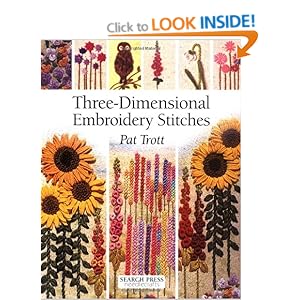
The stitches I used are the usual satin stitch, stem stitch sort of things. Now I want to try something a bit more ambitious and modern. With that in mind I bought a lovely book called:
Three Dimensional Embroidery Stitches by Pat Trott from Amazon. It arrived just a couple of days ago so I’m now raring to get on with another project. The book also shows you how to use paint in your designs too, which is something I haven’t tried yet. I can’t wait to experiment.

The image is from Amazon, if you want to look inside you’ll have to take a look at it on Amazon.

I posted about previous stages of this project here.

November’s Autumn Classics Challenge Prompt

November's AutumnI decided to do level 2 of this month’s prompt and I’m writing about the character Norna of Fitful-head. She appears in The Pirate by Walter Scott.

Level 2
How has the character changed? Has your opinion of them altered? Are there aspects of their character you aspire to? or hope never to be? What are their strengths and faults? Do you find them believable? If not, how could they have been molded so? Would you want to meet them?

Norna is a sort of prophetess/white witch of a character and as such she is held in high esteem by the inhabitants of the isles of Shetland, who also have a healthy fear of her because of her seemingly magical qualities. You can’t help but admire a woman who makes a good living by selling fair winds to sailors and anyone else who needs help. I suppose she’s a bit of a con woman really but there’s no real nastiness about her. She has just had to acquire her reputation as a way of surviving in a male dominated and harsh environment. I would have been quite happy to meet her.

She has had to put a lot of work into exploring the islands so that she knows all of the hiding places which were used by previous generations when Viking marauders came raiding, and she knows all of the short cuts, which means that the other islanders think she uses supernatural means of getting about as they don’t think she could possibly travel around so quickly otherwise.

At the beginning of the book Norna is living in a tower on a cliff, with a dwarf who is her servant, far away from anyone else.

Towards the end of the book we discover that as a young woman Norna had been an unmarried mother and her kinswomen had given her son to his father who had sailed away with him to Spain. She also believed that she had been the cause of her father’s death and the guilt had caused her to withdraw from normal life.

Years later Norna mistakes another young man for her son and her actions end up putting her real son in danger. When she discovers her mistake the shock changes her character completely. She refuses to answer to the name Norna which she had adopted and reverts to her real name Ulla Troil.

From the book:

“From that time Norna appeared to assume a different character. Her dress was changed to a simpler and less imposing appearance. Her dwarf was dismissed with ample provision for his future comfort. She showed no desire of resuming her erratic life; and directed her observatory, as it might be called, on Fitful-head to be dismantled. She refused the name of Norna and would only answer to the appellation of Ulla Troil. But the most important change remained behind. Formerly, from the dreadful dictates of spiritual despair, arising from the circumstances of her father’s death, she seemed to consider herself an outcast from divine grace; besides that, enveloped in the vain occult sciences which she pretended to practise, her study, like that of Chaucer’s physician, had been “but little in the Bible.” Now the sacred volume was seldom laid aside; and to the poor ignorant people who came as before to invoke her power over the elements, she only replied – ” The winds are in the hollow of His hand.”

I must admit I preferred the character of Norna but as The Pirate was first published in 1822 it probably wouldn’t have gone down very well with readers if Norna/Ulla didn’t have some sort of experience which caused her to become a good Christian woman again.

You can read my review of The Pirate here.

South Queensferry, Scotland

We travelled over the Forth Road Bridge to South Queensferry last Saturday, well the football had been cancelled due to hard frost.

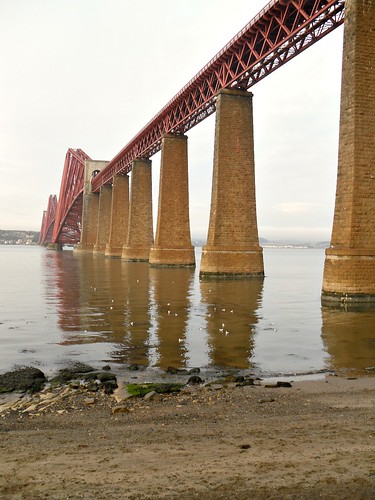
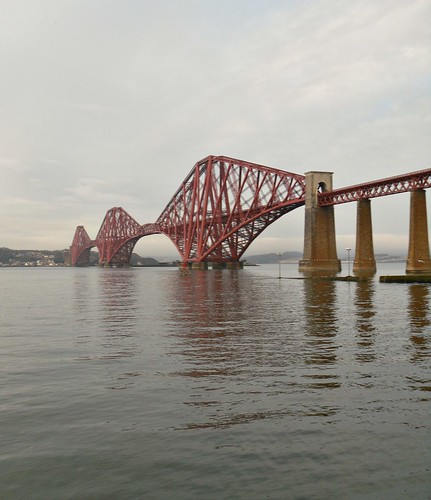
You can’t go to South Queensferry and not take some photos of the Forth Bridge, so here they are!
The Forth Bridge approach

The Forth Bridge

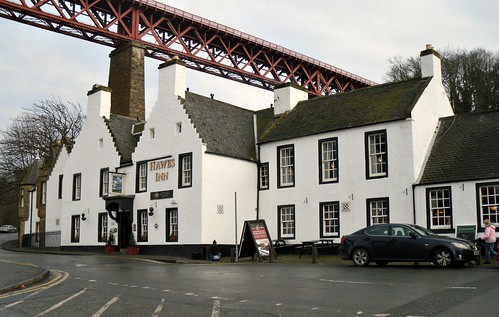
The Hawes Inn appears in Robert Louis Stevenson’s book Kidnapped. As you can see the approach to the bridge is more or less straight above the inn but of course the bridge wasn’t there at the time that Robert Louis Stevenson was writing about.

Hawes Inn, South Queensferry

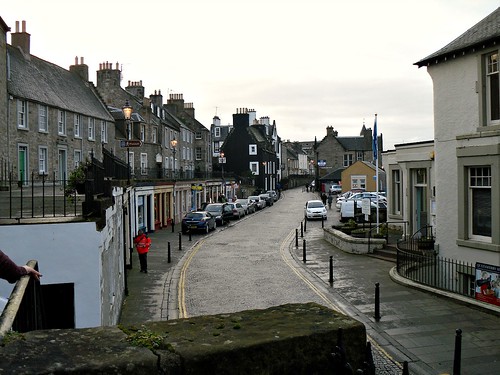
The photo below is of the main street in South Queensferry, I think it’s quite unusual to have a two tiered street with a pavement and houses being situated over the top of the shops.

South Queensferry

South Queensferry

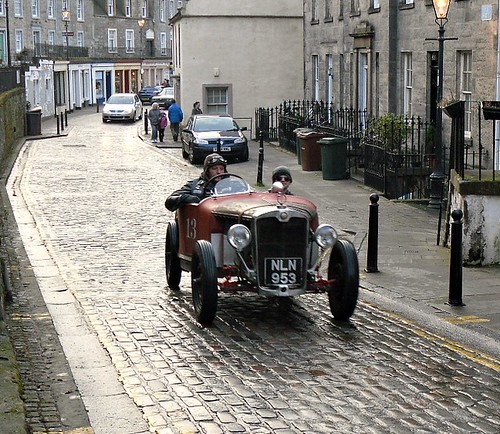
This vintage car came tootling along just as I was taking the photos, it was like something that Toad out of The Wind in the Willows might have driven. They must have been freezing! I wouldn’t mind going for a drive in it on a hot day though.

A vintage car

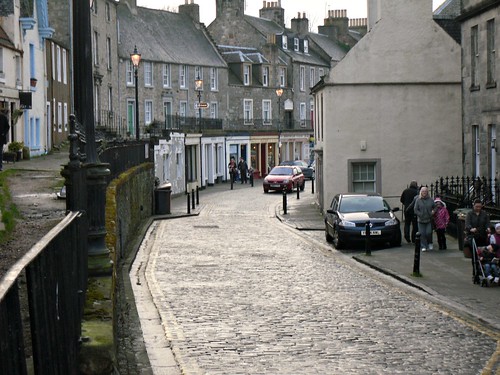
As you can see, they have some olde worlde streetlamps in South Queensferry which fit in nicely with the age of the buildings. Even although it was a cold day it was still busy with locals and day trippers, there are quite a few eateries in the town and I think it’s a favourite place for people living in Edinburgh to visit.

South Queensferry

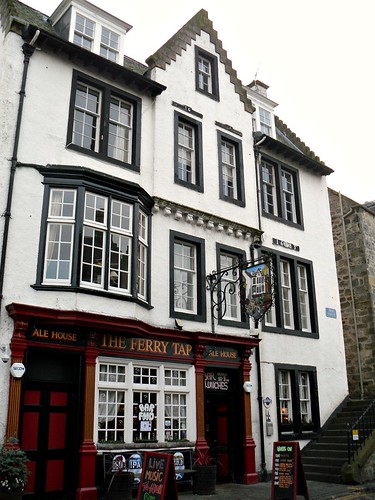
Some of the buildings are really quite ancient, as you can see the date on this pub is 1683.

The Ferry Tap

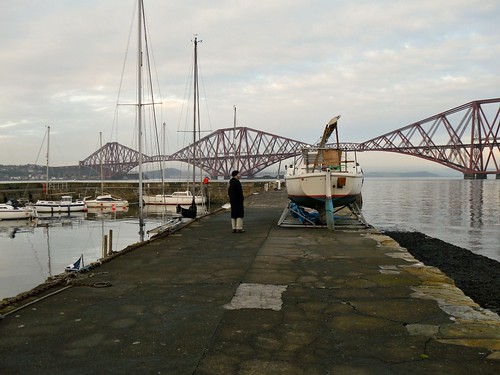
This photo below is of Jack (husband) eyeing up one of the boats which has been lifted out of the harbour but I don’t think he’ll be taking up sailing.

The Forth Bridge

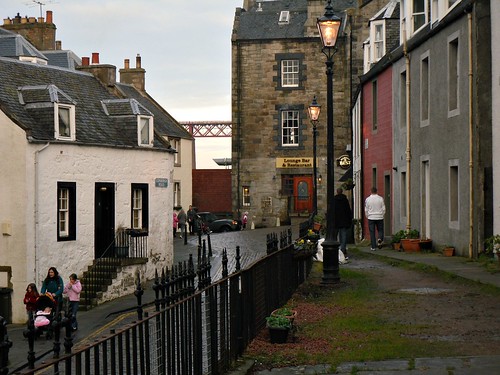
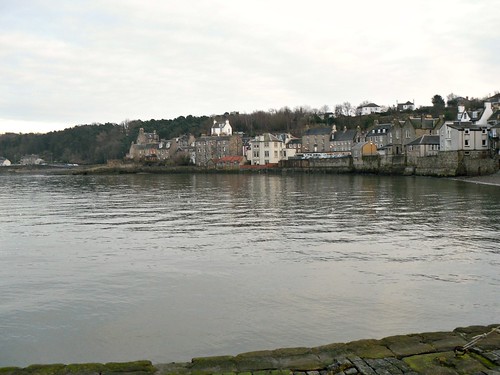
This is one end of the town from the harbour. It’s a nice wee place to have a bit of a stroll around.

South Queensferry from harbour

It was reading Margaret of Books Please review of a Catriona McPherson book which is set there which made me think it was about time we had another look at South Queensferry. The last time we were there was during the summer when we took a trip on one of the boats which sails regularly to the island of Inchcolm. It’s a good day out, when the weather’s fair. You really wouldn’t want to be stuck out on an island in the middle of the Forth if there was the chance of a howling gale and rain blowing up. You can have a look at my Inchcolm post here.

The Pirate by Sir Walter Scott

November's Autumn

I read The Pirate as part of the November’s Autumn classic challenge.
All the nice girls love a sailor, so THEY say – but what sort of girls like a pirate? My sort of course, I’ve always had a bit of a yen for the pirate type, in fiction anyway, which is why I opted to read this book. I can’t even read the word pirate without saying – aarrr Jim lad to myself, that’s Long John Silver of Treasure Island fame of course.

As I said previously this book was a very slow starter and I kept wondering when there would ever be some pirate action. It didn’t come until about two thirds of the way through the book. I was reminded of a heart monitor because The Pirate is very wordy and Scott does quite a lot of rambling for no good reason really, so it sort of flatlines and then there’s the odd spike of interest or excitement. But those bits are good and in the end I was glad that I hadn’t given up on it.

The action is set on Zetland, which is what we call Shetland nowadays, a group of islands off the north coast of Scotland. Mordaunt Mertoun is a young man who has never known his mother and has been brought up by a very cold and unloving father. When Mordaunt sees a ship being wrecked on the rocks near his home he has to save a sailor who is in danger of drowning, despite the fact that the Zetlanders don’t approve of such actions. In a harsh landscape where scavenging for goods from wrecked ships helps the islanders to survive, so they don’t want the complications which shipwreck survivors bring.

The survivor is a young man called Clement Cleveland and as predicted by the Zetlanders he brings no good to Mordaunt, in fact Cleveland turns Mordaunt’s friends and neighbours against him, particularly the sisters Brenda and Minna.

It’s a long book and I’m not going to say much more about the storyline but I have to say that although it dragged along slowly at times I did enjoy the atmosphere and descriptions of Shetland and later Orkney. The story is set not all that long after Shetland became part of Scotland, you might not know that up until the 15th century Shetland was part of Norway but it was given to Scotland as part of a dowry payment from King Christian of Norway on his daughter’s marriage. So there was a big Scandinavian influence and at the time The Pirate is set the islanders see the Scots as foreigners.

Walter Scott has woven Norse mythological tales into the storyline with the result that I want to read more about them, so that’s a plus point I think. I especially liked the character of Norna of Fitful Head who is a sort of white witch/soothsayer and makes a good living selling fair winds to fishermen and sailors, what a great idea! The population is generally wary of her and wants to keep in her good books.

Fitful Head is an actual place and you can see some wonderful images of it here and here.

So as I said before, reading The Pirate was a bit like wading through porridge at times, without the benefit of sugar or syrup but on balance it was worth it, if only to find out about Fitful Head, it might be added to our places to visit list!

Star Gazing by Linda Gillard

This is the third book I’ve read by Linda Gillard and although I’m not much of a romance fan, I must admit that I do enjoy her romances. The reason I usually steer clear of romance is I find them too predictable but the same can’t be said of her books. She manages to get as many twists and turns into the storyline as you would expect in a crime/mystery novel.

Star Gazing is set in Scotland, mainly in Edinburgh but the action moves to the Isle of Skye for a while. Marianne Fraser is a young widow whose husband Harvey died in the Piper Alpha disaster on the 6th July 1988. If you aren’t of a certain age you might not know that that was the world’s worst offshore disaster, causing the death of 167 men on an oil platform in the North Sea 120 miles north of Aberdeen.

Marianne who has been blind since birth subsequently miscarried her baby which everyone tells her was maybe for the best, and a baby would only have made life complicated. Music has become her passion in life but over time she has developed a coping strategy to protect herself from life and people, but during one of her frequent walks in the Edinburgh Botanic Gardens she meets Keir.

Keir goes out of his way to describe experiences which the sighted population take for granted but Marianne can’t even imagine, like cathedrals and stars. Marianne is thrilled but she still has an urge to protect herself from men and Keir is damaged goods too. It all adds up to an entertaining and cleverly written book. As usual I’m just giving you the bare bones of the story, I don’t like to spoil it for people.

One thing that I did think was a bit strange though – the sense of smell plays quite a big part in Star Gazing, as you would expect from something about a blind person, but the smell of snow was never mentioned. I can see reasonably well but I’ve always been able to smell snow. I know when it has snowed overnight, even before I open my eyes, and I can smell it on the wind when it’s coming, so I would have thought that Marianne would have been able to smell the snow on Skye. What about you, can you smell snow?

Peggy, maybe you could ask your brother Donald if he can smell snow?