Bookshelf Travelling in Insane Times

It’s the fourth week of Bookshelf Travelling in Insane Times which is hosted by Judith at Reader in the Wilderness, you can read about it here.

This week I’m looking at the bookcase which stands on the upstairs hall outside the room that Jack has as a study/office. It’s a tall IKEA one and when we first moved to this modern house we thought we were going to have to get a saw out and chop some of its height off as it wouldn’t fit downstairs. Then I decided to measure the ceiling heights and would you believe it – upstairs ceilings are three inches higher than downstairs – how weird is that?! So we just managed to fit it in sans sawing.

Scottish Books 1

Scottish Books 2

Anyway, this bookcase is home to the many books by modernish Scottish authors. Jack has read all of these but I have such a lot of catching up to do. I’ve really only read the Christopher Brookmyres, a couple by Margaret Elphinstone and the William McIlvanneys. Click the photos to see them enlarged.

Voyageurs by Margaret Elphinstone appeals to me, the blurb says: In the early 1800s, Rachel Greenhow, a young Quaker goes missing in the Canadian Wilderness. Unable to accept the disappearance, her brother Mark leaves his farm in England, determined to bring his sister home. It sounds like a bit of an adventure.

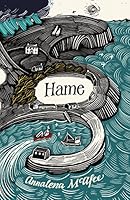
Hame by Annalena McAfee is about a woman who leaves New York after the breakdown of a relationship and moves with her 9 year old daughter to a remote Scottish island. She has been commisioned to write the biography of a cantankerous old Scottish poet who has an international reputation. It’s described as a dazzling kaleidoscpe of a novel.

This Is Memorial Device by David Keenan. The blurb on the back says: It’s not easy being Iggy Pop in Airdrie. The Year is 1983 and Memorial Device are the greatest band that ever existed. It’s described as being intoxicating and brilliant, compelling, funny and often profound. It might be a bit niche but I intend to give it ago soonish. Jack thinks it is brilliant, you can read his thoughts on it here.

 This Is Memorial Device cover
 Voyageurs  cover

 Hame cover

The Gathering Night by Margaret Elphinstone

Yet again I have to thank Judith of Reader in the Wilderness for her research, she was looking for Scottish authors and came up with Margaret Elphinstone.

The Gathering Night is set in Mesolithic Scotland and although there isn’t much evidence left of the people, Margaret Elphinstone has managed to weave an entertaining story from what is known of the lives of the hunter-gatherers.

The only definite historic fact is that a tsunami struck the east coast of Scotland around about 6150 BC and she has used this for the storyline.

I’ve been imagining the landscape described in it as I was reading, trying to work out which lochs might have featured in the story. I had decided that the Twin Daughter peaks were probably based on the East and West Lomonds in Fife as they are the only hills like that which I know of. In her afterword the author thanked a lady in Scotlandwell for explaining to her how wild honey was harvested. Scotlandwell is not far from the Lomonds, so that sealed it for me.

As so little is known of the people then, this book is inevitably a type of fantasy writing, but I think that as human beings really don’t ever seem to change much then the whole story is very believable.

I especially liked the reincarnation belief system which Elphinstone gave them and the behaviour of the people after a new baby was born. Obviously it was taken from the way we react nowadays. The baby had to be recognised as someone from the past by someone else in the family, other than the mother.

Of course that is exactly what would have happened. I’m sure we’ve all had experience of the older members of our families leaning over the new baby and claiming that the wee soul is the double of uncle Jimmy or whomever.

Anyway, I’m wandering again. I did enjoy reading this book and I’ll certainly read more of her work in the future.

Light by Margaret Elphinstone

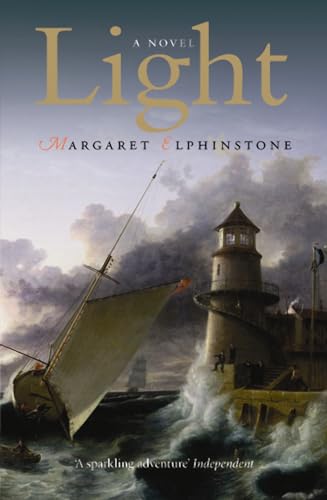
Light cover

I’m grateful to Judith at readerinthewilderness who is planning on doing a personal modern Scottish fiction challenge. In the course of her research she came up with the writer Margaret Elphinstone. It is just typical that I had to find out about her from someone in northern New York. Judith has a lovely eclectic book blog.

Anyway, there were only two of Elphinstone’s books in the library and I chose Light. It is one of those large format paperbacks which have very large clear print so the 421 pages don’t take long to read. The book cover is from a painting by Francis Danby (1793-1861) titled Boat by a Lighthouse and I must admit that it was the lighthouse that made me borrow the book.

The story is set in 1831 on a very small island off the Isle of Man called Ellan Bride, which is only inhabited by two women and their three children. One of the women, Lucy, is the sister of the man who had been the lighthouse keeper before he was swept into the sea during a gale, and she has taken over his duties. The other woman is the late lighthouse keeper’s widow, Diya.

Their world is about to be turned upside down as the owner of the lighthouse had died and a more modern lighthouse was going to be built and a male lighthouse keeper employed, making the two families homeless.

However, when Mr. Stevenson of the Northern Lighthouse Company sends two surveyors to Ellan Bride to measure and study the land, Lucy and Diya have to give them hospitality until their work is finished.

I enjoyed this book and will definitely read more of Margaret Elphinstone’s work. She uses quite a lot of Scottish words and some Manx ones but I think it would be obvious from the context what they mean if you didn’t know them. A glossary might have been useful for some people. The ending was quite abrupt and leaves things hanging, which I don’t mind. I just imagine that whatever I want the outcome to be actually takes place. But maybe a sequel is planned for the future.

Some people have been wondering if there is such a thing as Scottish literature, as distinct from English and I think that there are definite differences. Although Elphinstone was born in Kent, she has lived all of her adult life in Scotland. Obviously she threw herself into the Scottish experience as I would say that her writing is Scottish, she even manages the different ways of speaking for the various characters from far-flung parts of Scotland.

For me though, it is the fact that Scottish writers always seem to give a much stronger sense of place and environment than English writers do; so making the setting and landscape just as important as any of the characters. In Light we have the surveyors Archie and Ben measuring and charting the whole island with their chains, but it doesn’t feel like info dumping, as it might have in another writer’s hands.

Light doesn’t really have that inner darkness (no pun intended) which is prevalent in so much of the older Scottish fiction which I am more used to reading. I don’t know if that is because the author is from England originally and so hasn’t been brought up in an atmosphere of Calvinism which I think influences Scottish writers, even if they are Catholic.

I’ve been wondering if Margaret Elphinstone got the idea to write Light from Bella Bathurst’s book The Lighthouse Stevensons, which I reviewed here.