Death of a Ghost by Margery Allingham

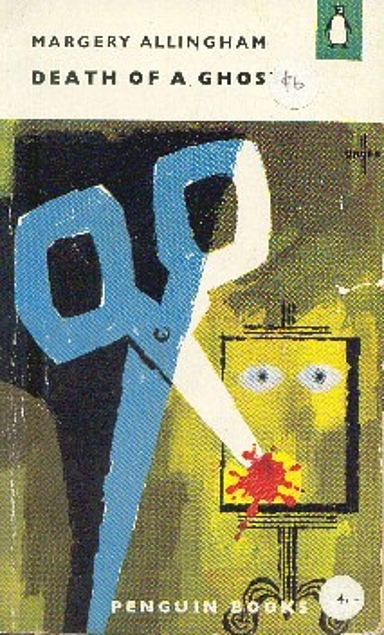
Death of a Ghost cover

Death of a Ghost by Margery Allingham was first published in 1934 and it’s the sixth Albert Campion murder mystery, so fairly early in his career and for me that’s the problem with this book. As he matured Allingham wrote Campion as a much more interesting character than he was in his early days, he’s just too shadowy and one dimensional, I much prefer the older married Campion.

John Lafcadio was a great artist and he decided that to keep his name going as long as possible after his death he would paint several pictures to be unveiled after his death – one a year, beginning ten years after his death. I have to say that that is a great idea.

It’s the eighth unveiling of one of those paintings, so eighteen years after his death, and there are lots of famous people at the party, suddenly the lights go out – a shilling is needed for the electricity meter, and there’s a murder!

So begins Campion’s investigation, aided by Stanislaus Oates, but for me there’s just not enough of Campion and it’s all a bit predictable.

The Pursuit of Paradise by Jane Brown

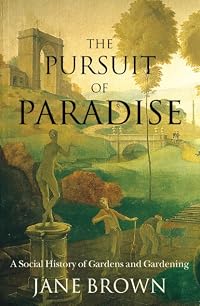
The Pursuit of Paradise cover

I think it must be a few years since I bought The Pursuit of Paradise – A Social History of Gardens and Gardening by Jane Brown. I wasn’t really too sure what to expect of it. Sometimes gardening books are a bit like ‘teaching granny to suck eggs’, not that I think I know everything about the subject, but as I’ve been gardening since I was a wee girl, over fifty years!! – it’s inevitable that you pick up a lot of information one way and another.

But this book was informative, it has eleven chapters:
1. The Purest of Human Pleasure
2. The Secret Garden
3. The Military Garden
4. Emancipated Gardeners
5. The Rise of the Small Garden
6. Acquiring Eden
7. Science Lends a Hand
8. It’s Clever, but is it Art?
9. Labour of Love
10. The Formative Garden
11. Future Gardens

I found The Military Garden most interesting as it hadn’t dawned on me that so many gardening terms come from the arts of warfare – cordon, earthing-up, trench, bastion, palisade, covered way and more. It seems that when generals were at a loose end after wars were won, they went home and started to plan gardens where they could keep everything under control, just as they had commanded their men. All that topiary stood in for regiments of men!

This one is definitely worth reading if you enjoy social history and gardening.

On The Beach by Nevil Shute

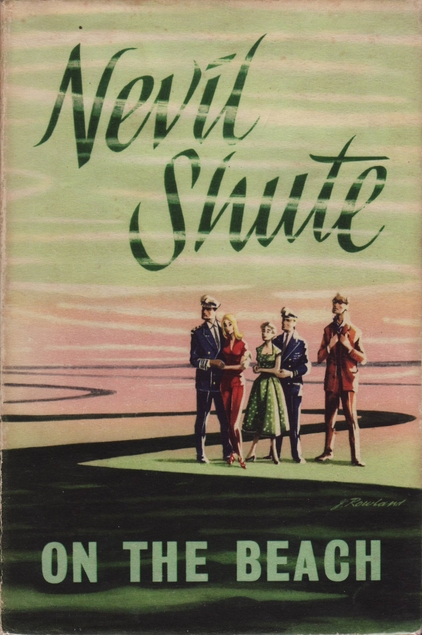
On the Beach cover

On The Beach by Nevil Shute was first published in 1957 and probably you’ve all read it already, but I hadn’t even seen the film (two have been made) and I had no idea what it was about.

Of course it’s about the end of the world – as we know it, and that came as a bit of a shock to me, in fact I wasn’t sure if I wanted to continue reading it, but I bashed on anyway and although it’s well written as you would expect of something written by Shute, I did find it a bit of a downer, especially given all the sabre-rattling that’s going on in the world today – and in every direction I look there seem to be unstable leaders.

The story is of course based in Australia where Shute moved to from England. It’s set mainly in and around Melbourne, there’s been a short but catastrophic war culminating in nuclear weapons being used and particularly a cobalt bomb which was designed to cause the maximum nuclear fallout over a large area.

At the beginning of the book most of the inhabitants of Earth are already dead from radiation sickness and the residents of Australia are waiting on the contaminated air to reach them. Everything is running out, people are using horse-power again as there is very little petrol for cars, but most people haven’t really come to terms with the fact that they only have months to live, people are in denial and still make plans for the future. I liked most of the characters and their actions seemed to me to be believable.

On a personal note, I was still at primary school and it was the height of the Cold War when I realised that in the event of a nuclear war the area that I lived in would be first in line for a nuclear strike as I lived close to the nuclear submarine base on the west coast of Scotland, in fact my dad worked there. It didn’t worry me for long though as I thought that it would be an advantage to ‘go’ in a flash so to speak. On The Beach just made me think that I was absolutely right about that.

I read this one for the Back to the Classics Challenge 2017.

Nella Last’s War – The Second World War Diaries of Housewife, 49

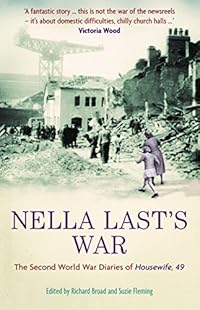
Nella Last's War

Nella Last’s War – The Second World War Diaries of Houswife, 49 is a great read, I loved it and the author Nella Last. Nella was one of the many people who had signed up to be part of a Mass Observation project which was started in 1937 by a social research organisation. Her wartime diaries are full of interest and lovely writing. Nella would have liked to have been a writer of books, presumably novels, she could certainly write and her diaries are a window into the life of an ordinary woman.

Nella had suffered from ill health before the war and had even had operations, although she didn’t specify what sort, but it seems that her illnesses must have been stress related and almost certainly caused by the narrow life that she led. Her home was her whole world and her husband, a self-employed joiner, was an old-fashioned man who felt he had to be in control, despite the fact that he was less than dynamic. Poor Nella must have had a life of watching him make the wrong decisions time and time again and she had to cope with the consequent fall-out, particularly a lack of money.

So it’s just as well that Nella was such a good manager – give her five tins of sardines and a few loaves and she could have fed the five thousand – AND had some left over for tomorrow’s lunch! Not that her husband was impressed, he took her completely for granted. Half-way through the book I thought that their relationship was improving, but it didn’t last for long.

Nella’s mental and physical health improved vastly when she started doing voluntary work for the war effort. This was the first time she had ever set forth to do anything without her husband William, and with two sons she had never had many females in her life, she lacked a woman friend and the companionship that she found in the three jobs that she took on must have given her a big boost, even although some of the other women were of the awkward variety.

Nella had a great affinity with her animals, cat, dog and chickens and knowing this her doctor entrusted her with the life of a tiny premature baby – until the mother was well enough to look after it herself. I’m aware that as she is writing all this herself then you might think that this is just a woman who enjoys blowing her own trumpet a lot but she doesn’t come across as that sort of person at all.

There were a couple of things that I didn’t agree with her about – she mentioned that it was in the newspapers that Hitler had euthanised (murdered) a lot of Germans who had been regarded as being mentally defective and that was one thing that she agreed with Hitler about as she didn’t see any point in such people being a drain on society – words to that effect anyway. But of course Nella would not have realised that many of the people who Hitler had had ‘put down’ had suffered from similar problems that she had had pre-war, people who suffered from depression or had had a nervous breakdown were murdered in that barbarism.

Nella also ‘laid into’ her husband when he was afraid for their soldier son’s life, something that I thought was completely natural.

I could write a lot more about this book but as almost everybody seems to have got to it long before I did I’ll leave it at that. Luckily I already have her peace time diaries to read.

I enjoyed watching Victoria Wood in Housewife, 49 but now that I’ve read the book I feel that Wood portrayed Nella quite differently, as I recall Nella seemed quite pathetic at times, and I don’t think she ever was.

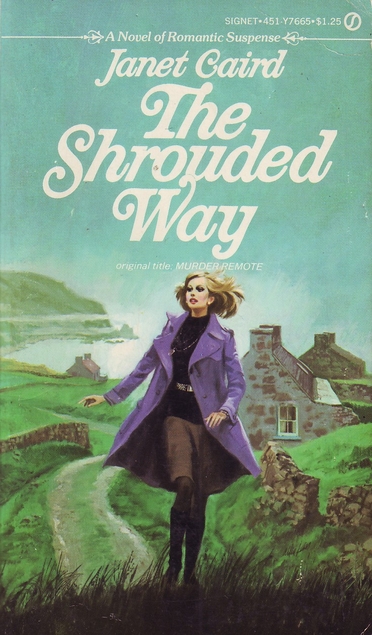
The Shrouded Way by Janet Caird

The Shrouded Way by Janet Caird was published in 1973 and it is one of the books that Peggy brought from the US for me. I have to admit that I had never heard of the author before Peggy started reading her books, which is strange as Caird was Scottish.

The Shrouded Way reminded me very much of Mary Stewart’s writing, well of her adventure/mystery books, and I enjoyed the way the mystery started almost from the very beginning, with Elizabeth Cranston discovering a body in a tractor when she is driving to visit her Aunt Jenny who lives in the small Highland fishing village of Mourie.

There are some strangers in the village where over the years there has been a belief that there is a sunken boat containing treasure just off the coast of the village. The strangers include Crane Maclean, a wealthy American who is the new laird and he intends to finance the search for the treasure, promising that if they find it he will give it to the villagers for the good of the community.

All is not well though, and more villagers end up dead. Elizabeth has attracted the attentions of the laird and the school teacher who is also a new arrival in the village. But Elizabeth has her doubts about both of them.

I enjoyed this one although for me it somehow dragged a wee bit around the middle of the story, however that might just have been me rather than the fault of the book and I’ll definitely be looking out for more books by Janet Caird.

I read this one for the Read Scotland 2017 Challenge.

The War in Pictures

At the moment I’m reading Nella Last’s War, the World War Two diaries of Housewife 49 – so I’m steeped in air raids, Morrison shelters and rationing. So I’ve been finding a recent book purchase fascinating, it’s a book of photographs from that era.

Book Cover

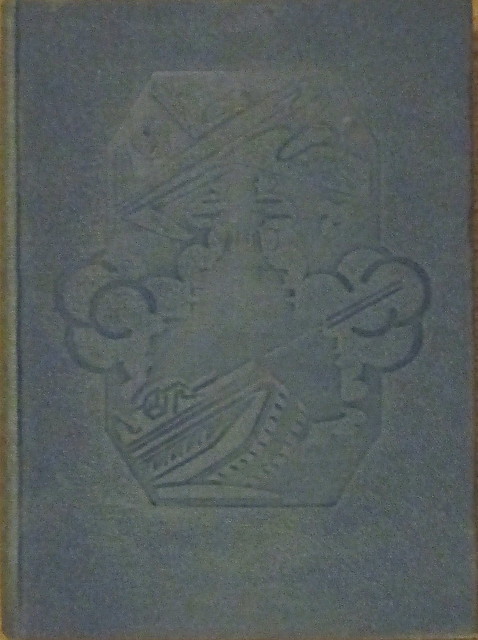
It’s called The War in Pictures and was published by Odhams Press. This is the first one in a series of six books that were published – one for each year of World War Two. The photographs were taken from everywhere that was affected by war and they’re really interesting.

The black and white photographs all have descriptions of what was going on in them alongside, and the beginning of the book explains how the war started in the first place.

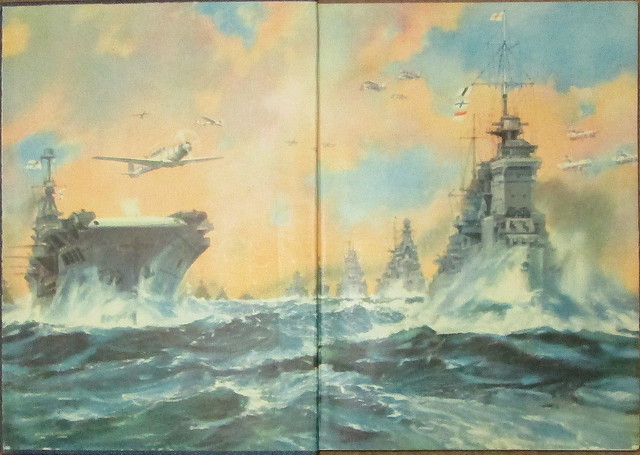
It has a stylish embossed cover of a tank, clouds and aeroplane and also lovely endpapers, and it’s in great condition. It cost me all of £1, but now of course I’ll be looking for the other five!

Book Frontispiece

I have a couple of sets of similar books about World War One, but this is the first time I’ve come across anything like this from World War Two.

The Fair Miss Fortune by D.E. Stevenson

 The Fair Miss Fortune cover

The Fair Miss Fortune by D.E. Stevenson was published by Greyladies in 2011, it was one of those books that D.E. Stevenson’s agent couldn’t get anyone to publish back in 1937 when she wrote it. At the beginning of the book there’s a correspondence between Stevenson (under her married name Peploe) and Mr Curtis Brown, her agent. He was explaining to her that publishers felt that the book was a bit too old fashioned as it featured identical twin sisters and mistaken identity. Having read the book I can see what the publishers meant, but on the other hand it’s a mildly entertaining read of the marshmallow or fluff variety.

The village of Dingleford in England is peopled by the usual widows, bachelors and retired army colonels, it is of course a time when Britain still had an empire so one of the bachelors is home on leave from the army in India.

When Jane Fortune appears in the village with the intention of turning an old house into a tearoom, helped by her old nannie – she quickly attracts the attention of two young men. They are a bit perplexed though when they realise that she doesn’t seem to be quite the same person as they had met before, and often seems not even to know them.

Throw in a truly ghastly smothering, selfish mother of a grown up son and and you have a reasonable light read, but this one doesn’t have the serious social aspects of some of her later books. It’s still entertaining though for when you can’t concentrate on anything too heavy.

I read this one for the Read Scotland Challenge 2017.

End of a library era – Glenwood in Fife

Everybody knows that local councils around the country are having to make horrendous cut backs, they’re trying to make savings everywhere and the upshot of that is that they decided to close sixteen libraries in Fife. Despite a campaign it has come to pass, some of them are closed already. The powers that be in Fife Council are philistines.

Quite a few of the libraries were only opened for ten hours or so a week, those ones were situated in small villages that already had virtually nothing in the way of amenities. But Glenwood Library was a full time library in Glenrothes, situated in an area with a fairly high level of poverty, well used by people in the community for access to computers, job clubs to help people into employment, reading lessons for adults, it was a collecting point for food donations to the local food banks (how my parents would have been shocked by that modern phenomenon) and with a really good stock of books. Local authors such as Ian Rankin, Val McDermid and James Robertson got involved in the campaign – to no avail.

A local neighbourhood community association was supposed to be taking over the running of the library but it now looks like this is not going to happen, it’s going to be a big loss to that community. Of course lots of librarians and library assistants are losing their jobs, thousands of library workers across the UK have been thrown onto the scrapheap over the last few years.

Glenwood Library Shelves

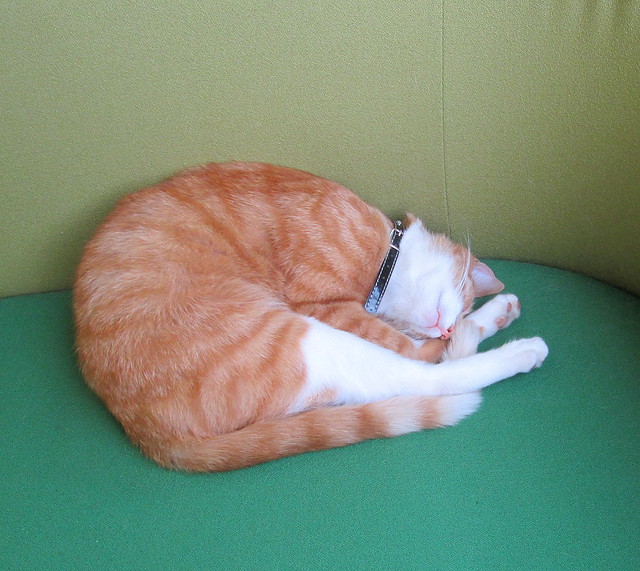
In recent months over the winter the library staff have been allowing some local cats to take advantage of the warmth on offer. Well who wouldn’t enjoy stretching out on a floor warmed by underfloor heating, especially if the alternative is a cold street?!

Glenwood Library Cat

Glenwood Library Cat 2

This ginger cat was usually in there whenever I visited the library, he/she just cocked an eye at you as you browsed, and then went back to his/her dreams when he rated you as no danger and not being likely to stand on him. Today I took a last visit to Glenwood and ginger cat had taken up position on on one of the wee sofas. Possibly the underfloor heating has already been switched off. It occurred to me that we went about that keep the libraries open campaign completely the wrong way. If we had had a keep the cat shelter open campaign it would probably have had a better chance of succeeding!

Back to the Classics Challenge 2017

As I’ve already completed my reading for the Classics Club I decided to get stuck into Back to the Classics Challenge 2017 which is run by Karen @Books and Chocolate (what a fab blog name).
My book list consists of:

1. Redgauntlet by Sir Walter Scott
2. On the Beach by Nevil Shute
3. Hungry Hill by Daphne du Maurier
4. Les Liaisons Dangereuses by Choderlos de Laclos
5. Montaigne Essays
6. The Black Arrow by Robert Louis Stevenson
7. The Legend of Sleepy Hollow by Washington Irving
8. Catch 22 by Joseph Heller
9. Doctor Dolittle and the Green Canary by Hugh Lofting
10. Down and Out in Paris and London by George Orwell
11. I, Claudius – Claudius, the God by Robert Graves
12. Anna Karenina by Leo Tolstoy

Have you read any of these ones? I’ve had most of these book waiting in a queue to be read for years now and this will encourage me to get around to them at last!

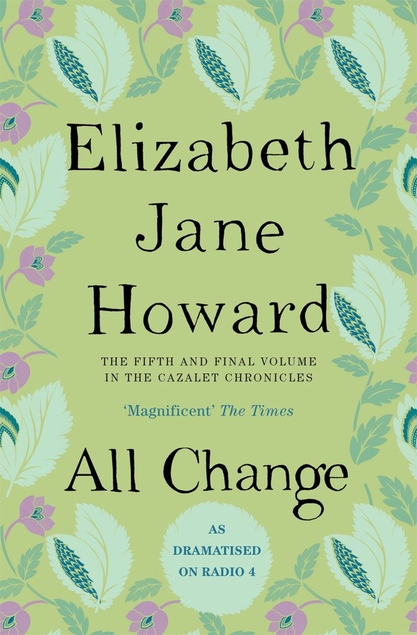
All Change by Elizabeth Jane Howard

All Change cover

All Change by Elizabeth Jane Howard was published in 2013, it’s the fifth and final book in the Cazalet Chronicles. I didn’t even realise there was a fifth book as there’s a big gap in between the fourth and fifth, I’m so glad that Howard got around to writing this one though as I absolutely loved it and I felt that the fourth book left a lot of strands of the story up in the air.

It’s a chunky book at 576 pages, but I just didn’t want to reach the end of it as I was enjoying being in that Cazalet world so much. Mind you that didn’t stop me from reading almost the whole of Monday, immersed in the family saga. I know that at some point I’ll read these books again and that isn’t something I often do.

All Change begins in June 1956, so that’s nine years after the events of book four. The Duchy’s life is coming to an end, it’s the end of an era as she is the last of the senior Cazalets and her daughter Rachel is of course looking after her, as she has done all of her life.

The wood importing business that has been able to sustain the Cazalets in some luxury over the years, is on a downward slope, mainly because the brothers don’t have the same business savvy that their father had. They’ve led a life of servants and comfort and Edward in particular has always lived beyond his means, with a huge sense of entitlement and a wife who is under the impression that he is a lot richer than he really is.

The younger members of the family are getting on with their own lives and for me everything was tied up very satisfactorily. There were so many things in this book that struck chords with me, such as nursing elderly parents and the death of the last of the older generation, and the breaking up of the family home.

Howard was very good at passing character traits down the generations, so there’s that recognition of someone ‘taking after’ their father or uncle, as there usually is in large families. Often when you’re watching an actor on TV you come to really despise them, if that is what their character calls for and of course we all realise that that is a testament to the actor’s skill and talent. In a similar way I really admire Howard’s ability to write a truly ghastly character – such as Diana who is gobsmackingly self-centred, manipulative and nasty – how I hated her!

Sex rears its ugly head quite a lot of course with several marriages and some affairs on the go, but I noticed that none of the women involved are really interested in it, and one by one the author lets us know that, it’s just something they put up with to get or keep their men. Some of them hide their lack of interest better than others.

I did notice that Howard had made a mistake because she mentions that one of the female characters has her widow’s pension (her first husband – a soldier- had died in the war). But of course when a woman re-married she lost the right to a widow’s pension, that is still the situation today although some people are trying to change it.

In the spirit of taking risks, instead of the usual taking care – I’ve just bought the DVDs of the TV series which I’ve never seen, it might be a mistake to watch it, I could be severely disappointed, but then again, I might love it. I’ll keep you posted!