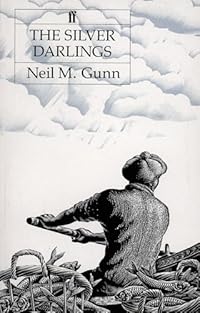
The Silver Darlings by Neil M. Gunn

 The Silver Darlings cover

The Silver Darlings by Neil M. Gunn was first published in 1941. The setting is mainly the coastal areas of Caithness in the north-east of Scotland in the early 19th century. It’s a time of upheaval, especially in the Highlands of Scotland. Inland crofters have been moved out of their crofts and land and have been transported to the coast where they are expected to take up fishing as a living, despite the fact that they know nothing about it. As crofters they had worked the land, but that land was required for sheep by their landowner, often the head of their clan.

These ‘clearances’ caused terrible strife but in The Silver Darlings the original fishermen of the village have been remarkably calm about the influx of newcomers and have shared their knowledge of the sea with them.

I really enjoyed the first half of this book more than the second half, I suppose because I was more interested in the domestic side of it. Early on some of the transplanted fishermen have been press ganged into the Royal Navy – as was quite common in those days. That leads to disaster for newly married Catrin as her husband Tormod is one of the ones who has been snatched, leaving the pregnant Catrin to struggle on on her own. She gives birth to a son Finn, but she’s in a limbo as she has no idea if her husband is alive or dead. This puts a break on the possibility of a relationship with Roderick who is the most skillful of the local fishermen.

As Finn grows up the local fishing industry goes from strength to strength. The silver darlings of the book title is the nickname given to the herring that brought riches to the area, not only for the fishermen but for the women who gutted the fish and for the various others involved, such as coopers and fish smokers.

This book is beautifully written, and it’s easy to imagine the landscape and seascape. I’m always impressed not to say aghast at the size of the trawlers that fishermen ride the North Sea in nowadays, but that is obviously nothing compared with the wee fourteen foot long sail boats that Roderick and his crew went out in, often fighting mountainous seas and always in danger of not making it back to land safely.

The Silver Darlings was chosen as a readalong for the Read Scotland 2017 Challenge. Jack read the book last year and if you’re interested you can read his thoughts on it here.
More book purchases

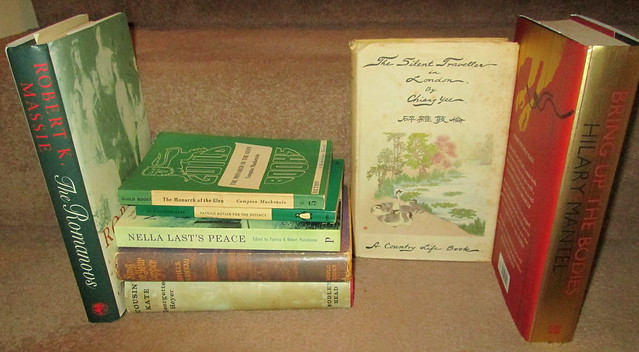
These are the other books that I bought a couple of weekends ago at the annual book sale.

More Books

1. The Monarch of the Glen by Compton Mackenzie
2. Patrick Butler for the Defence by John Dickson Carr
3. Nella Last’s Peace – The post-war diaries of Housewife, 49
4. Sing For Your Supper by Pamela Frankau
5. Cousin Kate by Georgette Heyer
6. The Silent Traveller in London by Chiang Yee
7. The Romanovs by Robert K. Massie
8. Bring Up the Bodies by Hilary Mantel

Not a bad haul I think. I’ve already read Bring Up the Bodies of course, as has Jack but he spotted it at the book sale and asked me if I wanted it for our shelves, as we have Wolf Hall. I loved both those books and I can see myself re-reading them at some point in the future, so it was added to my pile.

I loved Chiang Yee’s Traveller in Edinburgh book so decided to buy the London one although it doesn’t have much in the way of illustrations, I’m putting that down to London being a lot less scenic than Edinburgh is!

I loved Robert K. Massie’s book Nicholas and Alexandra so I have high hopes for The Romanovs – The Final Chapter

I’ve enjoyed a couple of Pamela Frankau’s books, Compton Mackenzie’s and the others. I know I’ll love the Nella Last diaries, but I’ll have to get around to reading her wartime diaries soon.

Have you read any of these books?

The Falls by Ian Rankin

The Falls by Ian Rankin was published in 2001, it’s a Rebus book and unfortunately I remembered it fairly well from when it was dramatised for TV which slightly marred my enjoyment of it.

There’s a missing student, she’s studying at Edinburgh University and she comes from a wealthy family, her father owns a private bank so maybe she has been abducted. Her boyfriend is from an equally rich family and he has a history of getting into trouble with the police.

During the investigation it transpires that the missing student is into internet role-playing games. Is a games-master involved in her disappearance?

The city of Edinburgh is a big part of this series and for me that’s one of the attractions of the Rebus books, I know most of the places mentioned in them, so I can easily imagine all of the locations, always a plus I think.

The thing that is most striking about this one though is how old-fashioned it seems now. They always say that nothing dates so quickly as technology and it’s absolutely true. In this book hardly anyone has a personal computer and Siobhan is forced to borrow one from the one colleague who just has to have any new gadget that comes out – although he rarely uses them, and of course it’s all costing Siobhan a fortune as she’s having to use dial-up to get on the net.

Otherwise it’s the many mentions of property prices in Edinburgh that are so dating. Rebus is in the throes of selling his flat which he thinks is worth about £160,000 as the prices have shot up since he bought it. Nowadays his flat would probably sell for at least double that price.

I’m wondering how many years have to pass before crime fiction becomes vintage crime and so develops a historical ambience – more than sixteen years anyway.

Recent book purchases

books

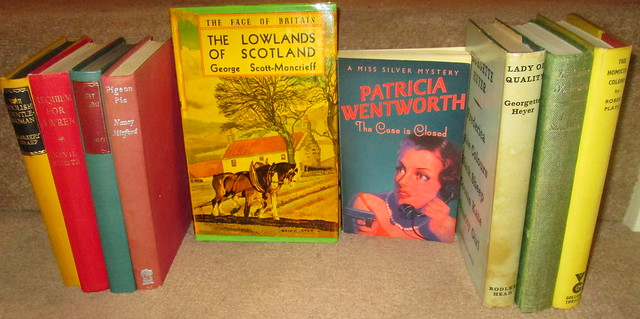
Last week we visited a booksale that occurs just one weekend in the year and the books in the photo above are about half of my haul.

1. Pigeon Pie by Nancy Mitford
2. Sweet Thursday by John Steinbeck
3. Requiem for a Wren by Nevil Shute
4. The Foolish Gentlewoman by Margery Sharp
5. The Homicidal Colonel by Robert Player
6. Katherine Wentworth by D.E. Stevenson
7. Lady of Quality by Georgette Heyer
8. The Case is Closed by Patricia Wentworth
9. The Lowlands of Scotland by George Scott-Moncrieff

As often happens- when I got home I realised that I already had a couple of the books, but not to worry I can pass them on to someone. The Lowlands of Scotland is one of them and my original copy doesn’t have a dust-jacket, I relly like the cover so I’m pleased I got it anyway.

The Patricia Wentworth book is a modern paperback but it looks like they have used an original cover from around 1937 when it was first published.

I’m particularly looking forward to reading the Steinbeck and Shute books. Have any of you read any of these books?

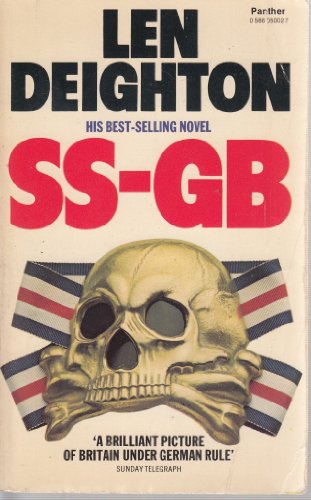
SS-GB by Len Deighton

SS-GB cover

I had intended reading SSGB by Len Deighton before the TV series was broadcast, but I didn’t get around to it. After last Sunday’s episode I just knew that I couldn’t wait a whole week to see what happened next, so I had to go into the garage where we have our overflow bookcases and hooked out our copy of the book.

SS-GB is the first book by Deighton that I’ve read and I’ll definitely be reading more, we have them all so it’ll be quite a long project.

It turns out that the TV adaptation is fairly true to the book, but not completely.

It’s 1941 and the Germans have successfully invaded Great Britain, the people are devastated as you would expect but there is some sort of resistance organisation at work.

Douglas Archer (of Scotland Yard) is a widower with a young son, his wife was killed in an air raid but he’s having to work closely with the Germans. It’s a difficult task, not made easier by the fact that the SS and the German Army are at loggerheads and involved in a power struggle, and Archer having to appear to be compliant with both organisations.

To make matters worse for Archer it looks like he is completely on the side of the Germans and is collaborating with them, meaning that he is in danger of being bumped off by the resistance movement.

The King is in custody – in the Tower of London and there’s a plot to rescue him and get him to safety in the US, but they aren’t interested in harbouring a King of Britain and won’t even hear of him being in North America, meaning Canada is ruled out too.

With nuclear secrets and a romance also in the storyline this book has a bit of everything and is a great read, although it’s also a chilling read as it could so easily have come to pass, and I would have been typing this blogpost in German!

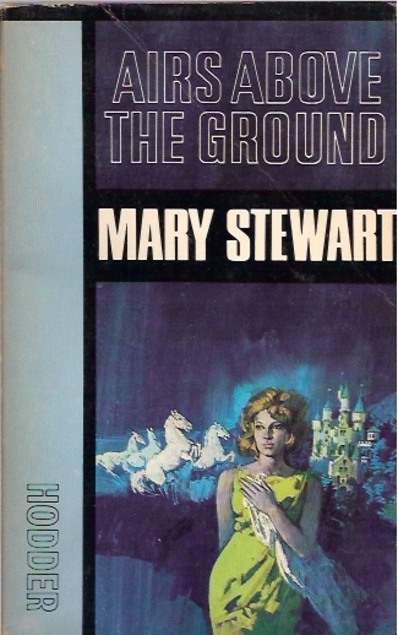
Airs Above the Ground by Mary Stewart

Airs Above the Ground cover

Airs Above the Ground was first published in 1965 but my paperback copy is from 1967, I really like the cover and I found the book to be a great read. In fact I’m sure that if this book had been written by a man it would have had a much higher profile and might have been made into a film. A lot of it is full of suspense, it’s much more of an adventure/mystery than for instance – John Buchan’s books, in my opinion.

On page one the Guardian newspaper is mentioned as the main character Vanessa March is a Guardian reader. Presumably Mary Stewart was also one as she incorporated a classic Guardian misprint in an article from the newspaper. The word ‘churned’ appears when it should have been ‘burned’. In case you don’t know, the Guardian is affectionately called the Grauniad as the typesetters were always making mistakes. Of course nowadays it’s all done on computers so that isn’t such a problem – or feature.

Anyway, back to the book. Chapter one begins in Harrod’s tearoom where Vanessa March is having tea with her mother’s old friend Carmel. Vanessa has only been married for a few years and she’s had a bit of a ‘domestic’ with her husband Lewis as he has had to change their holiday plans at short notice. From something that Carmel says – it seems that Lewis might not be where he says he is and so follows the adventure with Vanessa travelling to Austria in search of the truth and Lewis, with help from Tim – Carmel’s seventeen year old son who is in need of time away from his suffocating mother.

Tim’s a huge fan of the Spanish Riding School in Vienna and the Lipizzaner horses, and he’s very impressed that Vanessa is in fact a trained vet. With the storyline moving on to a travelling circus featuring animals (a pet hate of mine) it was a bit of a wonder that I wasn’t put off by that, although circus acts don’t feature too much.

I read this one for the Read Scotland 2017 Challenge. Sadly I don’t have too many of Mary Stewart’s books still to read now, I think I’ve read them all except My Brother Michael and maybe Madam Will You Talk.

Guardian Review bookish links

In Saturday’s Guardian Review section there’s an article by Ben Blatt that might interest you, it’s about the favourite words of particular authors, the words they most use and what they tell about that author. You can read it here.

There’s a review by Colin Kidd of a new biography of Oliver Cromwell by David Horspool. Oliver Cromwell: England’s Protector. An interesting read, although I’m not a mad royalist – I can’t stand Cromwell who didn’t just cause mayhem in England, he spread it up to Scotland too, doing much the same as certain contemporary people of his type are getting up to in the Middle East nowadays, but even more so in Ireland, where he is still hated.

We had a very busy weekend, donating boxes of books to a second hand bookshop for re-sale on Saturday, then travelling miles to go to a second hand booksale on Sunday, and buying another twenty books or so! But more on those books another day.

One Fine Day by Mollie Panter-Downes

One Fine Day by Mollie Panter-Downes was first published in 1947 but my copy is a 2011 Virago, how I hate those new Virago covers, bring back the original green ones, please.

This book was written in 1946, a time when everyone was trying to adjust to a normal life without war, it’s not made easy by the fact that everything post-war has changed, especially for those who had had some money and were used to servants looking after them. It’s a day in the life of Laura, a middle class wife and mother of Victoria, a ten year old. Laura’s not terribly domesticated and she’s a bit of a dreamer so she’s struggling to cope with cooking and mending.

Laura Marshall’s husband is getting into the routine of commuting by train to London from Wealding in Sussex every morning, but he’s also constantly worrying about the state of his garden and house, there’s no help to be found anywhere and it all seems to be crumbling around him.

This is so well written and observed, Panter-Downes has Laura comparing the differences between her middle class husband’s standoffish attitude to his own daughter and a local working class man’s obvious adoration of a young relative. They’re poverty stricken and slovenly, but happy. Of course Stephen had gone off to war, leaving a small girl behind and he’s having trouble recognising that wee one in the self-contained ten year old that she has become while he was at war for five years.

When Laura makes a visit to the local ‘big house’ she thinks:
All those windows, she thought in horror. For the rest of her life, now, she would see things from the point of view of cleaning them. Confronted by a masterpiece of architecture, she would think merely, How much floor to sweep, how many stairs to run up and down. The world had contracted to domestic-house size, always whispering to the sound of somebody’s broom.

There’s quite a lot of humour in the book, often in the way that the ‘lower orders’ express themselves. But Angela Huth who wrote an introduction to the book seems to have missed some of it, as she’s under the impression that the big house is being turned into some sort of institution.

In fact the family in the big house has decided to hand it over to the National Trust and retreat to a self-contained flat in the property, as many such stately home owners did around that time. Perhaps Huth didn’t understand the ‘joke’ that the charlady gives the information that National Trusses will be taking over the big house. Most of the humour is from the way the working class people speak but it isn’t really in any nasty condescending way.

It’s a very enjoyable read and I just hope that I can get my hands on more of her books. You can read her obituary here.

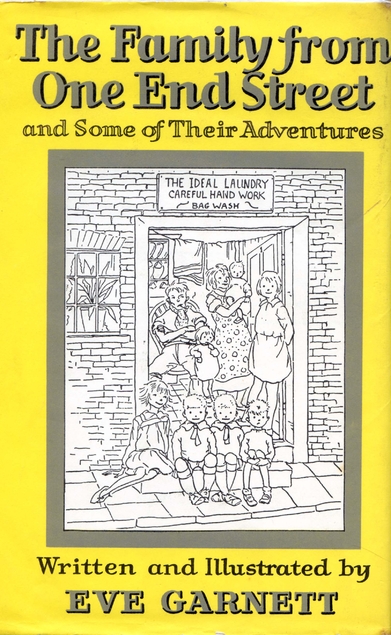
The Family from One End Street by Eve Garnett

The Family from One End Street cover

The Family from One End Street and Some of Their Adventures by Eve Garnett was first published in 1938 and it won the Carnegie Medal that year. That must have been particularly sweet for the author, who also illustrated the book, as it was rejected by at least eight publishers.

Those publishers were probably put off by the fact that the book is so unusual in that it is apparently the first book to feature an ordinary working class family. The Ruggles family is a large one – seven children with mum Rosie taking in washing and ironing and the dad Jo being a dustbin man. They live in a small town in Sussex – as did Eve Garnett.

With so many children around there’s always something going on but to begin with we’re told how all the children appear and how they get their names.

The neighbours pitied Jo and Rosie for having such a large family, and called it “Victorian”; but the Dustman and his wife were proud of their numerous girls and boys, all -growing-up-fine-and-strong-one-behind-the-other-like-steps-in-a-ladder-and-able-to-wear-each-others-clothes-right-down-to-the-baby, so that really it was just two sets, girl and boy, summer and winter, Mrs Ruggles had to buy, except Boots.

I found this to be an entertaining read and as until it was published children’s books always featured very middle class children with ponies, bikes and boats and no thought to the clothes that they wore, it must have been a bit of an eye-opener to some people to realise that there were others who couldn’t afford to buy a school uniform for a child who was bright enough to get into the grammar school, and who were constantly taking their shoes to the cobblers to have them mended.

The author herself had a very comfortable upbringing but when she was asked to illustrate a book called The London Child by Evelyn Sharp she was appalled by the conditions that she saw, presumably when she was doing research for her illustrations. It led to her writing this book about an ordinary family struggling to make ends meet, but they’re a happy bunch and I’ll be looking out for the other books detailing their further adventures.

The Casino by Margaret Bonham

The Casino cover

The Casino by Margaret Bonham is a collection of short stories published by Persephone Books. I had never read anything by the author before. I’m not averse to short stories, I think they’re especially good for bedtime reading, but I wasn’t too impressed with this collection, although I think towards the end of the book the quality of the writing improved.

To me the earlier stories were mainly uninteresting, verging on the boring or meh as they say nowadays. I have no idea when any of the stories were written but I’m assuming that the later ones were written when she had more experience as they are better.

I read the preface which is by Cary Bazalgette, the author’s eldest daughter. It is a mini biography of her mother and she paints such a ghastly portrait of her that I think I was really put off. Margaret Bonham was one of those women who abandon one husband and family to run off with a man and start up another family – only to repeat her actions again. That and her eight bottles of gin a week habit that didn’t ever stop her from driving – I found rather off-putting. I KNOW, very judgemental of me – but there you go, or there I am. On the other hand, some of her stories are quite entertaining.