
 The Lady of the Rivers by Philippa Gregory was published in 2011. It’s part of the author’s fictional Three Cousins’ War series. I decided to read it after I read her essay about Jacquetta in the book which I reviewed here.
It begins in 1430 at the Castle of Beaurevoir near Arras and Joan (of Arc) has just been billeted there as part of the houshold, which includes Jacquetta who despite just being 15 or so has been married off to the much older Duke of Bedford, Regent of France and uncle to the young English King Henry VI. It’s a marriage in name only as the duke just wants to use Jacquetta’s gifts.
Jacquetta is supposedly descended from Melusina, the river godess and can sometimes see the future, a dangerous trait to have when women in particular can easily be accused of being witches. There’s nothing that she can do for Joan when she herself is accused of witchcraft.
With the death of her husband Jacquetta is free to marry Richard Woodville, her husband’s squire, although they end up having to pay a fine because Jacquetta shouldn’t have married out of the aristocracy.
When they return to England they’re warmly welcomed by the king and so begins their life at the court, never an easy place to be but it has its compensations. Richard is made a baron and is given an estate, mainly because Jacquetta is a favourite with the queen. It’s the royal couples worst habit, handing out goodies to courtiers for no good reason which incenses those who might be more deserving of notice. Jealousy and anger abound, it’s a recipe for disaster.
Jacquetta seems to have been some sort of superwoman as she had at least 14 children, would hardly have had time to get over one pregnancy before she was pregnant again and still managed to pack a lot into life, supporting the king. But war was never far away and changes mean danger.
I must admit that I had never even heard of Jacquetta until recently, it’s really sad the way strong women have been overlooked by historians. Although this is a work of fiction the author has done plenty of research and woven an entertaining story around what is known.
 Death of a Chief by
 The Witch’s Brat by Rosemary Sutcliff was published in 1970. The setting is England in the reign of Henry I. Lovel is a young lad, just eleven years old, and his grandmother has just died. She had been the local healer and herbalist so she had been tolerated in the village. But Lovel was born with a crooked back and his mother had died when he was born, his father is dead too, so he’s all alone in the world and the villagers hound him out. They think that his crooked back means he must be a witch.
 I’m finding The Marriage Portrait by Maggie O’Farrell quite a difficult one to write about, but I really enjoyed it, which is the main thing. I always enjoy her books, despite or maybe because they are all different.
 The Stronghold by Mollie Hunter was first published in 1974 and it is a Carnegie Medal Winner.
 Cue for Treason by Geoffrey Trease was first published in 1940 but my copy is a Puffin reprint which was published in 1965.
 The Thistle and the Rose by Jean Plaidy was published in 1963 and if you’re interested in Scottish history reading this book will probably teach you quite a lot, in a painless fashion although I must say that at times Plaidy’s writing style seems quite stilted, certainly when compared with writers like Hilary Mantel and Alison Weir. This is the eighth book by Plaidy featuring the Tudors
 Friend and Foe by Shirley McKay is the fourth book in the author’s Hew Cullan mystery series. The setting is St Andrews in 1583. At the back of this book there is a glossary of Scots words used by the author which I imagine will be useful to some readers, I must admit there were a few that even I didn’t know, but I think they’re always easy to take a guess at from the context.
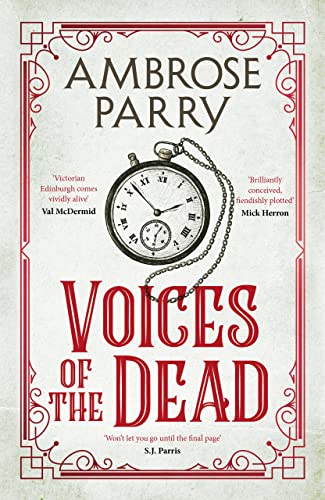 Voices of the Dead by Ambrose Parry has just been published and I was lucky enough to be sent a digital copy of the book by the publisher Canongate via Netgalley.