The Cheltenham Square Murder by John Bude

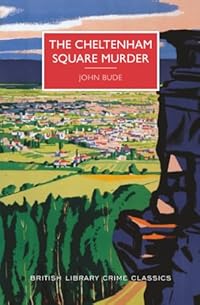
 The Cheltenham Square Murder cover

The Cheltenham Square Murder by John Bude was first published in 1937 but as you can see I read a British Library Crime Classics reprint. It has an introduction by Martin Edwards.

This is the second book by John Bude which I’ve read and I did enjoy it although it is a bit long-winded with all the possibilities gone into in depth. I’ve previously read his Cornish Coast Murder and you can read what I thought of that one here.

Cheltenham has a number of squares that are really cul-de-sacs with the houses only being on three sides and in Regency Square the inhabitants of the ten houses that it comprises are at loggerheads over whether a tree should be cut down or not. They are a disparate group of people ranging from well-heeled to just managing to scrape along financially. When one of the neighbours ends up being killed as he sat by a window Superintendent Meredith is asked to investigate. Was it an accident or murder?

I’ve found these British Library Crime Classic reprints to be a bit hit and miss, for me this one was a hit, although I still think that 1930s male crime writers in general concentrated too much on the minutiae of a mystery at the expense of the characters.

The Z Murders by J. Jefferson Farjeon

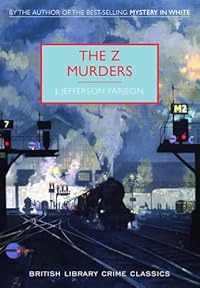
 The Z Murders cover

The Z Murders by J. Jefferson Farjeon was first published in 1932, but I read a 2015 British Crime Library Classics reprint which has an introduction by Martin Edwards.

I enjoyed this one, but not as much as his Mystery in White. Farjeon has a lovely turn of phrase at times, but towards the end of this book I began to feel that a major character was just too bizarre for words.

Again, a railway journey features in the story, I wonder if that was a bit of a motif where his writing was concerned. Not that I’m complaining because I think that a train instantly sets the scene for vintage crime.

Richard Temperley is travelling overnight by train from the north of England to Euston in London. Of course those overnight trains always get into London at crazily early times of the morning, it’s too early for Temperley to travel on to his sister’s house so he decides to spend some hours resting in a nearby hotel’s smoking-room.

The man that shared Temperley’s train compartment also ends up in the same smoking-room. He had ruined Temperley’s sleep through constant snoring so when Temperley realises that the man is no longer snoring he checks on him, sure enough – he’s dead – shot. The police are called and so begins a chase around the country from London to Bristol and back north again. In fact they were travelling along a road that I knew well, that’s always a plus for me.

But towards the end the storyline became very unlikely and I would say just about impossible. I think the author got fed up writing and just wound it up.

It’s still worth reading though and if possible I would give it a 3.5 on Goodreads.

The Golden Age of Murder by Martin Edwards

The Golden Age of Murder by Martin Edwards was published very recently, 2015. I read a review of it by Margaret@BooksPlease, and thought it was a must read for me by the sound of it. You can read what Margaret wrote here.

It’s one of those books which is fascinating but at the same time my heart sort of sank a bit as I kept adding yet more titles to my list of books to look out for, and even new to me authors to track down. I thought I had been quite good at delving into the more obscure crime writers output but it looks like I have a lot more to read.

Margaret was surprised at how many real murder cases had influenced so many of the authors but that was no surprise to me as I know that most authors don’t stray far from things which they’ve experienced, seen on the news or heard about from someone else. In fact one of my writer friends is completely up front about it and if you say to him in conversation something which he likes the sound of he’ll say – I’m having that for a book – and he does!

I have a copy of Bloody Murder by Julian Symons which Martin Edwards does mention as well as the author, but I didn’t manage to get to the end of that one yet, mainly because I find Symons to be too opinionated which is very annoying when he savages an author or book which you happen to rate quite highly.

The Golden Age of Murder is partly about the history of the Detection Club, which of course I knew about but I had been under the impression it was far more exclusive than it was, there were in fact a lot of members of it over the years, but I was interested to discover relationships between authors which I had no idea about, such as the close relationship between Anthony Berkeley and E.M Delafield of ‘Provincial Lady’ fame.

The book goes into the history of the paperback too as the books were launched in the 1930s at a time when few people could afford to buy hardbacks, in fact most of them were bought by libraries. Paperbacks were a cheap luxury which people were able to indulge themselves with. Austerity is a business opportunity if you can think of something which will be cheap and popular with the public. The chocolate industry went into overdrive in the 1930s, so many of the chocolate bars which we see as classics nowadays were launched in the early 1930s, cheap affordable luxuries for the masses. Roald Dahl was a real connoisseur of chocolate and he had all the facts and figures about them at his fingertips as you can see from a short bit on You Tube from years ago.

I see I’ve strayed yet again from the book I was chatting about, anyway – if you enjoy vintage crime/detective/murder mysteries – you’ll really enjoy reading The Golden Age of Murder.