Someone from the Past by Margot Bennett

Someone from the Past by Margot Bennett was first published in 1958 but it was reprinted by  British Library in 2023. This book won the Crime Writers’ Association’s Award for the best crime novel of 1958, but it was the last crime novel that the Scottish author Margot Bennett wrote. The setting is mainly London.

Nancy had been enjoying a night out with Donald, it seems to be a special date, they’ve been on the champagne and all seems well, but they are interrupted by Sarah, a one time work colleague of Nancy’s, but Sarah had been somewhat closer to Donald in the past, he’s not enamoured with her at all now.

But Nancy agrees to help Sarah who has been receiving anonymous letters, threatening her death, the threat seems to come from a man in her past – but there have been so many of them. Before Nancy can do anything to help, Sarah is found dead and a bad decision by Nancy means that she is a suspect. It’s all a bit of a nightmare.

The blurb says: As the real killer uses the situation to their advantage, Bennett crafts a nuanced story through flashbacks to Sarah’s life and loves.

This is a good read although my favourite era for crime novels is the 1930s and 40s, don’t ask me why, they just seem more atmospheric.


Green Willow’s Secret by Eileen Dunlop

Green Willow’s Secret by the Scottish author Eileen Dunlop was published in 1993. This book is meant for YA readers but is enjoyable to people of all ages I’m sure.

Kit had lived in Edinburgh with her parents and older sister, but a family tragedy has led to the father travelling to Australia and Kit and her mother moving to Maddimoss, a rural area. Kit isn’t settling in well and when her teacher tells the class about a Japanese exhibition she has been to the other pupils tell her that there’s a Japanese garden where Kit lives. Kit knows nothing about it but later when she gets home she does some exploring and discovers the remains of a very neglected but wonderful Japanese garden.

There’s a photograph of the garden in the house they are living in, as it was in its heyday, and there are people in the photo, including a Japanese man in traditional dress, but strangely he appears and disappears in the photo. There’s something slightly spooky about the garden. When Kit meets Daniel who is also not a local they decide to work on the garden together.

There’s a lot more to this book, but I don’t want to say much more other than that I enjoyed it. As it happens there is a Japanese Garden at Cowden, not that far from where we live and a hop and a skip from where Eileen Dunlop lived in the wee town of Dollar. I’m sure that is where she got the idea from because the garden at Cowden fell into neglect and was vandalised in the 1960s. As in the book the original Japanese gardener is buried in the local churchyard. You can read the garden’s history and see more photos here. It has fairly recently been brought back to perfection and is open to the public, obviously it’s a business too nowadays so you have to pay an entrance fee. It’s quite a few years since we visited, (you can see my blogposts on our visits here) I seem to remember that there was a small play area for youngsters who may not be so enamoured of the beautiful surroundings.


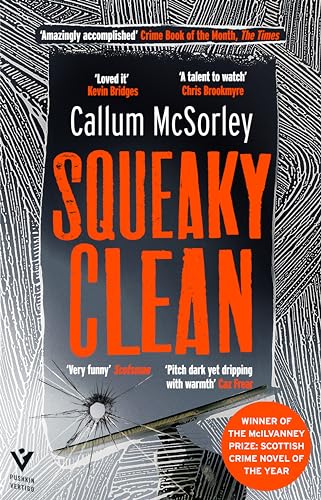
Squeaky Clean by Callum McSorley

Squeaky Clean by Callum McSorley is the author’s first novel and it won the McIlvanney Prize: Scottish Crime Book of the Year. The setting is Glasgow, mainly the east end.  I must say that I did like this one but in parts it’s not for the faint-hearted, or weak stomached, it’s definitely on the violent and gory side, but there is comedy too.
Detective Inspector Alison McCoist (yes, Ally McCoist) bungled her last investigation so she’s been demoted, if that wasn’t bad enough her husband has got custody of their teenage twins, things couldn’t get much worse for her but she’s determined to claw her way back up again, it’s either that or she’ll be retired out of the force.

Sean owns a car wash business, he doesn’t do any of the work himself though, he’s in the office, with a serious cannabis habit. Davey is one of his employees, and he makes the huge mistake of ‘borrowing’ a client’s massive 4×4 to get to a family court session on time, he’s in danger of losing visiting rights to his much-loved daughter. Unfortunately Davey gets kidnapped on the way there, and the very expensive car is torched. He has been mistaken for Paulo, Glasgow’s most violent psychopathic gang leader.

Ally has had dealings with Paulo and company before, and she’s very suspicious of the car wash business. It’s all very dangerous for her, but if she succeeds in getting a conviction she’ll be back on that career ladder again.

This was a good read which reminded me a bit of Christopher Brookmyre’s books, but with less of the crazy humour, although it is funny in parts. I would definitely read more by McSorley in the future. I must admit though that there is quite a lot of Glasgow dialect which was no problem for me and I think should be easy for non Glaswegians to understand, but some people just can’t cope with dialogue like that.


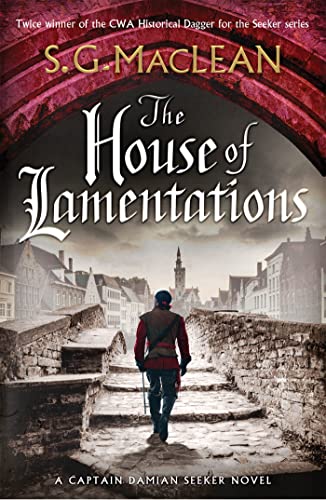
The House of Lamentations by S.G. MacLean

The House of Lamentations by S.G. MacLean is the fifth book in her Captain Damien Seeker series which ranges over the whole of the Cromwellian era.

It’s widely thought that Captain Damien Seeker had died at the end of the previous Seeker book, but in reality he has moved to Bruges where he has returned to his previous work as a carpenter. It’s a great cover for him as he is able to gain access to places he wouldn’t otherwise have reached.

Bruges has always been a popular place for the Royalist supporters to congregate. King Charles Stuart ( he had been crowned in Scotland after his father’s execution) hasn’t been welcomed elsewhere due to the politics of the time. His Royalist supporters have made themselves very unwelcome in the town as they’ve been spending a lot of their time gambling, drinking and causing trouble. A lot of the exploits centre around the House of Lamentations, a brothel.

Seeker is particularly interested in four of the Royalists, he has been sent information from England that one of them is a traitor to their cause, that puts Seeker himself in danger, but which of them is the turncoat?

Seeker, like many people had been becoming disillusioned with Cromwell’s regime which is as corrupt and nepotistic as the Stuarts’ had been, Cromwell’s cause certainly isn’t worth dying for.

The plot involves nuns and a Jesuit priest who even gives the nuns the creeps. The Jesuits always seem to be the bad guys, even nowadays, especially among old boys who had been taught by them!

I must say that at the beginning of the book there’s a description of a man being hanged drawn and quartered which for me was the most graphic that I had read, but maybe I’ve led a sheltered life.

There’s an author’s note at the back of this book, MacLean explains that she has used a lot of locations in Bruges which can be visited now by tourists, I wish I had known that when we visited the town some years ago, we just did a canal boat trip and walked around admiring the buildings.

The Bear Pit by S.G. MacLean

The Bear Pit by S.G. MacLean was published in 2019 and it’s the fourth in the author’s Captain Damian Seeker series. The setting is 1656, Cromwellian London.

The book begins with a botched attempt on Cromwell’s life, he has become so unpopular because it has become obvious that a large part of his reason for ousting the Stuart dynasty and having King Charles I executed was so that he could have the throne for himself. His regime hasn’t led to improvements in the lives of most of the ordinary people. Damian Seeker is kept busy sniffing out the many plots against Cromwell.

While chasing after one of the would-be assassins, Seeker discovers the horribly mutilated body of a man. He had been shackled to a wall by his neck, it looks like it must have been a bear that had attacked him, but all the bears had been shot on Cromwell’s orders, bear baiting has been banned. Who would do such a thing to an old man? Seeker is determined to track the perpetrator down, he’s a busy man.

I’m still enjoying this series. This one won the CWA Sapere Historical Dagger.


Destroying Angel by S.G. MacLean

Destroying Angel by the Scottish author S.G. MacLean was published in 2018 and it’s the third book in the author’s Captain Damian Seeker series.
At the end of the previous book The Black Friar Seeker had been sent to Yorkshire. He’s been banished from London and he isn’t happy about it. When he travels to the village of Faithly on the moors to let the inhabitants know of the most recent anti-Royalist laws, the place is far from its usual quiet backwater. The Trier has been summoned by Abel Sharrock, the gravedigger, but with the advent of the Cromwell era he is also the village Constable and so it was he who had summoned the Trier, to question the local preacher and schoolteacher the Reverend Jenkin. The villagers have no hope that Jenkin will be seen as being innocent of whatever he is supposed to have done.

Bess is a widow and she knows her pub is going to be very busy with people coming to the village for the trial, but she also has to cater for ten dinner guests the night before it, her young ward Gwendolen will help her. Although she’s just young, Gwendolen is the local herbalist and Bess always worries about her being accused of witchcraft, especially with the Trier being so nearby, and the village having more than its fair share of jealous gossips.

Seeker is kept even busier than usual as he’s also supposed to be looking for a man from a local family who hasn’t been seen for four years, but when the Trier and his wife arrive he’s astonished, they’re from his past and he has been looking for them for years.

The blurb on the front of the book says: ‘One of the best writers of historical crime … a fascinatingly flawed hero.’

I don’t know if it was because the action moved out of London and into rural Yorkshire, but I enjoyed this one even more than the previous two in this series which I’m binge reading now because the local lovely librarian ordered them all in for me and I noticed that this one now has two reserves on it.

However, one detail did strike me as being unlikely.

‘Grenade in there, is there? asked Seeker.

‘Of sorts, Captain. And once the pin is out I’d rather be in Mr Thurloe’s camp than the other.’

Some research online came up with this about the history of grenades. Pins on grenades are a very modern invention, they didn’t even exist in World War 1.


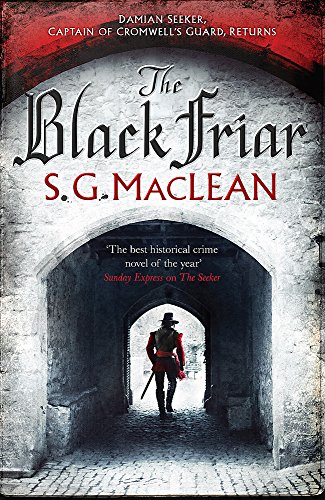
The Black Friar by S.G. MacLean

The Black Friar by S.G. MacLean was published in 2016 and it’s the second book in the author’s Damian Seeker series which begins with The Seeker.

The date is January 1655, the seventh year of Oliver Cromwell’s ‘reign’ and the people are discontented because for ordinary folks things are no better than they had been under the rule of the Stuarts. Seeker is having to deal with rebellious Royalist plots from abroad and disgruntled one time supporters of Cromwell.

Fanatical religious sects are springing up, most of them are based on the book of Daniel and they’re all more than a bit strange. It seems like desperation to me, but it is all very authentic and historically correct.

When a perfectly preserved body in the clothing of a Dominican friar is found to have been bricked up in the crumbling Blackfriars Monastery some people think it’s some kind of miracle, but Damian Seeker knows better. He recognises the body as  a man who had been working for him, and the reason the victim’s body is still fairly fresh is because he hasn’t been dead long, so it’s no miracle.

Some children have been disappearing from the streets of London, is it something to do with the murdered man? As Captain of Cromwell’s Guard Damian Seeker is kept very busy in this one, he’s well able to see that most of the ordinary people are actually worse off under Cromwell, or certainly no better off.

Shona (S.G.) MacLean has a PhD in 16th and 17th century history so presumably she gets the details correct. It’s interesting to see that women could have a prominent/ leading position as preachers in religious sects, something that seems to have gone backwards in more recent times.  If I’m nit-picking I find it unlikely that so many poorer women in these books are able to read and write, but often it’s necessary for the plot so I’m willing to suspend my disbelief.  I’m really enjoying this series and I think I’m learning quite a lot about the era.


The House on the Hill by Eileen Dunlop

The House on the Hill by Eileen Dunlop was published in 1987 and the setting is Glasgow.

Philip is an only child and his father has died recently, his mother is having to leave their home to take up a nursing course so that she can support them both in the future. Although Philip’s parents hadn’t had anything to do with old Aunt Jane who lives nearby his mother has decided that she will have to swallow her pride and ask old Aunt Jane to look after Philip for the duration. Aunt Jane hadn’t even bothered to go to Philip’s father’s funeral and that really rankles, but Aunt Jane agrees to look after Philip, she already has another young relative staying with her. Susan is close to Philip in age, but her father is in Kenya, he’s well-off but uncaring, she goes to a posh private school in Glasgow.

The Mount in Wisteria Avenue is a large mansion, but is very much down at heel as Jane doesn’t have the money or energy to refurbish it, or tackle the rampant garden. It’s a big change for Philip and Susan and although they dislike each other to begin with they warm to each other and start to investigate the old house and its strange quirks. It’s all a bit spooky. At times the past is all too present.

Aunt Jane has had a sad life at the hands of her over-bearing father and until Susan and Philip arrived she was stuck in his ways, but a more rosy future beckons for her.

This was another enjoyable read from this Scottish author who apparently taught at Dollar Academy, near Stirling.


The Wild Coast by Lin Anderson

The Wild Coast by Lin Anderson was published in 2023. It’s the first book I’ve read by the author, but she has written lots which feature Rhona MacLeod as a forensic scientist.

It begins in Arisaig, an idyllic setting in the North-West Highlands of Scotland, a very remote area. A young woman has driven there in her camper van and it transpires that she has taken the chance to leave her violent partner while he is out of the country. She has the bruises to show for it, but is attempting to cover them up with make-up. Stopping at a small camp site which is mainly used by just a few wild campers she’s reticent about communicating with the few other campers around, so when she disappears overnight nobody even knows what her name was.

But just before that happens a shallow grave has been found in the machar (grassland) on the edge of the camp. It’s the body of a young woman and bizarrely there’s a figure of a stick man alongside her in the grave. There’s also a stick man figure in the campervan, but the grave is around two months old, so it’s not the missing woman from the campervan. Rhona MacLeod is called in to dig up the body in the grave and gather as much forensic evidence as possible.

The setting changes to Glasgow where there are rumours of corrupt police officers sexually assaulting young students and it looks like Rhona’s close colleague McNab is involved – or is he?

Most of the male characters in this book are truly obnoxious and at one point I wondered if it would ever feature any men who weren’t monsters, although if I’m recalling correctly the reader is never actually in the room when women are being physically abused.

As ever I enjoyed the Scottish setting and it was good to have so many mentions of my old stomping ground of Glasgow’s west end. I’ll definitely read more in this series, but I imagine that if you have suffered from abusive and coercive men in the past then you probably won’t want to read this one.


Young Mungo by Douglas Stuart

Young Mungo by Douglas Stuart was published in 2022. Previously I have read Shuggie Bain by the same author, he won the Booker Prize in 2020 for that one.

To begin with I had my doubts about reading this one because I wasn’t totally enamoured with the premise which is the awakening of gay sexuality between the main character Mungo and his friend James. But there’s an awful lot more to the book than that. I really liked it, my only quibble is that it is very similar to Shuggie Bain in that it features a family of two young boys and a sister, with a totally out of control alcoholic mother. Jodie the sister is the smart one, she wants to make something of herself, and thinks that Mungo could too, if he gets away from the family.

The setting is mainly Dennistoun in Glasgow’s east end (where I was born – it has changed a lot since then!)

Mungo is the youngest in the family, but they’re all very close in age. Hamish is a bit of a wee hardman, he’s a small time drug dealer and general bad lad, incredibly violent and a proud and bigotted Protestant. He wants Mungo to be just like him, part of a family firm. Mungo really isn’t interested in the violence and mayhem that surrounds Hamish, but Hamish makes him take part in an attack on the Fenians, the Roman Catholic lads in a nearby neighbourhood.

Mungo is much happier spending time with James at his racing pigeon doocot/dovecot, but James is a Catholic. Hamish isn’t going to let that relationship flourish.

Meanwhile Mo-Maw as they call their mother is steeped in self pity and like all addicts the only really important thing to her is alcohol, so she’s often absent from home for weeks at a time. From time to time she goes to Alcoholics Anonymous meetings and it’s there that she meets two men who she happily hands Mungo over to so they can all go on a fishing holiday to the Highlands, with the idea that they will help Mungo to ‘man up’.  Mungo just wants to be with James.

I ended up enjoying this one a lot more than I thought I would, but I hope that the next book by the author has moved away from a three child family with an alcoholic mother.