Edinburgh Book Haul

31 July 2012 00:22

You might know that I went to Hay-on-Wye (that famous book town) recently and was quite disappointed with the place, I didn’t manage to find any books which I wanted to buy.

So it was a lovely surprise when we came out the east gate of the Botanic Gardens in Edinburgh, to discover second-hand bookshops which were completely unknown to me. We hadn’t been in that area of Edinburgh before, I think it is called Broughton Road.

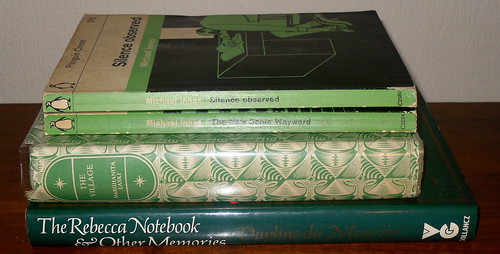
Edinburgh Book Haul

As you can see, I bought four:
Silence Observed by Michael Innes
The New Sonia Wayward by Michael Innes
The Village by Marghanita Laski
The Rebecca Notebook and Other Memories by Daphne du Maurier

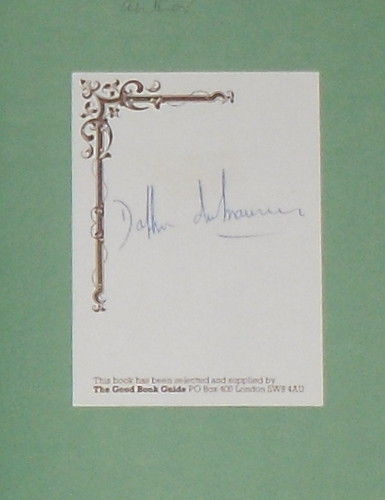
I was especially chuffed to find the du Maurier book in a shop which is part bookshop and part antiques shop. I would have bought it anyway but it’s particularly nice that it’s a signed copy, as you can see. It was very reasonably priced too.

Bookplate

I always get my best book finds when I least expect to. I could have bought quite a few more books but I exercised restraint and of course I now wish I hadn’t. Luckily, Edinburgh isn’t very far away!

November’s Autumn Classics Challenge

30 July 2012 00:05

It’s months since I’ve read anything for this challenge, you can have a look at the July Prompt here.

So, which book has left a Lasting Impression?

For me that has to be Germinal by Emile Zola. I must admit that I read it a while ago, you can read my review of it here.

It isn’t a comfortable read and that’s probably one of the reasons that bits of it are still so clear in my mind. It’s about unemployment and people who are starving, rich people exploiting the poor and the terrible working conditions down mines which had to be endured, just to try to stay alive.

More than a hundred years on, the same problems are still with us. In the case of the men who are mining, they are still being buried alive and killed by roof collapses or explosions. If anything the conditions are even worse down the mines nowadays as machinery is used, so the noise and heat of that is added to what was already a hellish environment.

Remember the miners when you buy some silver/gold jewellery or a diamond ring. Some poor soul had to risk their life to dig it out of the earth for you. If, like me you’re squeamish about that thought, the only way you can get around it is to forego the bling or buy the antique variety. Then you aren’t propping up (no pun intended!) the modern mining industries.

The Setons by O. Douglas

29 July 2012 00:09

If you have a look at my library thing you’ll see that I’ve been reading John Buchan’s Witch Wood, but I have to admit that I only got to page 43 before deciding that I wasn’t in the mood for it. I almost never give up on a book completely so it’s just waiting until I feel more like reading it, or as we used to say in Scotland – until it comes up my back. Do not ask me where that saying comes from as I haven’t a clue!

Anyway, I felt that John Buchan’s sister O. Douglas matched my mood more, so I settled down with The Setons which was first published in 1917.

This book follows a now familiar pattern of a family with widely differing ages of children. It’s set in Glasgow and of course it’s the Seton family who live there, the father being a widowed church minister. Elizabeth, his daughter, is in her 20s and she takes the place of ‘mother’, especially to her brother ‘Buff’ who is only five years old.

It’s a comfy book, very autobiographical I’m sure, it’s probably an accurate depiction of the sort of life which O. Douglas experienced when the Buchan family was living in Glasgow, no doubt she used plenty of her acquaintances as characters. There is inevitably quite a lot of Scottish Presbyterianism and mentions of the Bible.

She was very fond of having a wee boy who was doted on in her books, it seems such a shame she only had brothers and never had any children of her own. Although the mother in this book is dead, the Buchan’s mother was very much alive and the book is decicated to her.

To MY MOTHER IN MEMORY OF HER TWO SONS
They sought the glory of their country: they see the glory of God.

Towards the end of The Setons the Great War rears its ugly head and it moves from being the usual cosy, romantic and amusing tale with interesting Scottish social history, to something altogether more sad but no doubt it echoed so many peoples’ experiences at the time.

I of course enjoyed it for the Glasgow setting, as I was born there and brought up not far away from the streets mentioned. There were quite a lot of visits to shops and Glasgow owned up-market department stores which I had remembered being in as a child. They’re all gone now, such a shame, but it was quite a nostalgia trip for me. It’s always good to be able to imagine an exact location, even when almost 100 years has gone past since the book was written. I think you can get The Setons from Project Gutenberg.

Evee’s blog

27 July 2012 23:56

If you’re interested in Scotland you’ll want to visit Evee’s blog. At the moment Evee is being a friend in deed (indeed) as she’s looking after a friend who is just out of hospital.

Her recent posts have been from Yorkshire and now they have moved on to the Braemar area of the Scottish Highlands. Evee has taken loads of great photos of the area, including Balmoral, the Queen’s Highland home. It looks like a fairytale castle.

Alloway, Ayrshire, Scotland

27 July 2012 01:04

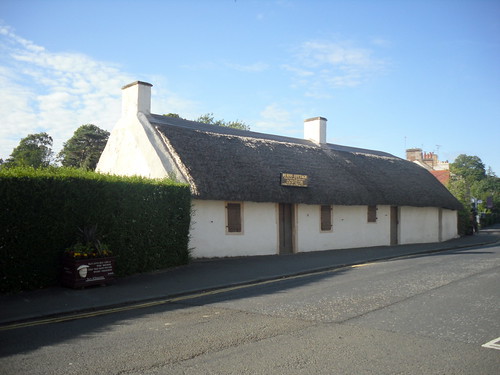
As I said before, by the time we got to Alloway, which is just a short hop from Culzean Castle, Robert Burns’s birthplace was shut. But here is a photo of it anyway, thatched roof and all. Hopefully the next time we’ll get there earlier.

Burns's cottage

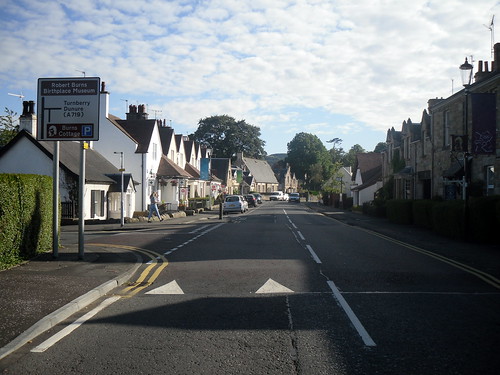
This one is of the main street in Alloway, speed bump and all! You can just see the gable end of Burns’s cottage at the top right hand side.

Street in Alloway

If you carry on walking past the cottage it isn’t long before you reach the Auld Kirk which was already a ruin by the time Robert Burns was a wee boy (he was born in 1759). It’s this church and graveyard which inspired him to write his poem Tam O’Shanter, which you can read here.

Alloway kirk + yard

This sarcophagus is actually situated within the ruined kirk, it’s obviously very ancient.
a sarcophagus

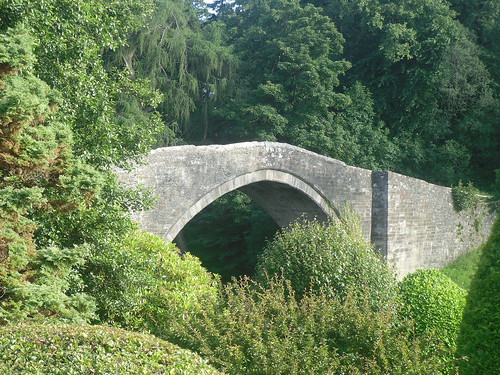
Just along the road again a very short distance and you reach the River Doon. This is the famous Brig o’ Doon which features in the poem, with the witch pulling the horse’s tail as it gallops across the bridge to escape, of course witches can’t cross water!

auld Brig o' Doon

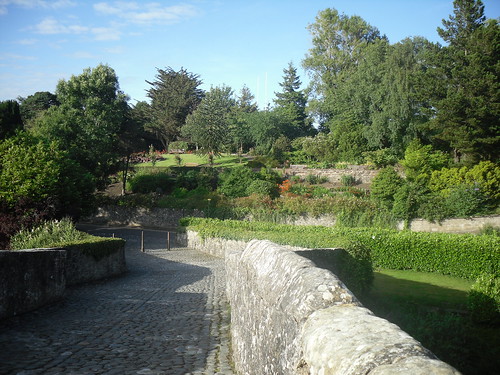
I took this photo actually on the bridge which is very steep and the garden beyond is the Robert Burns memorial garden, sadly it was shut but from what I could see it looks beautiful.
auld Brig o' Doon  and gardens 2

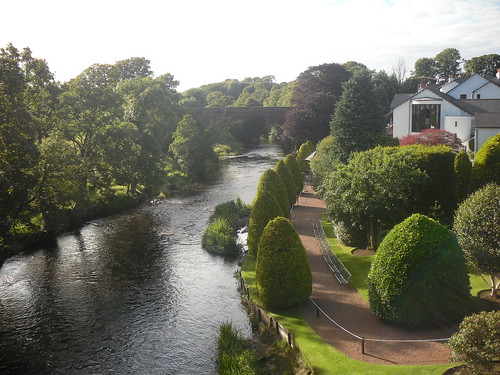
This is a view from the old bridge to a newer bridge which isn’t all that new really. The pretty area of planting to the right belongs to a local hotel, it looks like a good place to relax and watch the river.
River Doon

And this is the river from the other direction and yet another bridge.

River Doon

I must say that Alloway was never a place which featured high on my list of ‘must visit’ places, but I was very agreeably surprised. The River Doon is really beautiful, fast flowing and clear and having been to the Burns house in Dumfries, I think he must have been pining for his beloved Alloway all the time he was there. Maybe that was why he wrote this song.

Culzean Castle, Ayrshire, Scotland

26 July 2012 00:44

Culzean Castle from garden

This is Culzean Castle from the front, the right hand side of the building is the oldest part, dating from the 15th century and the building has been added on to and redesigned over the centuries. The famous Scottish architect and designer Robert Adam made a beautiful job of the whole place, particularly the interiors, some of which you can see here. You can read about the building of the castle here and more about Robert Adam here. He was actually born in Kirkcaldy, not far from where I live but sadly his home, Gladney House, was pulled down some years ago. They’ve got rid of everything which would have been of interest to visitors to the town, including the economist Adam Smith’s home and Pet Margery’s home and the school which Thomas Carlyle taught in. Shame.

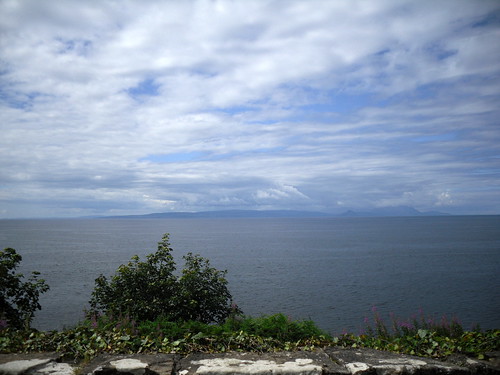
Culzean Castle sea view

The photo above is the view from the castle, over to the isle of Arran, on a very clear day you can apparently see down as far as Ireland, but not on the day we visited, despite it being a beautiful day.

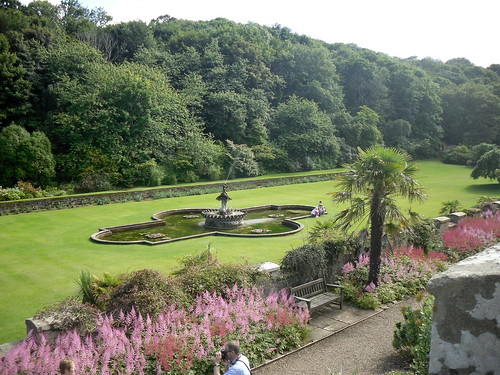
Culzean Castle garden + fountain

Culzean is set in beautiful parkland with gorgeous trees but there’s plenty to be seen in the way of formal gardens. These are a couple of photos showing the fountain.

Culzean Castle fountain

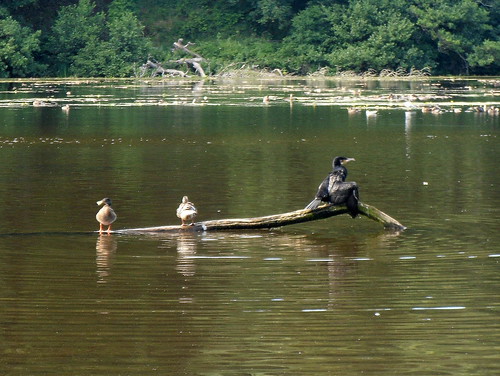
At first we thought that this cormorant was a model but it eventually moved. I can’t make up my mind about it, it is a sort of mixture between comical and sinister, a wee bit vulture-like somehow. It was crouched over Swan Pond, we didn’t see any swans at all though.

Culzean Castle cormorant

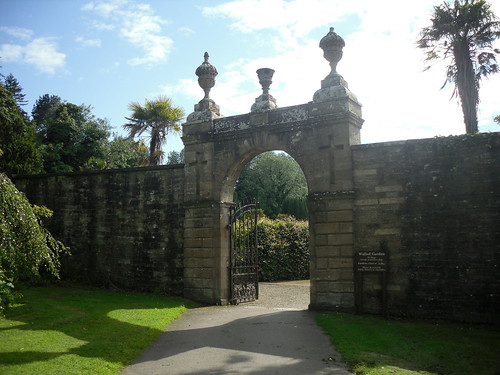
The walled garden below is quite a walk away from the castle but it’s worth visiting and there are nice benches to have a rest on.

Culzean Castle walled garden gate

The top storey of the castle has ben turned into a very upmarket hotel. It’s handy for the golf course at Turnberry but I think it would be a bit too expensive for my liking. President Eisenhower was given a set of apartments for his lifetime, as thanks for his wartime contribution, but since his death it has been incorporated into the hotel.

This was a really enjoyable castle to visit, although here’s quite a lot to see, unfortunately they don’t allow you to take photos inside the castle. I can’t understand why the National Trust has this policy at all of their properties. They would get more publicity if people could see what the interiors are like. It costs £15 to get in but you can easily spend the whole day there. Joining the National Trust is the best way to go about it because at a cost of £64 or so for a double membership, we’ve already saved ourselves a lot of money just in the last month.

Unfortunately we didn’t realise that there was too much to see in this area in one day, otherwise we would’ve arranged to stay overnight. We could have visited Robert Burns’ birthplace and Souter Johnnie’s cottage too. Alloway turned out to be a lovely village, as you’ll see tomorrow.

Decline and Fall by Evelyn Waugh

25 July 2012 00:26

This is a quick read at 216 pages. It’s another of Grandad’s old Penguins from 1953 but it was first published in 1928.

I realised quite late on in this book that I’ve been reading Evelyn Waugh’s books completely out of order. I’m sure that Scoop has the character Lady Metroland in it and in this book Margot marries Lord Metroland. I should have read this one first.

Anyway, it begins in Oxford on the night of the Bollinger Club’s annual dinner, it’s a time of stress for those in authority as the filthy rich members of the exclusive club always cause mayhem in the town.

Paul Pennyfeather is a serious young student, studying to become a vicar, but when he runs into a group of drunken Bollinger toffs on his way home, the result is that he ends up being ‘sent down’ and his future is in ruins.

He ends up having to take a job as a schoolmaster in a very bad boarding school at a time when the only qualification that you seemed to need to get a job like that was to have been educated at a public school yourself.

I found it very amusing, if a bit too close to the truth in parts, because it does seem that even nowadays you can get away with an awful lot if you go to certain schools and know the right people. The whole Bollinger Club thing is obviously modelled on the Bullingdon Club – which our dear, dear leaders (and I don’t think!) Cameron and Osborne attended.

It was interested to see Evelyn Waugh mentioned quite a lot in the Mitford letters. He was regarded as a complete drunk and a shameless social climber. One of the sisters mentioned that you could track his ascent by the people that he had dedicated his books to. This one is decicated to Harold Acton, apparently he reached a pinnacle when he dedicated a much later book to Deborah (Mitford) Devonshire. Annoyingly I’ve packed his other books away already so I can’t check out his social progress. He was a dreadful snob but he was also a good writer. I don’t think I would have wanted him as a dinner guest though, not that he would ever have lowered himself to come.

Angharad Rees and Poldark

23 July 2012 23:53

Jack got to the Guardian before I did this morning – as usual – and when he reached the obituary page he said, Angharad Rees has died. I was/am really sad about that, I thought she was a great actress who never seemed to get the fame which she should have. It’s as the red-haired, fiery Demelza in Poldark which most of us will remember her. You can read her obituary here.

The BBC aired the Poldark series in 1975-77 and it was wildly popular. Set in Cornwall (I’d watch anything set there I think) just after the American War of Independence. Poldark was based on the books by Winston Graham, who had been a history teacher before taking to writing, he was a rattling good storyteller and as a bonus, his books are factually accurate too.

I first read the novels years ago and re-read them all not all that long ago, they were still real page-turners so if you haven’t read them you might want to try them out. I know that Evee loved the books too as she has mentioned in the past how she raced through them while she was going through a terrible time in hospital. Did you watch the TV programme too Evee? Half the female population seemed to fancy Robin Ellis (Ross) while the other half were all for George Warleggan (Ralph Bates).

Poor Angharad, she was 63 but she’ll always be Demelza to me. What’s going on up there? Yesterday it was the actor Simon Ward who popped off. Who’s the third one going to be?

What’s Occurring?

23 July 2012 00:22

Well, as it hasn’t actually rained for two days in a row now, I know it’s hard to believe, I’ve been hard at it in the garden as it had got to the stage where I couldn’t actually see the path which leads to the greenhouse. Everything was so overgrown, what with all the rain we’ve had, I’ve made a fairly good start but, there’s still a lot to be cut back and weeded and the rain is coming back tomorrow according to the weather forecaster.

On Friday it was a lovely day so we made a picnic and drove for about two hours south-west over to Ayrshire to visit Culzean Castle, it’s pronounced Cullane. It’s just over 100 miles away from us and we hadn’t been there before. It’s a wonderful place, set on cliffs above the Firth of Clyde, with views over to the island of Arran and on very clear days you can see all the way to Ireland. I’ve not had a chance to flickr the photos yet but if you want to see what it looks like have a look here. Go on give yourself a treat and click on it, it’s a gorgeous place.

After Culzean we drove to nearby Alloway, Robert Burns’s birthplace, but by then it was late so the house was shut, we did have a lovely walk around the village though and, it’s much prettier than I thought it would be. Again, photos to prove it will be here during the coming week.

It was a beautiful evening so the drive back east to Fife was a treat, after all the chat about Scotland’s gloaming it was great to actually experience that long summer twilight, there was still plenty of light in the sky around midnight but we haven’t been having many gloamings like that, as the weather has been so dull and wet.

Jack did comment to me the other day that I didn’t seem to be able to go anywhere without buying a book, and he’s right because the National Trust houses all have second-hand book sections now. So I’ll be listing more book purchases soon, I haven’t even had much time for reading and I never did get around to signing up for the Rosamond Lehmann Challenge which I found out about from Anbolyn. I had every intention of reading A Sea-Grape Tree for it as I’ve had it for ages and I’ve read most of her other books. Oh well, I can drop by and see what other, more organised bloggers are saying.

Tomorrow, the forecaster is promising us rain again, maybe I’ll catch up with things then!

Just one wee mention of Bradley Wiggins – the first British man to win the Tour de France apparently, but I read in the Guardian the other day that he was actually born in Belgium! I think that’ll be one to remember for pub quizes – if you partake in such things. Apart from that it’s one to remember for that ever popular game of – Name Famous Belgians. He can replace the inevitable Hercule Poirot, that’s always a controversial one as he’s a fictional character, strictly speaking!

King Charles II by Antonia Fraser

20 July 2012 01:22

It’s quite a while since I read a proper history book so when I spotted this one recently in a second-hand bookshop it was just perfect timing for me. During our recent road trips we’ve been visiting lots of English towns which were heavily involved in the action of the English Civil War. It’s not a subject which I knew an awful lot about, I certainly didn’t get much about it at school, not surprising as I obviously went to Scottish schools. Mind you, Scotland does feature a lot in the book and apparently Charles II really disliked Scots, which is a laugh given who his ancestors were and that he was a Stuart.

Anyway, in Warwickshire and Worcestershire it was all go and it made the book all the more vivid for me as just a couple of days after visiting Worcester Cathedral I was reading about all the fighting which went on in the streets there, they were running with blood apparently!

If you want to find out a bit more about Charles II have a look here. But if you want the detail then you’ll enjoy reading this book. I had no idea that Charles had such a bad time of it when he was in exile for years after his father was executed. He literally went without food as there was no money and he had already borrowed from everyone.

At one point I did become a bit dissatisfied because I wasn’t getting enough historical detail but I came to the conclusion that as the book title isn’t The Life and Times of Charles II – I was being a bit unfair. But it has made me want to find out more, for instance, when Charles came back to England and he was restored as monarch, his behaviour and attitude helped a lot with the healing of the nation and peace. He wasn’t determined to ‘get’ the men who had signed his father’s death warrant and indeed some of them were even given very important positions in the government. However, on leafing through another history book I discovered that some of them were hunted down and even brought back from abroad to be executed. I want to know why the disparity in treatment, more reading is required obviously.

I think Antonia Fraser did her best to be impartial as far as religion is concerned, but given the fact that she herself is from an aristocratic Roman Catholic family, who were all converts, she doesn’t always quite manage it. She seems to be quite certain that Charles became a Catholic on his death-bed but I’m sure others don’t agree. It’s common even nowadays for RC priests to ‘claim’ folk for their brand of Christianity at death-beds.

Inevitably the Catholic/Protestant religious problems feature in the book and at one point Fraser says that John F. Kennedy made it clear that he drew a distiction between his role as President of the US and as a private member of the Catholic church; as the former for example he was not subject to the authority of the Papacy.

It’s all very well to say that but I read just a few weeks ago that during the Bay of Pigs crisis JFK was on the phone a lot to the then Pope, apparently taking advice from him. It’s that sort of thing which really worries some people about religion and it’s just one of the many theories about JFK’s assassination, that it was done because of his percieved allegiance to the Pope rather than to America.

I don’t think it’s all Henry VIII’s fault as all the world religions have schisms and factions who are at loggerheads with each other. Maybe the Buddhists all get on with each other, I’d like to think so anyway.

Well I’ve gone off track a bit but I’ll just finish off by saying that there’s more to Charles II (Stuart) than the facts that he had loads of mistresses and a dozen or so illegitimate children. This book is a painless way of learning more history.

If you want to see some images of him, look here.