
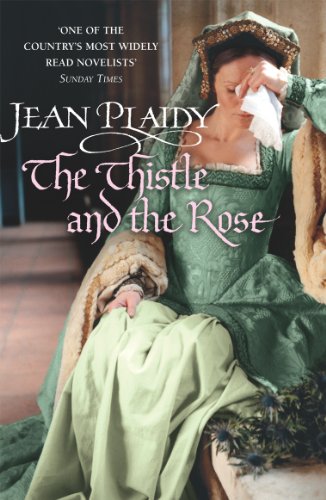
 The Thistle and the Rose by Jean Plaidy was published in 1963 and if you’re interested in Scottish history reading this book will probably teach you quite a lot, in a painless fashion although I must say that at times Plaidy’s writing style seems quite stilted, certainly when compared with writers like Hilary Mantel and Alison Weir. This is the eighth book by Plaidy featuring the Tudors
The book begins in the Tudor court of Henry VII, not long after his heir Prince Arthur has died. Only Princess Margaret, Prince Henry and Princess Mary are left, but Margaret is of an age to be married off and Henry VII negotiates with the Scottish King James IV. Margaret is sent to Scotland to become a Stuart Queen and be a political pawn for her father. Unexpectedly Margaret falls for James IV and for her new country, despite it being obviously poorer than England. She has at least escaped her father’s famous meanness. But James had had an even worse father, he wanted nothing to do with his son, giving him no love or time. Despite his upbringing James was a good and successful king.
When James dies at the Battle of Flodden Margaret is made Regent, she has one small son and gives birth to another soon after her husband’s death. The Scottish ‘nobles’ are of course all fighting among themselves and Margaret ends up losing her children and the Regency. Her brother Henry VIII is no help at all.
I liked this and might try to track down the others in the series. It’s amazing how often Stuart kings died, leaving young children at the mercy of men who want the power for themselves. History does indeed repeat itself.
This is one of my 20 Books of Summer 2023.
I was an avid reader of Jean Plaidy back in my school days – far more interesting than our history lessons about Reform Acts and Corn Laws! But I don’t recall this one. I wonder if I read them now I would be just as enthralled? I suspect my tastes have changed..
BookerTalk,
The writing style is very different from what we are used to today, but it doesn’t take long to get used to it. I think historically it was very good, it’s easy to get mixed up with all the James, Mary and Margarets and this cleared it up for me. How I remember those Reform Acts and Corn Law lessons, but not much of the details!