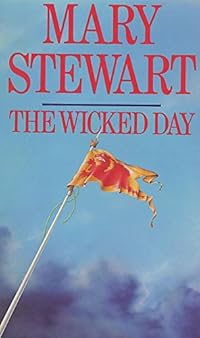
I went through a Mary Stewart phase as a teenager and I read the first three books of this series way back in the 1970s and I absolutely loved them. The Merlin trilogy comprises of The Hollow Hills, The Crystal Cave and The Last Enchantment and The Wicked Day is the fourth and I didn’t even realise until recently that there was a fouth and fifth book. I sort of wish that I had gone back to the beginning and read them all in order but I didn’t really think it was necessary because I remembered the books so well. The trouble is that although I enjoyed the book I wasn’t as into it as I was with the others in the 1970s. I don’t know if it’s an age thing because I’m certainly not a teenager anymore but then again even as a teenager I was never one of those daft romantic girls, it was more than just King Arthur which appealed to me. The 1970s serial ‘Arthur of the Britons’ was on TV when I got home from school and I have to admit that I loved it and the actor playing Arthur Oliver Tobias was a big PLUS!
Anyway, back to the book, I did enjoy it but at some point when I don’t have such a big backlog of books still to be read in the house I’m going to go back to the beginning of the series again. Will that day ever come, I ask myself?
You might remember that Arthur was duped into sleeping with Morgause who unbeknown to him is his half-sister and when Morgause gives birth to the resulting son Mordred she farms him out to be brought up by an old couple who are fisher-folk on an Orkney island in the North of Scotland. Merlin had prophesied that Mordred would be Arthur’s doom and as Morgause hates Arthur she hopes that Merlin is right.
Eventually Mordred is taken from his foster parents and goes to live with Morgause and her sons by her dead husband King Lot. King Arthur hears about this and takes Mordred to live with him at Camelot, and although the half-brothers go too, they aren’t happy about Mordred being given special treatment by Arthur, Mordred’s paternity is a secret, even to him.
Mordred’s half-brothers are a wild bunch and mayhem ensues. If you’re at all interested in Arthurian legend then this is a book for you. There have been plenty of stories throughout the centuries and Mary Stewart has taken some of them and come up with a good storyline.
There is a map on the end papers of the book and it has various places of importance on it. One of them is Dumbarton and I was agog the whole way through to find out what part the place was going to play in the story as it is the town which I grew up in. However it wasn’t mentioned until near the end of the book and it was only that Mordred’s youngest son was born there. If you look to the top left hand of my header you will see Dumbarton Castle Rock and this is where his son was supposed to be. Another name for Dumbarton Castle is Arthur’s Castle as it is in the west and Arthur was supposedly King of the West. The name Dumbarton is a corruption of Dunbritton, meaning fort of the Britons.
That’s your Scottish history lesson for the day! I’m now looking for the last book in the series The Prince and the Pilgrim, but I’m not in a hurry to get it as I’ll need to seriously get stuck into my TBR pile first.
If you want to know what Oliver Tobias looked like wayback in the 1970s have a look here.