Toffee Cake

This is the cake which I baked for Gordon’s birthday and it’s based on a Marguerite Patten recipe. It was a nice change from a completely chocolate cake. Although the ingredients specify using castor sugar I usually just use normal white sugar. The brown sugar can be any kind from Demerara to dark soft brown sugar depending on how strong you want the toffee flavour to be.

6 oz brown sugar
5 oz butter or marg.
4 tablespoons milk
2 oz castor sugar
2 eggs
8 oz self-raising flour

Put the brown sugar, 1 oz butter and 4 tablespoons of milk into a heavy based pan and stir until the sugar has dissolved. Then allow the mixture to reach the ‘soft ball’ stage.

Cream the remaining butter and sugar together until it’s soft and light then beat in the warm toffee syrup gradually to stop the mixture from curdling. If it does curdle just add some flour.

Beat in the eggs and then the rest of the flour.

Put the cake mixture into an 8 inch cake tin which has been well greased.

Bake for about 50 minutes in a pre-heated oven at 170 C, Gas mark 3 or 325-350 F. Remove from oven and run a knife around the edge of the cake tin, the cake should come out quite easily. Leave to cool on a wire rack.

This cake tastes lovely on its own but I decided to cover it with my own version of buttercream icing. This is quick and easy, no faffing about with butter and cocoa powder required.

Nutella Topping
Place about 3 heaped tablespoons of Nutella into a glass bowl with a sploosh of milk, about a quarter of a cupful, and microwave for about 30 seconds on medium or until the Nutella mixture has melted. It depends on the strength of your microwave.

Stir the mixture until the milk is well incorporated then add about 4 heaped tablespoons of icing sugar into it. Be sure to sift the icing sugar first otherwise the icing will be lumpy.

Mix well and quickly spread it over the cake and down the sides if wished. It sets fairly fast so I couldn’t get the top of my cake as smooth as I wanted and I ended up taking a rolling pin to a bar of Aero to disguise the top. No disaster. Chocolate on top of chocolate isn’t exactly a problem.

We were half way to Stirling before I realised that I had left the birthday candles behind. So we had to improvise with a tealight. Well, he could still make a wish, which is the main thing.

Death Comes for the Archbishop by Willa Cather

I’ve really enjoyed all of the books by Willa Cather which I’ve already read so I’m going to work my way through the rest of them.

I was quite disappointed that she wrote a book about the Roman Catholic church because as I was brought up in the west of Scotland I’ve found that avoiding religion is the best policy. Anyway, I ‘girded my loins’ and remembering that I had enjoyed Rumer Godden’s In This House of Brede, I took a big breath and plunged into it.

As ever it’s Cather’s descriptions that I love, she gives her novels a wonderful sense of place and makes it really easy for you to live there in your imagination, even if the landscape which is written about is an entirely alien one to you.

Looking at the story from a non Catholic viewpoint: This is about Roman Catholicism taking over from the original religion and traditions of the people of New Mexico. Two priests Father Vaillant and Bishop Latour are given the task of making the RC church more powerful. They are welcomed by the natives who are generous to a fault and the two priests sponge off them, taking everything that is offered to them – and more. The one mountain in the area which is a beautiful cream coloured rock is plundered and quarried to build a huge stone cathedral in a sparsely populated area. It’s Bishop Latour’s vanity project.

From the Roman Catholic point of view: This is the story of the church spreading its influence into New Mexico and helping the inhabitants have a better way of life through Catholic worship.

Having been brought up a Presbyterian and married to an Episcopalian (which Willa Cather converted to), I decided that atheism was the one for me and the only ‘religion’ that interests me is Celtic mythology because I like the importance that it places on nature and plants. But the Christians nicked all of the Celtic/Pagan festivals. The December holiday should be the celebration of the winter solstice, especially as Christ was apparently born sometime in September.

Anyway, back to the book, I didn’t like this one as much as My Antonia as the subject and the setting didn’t appeal to me as much. I was amazed to read that this book had been banned at various times, according to the Wikipedia article.

Scottish words: nippin’ ma heid

Well, it’s really a Scottish phrase isn’t it and it’s what people say when they are feeling discombobulated and troubled about something or someone is ‘getting at them’.

For some reason the phrase is often used by husbands, about their wives of course.

She’s nippin’ ma heid or in English-She’s hurting my head. It means that someone or something is giving you grief, causing you severe annoyance.

It doesn’t always have to be a person that’s causing the problem. It can be a large company like British Gas or BT. The sort of company that keeps you on hold for ages when you phone them and you can never speak to an actual human being. It does your head in, it really annoys you, but I think that there’s no point in letting yourself be bothered like that. Rise above it otherwise the only thing that does go up is your blood pressure!

The Tapestry of Love by Rosy Thornton

Just after I read Stefanie’s (So Many Books) review of this book it appeared on the ‘new books’ shelf at my library, so I took it as a sign that I should read it. This is what I call a marshmallow book because it’s the sort of thing that’s lovely now and again – but you wouldn’t want to live on it. Perfect light holiday reading or for when you just want to escape somewhere different and dream.

It’s set in France, in the Cevennes mountains where Catherine, an English woman has bought a remote granite cottage with the intention of starting up a sewing business. She’s a divorcee with grown up children and at last it’s time for her to do her own thing. But she hadn’t bargained on the amount of red tape that she encounters in France nor the heavy rainfall that the area gets and she begins to wonder if she’s done the right thing in settling there.

This book is well written and has a lot of deja vu moments if you’re a certain age, with guilt about a sick/dying parent and having to clear out the family home featuring in it.

Catherine’s cottage is close to the road which Robert Louis Stevenson travelled and wrote about in his book Travels with a Donkey in the Cevennes which was first published in 1878. I read it years ago and seem to remember that it’s quite funny. It’s a shame that hardly any of Stevenson’s books are read nowadays, except for Kidnapped of course.

Rosy Thornton has written into her book modern day tourists who pass by on their quest to replicate the 120 mile trek with their version of Modestine the donkey. It’s quite a touching nod towards Stevenson, I think.

This is a wish fulfilment book for a lot of English people who have a love/hate relationship with France. In general the English love France but don’t like all the French people in it and the French people hate the English – unless there is money involved. I’ve always taken the precaution to wear a Saltire (Scottish flag) brooch whenever I’m in France, but then you do run the risk of being kissed in the street by complete strangers, it’s a war thing.

Anyway, back to the book. Nit-picking alert! It isn’t terribly realistic as Catherine completes at least three large tapestries/needlepoints really quickly and if you’ve ever done any then you’ll know that it’s a slow process. The book has quite a lot of typos, downright mis-spellings and words completely missing but for me the most annoying one was the spelling of the town of St Andrews, in Fife, because all through the book it has an apostrophe s – which of course it shouldn’t have. I live nearby so I should know but so should a proof-reader.

On the other hand this was a pleasant change because I had given up on modern fiction as a succession of books that I read at one point all had the same story line and ended up with the main character, aka A Trollope, running off with another woman’s husband, in the guise of romance. It isn’t what I call romance, in fact, I can’t say what I do call it, apart from a diabolical liberty. And I cleaned that one up!

Kelvingrove Art Gallery and Museum again

The best laid plans of mice and men gang aft agley – as good old Robert Burns said, and so after really looking forward to the autumn holidays we ended up not being able to go away, just as well we hadn’t actually booked anything. When a good builder knocks on your door and says he can fit you in earlier than planned you just have to grab him rather than wait until the spring. So the west, Oban and the Isle of Mull will have to wait. We only managed one day in Glasgow instead and chose to go to the Kelvingrove, my home from home.

They are very relaxed about people taking photographs unlike some places and I thought you might like to see some Charles Rennie Mackintosh designs and other Scottish art nouveau designers.

This is from the original Miss Cranston’s Tearoom. I love the designs but I’m sure that Miss Cranston must have asked him to design chairs which were uncomfortable to sit in for any length of time, fair enough I suppose, she obviously wanted people to move on so she could make more money.

These gesso panels by Mackintosh’s wife, Margaret Macdonald, are lovely – ethereal women are a recurring theme.

I think the stained glass is my favourite, it’s such a pity that the chair is positioned so badly here.

This type of stained glass is typical of what you commonly find in a ‘middle class’ Edwardian tenement building in Glasgow. This one is small and quite plain compared with some. The front doors and vestibule doors usually have stained glass or painted glass panels in them. I think this one came from the bottom of a window. The panel would have been fitted over the bottom of the glass from the inside. You can still buy panels like these quite cheaply from reclamation yards. I’ve got a few painted glass ones which I intend to make into light boxes – some day!

If you’re into CRM and The Glasgow Style you’ll want to visit Kelvingrove.

Birthday Boy

We had a meal out at the Westerton Arms in Bridge of Allan near Stirling a couple of nights ago. It was Gordon’s 23rd birthday, how time flies.

The meal was really lovely, the only thing that was a bit disappointing was the size of the pasta dish which Duncan ordered. He has the biggest appetite but his mushroom ravioli was about half the size of all the other main courses. So if you are really hungry, don’t go for the pasta.

My husband took the photograph and I was sitting too far back!
The birthday boy is on the right with his lovely ‘bidey in’ Laura opposite him. I’m the nearly invisible red head in the middle, I’m only 5’3 but Laura is tiny and I always feel like a cart-horse beside her. Duncan, our eldest is on my right. A jolly good night was had by all.

I haven’t had a look at the on-line reviews but I’ve been told that one of them complains that the Westerton Arms is pretentious, but it certainly is not, the person who wrote that review must have been used to greasy spoon cafes.

As you can see, we all had puddings and Laura and I chose the hot Black Forest pudding with white chocolate sauce and ice-cream which was a lovely variation of that 1970s-80s staple of Black Forest gateau. But all of the desserts were lovely, for once. Sometimes they look so much better than they taste which leaves you cursing when you realise it must have been about a thousand calories. Not that I’ve ever counted a calorie in my life, I just walk the excess off.

Autumn garden

This was how my back garden looked yesterday, as you can see the acers are holding on to their leaves and there is still quite a lot of colour around. You can’t see the rowan tree (mountain ash) in any of these photographs but it is completely bare now. It’s a good tree to have as according to Celtic mythology it keeps evil witches away.

I managed to get out there this morning and gave it a bit of a ‘redd up’. I was quite ashamed, there were even brambles growing through the shrubs. By the time I realised, they were nearly ready to eat so I just left them and added them to a crumble of home grown apples, very tasty. But I had to get rid of them before they took over the garden.

You can see the finished stonework of the house. At first we thought it looked a bit weird but we got used to it and it’s good that the house now looks as it did when it was first built over 100 years ago. Well apart from the kitchen chimney now being missing and the roof slated over where it had been. It means that the kitchen isn’t so draughty now. The patch of ground underneath the wee square window (which used to be the coal hole and is now part of the kitchen) was my herb garden but most of them got flattened by the builder. They were beginning to die back anyway and they’ll be back again next year.

I’m not happy about the more modern small stone extension to the left. The previous owners built this (f)utility room and it doesn’t really blend in with the rest of the house.

I had to give up on the gardening this afternoon though as it had started to rain really heavily (which wasn’t forecasted) and it’s our first winter time day so it started to get dark about 3 o’clock in the afternoon. Quite depressing really. On the plus side – it isn’t cold or windy.

It’s just a wee garden but there’s a lot packed into it and it’s the playground of an amazing number of birds.

I hate that ugly green metal clothes pole and I’m going to get rid of it. It’s nearly rusted through at the bottom anyway so any day now I’ll look out and the washing will be all over the garden when the clothes pole collapses under the strain. I think I’ll get one of those whirly things that you can remove when it’s not in use.

The Small Room by May Sarton

This is the first book which I have read by May Sarton and I did enjoy it. The book is set in a prestigious women’s college in America but I’m not absolutely sure what age the students are supposed to be, they did seem quite young to me which wasn’t helped by the fact that there seemed to be a habit of women calling younger women ‘child’.

Lucy Winter had only done her Ph.D at Harvard because her fiance had been studying at the medical school nearby but the relationship founders and she accepts a teaching post, not at all sure that it is the right thing for her to do.

I think the relationships between the staff of the college were written very well as I’ve experienced similar conversations amongst university lecturers at a time in my life when almost everybody I knew had a Ph.D.

Anyway, it isn’t long before Lucy discovers that Jane, a supposedly brilliant student has nicked somebody else’s work obviously thinking that nobody will ever find out because it had been published years ago. Jane is a protege of Prof. Carryl Cope who is very well thought of within the academic world and is convinced that Jane does possess a ‘brilliant mind’. We don’t have any evidence of it though and I do find it a weird concept given the fact that we are talking about history.

Much as I love books and literature/history in particular, brilliant is not the adjective which would spring to mind. Let’s face it, nobody studying for an arts degree is going to cure cancer or do anything else really important for the world. Have I been influenced by my Chemistry Ph.D. husband in this? I don’t think so, it’s just common sense.

I digress. Eventually the rest of the students hear that Jane has been caught plagiarising but it has been hushed up. They were already upset by the favouritism shown to Jane previously and they revolt. Unknown to the other students, Jane feels that Prof. Cope has been pushing her too hard and it is decided that she is in need of a psychiatrist. This decision causes more problems for the college as Olive Hunt, a very wealthy elderly patron is dead against the idea of the college employing a psychiatrist and has always said that she won’t leave the college her money if they go against her wishes.

The whole experience has torn the college apart and even threatened a marriage as people take opposing views of the situation.

Was it just a simple case of Carryl Cope identifying with the young Jane and therefore giving her special treatment or, given the fact that Carryl was a lesbian was she attracted by her? If Carryl had been a male professor he would definitely have been suspected of having an ulterior motive for his behaviour. Carryl’s long term relationship with Olive Hunt had fizzled out so perhaps that was the reason for singling Jane out for special attention. Or, did Carryl feel that her own intellectual abilities were waning hence her pressure on Jane to come up with ‘brilliant’ work. Profs. have been known to nick student’s work or at least take the kudos for it.

Does this sort of thing happen every year in every university? It’s a sad fact that there are students who manipulate university staff for their own gains, it happened 30 odd years ago when my husband was a student and it was in evidence again more recently when my son was at uni. Am I being too Presbyterian about the whole thing?
Probably but I just think that the same rules should apply to everyone.

I could say a lot more but I’ve gone on too long already. This was an interesting book which was first published in 1961.

I read The Small Room for Slaves of Golconda where there is a discussion on the book taking place at the moment.

Scottish Hallowe’en

In recent years Halloween has become very popular in parts of Britain where it had been completely unknown before, and by that I mean England. Unfortunately it is the American version of it featuring pumpkins, which are completely alien growths in Britain. Sadly, because there are now no Scottish owned supermarkets we aren’t even able to buy the big turnips which are a necessity for making the carved turnip lanterns which ward off evil spirits.

And here it is lit.

I had to make do with this small turnip and yes, I do know that in England this is what is called a swede, but as far as we are concerned there is nothing Scandinavian about it at all! Say no to pumpkins, unless you happen to be American. Seriously, I once carved a pumpkin and I couldn’t believe how horrible it smelled, just like sick. How could anyone possibly eat them, maybe that one was over-ripe. Are they supposed to smell of sick.

When I was a wee girl Hallowe’en was a really big thing and there were always school/Brownies/Scout parties where we dooked for apples and ate huge pancakes which had been spread with black treacle and strung up across the room. With hands behind your back and up on tiptoe to reach the pancakes, there was just no way you could eat them without getting your hair and face covered with treacle. We were all dressed up as witches, warlocks, ghosts or pirates too. Such fun!!

When we went out dressed like that it was called ‘guising’, obviously because you were in disguise. We were only allowed to visit the houses of friends or relatives and we had to sing a song or tell jokes, something to entertain the householders anyway. In return we would be given some fruit, nuts or sweets and sometimes a small amount of money.

There was none of this terrible chaos that seems to go on nowadays, especially in England, where they seem to have got the wrong end of the stick altogether.

Hallowe’en is the old pagan festival signifying the end of summertime, which it is literally as we’ve just moved the clocks back an hour and we’re now on Greenwich Mean Time.

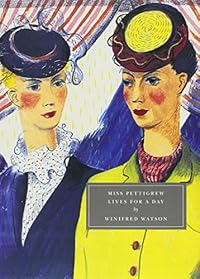
Miss Pettigrew Lives for a Day by Winifred Watson

Miss Petigrew Lives for a Day cover

This is the first Persephone book that I’ve read and it was the perfect choice after reading Dracula. I wanted something completely different and light-hearted and this just fitted the bill.

The story takes place over one very eventful day in which Miss Pettigrew, a 40 year old spinster who has very little experience of the world, has had to eke out a meagre existence working as a governess to ghastly children whose parents are even worse.

Finding herself unemployed again Miss Pettigrew is sent by the employment agency to Miss LaFosse’s flat as she is apparently looking for a nursery governess.

Miss Pettigrew is bowled over by Miss LaFosse’s beauty and quickly becomes involved in the exciting life of the night club singer who is juggling men, and considering this book was written in 1938, is so ‘fast’ that if she were a car she would be a Grand Prix winner.

Anyway, if you want a jolly good uplifting read this one is definitely worth reading, you’ll find yourself smiling your way through it.