Henry VIII: The Heart and the Crown by Alison Weir

Henry VIII:  The Heart and the Crown cover

There have been plenty of books, fiction and non-fiction about the wives of Henry VIII, but in Henry VIII: The Heart and the Crown the author Alison Weir has chosen to write from the perspective of King Henry himself. He’s usually portrayed as a monster, certainly a nightmare of a husband, but he didn’t have his troubles to seek. The first thing any monarch wants is ‘an heir and a spare’ and in the Tudor court girls just didn’t count. There’s no doubt that the pressure to keep the Tudor dynasty going weighed heavily on Henry for his entire adult life, as can be seen in this book. I lost count of the number of miscarriages that his wives (and he) suffered, but I think it was at least 15 deadly sorrows and disappointments – lost futures – all of them. No wonder he thought that his god was against him.

I really enjoyed this book which I have no doubt was well-researched. If you’ve already read some of the many books about Henry’s court then you would have realised how much he allowed himself to be manipulated by the various factions within his court, despite having apparently been warned about that likelihood by his own father before he died. No doubt Henry was happy to agree with his dukes if the end result suited him, then he could blame them for the outcome, such as the execution of Cromwell, and other people he had regarded as friends. That helped salve his conscience.

This was a time of huge changes within England which tend to be ascribed to Henry’s need to get rid of his first wife Katherine, however I suspect that all those religious changes would have taken place anyway, but maybe just a bit later. Henry needed the vast amount of money that the Roman Catholic church generated (through selling indulgences and such) and sent to Rome, instead of it being kept within England. The Roman church at that time was mired in chaos and scandals and with Martin Luther doing his thing in Europe, there was change in the air.

As ever though what strikes me most is what a tiny fish pond that Tudor court was, with just a handful of families who were all related to each other being at the top of the pile. It might help explain all those miscarriages!

I’m grateful to the publisher for giving me the chance to read and review this book in digital form via Netgalley.

I’m a bit previous with this review as the book isn’t due out until May the 9th, 2023.

The Corner That Held Them by Sylvia Townsend Warner

The Corner That Held Them by Sylvia Townsend Warner was first published in 1948. I read a 2012 reprint which has an introduction by Philip Hensher. I borrowed it from a library.

The setting is a 14th century Benedictine convent at Oby in rural Norfolk. It had been founded two centuries earlier by an abusive husband in memory of his dead wife who had despised him and been unfaithful, so not the usual pious act of remembrance. To begin with the community had done well and had been a comfortable destination for young women who had either taken the decision to dodge the difficulties that women typically had in those days, or had been sent there by their parents. In more recent times though nothing had gone well. The head nun has an ongoing vanity project to build a tall steeple which would be seen for miles around in the flat countryside of Norfolk, it’s eating up any spare money.

Things are even worse for Ralph Kello though as he has no money as he has drunk it all. He had been brought up in a convent as his mother had been a nun, so he has been taught Latin and knows how to conduct a mass, so when he pitches up at the convent feeling very sorry for himself and meaning to beg for food the nuns assume that he is a new priest, something they’re desperate for. As he’s illegitimate Ralph could never have been a real priest, but he can pass for one and despite knowing that he’ll be damned to hell for his behaviour he becomes part of the community.

I can’t say that I found this to be a gripping read, it’s a bit of a long meander, just an account of life in a 14th century convent but it is almost certainly a very true account, with nobody being particularly religious or worried about the amount of sins they commit. In fact I’m pretty sure that among all of the characters all ten of the commandments are broken! I’m wondering if this was deliberate, nobody else seems to have mentioned it.

I had to laugh though when I read this bit:

For all men are alike; if one asks a direct question they reply with a treatise. Edmund Gurney the mason had been just the same, wrapping himself in long discourses about the natures of different kinds of stone. That is how men are made, and that is what they expect women to put up with.

Mansplaining. – However I think that the author could have gone further and had the men explaining how the washing or embroidery should have been done!

The introduction by Philip Hensher is interesting, he points out that the seven novels written by Sylvia Townsend Warner are all very different, so you never know what you’re going to get from them, but I feel that she really enjoyed writing this one, which is probably why it’s so long at 399 pages (it seemed longer). She even managed to get in a bit about medieval choral music, something which she was interested in. However I didn’t really like any of the many characters, and that’s always a problem for me.

The Mirror and the Light by Hilary Mantel

The Mirror and the Light cover

The Mirror and the Light by Hilary Mantel is the last book in her Thomas Cromwell trilogy which was published in 2020 and this was a re-read for me as I had been waiting impatiently for years for its publication, unusually for me I bought it as soon as it hit the bookshops. At 882 pages it’s a tome and a half. I think that Mantel said that she was putting off the inevitable execution of Thomas Cromwell as she had become so close to him.

However there’s a lot to fit in from 1536 to 1540 – three of Henry VIII’s marriages, one annulment, unrest within the population due to many of them not wanting to give up their Roman Catholic saints and holidays, and wanting to cling on to the comfort of their beliefs, things get violent. I think that the book should probably have been edited to slim it down a bit, but that was never going to happen. Although I enjoyed this book I don’t think I loved it as much as I did at my first read of it, but that’s possibly because I had been anticipating it for years. You can read my original and more detailed blogpost here.

There is a mistake of sorts on page 561 when it’s written that Madame de Longueville (Mary of Guise, the mother of Mary, Queen of Scots) has landed at the town of Fife. In fact Fife is a county and it was the village of Crail in Fife that she sailed to after her proxy marriage to the Scottish king James V.

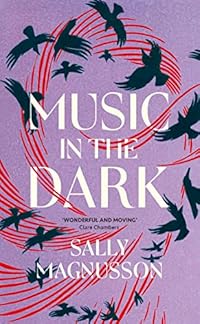
Music in the Dark by Sally Magnusson

Music in the Dark by Sally Magnusson begins in 1884, Rutherglen which is close to Glasgow. Jamesina Ross moved to Rutherglen from the city after all but one of her children had died because of the poor living conditions in Glasgow, her doctor had said it was the only hope for her last child. Jamesina had had dreams of a very different future for herself as she had had a classical education, but it wasn’t to be.

This book is about the Highland Clearances, particularly at Strathcarron in 1854 when the inhabitants were brutally forced out of their homes which were then set alight and pulled down so that there was no shelter at all. Jamesina was one of the women caught up in it and the beating she took from the police has affected her whole life, now as she gets older it’s more obvious that her brain has been impaired. She was left with a dent in her head and a mashed up jaw from a police baton.

I must admit that I found the first half of this book to be rather slow, but the second half was more interesting as Jamesina and her second husband, also a Strathcarron survivor travel back to the scene of the attack.

Music in the Dark is obviously very personal to the author as it’s based on the clearance experiences of her great-grandmother. I had to laugh when she wrote. – There was hardly a man’s name in the Highlands that someone had not had the bright idea of burdening a baby girl with by adding an – ina.

When I worked in libraries in the west of Scotland I obviously knew the names of the readers, there were women called Jamesina, Hughina, Andrewina and Donaldina and of course Williamina. I thought it was just a very local thing – but apparently not.

In the 17 and 1800s landowners in Scotland decided that they could make much more money from the land by filling the place with sheep. It meant that the crofters had to be removed, sometimes they were rounded up and put onto ships bound for America or the colonies, they didn’t have any say in the matter. Others made their way to Glasgow looking for work, presumably that’s how my own ancestors came to be in Glasgow. Going by the letters written home from the colonies, the Glaswegian Highlanders were the lucky ones.

I didn’t enjoy this book as much as the author’s previous ones. This book will be published in May 2023.

I was sent a digital copy of this book by the publisher John Murray Press via Netgalley for review. Thank you.

Bring Up the Bodies by Hilary Mantel

Bring Up the Bodies by Hilary Mantel was a re-read for me, I originally read it back in 2012, you can read my thoughts on it then here.

I enjoyed the book just as much this time around. Again I was amazed at the behaviour of Anne Boleyn, not that I think she was guilty as charged, but that she was so sure of herself where Henry was concerned and had arguments with him, and threw tantrums. I read the love letters between the two of them, which you can read on Project Gutenberg here. Considering that she strung him along for seven years it’s no wonder Henry was more than a wee bit disgruntled.

I don’t think I noticed at my first reading of it that there were a few mentions of Cromwell’s father Walter going out of his way to help his son out of difficulties, but he had kept it secret from Cromwell, so he didn’t discover his father’s kindness to him until he was an adult and well on his way in his career. Cromwell had hated his father, with good reason as he was abusive and brutal, especially when drunk. But Cromwell’s harsh upbringing helped form the man he became.

I couldn’t help thinking about the Johnny Cash song – A Boy Named Sue.

Another thing that struck me was the number of men called Thomas who were around the Tudor court of that time. It’s not a very common name nowadays, Thomas seems to have been like the ‘John’ of the early 20th century. There are almost no Johns nowadays, but plenty of Jacks.

So why were so many men named Thomas in Tudor times? I can only think that they might have been named after Thomas Beckett. As biblical names go Thomas isn’t a great one to choose as the Thomas in that was ‘doubting.’ It’s a mystery to me, do any of you have any thoughts on the matter? For some reason names have always interested me.

If you’re interested you can read Jack’s thoughts on Bring Up the Bodies here. I’m now reading The Mirror and the Light.

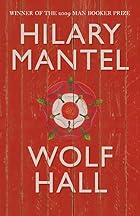
Wolf Hall by Hilary Mantel – a re-read

I decided to read Hilary Mantel’s Wolf Hall again, I rarely re-read books but in my mind this is a book that I remembered loving, imagine my surprise when I looked back on my 2012 thoughts on it and discovered I wasn’t that enthralled with it. You can see what I thought of Wolf Hall here. I suspect that when I watched the TV series with all the sumptuous costumes, settings and good acting I was enamoured.

Anyway, this time around I did really enjoy it. As it happens I discovered that late at night on TV Wolf Hall was being shown again, so I ended up watching it at the same time I was reading the book and realised that all of the dialogue is exactly as it was in the book.

Wolf Hall begins in 1500 and ends in 1535, but does slip back to the 1520s for a few chapters early on. It was definitely interesting times. I very much doubt that a neglected and abused child in the 20th or 21st century could have risen to the heights that Thomas Cromwell did, which is quite depressing really. Cromwell was definitely a flawed human being (which of us isn’t?!) but especially within his family and personal life, he comes across as being a good guy with really likeable traits.

You can read Jack’s thoughts on the book here.

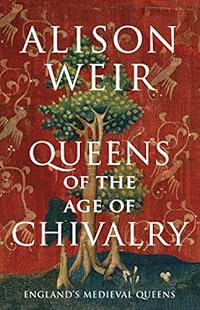
Queens of the Age of Chivalry by Alison Weir

Queens of the Age of Chivalry by Alison Weir is subtitled England’s Medieval Queens and it tells the stories of the lives of the five queen consorts in England in the 14th century, the Plantagenet period from 1299 to 1399, but inevitably it’s a lot more than that as while writing of the experiences of the women and their husbands, the history of their era and how it affected them also has to be written about.

The five Queens are: Marguerite of France (Edward I’s second wife), Isabella of France (Edward II’s wife), Philippa of Hainault (Edward III’s wife), Anne of Bohemia (Richard II’s wife), Isabella of Valois (Richard II’s second wife).

These Planatgenet wives were far from being shrinking violets, it was quiet an eye-opener how much power and influence they could have. Reading this book you learn an awful lot about English history but also the history of Scotland and the various European countries that become embroiled in English history. It’s a painless and entertaining way of learning. I’m constantly amazed by how many documents and personal letters are still in existence from so far back in history. What a thrill it must be to be able to see and possibly even touch them.

This was a really enjoyable and interesting read. I received a digital copy for review from the publisher via Netgalley, for which many thanks.

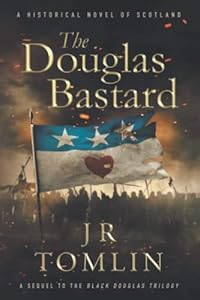
The Douglas Bastard by J.R. Tomlin

The Douglas Bastard by J.R. Tomlin is part of a series of historical fiction, none of which I had read, but that didn’t stop me from enjoying this book.

The story begins in 1338 and young Archibald Douglas’s mother has just died of the flux and his father Sir James Douglas is already dead. Archie is only nine years old but his friend King David is fifteen. Both of them are exiled in France and when David says that Archie will need a foster father Archie isn’t keen, but he’s quickly settled as a page in the royal household to be taught everything someone of his status should know – eventually. As Archie is illegitimate he’s lucky to be in such a position. Archie dreams of getting back to Scotland to fight the English and with the help of his father’s relatives who recognise him as Sir James’s son he manages to do that.

This is a good adventure tale and although there are a lot of gory battle scenes which I generally don’t like I still enjoyed it enough to wish I had read the previous three books in the series although this can be read as a standalone book. It was good to be reading about Scottish history which doesn’t revolve around Jacobites which is the era that most fiction authors tend to focus on.

The author seems to have done lots of research, and there’s a glossary at the back for those that might not understand mediaeval or Scots words.

Thank you to Albannach Publishing who sent me a digital copy of the book for review via Netgalley.

The Secret Diaries of Charles Ignatius Sancho by Paterson Joseph

Charles Ignatius Sancho was an actual person and the actor Paterson Joseph chose to write about him in his first foray into novel writing. It’s quite an enjoyable read although I found the mid section which is epistolary to be less than gripping although necessary I suppose.

Sancho was born into slavery on a slave ship and this book is in part made from his diary entries which he’s relating to his surviving son William.

Sancho arrives in London at the age of three and is sent to live in a household of three maiden sisters, treated as a cute toy to dress up really. But as he grew the sisters were against him being educated and he had to secretly teach himself to read. Walking around London was dangerous but more so for a black boy and Sill an evil slave catcher seemed always to be on the lookout for him. A narrow escape from Sill led to Sancho making a very useful friend and ally, the second Duke of Montagu, who taught him to read and encouraged his interest in literature and music. Sancho became the first black man in Britain to have the vote and he composed music. but his life had ups and downs – as they do.

This is well written and I enjoyed it. I had never heard of Charles Ignatius Sancho before so when I began reading this book I didn’t realise that he wasn’t fictional, however I do know of a descendant of one of the other characters who lived close to where I used to live, so when his ancestor was mentioned I realised that the author had done his research.

I’ve seen Paterson Joseph act in a few things now and he’s a talented actor too.

My thanks to the publisher who gave me the opportunity to read this book via NetGalley.

Shrines of Gaiety by Kate Atkinson

Shrines of Gaiety by Kate Atkinson is set in 1926 London and it begins with a large crowd gathering outside Holloway prison which (Ma) Nellie Coker is just about to be released from. She’s something of a celebrity, the matriarch of a large family business as she owns a string of nightclubs, all catering for different types of clientele. Her six adult children have arrived in their two Bentleys to whisk her away, but not before the press photographers have snapped their mother.

Chief Inspector John Frobisher of Scotland Yard is also among the crowd. He has been sent to Bow Street Station to shake them up, it’s thought that there’s a lot of corruption in that police station. He’s not the usual type of police inspector, he’s keen on books and might take to writing himself.

It looks like Nellie hasn’t fared well in prison, it’s the first time she had ever been there and she’s no spring chicken. Some gangsters intended to take advantage of the situation and move in on her business. There’s also a corrupt policeman making a nuisance of himself and some of Nellie’s children are less than supportive.

I loved this one which I think has an authentic atmosphere of the post WW1 society with the Bright Young Things and their excesses, including drugs, but there’s also a more domestic thread with some runaway girls being sought by Frobisher and his undercover temporary sidekick.

In general I really love Atkinson’s writing – except for When Will There Be Good News? which was far too depressing for me.

My thanks to the publisher Random House UK and NetGalley who sent me a digital copy of the book for review.

Shrines of Gaiety is due to be published on the 27th of September 2022.