
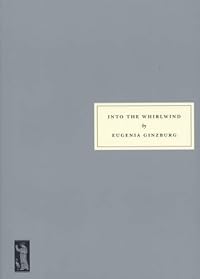
One day a couple of weeks ago I entered the word Persephone into Fife libraries’ catalogue and it seems they only have a handful of Persephone publications. I had already read most of them, so I decided to request Into the Whirlwind by Eugenia Ginzburg. I must admit I had never even heard of the author, but the book is her autobiography, telling of her horrendous experiences when she was a victim of one of Stalin’s purges in the early 1930s.
As a member of the Communist Party and a writer and university teacher she had led a comfortable life, especially as she was married to a Party official. Holidays in luxury Communist Party hotels had been normal for them although they weren’t quite as well off as some others. They only had a Ford car whereas the wealthier officials had Buicks and Lincolns. That information in itself proves that real Communism has never been tried, when you consider how abject was the poverty that most ordinary Soviet citizens suffered.
Ginzburg may have been an intellectual but she lacked street-wise commonsense, and when questions began to be asked about a work colleague Ginzburg assumed that as she hadn’t done anything wrong then she couldn’t be in any trouble. Her old mother-in-law knew differently though, she had the experience of living through Tsarist reigns of terror and understood that things were much the same with Joseph Stalin in power. Ginzburg’s mother-in-law advised her to disappear to the country until things cooled down and the authorities got tired of looking for her, a ploy that apparently did work for many, but Ginzburg knew better and the result was she was eventually sentenced to ten years in prison for terrorism. She actually ended up serving a sentence of eighteen years.
This was the beginning of Stalin’s purges of the Communist Party. He was getting rid of anybody he thought might be a rival to him and the prisons and camps were jam packed with innocent people – Communists, religious people, foreigners including ballet dancers and film stars.
Obviously this isn’t a comfy read, but it is fascinating and it makes you wonder how people could survive such terrible treatment, starvation and punishment cells, being constantly freezing and frostbitten in winter and sweltering in summer and having to do heavy work like tree felling in 60 degrees of frost, wearing just rags. It’s hard to feel that those people were the lucky ones but millions were shot immediately and I’m sure a lot of prisoners must have wished that they had been too.
There is an afterword by Rodric Braithwaite, he was the British Ambassador to the Soviet Union in the 1960s and 80s, and in it he explains that Eugenia Ginzburg actually had more favourable treatment than most prisoners as she had been in the Communist party and was seen as being a member of ‘the intelligentsia’.
These purges started in 1934 and the really depressing thing is that they continued until Stalin’s death in 1953. It’s just as well that those incarcerated in 1934 didn’t know that, many of them lived in hope of their god Stalin coming to their rescue, never being able to believe that it was Stalin who was at the back of their misfortune. After Stalin’s death Nikita Khrushchev set about releasing political prisoners and ‘rehabilitating’ the reputations of those who had been vilified by Stalin.
This book is an account of Ginzburg’s first three years of imprisonment and I think she wrote another book years after that, I’ll have to see if I can get a hold of that one.