
This book was first published in 1969 and at 667 pages the sheer thickness of it could be a wee bit off putting to anyone with lots of books in the ‘to be read pile’. However, if you are at all interested in Mary Stuart then this is a must read for you.
You can easily tell that Antonia Fraser has a real passion for Mary and she obviously did a fantastic amount of research on her subject, which I suspect was a real treat for her.
Mary Stuart has always been a familiar tragic figure to me. My favourite doll as a teeny wee girl was that well known one of her dressed in a black velvet gown with a lace cloak. When I was told of her sorry tale and ghastly end – well, you couldn’t not love the idea of her.
So it was inevitable that I was going to read this book sometime.The book won the James Tait Memorial Prize and although it was written so long ago, it has never been bettered.
Although the book is packed with historical detail, it never becomes dry or boring as Antonia Fraser has a wonderful free-flowing way with words. Despite the fact that she is so keen on her subject, it hasn’t blinded her to the fact that Mary was very far from being perfect. It’s a real pity that she didn’t take a leaf out of her cousin Elizabeth’s book and steer clear of marriage altogether.
It seems that wherever you live in Scotland, you will be close to a castle or palace with links to Mary Stuart.
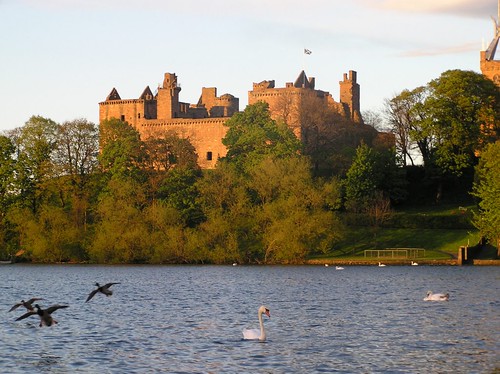
She was born in Linlithgow Palace in 1542. The palace is just a shell now as it caught fire in 1746, but it must have been wonderful in its day.
Her first marriage to the dauphin ended when he died of complications from an ear infection a month before his 17th birthday. So at the age of 18, Mary sailed for Scotland after 13 years in France.
Considering that she was a Roman Catholic queen in a Presbyterian country, things went rather well for her. She was greeted by enthusiastic crowds and she didn’t disappoint them.
Her choice of husbands left a lot to be desired and brought nothing but trouble for her.
She gave birth to her only child James VI in Edinburgh Castle.

She spent a large part of her life being held captive in various
castles, and managed to escape from a few of them. Lochleven Castle being the most famous escape.

She loved to spend time at Falkland Palace in Fife, where she could ride and fly her falcons. This palace is well worth a visit, there is plenty to see, it has lovely gardens and the village of Falkland itself is worth a walk round. For those who are a bit more energetic, take time to walk up the East and West Lomonds, to get a great view.
