Cragside, Northumberland

On our way back up to Scotland, after our short break in Yorkshire a few weeks ago, we stopped off at Cragside in Northumberland, another National Trust property. It was the first house in the world to be lit by hydroelectricity. Thanks again to Margaret @ Booksplease for pointing us in its direction. We were lucky with the weather, although it had been raining most of the week which meant it was a bit muddy underfoot in the gardens. We got a great day for viewing it all, it’s a very popular destination so it was fairly crowded in parts but most people stayed close to the house. I think it’s best described as quirky, I’m glad I don’t have to worry about all those roof angles but the inside is full of Arts and Crafts details.
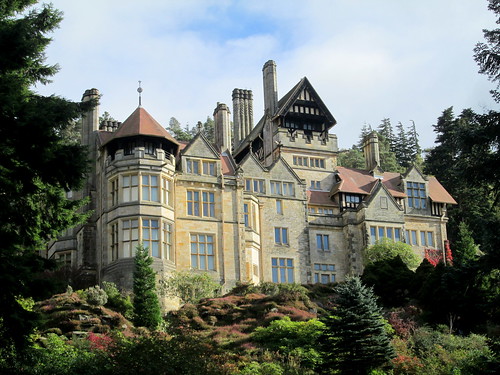
Cragside house from gardens

It’s a very homely place though, despite being huge, as it’s Victorian, the furniture isn’t too precious, lots of us own bits and pieces of Victorian furniture and knick knacks, so most of it doesn’t seem grand, especially the bedrooms. I’d love to own a patchwork quilt like this though.
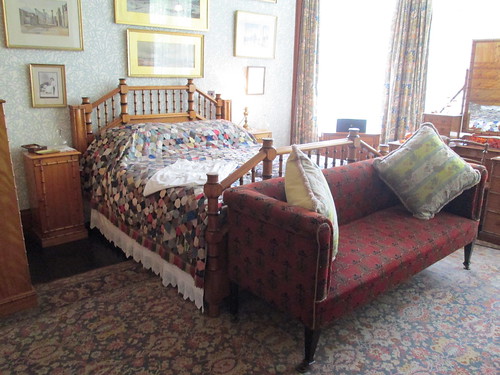
A bedroom in Cragside.

I love this quilt too, as you can see, this room has William Morris wallpaper, one of his brighter designs, they can be a bit dark sometimes. I have absolutely no idea what the boxes on the floor at the bottom of the bed are, I don’t even recall seeing them!
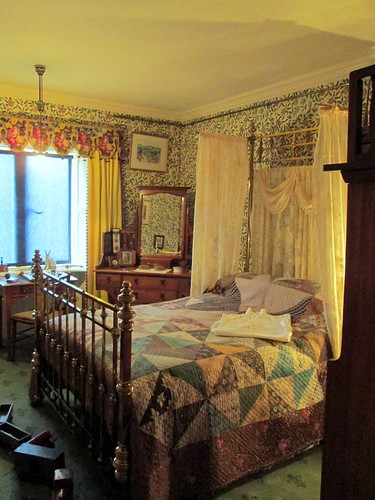
Cragside interior bedroom 1

I took lots of photos of the interior as it was such a nice change to be able to, for some reason the National Trust for Scotland still don’t allow photos inside. So I’ll probably show more of Cragside again soon, it’s a real delight for anyone interested in Arts and Crafts design.

Duddo Stone Circle, Northumberland

I had never heard of Duddo until Margaret@BooksPlease blogged about it recently, do have a look at her very interesting post, her photos are better than mine too, here. I’m still getting used to the new camera, well that’s my excuse anyway!
Thanks Margaret, we would never have found the Duddo Stone Circle on our own, it’s fairly off the beaten track.

Duddo information board

Lorraine was asking how long it took for us to get to York from Scotland and I have to say that I’m not exactly sure, somewhere between 3 and 4 hours I think, because we stopped off at Duddo on the way there. The sign on the gate which you go through to get to Duddo says that it’s about an hour long walk there and back – and it was for us anyway. It’s an easy walk if you’re fairly fit, along the edges of fields of crops which had recently germinated, and we had a lovely day for it.

Duddo from a distance 1

Although Duddo is in Northumberland and so is now definitely part of England, I think of it as historically Scottish as it’s north of Hadrian’s Wall. It was obviously a very important place for Neolithic/Bronze Age inhabitants. The whole thing is a bit of a mystery but they do know that it dates from about 2,000 BC. Cremated human remains were found in the centre of the stone circle, it might have been a place of worship and burial or for sacrifices, or both.

Duddo from distance 3
It’s an impressive spot today, just imagine what it must have been like all those years ago.

Duddo standing stone 1

It’s thought that these massive grooves have been worn into the stone by the weather over the centuries, they look spookily like they’re man-made though.

aOne of the Duddo standing stonesstone 3

This one is actually the smallest stone but it’s still about 5 feet in height, as you can see there are lovely hills in the background. We were lucky in that there were no other sight-seers there and we had the place all to ourselves, which made it all the more magical for me. I count myself as being a fairly hard and cynical person but I definitely felt that there was a special atmosphere at the stone circle and I walked around them touching them all.

Can’t you feel it? I said to Jack. That’s the Viking in you. They’re just stones – he replied.

That’s the scientist in you! – I said. Honestly there’s nae romance in that man of mine.

Duddo landscape

I think Duddo would be quite bleak in grey weather but it was very pleasant on a blue sky day. There was quite a lot of fighter jet activity, some of it too high up to see but you could certainly hear them and a couple of jets did pass over us, very low. It’s a very rural and sparsely populated part of Britain at Duddo, which makes it a good training airspace for them I suppose. It does seem a bit weird though when all that state of the art metal, costing millions of pounds flies over a Bronze Age structure.

Corbridge Roman Fort

We visited Corbridge in Northumberland during the summer holidays. The Roman remains there are quite extensive although it’s thought that there is still a lot to be found underneath the surrounding fields.

The town which I was brought up in is situated just to the north of the Antonine Wall which was the wall which marked the farthest point of the Roman Empire. They might have managed to get a bit further north but I don’t think there is any proof of that. I’ve always found it really funny that the Romans managed to conquer just about everyone else but the folks of the Dumbarton area were just too much for them to cope with.

So visiting this Roman ruin was a real novelty for us and there is quite a lot to see inside as well as outside. There is an interesting museum on the site which houses a lot of the artefacts which have been dug up from there. It’s well worth going to see if you’re in Northumberland.

Hadrian’s Wall is another great place (thing). It was built by the Romans to stop the Scottish savages from being able to attack the Romans. The first time I went there on a school trip with the Latin/Classical Studies department I couldn’t get over how big the wall is. The Romans must have been very scared of us. I’ve always fancied walking the whole length of it, the whole breadth of the border, but life has somehow got in the way, maybe one day!

Bondgate Tower, Alnwick

Bondgate Tower is a 15th century three storey tower in Alnwick and as you can see cars drive through it all the time to get to the main street. If you are in Northumberland and you are interested in history, then you will enjoy visiting the small town of Alnwick with its Castle.

The town hasn’t been pickled in aspic though. You can point your camera in one direction to snap the tower gateway, then turn on the spot and take a photograph of the Art Deco Playhouse. If you’re interested in that then take a look at it at A Son of the Rock.