
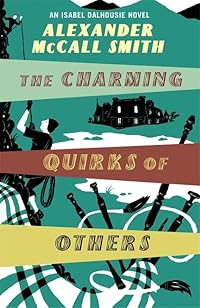
This is the latest in the Isabel Dalhousie series and although I have to say that I don’t like this series nearly as much as the Scotland Street books, it’s still worth reading, especially if you like anything set in Scotland. Apparently a lot of people do because McCall Smith books have been translated into 45 different languages. I doubt if I could name 45 languages.
Anyway, the book suffers from quite a lot of info dumping early on, for people who don’t know much about Scottish history presumably. Isabel now owns the Review of Applied Ethics, as well as being the editor and the book is liberally dotted with ethics with Isabel wondering what she would do in particular situations, and that can come across as being a bit ‘holier than thou’.
Isabel has been approached by the wife of a trustee of one of the posh schools in Edinburgh. The school is interviewing for a new headmaster and they have got it down to a short leet (list) of three. A poison pen letter has been sent claiming that one of the applicants is unfit for the position, but doesn’t elaborate. Isabel is asked to look into the backgrounds of the interviewees.
The blurb says: Level-headed, sharp-eyed and judicious, Isabel Dalhousie picks her way through her latest set of moral challenges with unfailling intelligence and proves herself yet again to be one of Alexander McCall Smith’s most lovable and enduring creations.
I can’t say that I agree with that because I find her annoying and therefore not very likeable. Plus Isabel has upset her niece by taking up with her one time boyfriend. Most women wouldn’t ever do that so the morality is only there when it suits her, not that I’m being judgemental or anything! This series lacks the humour of the Scotland Street series but there’s no doubt that other people enjoy them a lot.
McCall Smith also mentions in passing that cricket is hardly played in Scotland and when it is it is because of English influence. That is a piece of nonsense because cricket is played all over Fife and the West of Scotland. The author of Peter Pan was a huge cricket fan and he had played it in his youth in Kirriemuir where he built a lovely wee pavilion for the town. Fellow Scots Arthur Conan Doyle and A.A. Milne also played in his cricket team called the Allahakbarries. Perhaps McCall Smith should read the book Peter Pan and Cricket by David Rayvern Allen which would enlighten him on the subject.
As I got towards the end of the book it struck me that this is the sort of thing which could have been serialised in The People’s Friend, that ‘couthie’ magazine beloved by old ladies in tweed skirts.
At 245 pages it is a very quick and light read.