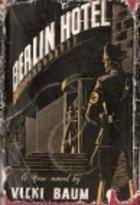
Berlin Hotel by Vicki Baum

Berlin Hotel cover

This is the first book by Vicki Baum which I’ve read although I’ve known about her for years. Hotel Berlin, which is sometimes called Hotel Berlin ’43 was published in 1944.

The setting is obviously Berlin and Berlin Hotel is home to General Arnim von Dahnwitz a war hero and career soldier of the old school who has attracted the wrath of his Fuhrer. The general’s lady friend is a beautiful and famous Berlin stage actress called Lisa Dorn. She has had an easy war as her fame means that the shortages and discomforts of war haven’t touched her. She’s so wrapped up in her life and career that she is completely clueless as to what’s going on around her. Slogans are being chalked up all over the city: “You can kill Richter – but you can’t kill his spirit!”

Gestapo men are all over the hotel, hiding behind newspapers and spying on everyone. The hotel has been searched from top to bottom, in fact the whole of Berlin is being searched for Martin Richter who is a young student who was about to be executed along with other student political activists. They had printed some anti-Nazi pamphlets and had been sentenced to death by beheading, Martin has managed to throw himself off the lorry which he was being transported in and has so far evaded recapture.

This is a tense read, in fact I thought it would have made a great wartime film and really expected to discover that it had been made into one, but apparently not.

According to the storyline things were beginning to fall apart in Berlin as early as 1943 and Hitler was already getting rid of his army generals, blaming them for failures in the war’s progress. If so then the following two years must have been nightmarish.

Peace Breaks Out by Angela Thirkell

This book was first published in 1946 and as you would expect from the title it’s 1945 and the war in Europe is just about to come to an end. You would think that it would be a time of celebrations and relief but in truth the people are all a bit unnerved by this new situation as they’ve become used to war and all pulling together and having one common enemy. Everyone is worried about the future and how things are going to change.

I really enjoyed this one though and all the young people are getting nicely paired off with each other. Even David Leslie, the charismatic but ‘bone-selfish’ favourite of Miss Bunting is being ‘managed’ by one of his many old flames. It’s mainly light-hearted and humorous but it has the odd passage in it which I’m sure had a lot of readers of that time shouting ‘hear hear’ when they read them. Like:

A very horrid rumour of more peace was floating about in Barchester and indeed about all England for a few days before Anne’s visit, filling everyone with deep misgivings about trains and more especially about the grocer and bread. Public opinion was divided, some saying They would certainly have peace on a Tuesday so that one could get the rations done on Monday, others saying that they knew for certain that the King had asked for peace to happen on Friday, so that everyone could have a long weekend. Yet others, and these a very large class including all the housewives of England who had been working for sixteen or seventeen hours a day ever since the war began, looking after children and aged relatives, standing in queues, walking a mile to the bus and taking an hour to get to the nearest town only to find that the whelk oil or chuckerberry juice or whatever it was they were told their children must have wasn’t in and it was two hours before the bus went back and anyway they had been given the wrong certificate, slaving at W.V.S. in their meagre spare time, suffering evacuees, taking in lodgers because their husband was getting only army pay now, cooking for everyone, firewatching, being wardens, being mostly too tired to eat, seeing Italian and German prisoners of war riding happily about the country in motor lorries while they pounded along on bicycles against wind and rain or lugged heavy baskets on foot, seeing mountains of coal and coke at the prisoner of war camps while they were down to two hot baths a week and very little soap for the washing and the laundry only coming irregularly every three weeks, seeing Mixo-Lydian and other refugees throwing whole loaves into the pig bin and getting the best cuts at the butcher’s, keeping their children nicely dressed while they got shabbier themselves every day, too driven to consider their looks, unable to have their houses properly repaired, having to be servile to tradesmen and in many cases to tip them in money or kind, seeing one egg in eight weeks with luck, in a state of permanent tiredness varied by waves of complete exhaustion, yet never letting down anyone dependent on them; this great, valiant, unrecognised class, the stay of domestic England, all knew that THEY would burst peace on them whenever it was most inconvenient and went about their shopping listlessly, waiting for the tiger to spring.

Whew – that’s what I call a rant, and it’s just as well that the people then didn’t know that things were going to get even worse, and rationing was going to carry on right into the 1950s because Britain was having to send food to Europe, when they didn’t even have enough for their own population. Then of course there was the debt of more than one variety which was owed to the U.S. The monetary one was only paid off a couple of years ago!

Anyway, if you ever see an Angela Thirkell book, and you enjoy books which are set in the 1930s and 40s, do yourself a favour and snap it up.

Miss Bunting by Angela Thirkell

I got this one from Ebay and it’s an original from 1946, I think this is one of the easier Thirkells to get a hold of.

As you would expect it reflects the times it was written in and the characters are all involved with war work and coping with rationing, coupons and black out material.

Miss Bunting, the governess who has been part of the household in many of the better establishments of the county, is helping out with Lady Fielding’s daughter Anne who is deemed to be to delicate to go to the now over-crowded local school.

Although the book is titled Miss Bunting, a large part of it is about the nouveau riche and boorish Sam Adams and his daughter Heather and how they fit into the area.

This is the third Angela Thirkell book which I’ve read and I thoroughly enjoyed it, but this one is by far the one which has most references to things that I think a lot of people nowadays might have difficulty with. There’s quite a lot about politics in it with the then chancellor of the exchequer coming in for abuse, amongst others. The government is always called ‘They’ and it’s as if they have taken over from the Nazis as the big enemy to be dealt with. This must be because the government elected immediately after the war was Labour and the upper classes would have been dead against them.

In fact, there are people who are hankering after the good old days of the war and looking back to the time when the local aristocracy could become a member of parliament for the price of some cakes and ale! But throughout it all Miss Bunting has a recurring nightmare that all of her former pupils are being killed in the war, so many of them already have been, so there are dark moments as well as light-heartedness.

Angela Thirkell used some of the descendants of main characters from Anthony Trollope’s Barsetshire and Palliser books in her books, in some of them they are barely mentioned but the 1940s Duke of Omnium and various others crop up quite a bit in Miss Bunting. There’s still plenty of humour in the shape of Gradka, a Mixo-Lydian refugee who runs Hallbury, Fieldings’ home. One ‘joke’ which runs most of the way through the book depends on people mistaking the Italian word ‘loggia’ for the English word ‘lodger’ and I nearly didn’t get that because you have to read it with an English accent!

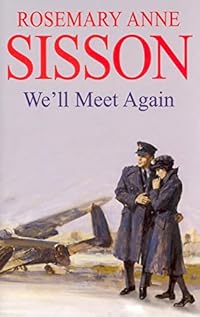
We’ll Meet Again by Rosemary Anne Sisson

School for Love cover</div

As you would expect from the title this book is set during World War II and it's a romance. Not really my cup of tea but I couldn't stop myself from taking it out of the library when I saw it there. Way back in 1977 I gave my mother-in-law a copy of Rosemary Anne Sisson‘s book Will in Love to read. The ‘Will’ is William Shakespeare and it’s the story of his romance with Anne Hathaway. My mother-in-law loved the book, and she wanted more by the same author. Unfortunately at that time Sisson was writing things for TV such as Upstairs Downstairs and The Duchess of Duke Street, and no more novels were forthcoming for some years. That was of course MY FAULT, m-i-l seemed to think that I was keeping non existent books away from her! Such is life.

The good thing about Sisson is that there is no naughtiness, as my mother-in-law was a daughter of the rectory she couldn’t be doing with racy novels, which is such a shame really because they might have improved her.

She would have adored We’ll Meet Again. It begins in 1944 and Anne and Tom are stationed at an RAF base near London. Inevitably they fall in love but as Anne is a very strait-laced vicar’s daughter and Tom is a married man, it’s all very chaste.

When Tom is moved to another base they know that they won’t be seeing each other again and they decide not to keep in contact. After the war they get on with their lives as best they can but nine years later Tom’s circumstances change and he decides to try to find Anne again.

Apparently the book is based on a true story which was told to Sisson by her sister. I did find this a bit schmaltzy, especially at the beginning but I’m not a big fan of romance. It’s a ‘safe’ book to recommend to those of a delicate disposition. Mind you, people like that are usually as hard as nails – underneath it all!