
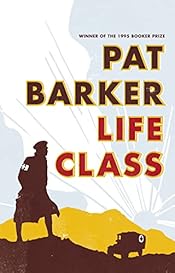
 Life Class was published in 2007. It is set in the spring of 1914 and the characters are art students at the Slade School of Art in London.
Paul Tarrant has been left a small legacy by his grandmother and he is using the money to finance his art studies, although things aren’t going well for him and he is thinking about leaving the college before his first year is up. He doesn’t think he is progressing with his art and seems to feel that he doesn’t fit in with the rest of the students because of his northern background. He forms a relationship with Teresa, an artist’s model and fellow northerner.
I felt that this part of the book was the least successful bit, and it annoyed me that Barker couldn’t make up her mind whether the character of Elinor had cropped hair, bell shaped hair or it could be tied back with a ribbon.
At the outbreak of war, Paul and Kit, an ex Slade student and up and coming artist, decide to do their bit, hoping to be ambulance drivers in Ypres but starting out as hospital orderlies, although both continue to paint. I think this is the most interesting part of the book. It seems that Barker is most comfortable with the subject of the war.
However, she still made annoying small mistakes. For instance, whilst Paul is back in London and recovering from a leg wound which has left him with a stiff knee, he meets up with Elinor. When they reach her rooms, she asks him to light the fire, which he does and then sits back on his heels. Now I don’t know how it is possible to sit on your heels without bending both of your knees. But a couple of paragraphs later he is saying that he can’t bend his knee.
I know it’s nit-picking and probably nobody else bothers about that sort of thing.
Anyway, apart from that I did quite enjoy the book although it isn’t one which I would read again. If you like books which are set in The Great War you will probably enjoy this one.
I’m impressed with your close reading of the text–these nits completely escaped me, I’m afraid!
I felt a bit cheated as a reader that she didn’t quite follow through on the triangle she initially set up. And I would really have liked to know more about Tonks. I agree that she’s strongest when it comes to writing about war.
I know what you mean, the storyline just seemed to drift away in parts, like she got fed up with it. I agree about Tonks, but on the other hand it annoyed me the way she name-dropped Augustus John from time to time, so he was around at that time but didn’t really add anything to the story. Nit-picking again, I wish I could write a quarter as well as Barker!