
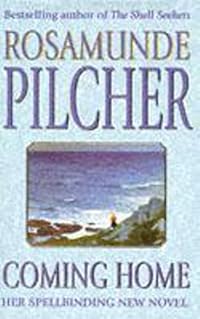
It’s week 2 of the year so this is the second book which I’ve read from Katrina’s 2011 Reading List. It’s quite a chunkster at 785 pages and I was a bit worried that I wouldn’t get through it within the week but the dreich, freezing fog of yesterday meant that I spent a lot of the day reading, much longer than I had meant to actually.
Rosamunde Pilcher has set this book in her native Cornwall, although she has lived in Scotland for most of her life, since marrying a Scottish soldier at the end of World War II.
Anyway, I did enjoy this book, although I think that her book September is still my favourite one so far. Coming Home has such a lot going for it though. Ever since reading Rebecca in the year dot I’ve had a soft spot for books set in Cornwall.There’s also a sort of crazy comfort zone about books set during World War II for people brought up on stories told by parents with first hand experience of that time. Beginning in 1935 it’s the story of 14 year old Judith who is being left behind at a new boarding school as her mother is returning to Colombo to be with her husband and takes Jess, Judith’s 4 year old sister with her.
Aunt Louise has been given the job of looking after Judith during any school holidays but things don’t go to plan and it’s the Carey-Lewis’s of Nancherrow who become Judith’s surrogate family and her whole future is wrapped up with them and the people that she meets through them.
There are lots of familiar themes as Britain is at war and Pilcher goes into great detail about the rationing and wartime life which if you are about my age you will already have heard about from your parents. But there were things in it which were so familiar, like the smiling Border collie which sounded exactly like the one that I had in my childhood, except that our Candy actually laughed, truly!
In another part a merchant ship has a refit in the Brooklyn refit yard, New York. The same thing happened to my dad when he was in the Merchant Navy in the Atlantic Convoys during the war and he spent a wonderful 6 months in peacetime New York, having a good rest from being torpedoed by the Nazis. Well, it was a refit in New York, maybe not that specific yard. We even have a Dunkirk survivor and a Japanese POW camp survivor in the family just as in the book.
What we didn’t have though is the lovely Cornish house, Nancherrow, which is such an important character in the book, just like Rebecca’s Manderlay – which is acknowledged. But houses and the land in general play a large part in the story, which I think is the mark of Celtic literature.
There is a well flagged up incident in a cinema of the ‘something nasty in the woodshed variety’ and having led a sheltered life I have had no such experience. I’d like to think that if some dirty old man tried to take liberties with me I would have had the wit to bat his hand away and stand up shouting a rat has landed on my knee with the usherette’s torch trained on the assaillant I think it would have been obvious what had happened. I like to think that anyway but maybe I would have been frozen too.
So, I would recommend this one as a good read. However, I do think that it was written with an eye on it being made into a film – which I think it was, but I haven’t seen it. There is too much detail in it with not a lot of space left for the reader’s imagination as there is a lot of what I would regard as stage direction with a character’s every movement described.
On a really personal note, I couldn’t help noticing that every time a character wept – there is quite a lot of weeping – it was swiftly followed by them ‘lustily’ blowing their nose, and often not into a hanky. Once it was a towel, a sheet, a shirt tail and even curtains were considered but rejected, thankfully. Possibly nobody else would notice this, but as I waited nearly 10 years after getting married before starting a family and one of the reasons that I put it off so long was the fact that I can’t stand snotty nosed children, you’ll realise that I prefer a snot free zone. Thankfully my kids rarely had that problem or I might have had to take them back to the shop!
A good read, especially if you enjoy long books.
This is a chunkster of a book, but it’s one I flew through as well! Glad you liked it. I really need to read September now!
Danielle,
September is set mainly in Scotland but I think you’ll really enjoy it. Winter Solstice is the one that I’m hoping to get my hands on soon.
“There’s also a sort of crazy comfort zone about books set during World War II for people brought up on stories told by parents with first hand experience of that time.” I do think this is part of the appeal of this book, and Rosamunde Pilcher’s work, for those of a certain generation. Thank you for putting it into words.
C,
I still feel WW2 settings to be strangely comforting, in fact there seems to be a bit of an industry going on in publishing at the moment with lots of books being written with home front settings. I’m not sure if they will have the same appeal though.
Thanks for dropping by and taking the time to comment.
Katrina
Yes, you’re right about that comforting element. The parallels with your family must resonate strongly. I’ve read and enjoyed some of the novels being published now with similar settings, but do feel there’s something special about those written by people who were there at the time. My mum was similar age to Rosamunde Pilcher; maybe it’s something about the language used, little phrases, that reminds us of the people of that generation in our own families. A favourite re-read, this one!
C,
My mum was born in the mid 1920s and just about every conversation with her ended up at the war. When I got to school I didn’t know any fairy tales at all, just stories about the war! It was a bit of a disadvantage for me I think.