Ann And Her Mother by O. Douglas

This book was first published in 1922, it was the fourth book to be written by O.Douglas and it comes in between Penny Plain and Pink Sugar. It is exactly as the title says, all about Ann and her mother, the Ann being O.Douglas (Anna Buchan)herself. The mother was of course also mother of John Buchan.

I really enjoyed this one, apart from anything else it gave me so much information on the Buchan family and answered a lot of questions I had had. By this time Mrs Douglas is a widow who misses her husband a lot and is becoming quite depressed and ready for her own appointment at the pearly gates. Ann has decided to write her mother’s ‘life’, it’s a way of getting her mother to talk about happier times and her three children who have already been ‘taken’.

The family originally came from Peebles (Priorsford) of course but they moved to Kirkcaldy (Kirkcaple) when Mr Buchan (Douglas) became the minister of the Free Church of Scotland in the town.

I had often wondered how they managed to survive such a change of scene from the soft hills and river scenery of the borders to the icy North Sea blast of Kirkcaldy, and this book has the answer. The family seems to have been full of wild children, not what you would expect from the children of the manse at all.

They did move away after staying in Kirkcaldy for about 13 years but I can imagine that when this book was first published the townsfolk must have been quite thrilled as there are so many local streets mentioned and even the names are local ones, I wonder if they were the real people or the names had been changed.

Glasgow was their next destination and that must have been an even bigger shock to them as they found themselves in a very poor and deprived neighbourhood with not much of a congregation. There is an inevitable churchiness and biblical quotations abound in these books but they are very readable and I think that O.Douglas would have made a good agony aunt for a magazine because she is full of good common sense and helpful observation. Given the time this was published I imagine that it was read by many a woman who had lost sons in the Great War, and it might have given them some solace to read about another woman in their position.

The Buchans were members of the Free Church of Scotland which is the very strictest form of Presbyterianism, so I was surprised to see that a Christmas tree was mentioned. They must have been a fairly lax set of ‘Wee Frees’ – as they’re nicknamed. It was only a few years ago that a minister was on the news because he had banned a Christmas tree from outside a primary school. They’re seen as pagan symbols and so I suppose the work of the devil. It was also mentioned that they sang hymns, something else which I thought was unheard of as they don’t allow music – it’s also the work of the devil.

The only thing the Wee Frees really seem to enjoy is fighting amongst themselves and every ten years or so they have a big fight and break into yet another schism, then they have a big argument about who owns the church and manse.

Anyway, none of that nonsense goes on in this book and I think this is my favourite of her books so far.

Studley Royal, Yorkshire

Studley Royal is a water garden, owned by English National Trust which adjoins Fountains Abbey, it was created in the 1700s and its setting is very artificial looking compared with all the trees which surround it, but gardening has always been about fashion and I suppose the moulding and taming of the natural water to a man made shape was popular then. The photo below seems quite foreshortened somehow, it was actually taken quite a long way away from the bridge. The whole place is covered with hundreds of pheasants, you can just see a couple of them in the foreground. It was a surprise to me that there were so many of them because I thought that they mainly spent their time hanging about on the edges of roads, trying to chuck themselves in front of cars. They are handsome looking birds but terrifyingly stupid.

a stone bridge

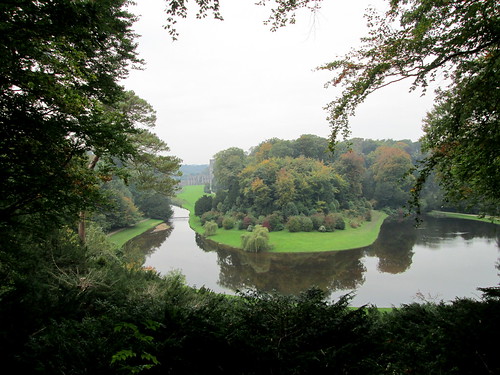
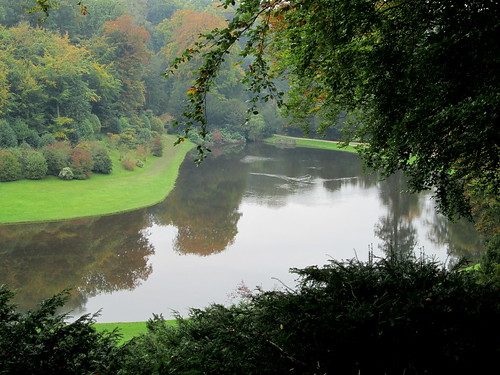
The photo below is taken from quite high up on the opposite bank from Fountains Abbey, as you can see, some of the trees were just beginning to get into their autumn colours. The water is home to quite a variety of birds.

reflections at Studley Royal

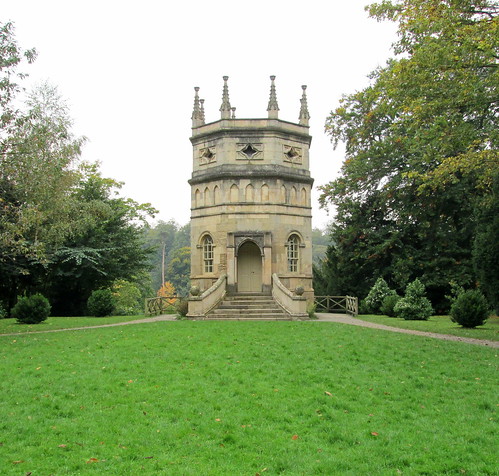
This octagonal tower is one of several ‘folly’ like structures in the gardens, the others are mini classical temples but I thought this was the prettiest of them.

an octagonal tower

I couldn’t resist another view of the tree reflections. Studley Royal is a lovely place to visit, even on a cold and slightly misty autumn day. It involves quite a lot of walking and some steep paths but it’s well worth it if you’re fit enough. If you aren’t up to it then you can just enjoy the view from the water’s edge. You can see more views here.

a long view, Studley Royal.

The C – Word

Yes, it’s Christmas I’m talking about of course!

I was walking along a street in Wetherby, Yorkshire, where we were staying for a few days, it was dark and wet – when hasn’t it been wet this year – and we were looking for a good place to have our dinner.

Out of the corner of my eye I saw a well lit window, a possibility for a restaurant or hotel I thought, but no – it was a Christmas window!

Wetherby window

It was early October so strictly speaking not too early I suppose. I remember a few years ago there was a department store near where I live which had a Christmas tree in its window at the beginning of September. SO ANNOYING! Because by the time Christmas comes around most people are sick to death of the whole thing.

Anyway, I must admit that it’s a cosy looking Christmas setting so I had to take a photo of it. I could be doing without the evil looking stag’s head on the upper right hand side, though. I’m wondering why tartan is always thought of as being Christmassy. Is it something to do with Queen Victoria and her love of all things Scottish?

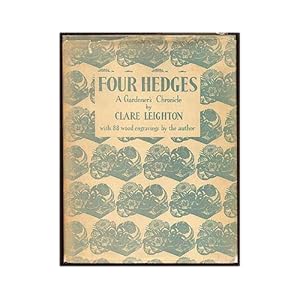
Four Hedges by Clare Leighton

Four Hedges

I really bought this book because I love the illustrations by Clare Leighton, having just seen some of her work for the first time a few days before, obviously having been ripped out of books, I was amazed to stumble across the original book in an antiques/bric a brac shop.

What a find, not only are the illustrations lovely, wood block engravings, but the writing is beautiful too. Well, if you like gardens, plants and birds as I do, then this book is a treat.

It was first published in 1935 but my copy is a reprint from 1970 although I think there has been a more recent printing.

It’s an account of the writer’s experiences of making a garden from scratch in meadowland on a slope of the Chiltern Hills. It’s hard chalky ground and colder than any of the gardens in the sheltered villages, but the extra care and nurturing that the plants need just make each surviving plant all the more special for the owners.

Each chapter is one whole month, starting from April and it’s a plethora of plant names as they plan what they are going to have in the garden. A love of gardens and plants goes hand in hand with a love of wildlife as far as I’m concerned so it’s natural that the nesting birds feature almost as much as the plants do. I say ‘they’ because Noel is her companion and it was their garden, the book is dedicated To My Companion within the Four Hedges. Noel Rooke was also her teacher and he taught wood engraving to lots of people who went on to become illustrators.

One thing that is sad though is that details of all the many trees which they planted, especially the elms, make you wonder how many of them are still standing today. People always plant trees for future generations but there seem to be so many tree diseases going around the world now, it’s maybe just as well that they couldn’t look into the future. I wonder if anyone knows exactly where that garden was/is situated. I suppose it would be entirely different now anyway, it’s quite scary the way gardens revert to nature almost the minute they are left to its own devices, no matter how much love and care has been poured into them.

Anyway, I’m going to be looking for some more books by the author as she had a talent for garden writing as well as illustrating. Clare Leighton was the sister of Roland Leighton of Vera Brittain fame, they were supposedly engaged to be married before he was killed in the First World War. Clare Leighton moved to America in the late 1930s and became a citizen in 1945, her ashes are buried in Connecticut.

You can see some of her engravings here.

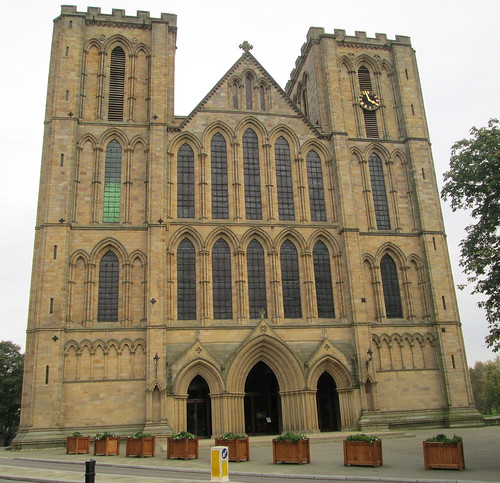
Ripon Cathedral, Yorkshire

Ripon has never been on my list of places that I want to visit but when we realised that we were just a few miles away from the city, during our recent trip to Yorkshire, we thought we might as well take a look at it. It’s actually a really lovely cathedral, and I don’t much go for big religious structures, but this one has a good atmosphere, almost as friendly as Durham.

As yesterday was Hallowe’en, that makes today All Saints’ Day, so it seems apt to have a cathedral post today. I’m not madly keen on organised religion but I always like to have a look at the local churches.

Ripon Cathedral

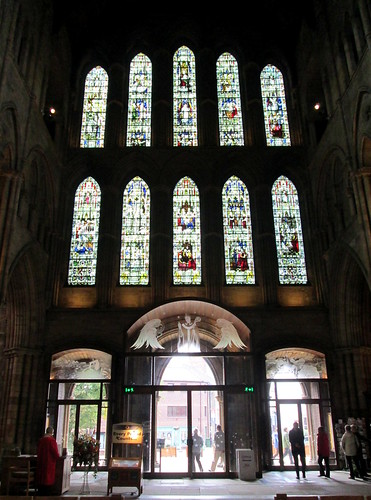
This is the front door from the inside and as you can see they’ve added some modern glass underneath the medieval stained glass windows. Unfortunately the glass never seems to look half as good in photos as it does in real life. You don’t have to pay to go in to the cathedral but obviously they’re keen on donations as it costs such a lot to keep it standing.

front entrance stained glass

I remember when I was reading someone’s review of Trollope’s Barchester books that they didn’t understand all the church politics, and didn’t know the difference between high and low church. Well, this is high church, often referred to as ‘smells and bells’ because apart from the very ornate decor ‘high’ means the use of bells and incense at particular times during the church service. It’s almost indistinguishable from Roman Catholoic, although this is of course a Church of England cathedral.

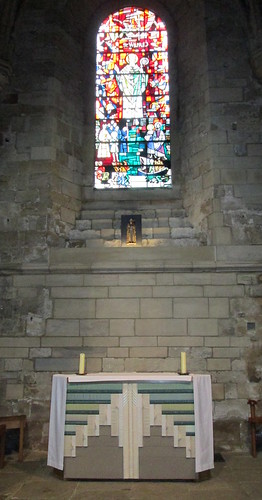
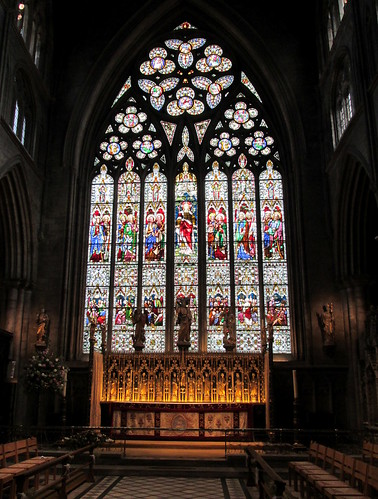
I love stained glass, it’s the colours that get me, somehow they always seem so much more vibrant in backlit glass than at any other time. This is quite a modern window and as you can see, the altar cloth is also modern but a beautiful design, quite three dimensional which doesn’t quite show up in the photo.

a side altar +stained glass

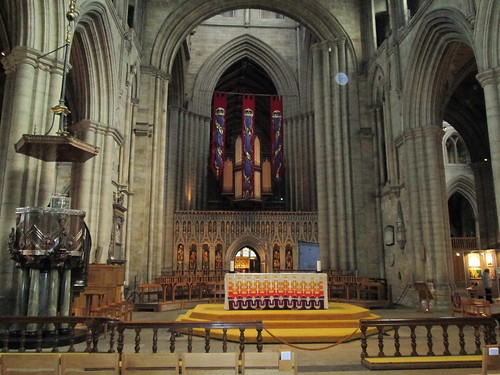
aRipon Cathedral, Yorkshirefront altar and figures

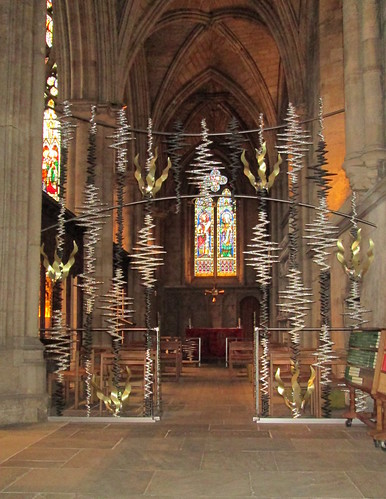
Ripon Cathedral has definitely been a patron of the arts over the years. The side chapel below has really wonderful textural metal work, as you can see. They were busy setting up an art exhibition at the time we were there, it seems to be quite a hub of the community, which you can’t say of all cathedrals.

a side chapel modern art

Yet another altar, the original I would think, and more stained glass.

stained glass in Ripon Cathedral, Yorkshire

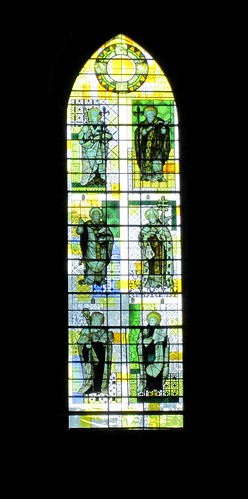
This one is a very small window but I think it’s quite unusual to see stained glass in shades of yellow and green and it looked really zingy wth the sun coming through it.

stained glass in Ripon Cathedral, Yorkshire