The Gordian Knot by Bernhard Schlink

After reading Homecoming, my first foray into Bernhard Schlink’s writing, I thought I would give one of his thrillers a go. This one was first published in 1988, and it’s still the ‘Cold War’ era, which is a time which seems to be taking on the aura of a golden age for some people who have become disgruntled with the more complicated aspects of ‘freedom’.

Georg Polger is a 38 year old translator living in a small town called Cucuron, in France, things haven’t been going well for him, he has a failed marriage behind him and Hanne, his most recent girlfriend has left him. He had been a lawyer but an argument with his boss led him to leave the practice which led to a fight with his parents. Cucuron was a new beginning for Georg, he planned to write a novel but had to earn money to support himself through doing translations meantime.

Eventually the translation work he is given involves military plans for the arms industry and Georg realises that he has inadvertently become involved in industrial espionage. He discovers Francoise, his new girlfriend photographing the plans and realises that the whole relationship is a set up. Worse than that though is the fact that he is likely to be accused of murder as well as spying. Francoise disappears.

The action moves to the US where Georg hopes to be able to find Francoise and the solution to his problems.

I don’t often read modern thrillers, and yes I do regard 1988 as modern. I can’t say that it’s a great read, plot-wise it’s fair enough but there really isn’t one character in it who is truly likeable, and that’s a big problem for me as I have to have at least one character whose side I am on. In the end I didn’t much care what happened to any of them.

Such is life or la-di-dah, as Annie Hall would say.

How It All Began by Penelope Lively

Earlier in the year I read and enjoyed Moon Tiger by Penelope Lively so when I saw How It All Began in my local library last week I thought I would give it a go. When I got home with it I was surprised to discover that it was published in 2011, I don’t read an awful lot of modern fiction nor do I keep as up to date with new publications as I should do. This is a bookish book as Charlotte, although past retiring age, is now teaching adult students to read, so there are plenty of old favourites mentioned.

Anyway, I really enjoyed this one so much so that I found myself googling Lively to see how old she is. I know that is probably terribly ageist of me but it does sometimes happen that people stick at things too long instead of bowing out gracefully when they’ve run out of ideas or just lost the ability to write as well as they once did. Lively just seems to get better with old age, or should I say – maturity. She was born in 1933 so she could be said to be ‘getting on a bit’ but honestly, you’d never think it.

How It All Began begins with Charlotte, a lady probably about the same age as the author, falling down in the street, as it says in the book – the pavement rises up and hits her. It turns out that Charlotte has been mugged and is hospitalized with a broken hip. The story is about how this incident has a knock on effect for so many people, beginning with Charlotte’s daughter Rose and her husband Gerry who look after her in their home until she’s well enough to live on her own again.

Then there’s Anton, Jeremy, Stella, Marion, Henry and Mark, most of whom only know Charlotte vaguely, if at all. But their lives are changed by her temporary incapacity. It’s the Butterfly Effect of chaos theory in action but all the strands of the storyline are beautifuly tied up, which is a plus for me, I’m not keen when characters just fizzle out and are left dangling, as some writers do.

Another plus is that just about all of the characters are likeable, well there’s maybe one who is a bit of a rotter, nobody is perfect of course but I do hate books which have no likeable characters in them at all, it’s impossible to like a book if you don’t care about the people in it.

Moon Tiger won the Booker prize way back in 1987 and I think this book has been nominated for at least one literary prize.

Homecoming by Bernhard Schlink – and a meander

This is the first book which I’ve read by Bernhard Schlink and I don’t know if ‘enjoy’ is the word which I would use to describe my reaction to it, but as Judith, Reader in the Wilderness said, it gave me plenty to think about too. I warn you, maybe you should make yourself a cup of tea or coffee first and IF you reach the end of this meander – you might just need a drop of the hard stuff in it.

To begin with I was quite disappointed that the storyline follows that of The Odyssey because it seems quite a hackneyed one, in English anyway. There has even been a film starring George Clooney called O Brother Where Art Thou which borrows from it. That’s a personal moan though.

Peter Debauer has grown up in post war Germany with very little information from his mother about who his father was but she does send him to Switzerland to live with his paternal grandparents during the school holidays. Whilst reading one of the books which they publish he realises that the end of the story is missing and as an adult he’s still looking for the ending, it’s his quest.

In fact it’s a bit of an obsession and through it he does actually meet up with the man whom he believes is his father. He’s a man who has spent his life bending like a willow in the wind, a determined survivor who had written for both the Nazis and Communists.

I’m presuming that this book was written to try to explain how things like the Third Reich can come into being, because there is an experiment towards the end of the book which isolates people and puts them in a position where they are bullied and do things which they would not normally do.

These experiments are conducted fairly regularly in universities but they’ve always struck me as being unreal situations which have generally used young people (students) as the guinea pigs. The trouble is – I just don’t accept that everybody behaves like that. Some people might, a lot of people might, and after all the McCarthy era in the USA was a similar situation where peoeple were bullied and intimidated into denouncing friends and colleagues. For me this smacks too much of being a ‘don’t blame us – you would have done the same thing too’ situation, regarding the Nazis. I can assure you we wouldn’t, in fact we didn’t.

By coincidence I’ve been reading some travel books recently, which involved journeys by people who happened to be in Germany around 1930. One is Patrick Leigh Fermor‘s A Time of Gifts a well known book, amongst other things he writes about how people in Austria thought Hitler was something to laugh at, he just wasn’t taken seriously. The other book is Modern Germanies as seen by an Englishwoman Cicely Hamilton, published in 1931. Chapter 13 is titled Jew-Baiting. This is the opening paragraph:

The traveller for pleasure in Central Europe who confines himself to the taking of tickets, the paying of hotel bills and the sights and excursions advised by Herr Baedeker may meander through his holiday and return to his home without suspicion of a Jewish problem. But let him once get out away from his tourist beat into private houses and private lives; let him make personal acquaintance even of the slightest; and the chances are that it will not be long before it is made plain to him that here is a Jewish problem and that Anti-Semitism, in Central Europe, is a force both widespread and dangerous.

The whole problem was that Jews were despised in Germany in a way which they hadn’t been in Britain for centuries. Shakespeare’s The Merchant of Venice was written between 1596 and 1598 and it is about Jews being the same as Christians, in Scotland we would say: We’re all Jock Thampson’s bairns.

In 1930s Britain, the British Fascists led by Oswald Mosley, with close links to Hitler went around marching and trying to stir up trouble, especially in the East End of London where there was a large Jewish population. The upshot was that the barricades went up and they couldn’t march, there were running fights in the streets but in the end Oswald Mosley the fascist leader spent World War II in prison at His Majesty’s Pleasure, as did his wife. If you want to know a wee bit about the anti-fascists in London’s East End have a look here.

Anyway, back to the book. It’s about missing information, people not having the knowledge which they should have, things being hidden, and that is something which has always worried me about Germany. I have to tell you that I’ve had a German pen-pal since I was about 10 years old and I was 12 when I went to Bavaria for the first time. I went on my own (!!!) but I was well warned by my parents not to mention the war, just think John Cleese in Fawlty Towers – as if I would! So it was something of a shock to me to see the Nazi war medals and various other things proudly displayed in the living-room. My parents were the generation who went off to war, as did all of their siblings, and my husband’s relatives too, and for that matter the parents of everyone I was at school with and not once in any house did I ever see anything war related in the way of medals. In fact we didn’t find my father-in-law’s medals until after he died, they were in a cardboard box, they’re still in it but we have it now. My own father was in the Merchant Navy during the war (North Atlantic convoys, regularly being torpedoed) and at the end of it all they had to apply to get their medals and he didn’t bother doing it! In fact he hardly mentioned the war until he was on his death-bed, in common with most men who had a particularly bad time during the war. So, I thought the swastikas were weird, but thought no more about it.

Over the years though I’ve been gobsmacked by the occasional barbs at the hands of the wartime German generation, who were obviously more than miffed that they didn’t win it. Like when we happened to be walking past a Bavarian village church – Your RAF bombed our church – it apparently had suffered a tiny bit of damage from a stray bomb. Did I say – Your Luftwaffe killed my great-grandmother? No of course not, I’m too polite – don’t ever mention the war! I sometimes really wish I wasn’t so well-mannered. Then there was: why is your country the only one which calls itself ‘great’- what’s so great about Britain? I had to explain that it doesn’t mean great in that sense. If you only say Britain then it means the main island whereas Great Britain includes all the many inhabited islands which form the country too, from the Channel Islands halfway to France to the Shetlands halfway to Norway. Great means larger, not better than.

Coupled with that is the Germans that I’m related to by marriage, who bring out an enormous life-time sized photograph album, but you aren’t allowed to look at most of it, the photos that we can see are all post-war. Oh how I want to see the Third Reich photographs.

So I’m more than a bit perplexed by Bernhard Schlink’s idea of the war as a burden for Germans, it isn’t to the war generation Germans that I know and what is most worrying to me is that the younger generation, certainly the ones who are about my age (53) are fairly clueless about the whole thing. This is where the gaping whole is in modern German life and it always worried me – even as a child, that if people aren’t told about past mistakes, they can’t learn from them. History is more likely to be repeated and I couldn’t help looking at all those very strange looking guys who used to wander around in gangs in Stuttgart, dressed in leather, with large chains hanging all over them. This was pre-punk and they were in their 30s in the 1970s, maybe it’s still like that but it looked more than evil that the children of the Nazi generation were still dressing like – well Nazis.

Judges in the UK are well known for being rather outside normal society and clueless as to how the rest of us live, so I’m wondering if it’s the same in Germany. Bernhard Schlink was a judge in Germany and according to his interview in the Guardian he knows Germans who try to hide their nationality, perhaps it’s something only done by academics such as himself. The less cerebral ones don’t care. I see no reason why any German who wasn’t involved with the war as an adult should feel any burden for their parent’s mistakes. I’ve never met a German who tried to hide their nationality but I do know a chap from Texas who lives in Scotland and tells people that he is Canadian! Each to their own but I can’t imagine any situation in which I would not say I was a Scot, and woe betide anyone who calls me English – nothing against the English.

I’m glad to say that although my pen-pal of more than 40 years was brought up by strange parents who were obviously less than happy about the outcome of World War 2, she has none of their outlook. For obvious reasons Hitler doesn’t/didn’t feature on German TV, he’s never off some channels here and I think that Germans have to go out of their way to find out about that episode of their past. I used to collect ‘peace’ mugs/cups – which were sold in the UK to celebrate the end of the Great War but I also have one very small German cup which I hoped was from the first war but wasn’t sure. Yes, it’s the 14-18 war my friend said because it is so strongly patriotic!! Honestly, you have to laugh because they weren’t exactly less patriotic in the second war. It does make you wonder though, especially when she says that her father had a terrible time at the hands of the French as a prisoner of war. Not for long surely.

She’s gone a bit off her trolley I hear you say – but, neo-fascists have been rearing their ugly heads in Europe for quite some time now, and you can’t afford to ignore them! Austerity such as we are experiencing now is likely to be used by extremists to whip up support for despicable political parties. Today there were strikes and demonstrations in 25 European countries, that’s all very understandable, we just don’t want any modern day Mussolinis, Francos, Greek colonels or Hitlers taking advantage of the situation.

Well, did you get here? Yes, well then – whisky, vodka, beer or I have some lovely pear cider? Oh all right then, lets have a bit of poor Basil who has concussion and can’t stop mentioning the war.

The Demoniacs by John Dickson Carr

The Demoniacs

I bought this book quite recently at a charity shop I think and I was quite disappointed when I realised that this is one of Dickson Carr‘s historical whodunnits, set in London in 1757. The 1930s/40s and 50s are really my favourite crime settings, it’s all those steam trains and Austin Healys that I love. It was first published in 1962.

But I thoroughly enjoyed The Demoniacs which is a great mixture of murder and romance. Jeffrey Wynne is a sort of under cover Bow Street Runner, he has already saved Peg Ralston, a beautiful young heiress from a fate worse than death in a so called high class French brothel. On getting Peg back to London Jeffrey discovers that she is in even worse danger there, can he come to her rescue again?

Dickson Carr uses real historical figures such as Laurence Sterne the author of Tristram Shandy, and John Fielding, the famous ‘blind beak’ who set up the Bow Street Runners.

The whole atmosphere feels right, Dickson Carr must have done a lot of reaearch about the period, the only thing which grated slightly was one minor character at the beginning who kept saying things like ‘split my bottom’ – it reminded me of the silly ass character in Blackadder played by Hugh Laurie.

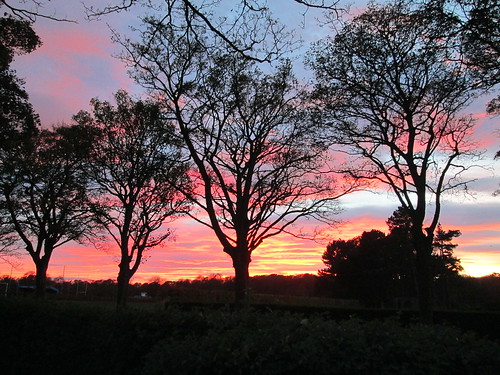
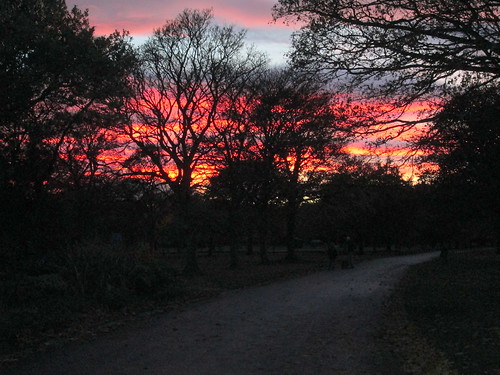
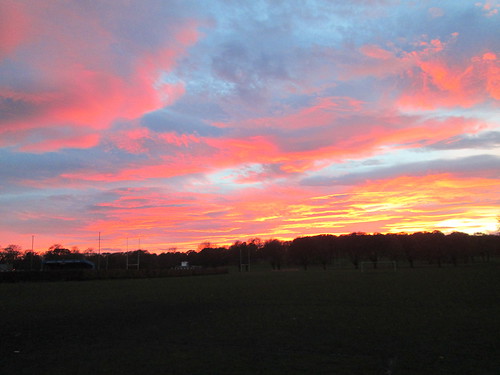
Sunset at Beveridge Park, Kirkcaldy, Fife

When Jack got home from work last Tuesday night he said: there’s a fantastic sky out there – so we shot out with the camera to see what we could capture.

trees at sunset, first

For some reason the sky looked even redder behind the trees, but the shapes of trees on their own are lovely. I’m fairly sure these are cherry trees, they’re the first to lose all of their leaves anyway.

trees third

The boating pond again, with the trees on the island on the left hand side. As you can see there are some birds on the pond but as ever they’re too shy to show their heads, they always duck down just as I snap them.

Boating pond

Red sky at night – shepherds’ delight and all that – well it delighted me anyway.

Beveridge park second

The Fathers by Allen Tate

The Fathers cover

I bought this book, a Penguin Modern Classic, because I liked the cover, so shallow of me I know, but the subject matter interested me too. It popped up in an Edinburgh second-hand bookshop. The cover shows a detail from The Plantation c.1825, is by an unknown American artist and is in the Metropolitan Museum of Art, New York.

It’s about the beginnings of the American Civil War and how it affected the lives of the Buchan family and the story is told by Lacy Buchan who is now an old man looking back to the events of 50 years before, but his story begins with the death of his mother when he was just a teenager and his family is gathering for the funeral at Pleasant Hill, Virginia.

For some reason Lacy hero-worships George Posey who has married Susan Buchan, Lacy’s sister. I say for some reason because for the life of me I can’t see anything to admire about the man.

The two families are vastly different, Major Buchan, of Scottish descent has the manners of a gentleman and is crushed by his wife’s death. The Buchans see themselves as Southern aristocracy, but they’re poverty stricken. Major Buchan leaves the running of his estate to his son-in-law George, which is a bit like putting the child-catcher in charge of an orphanage.

George has only one interest in life really, the making of money, and George even sells his own half-brother Yellow Jim – a slave, as he tells him he’s liquid money. Even Lacy suspects George of brutality towards Susan, so it’s no surprise when the civil war begins that George’s interest in it is the chance to make a profit.

I enjoyed this book, which is apparently quite neglected and only read in academic circles in the US. Obviously the two families are supposed to represent the different factions of the civil war, and after the events of this week (the Obama/Romney election) it’s obvious that the US is still a country which is very much split in two in some ways. A lot of people aren’t happy about the result but when you think of the alternative of all out civil war, instead of sorting things out, you have to say the election was a triumph, whatever the outcome.

If you want to read more about the book and author have a look at this interesting article from The Washington Post.

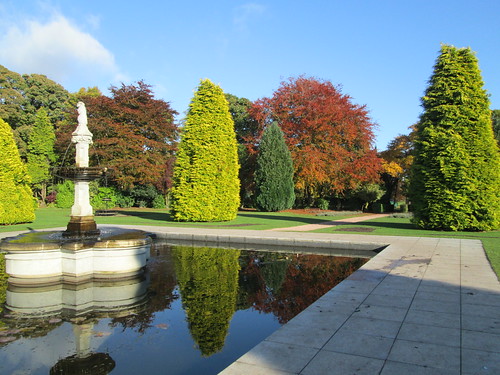
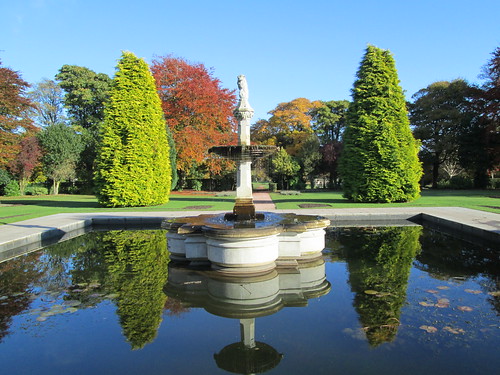
The Fountain in Beveridge Park, Kirkcaldy.

We’re still in Beveridge Park, at the lily pond and fountain now.
I really wanted to get a photo of the different autumnal shades of the trees which is why the fountain is in the corner of this photo.

Beveridge Park fountain & trees 1

I just had to take one of the fountain on centre stage though. I love fountains and although this is a very tame one, it’s a trickle rather than a fount, it’s still a thing of beauty, especially on the lovely autumn day when I took the photo.

Beveridge Park fountain & trees 2

Autumn in the Park

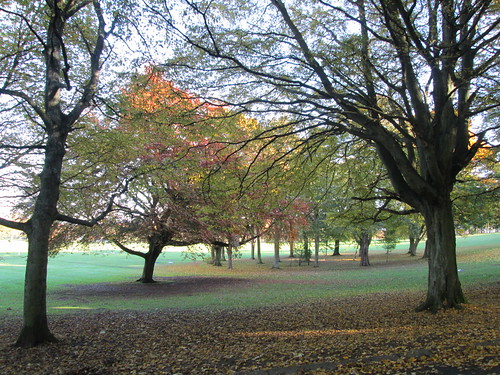
We rarely get two days in a row with the same weather so when you get a good day, you just have to go out there and grab it as tomorrow will probably be grey if not wet. That’s why I found myself at my local park getting some fresh if chilly air and exercise. I took my camera of course, just to let you see what autumn is like in Kirkcaldy in Fife. Are you coming for a wee walk?

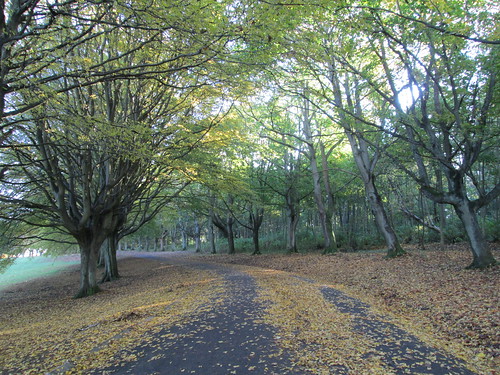
These trees are at the beginning of the pathway which leads all the way around the perimeter of what is a large Victorian Park.

leaves & trees 4

The path gets quite steep here and I used to get quite puffed out by this stage of the walk. I sometimes had to stop and pretend to be tying a shoe lace or something, just to catch my breath but it’s no bother to wheech up it now.

leaves & trees 3
We’re at the top of the hill and looking back now, I think, there were men in the park gathering up the leaves using machines, shame on them!

Trees 1

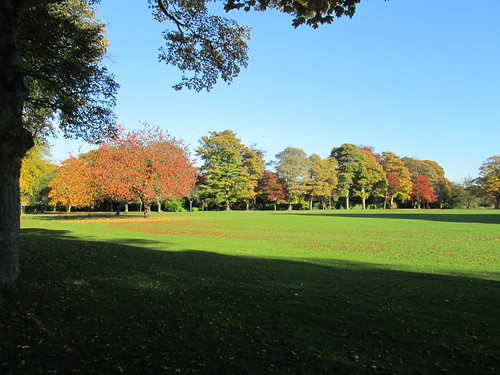
This is the view from the path, down into the main part of the park, there are the usual play areas for wee ones and skate board thingy for the bigger ones. Luckily the trees screen all of that.

Trees 4

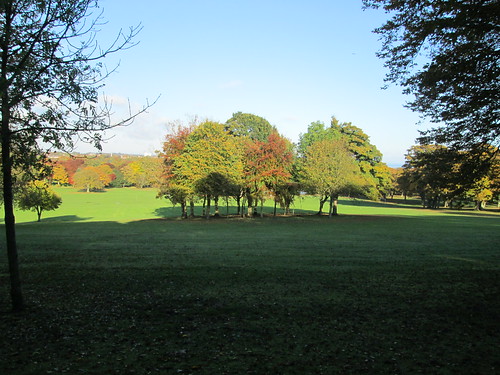
Another stand of trees, there are lots of them dotted around, unfortunately there are none of our native red squirrels here, only those American grey squirrels, they get everywhere!

Trees 2

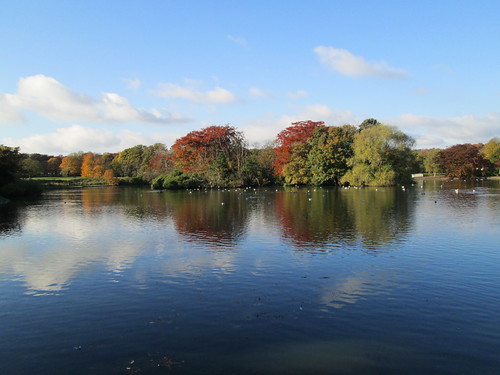
After walking all around the edge of the park it’s time to veer into the centre for a walk around the boating pond, it’s much like any other one with an island in the middle where the birds can nest safely. The boats have all been tidied away for winter, they’re swan shaped.

The Boat Pond

And here it is again from the other side. It’s hard to believe that there was a film of ice on the pond just the other day, well I did say that we don’t get two days together the same here.

The Boating Pond 2

That’s the end of today’s jaunt, I hope you enjoyed the breath of fresh air and exercise!