
I usually have quite lot of bees in my bonnet, you probably do too, but sometimes one of those many, many bees escapes and does some buzzing.
What is your High Street like? Have you had a look up recently to see what’s going on on the rooftops and buildings in general? I’m always looking up at buildings and for a long time now it’s more than architecture which is grabbing my attention, it’s another B – b for Buddleia. On our travels around Britain I’ve seen lots of buildings festooned with weeds, so I know it isn’t just a local problem.
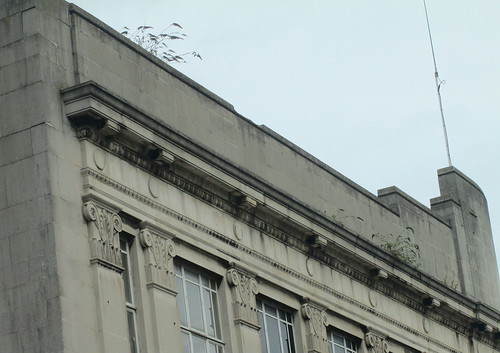
The photo below is of one of the very few art deco buildings in Kirkcaldy, it was all newly refurbished recently but some Buddleias have got a grip of it now and they won’t let go without human intervention, they’ll just keep getting bigger, and it’s bound to end up with the building being badly damaged.
As you can see these chimneys have what look like trees growing out of them.

I think there are a few different plants growing out of the building above Specsavers.
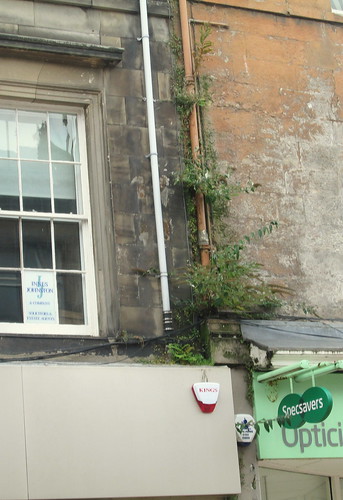
Buddleias are the culprits again as well as some sort of creeping plant. There’s no excuse for this mess as someone could easily have opened a window here and grubbed out the offending plants before they got a chance to get a good root hold.

More Buddleia, this looks big from the ground and I dread to think how big it must be.
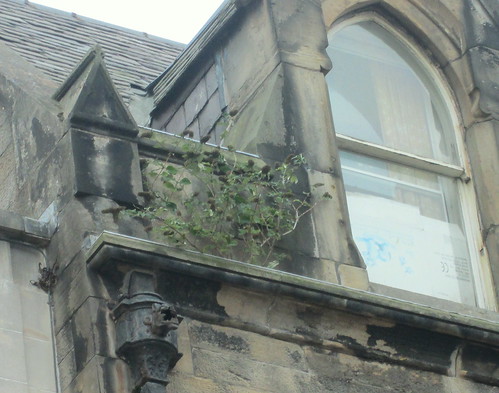
There are some lovely old buildings in Kirkcaldy, relics of a far more prosperous past and it’s a real shame to see them being infested by weeds with absolutely nobody bothering about it. It’s about time that whoever is responsible for it pulls their finger out, and if the buildings are all owned by various private landlords then the council should do the work and send the bill to the building owners.

A large part of the problem is that there is a derelict site in the High Street where a 1960s building was pulled down some years ago and it is now just a vacant plot. The ground is obviously full of lime leftover from the demolition and the original building materials. That is the perfect growing medium for Buddleias and the building plot has plenty of them growing there, of course they aren’t content to stay there and the seeds end up on the rooftops and buildings nearby. If that vacant site was cleared of Buddleias then the problem would never have got so bad.
I actually cut my own Buddleia down last year because I didn’t want it adding to the problem. I planted it to attract butterflies but there are lots of plants which attract butterflies just as much, and they aren’t invasive and damaging to buildings.
So that’s my bee, going back to my bonnet, settling down to buzz quietly again, except Jack wouldn’t agree with that, he would say I never stop going on about bees in my bonnet. Who me?!
As a gardener and Conservation Commissioner in Massachusetts, I became very aware of garden plants invading the countryside. I had no idea it was / would be a problem in cities! Butterfly bush (Buddleia davidii) and Burning Bush (Euonymus alata) were two shrubs that I noticed growing in places where no one had planted them. They’re lovely in the garden, but sometimes it’s hard to keep them there. Amazing that they’ve taken to the skies via buildings!
Joan,
Conservation Commissioner sounds very important. I haven’t seen Burning Bush becoming a nuisance around here, but there are plenty of other garden escapees. Nobody seems to be bothering about the problem though.
I’ve always wanted a butterfly bush did not know it was invasive like that! Glad I didn’t get one now!
I think B davidii would grow into a monster where you are Peggy. They grow fast enough here!
Peggy, The following is a portion of an on-line article by Tony Avent of Plant Delights Nursery in NC. Looks like you can have a non-invasive butterfly bush as long as you pick the right cultivar or make sure you always dead-head your Buddleja davidii, which is the cultivar that’s most commonly available.
For gardeners whose property borders a non-forested natural area, use the sterile or low fertility cultivars or remove the seed heads in the fall before they open. Many of the modern cultivars of Buddleia davidii have dramatically reduced fertility and are not invasive. Some hybrid cultivars (such as Buddleia ‘Blue Chip’) are almost completely sterile and pose no threat. Some low viability selections include Buddleia weyeriana, Buddleia fallowiana, Buddleia hemsleyana, Buddleia longifolia, Buddleia macrostachya, and Buddleia nivea.
I’m impressed! I don’t get much further than “green weedy stuff” and “yellow flowered ground cover”.
Pearl,
Joan certainly knows plants!