
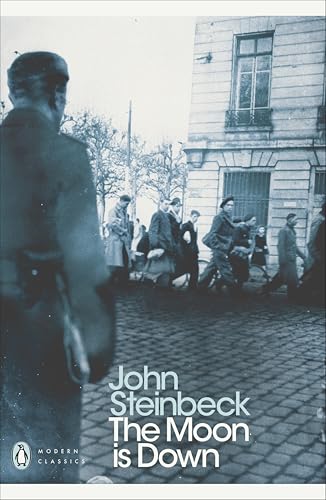
The Moon is Down by John Steinbeck was first published in 1942.It was Steinbeck’s reaction to what was going on in the world at that time, although written before the USA had entered World War 2.
The setting is a North European country which has been overrun by an anonymous enemy. Somehow Steinbeck was able to put himself in the position of the people who had been invaded by aggressors in the war, and so he tells of how the population behaved towards the invaders.
It’s not long before everyone realises that they had had a traitor in their midst and the man they thought had been everybody’s friend had actually been working with the invaders, giving them the details of who owned a firearm and where it was kept, and other sorts of useful information.
The Nazis are never mentioned in the book but the invaders refer to The Leader and it is mentioned that they had fought Belgium and France twenty years previously. Steinbeck wanted to write a propaganda book, but something subtle rather than a rant. His German soldiers are human and they hate that they are despised by those they have overcome.
Steinbeck worked for two organisations who were precursors to the CIA and as part of the work he was involved with a lot of refugees, first from Norway and Denmark, then France, Belgium and the Netherlands as they were invaded. From the refugees he learned how the Germans behaved and about collaborators and the punishments meted out to those who were caught working against the Nazis. All the information helped him to write this book.
The Moon is Down is very similar to Island at War which was an ITV series about the Nazi occupation of the Channel Islands. I’m sure whoever wrote that must have read this book. I must admit that I had never even heard of The Moon is Down until I spotted it at the library last week, but that was obviously some sort of weird gap in my knowledge because the book has an amazing history.
The Germans banned the book in every country they occupied, a member of the Italian resistance reported that being found in possession of the book meant an automatic death sentence. Despite that hundreds of thousands of copies of it were translated and circulated in Norway, Denmark, Holland and France, it was the most popular work of propaganda in Western Europe. In Copenhagen a bookseller bought a mimeograph machine and churned out 15,0000 copies of the book, on the ground floor of a building. The Gestapo HQ occupied the rest of the building – talk about being hidden in plain sight! The bookseller even cajoled Gestapo officers into helping to load the books for delivery by students – resistance workers. How the Gestapo would have screamed if they had realised what they were loading! In the beginning the Nazis were keen to keep on the good side of the Danish people, but that obviously didn’t last.
According to the French patriotic press the impact of The Moon is Down in occupied France was ‘immense and incontestable’. In 1946 Steinbeck went to Norway and he received King Haakon’s medal. He was asked how he knew what the resistance there was doing and he answered – “I put myself in your place and thought what I would do.”
It must have been so satisfying to Steinbeck that the book was so well received by those who were overrun by the Nazis because when the book was first published he was criticised as being too soft on the Nazis as he portrayed them as human beings, but that was what made The Moon is Down so successful.
It’s an interesting and good read and I read it for the Classic Club Challenge.
I’ve watched the film on YouTube: an excellent and compelling movie. I imagine the book would be extremely powerful.
Valerie,
I had no idea it had been made into a film. I must take a look at it. Thanks.
Valerie,
I had no idea that it had been made into a film. I’ll have to take a look at it. Thanks.
I have never heard of this book before – what a fascinating story about it. Reminds me a bit of how Hans Christian Andersen’s story “The Most Incredible Thing” became a symbolic story for the Danish Resistance during WWII. Obvious difference being that Andersen died decades before the war whereas Steinbeck meant for his book to be understood in the context of the war.
Christy,
I’m glad you said you hadn’t heard of the book too. I think it must be better known outside English speaking countries. I haven’t read The Most Incredible Thing, now of course I feel I must read it. Andersen had experienced German/Prussian invasions of Denmark which may have inspired him to write it.