
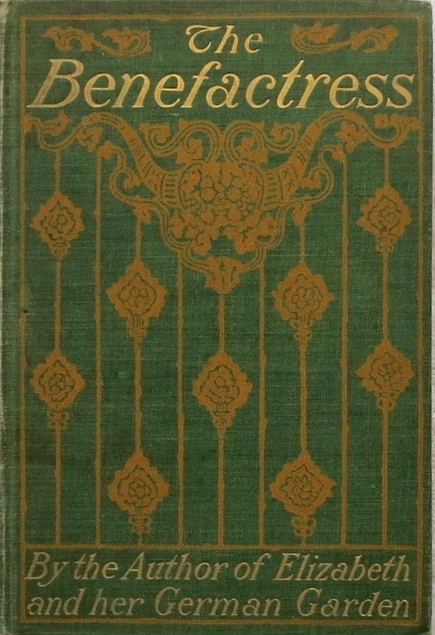
This last week has been Elizabeth von Arnim week on Facebook’s Undervalued British Women Novelists 1930-1960 group, which is the only reason I’m on FB really, well that and the Golden Age Detection group. I read Expiation and The Benefactress, both first time reads for me.
The Benefactress by Elizabeth von Arnim was first published in 1901 and it’s very much of its time, so quite different from The Enchanted April (1922) which I think is many women’s favourite.
Both of Anna’s parents are dead and at 18 she was taken in by her brother and his wife Susie. Susie is determined to get Anna married off well and begins to spend money on her on clothes and taking her around everywhere eligible men are found. Although Anna and her brother come from an aristocratic family they’re not rich, the money is all Susie’s and she is forever talking about it. Susie’s family comes from Birmingham which means they are trade – something that the snobs of the local society won’t forgive, she’s always being snubbed.
Seven years on Anna is sick fed up with being taken around in search of a husband, she has refused many offers because she isn’t in love with them. In protest Anna has taken to looking as plain as she can – the upshot of that is that she gets marriage offers from clergymen. Her salvation comes when an old uncle from the German side of her family dies and leaves her a small estate, but it’s in a remote area of northern Germany.
Travelling there with Susie and her daughter Letty it turns out to be an old, cold and run down house with unhelpful servants. Susie leaves shortly after getting there, leaving her young daughter behind for a holiday. Anna falls in love with the place and sets to brightening everything up but after having been miserable when she was dependent on Susie for money she decides that it would wonderful if she could share her good luck and happiness with twelve gentlewomen who are now in difficult circumstances money-wise.
That’s when all her troubles begin because of course it often doesn’t take long before people who are the recipients of charity develop a disagreeable outlook towards the person that they should feel grateful towards, such is human nature. The first three women to take up residence include two ‘vons’ a sign of German aristocracy. They despise each other and only agree over their attitude to Anna. There must be some nasty reason for her charitable actions, they decide that she must have been a society outcast, it’s implied that they think that Letty is her daughter. The baroness owed Anna everything – “and what more natural then, to dislike her? The rarest of loves is the love of a debtor for his creditor.”
Anna realises that she has made a mistake, but worse is to follow. Letty has decided to meddle in her aunt’s love life which leads to a lot of trouble for which she does get her come-uppance with the loss of her most attractive feature.
Although this isn’t my favourite and indeed near the end it did veer towards being disastrous in a Thomas Hardy sort of way, there are also quite a lot of moments of humour, as ever von Arnim is such a good observer of human nature, especially between men and women and more particularly husbands and wives. Worth reading.
Ooh, I love von Arnim and haven’t read this one. Will have to find it at the library sometime. I always expect her to be light and optimistic but sometimes she rattles me with how dark she can be.
Stefanie,
It’s available from Project Gutenberg if you’re interested. Yes she can be very dark as well as witty and light-hearted.
How interesting to learn a bit about Elizabeth von Arnim.
I have, or had anyway, a copy of “Elizabeth and Her German Garden”.
And I was interested to see she was related to Katherine Mansfield. I remember studying some of *her* work at high school, although at 16 it failed to grip!
Valerie,
Yes I think they were cousins. I have a lovely Folio edition of Katherine Mansfield’s short stories. I think I was probably about 30 when I read Elizabeth and her German Garden, probably a better age for her books than 16!