
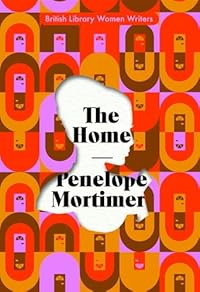
The Home by Penelope Mortimer was first published in 1971 and it has just been reprinted by British Library in their Women Writers series. I was lucky enough to be sent a copy by them, for review.
The book begins with Eleanor vacating the family home with her teenage son Philip. Her husband Graham, a successful psychiatrist had left the family home and had moved in with his girlfriend Nell, (yes she has the same name as his wife – handy) she’s the latest in a long line of his infidelities. Graham is incensed when he realises that his wife has taken absolutely everything from their home and it’s now all in the house that she has chosen and he had had to pay for. She claims she needs a home for the children but of their five children only Philip is still at home and he’s at his boarding school most of the time. Of course Eleanor is emotionally fragile, and it seems that the men who had been interested in her have now transferred their allegiances to her adult daughter. As soon as she is available the men melt away. Eleanor finds herself lonely and unwanted, not only by her husband, but by her children too.
This makes it all sound rather grim but there’s also some humour there too. Graham is a rather pathetic soul, an embarrassment to his children, and not that he realises it, but his new young squeeze isn’t that enamoured of him, but he has celebrity patients and that impresses her.
Penelope Mortimer, who was married to the author John Mortimer, was in the middle of their divorce as she wrote this one. It’s such a tale of its times, when divorce became a bit easier although it still took five years if one of those involved didn’t wish to be divorced. The free availabilty of the contraceptive pill even to unmarried women at this time was a game-changer. The times they were a-changing!
I really enjoyed this book and I was amused to read in it that a female barrister called Georgina looked like Portia when she was in court. If you watched Rumpole of the Bailey or read the books you might remember that Rumpole always called the character Phyllida Erskine-Brown QC – Portia. It was obviously a Mortimer family thing.
Thank you to British Library for sending me a copy of the book for review. It has just been published. There’s an Afterword written by Simon Thomas. I love all the extra information on the times that are included although this era is well remembered by me as we got married in 1976 – but missed out the divorce bit! (Jack says – so far!)
I could find this book interesting due mainly to the time period when it takes place. My husband and I also married in 1976 – and we still are, thankfully. Because I grew up in a small town, rather sheltered environment, I was not terribly aware of the social changes taking place during the 70’s.
Paula,
I suspect that the changes were a lot more obvious in cities such as London, it usually does take quite a while longer for big social changes to hit small towns such as the one I grew up in too. I think my parents would have had a fit if their kids had got divorced, or even lived together!
Oh, absolutely! In fact, it was rare for me to even know kids whose parents were divorced, and I don’t remember being aware of couples living together until well into my adult years. My upbringing was very religious, too, so I’m sure that had a great deal to do with my not being very worldly wise. It was a great childhood in so many ways, but I am thankful to be free of religion and have a vastly different understanding of God.
Paula,
That was exactly my experience too. Mind you in Scotland there’s a Presbyterian atmosphere that even affects people of no religion and RCs. I’m really not interested in religion, they all seem to have been devised to keep women down, and so often they attract the wrong sort of people – very wrong!
So glad you enjoyed it! I was conscious, writing my extra bits, that I was writing about a time that many readers would remember 😀
Simon T,
It doesn’t seem that long ago, but I was a child bride! I did find it quite sad when I realised that the author had really written about the breakup of her own marriage – and she had been replaced by another Penelope. I suppose that for John Mortimer that meant he wouldn’t be getting their names wrong during the affair!
This would be interesting just knowing that she was going through a divorce while writing the book. And the time period. I got married the first time in 1971, and married my current husband in 1980, just 6 months after my divorce was final. That seems so long ago now.
tracybham,
It all seems to be very autobiographical. Your current husband has lasted quite a long time! In some ways even the 1970s seems like yesterday but so much has changed since then. I still think of the 80s as being fairly recent, then I realise it’s over 40 years ago!