Five Children on the Western Front by Kate Saunders – 20 Books of Summer

Five Children on the Western Front by Kate Saunders is a continuation of E. Nesbit’s book Five Children and It.  This book was first published in 2014.

It begins with a prologue set in London in 1905.  Cyril, Anthea, Jane, Robert and the Lamb had found the Psammead, a sand fairy, a desert god from the times before the ancient Egyptians. He’s a  cantankerous brown furry grump with a small stout body, eyes on stalks and long arms and legs, he usually lives in hot sand and any hint of dampness near him causes him terrible pain. He had been sleeping for years but the children decide to wake him up, the Psammead has the power to grant wishes. They ask him to take them to the future, somwehere quite near, and they end up in 1930, in the home of their old friend the Professor where they see some photos of themselves as they will be as adults, but they aren’t all in the photos, it’s a bit of a puzzle. Of course the older children are just the correct age to be involved in the First World War, and the Psammead whisks some of them to the Western Front.

I’m usually not all that mad keen on continuations written by a different author, but I think this idea really works, inevitably it is a bit sad, but realistic.

At one point (chapter 10) the children and the Psammead go to see the play Peter Pan. The Psammead is thrilled by it, especially when the audience is asked to clap if they believe in fairies. I was almost as thrilled as the Psammead. J.M. Barrie is a much underrated author nowadays.

You can read  Linda Buckley-Archer’s review of the book in The Guardian here.
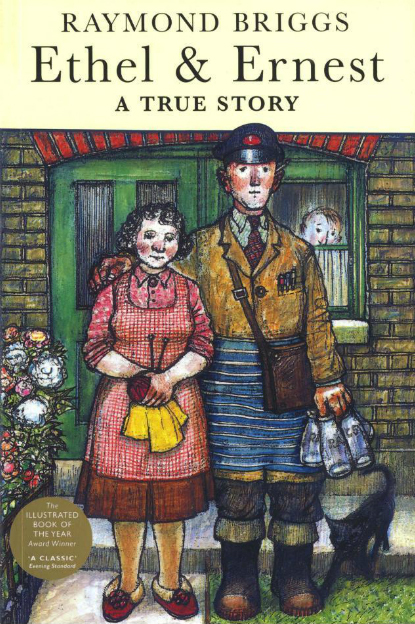
Ethel and Ernest by Raymond Briggs

Ethel and Ernest by Raymond Briggs  (of The Snowman fame) was published in 1998, it’s the biography of his parents’ lives and relationship and it’s a delight. At just 102 pages of mainly illustrations I read through it very quickly and then turned back to the beginning again to savour his charming and so detailed illustrations.

Ethel was working in service for two snooty looking women when she fell for Ernest who often waved to her as he cycled past her employers’ home. Ernest is a milkman and the two of them decide to get married and buy a home of their own. The illustrations show them looking around the empty house as Ethel wonders if they can afford it, and bit by bit you can see them gathering furniture and ‘stuff’ to make their quite large nest. Sadly after Ethel has a tough time giving birth to Raymond they are told to have no more children. Ernest says, but we wanted a proper family! It wasn’t to be.

Apart from all the landmarks in a couple’s life such as Ethel being thrilled to have a gas copper for washing the clothes in, there are also all the stand out moments such as the BBC announcing that we were at war in 1939. Then all the preparations involved in that, the gas mask, building an Anderson shelter in the garden, a Morrison’s shelter in the living-room, making blackout shutters and Raymond being evacuated to safety. Just as well as their home is badly damaged in a bomb blast.

This book starts in 1930 and ends in 1971 as Ethel and Ernest both die in that year. Obviously Raymond’s life appears in the book too. It’s a real love letter to both of his parents in their memory. They come across as being a lovely couple, so human and quite different from each other in outlook, with Ethel beinng a bit of a snob, as befits an ex ‘ladies maid’. Ernest is all for the working man.

I’m just amazed that in 1930 a milkman could afford to buy a large terraced Edwardian house with living-room, dining-room, four bedrooms, scullery, kitchen AND bathroom.  They lived in that house all their 41 years together. Apparently this book has been made into an animated film, that seems so fitting.

Human Croquet by Kate Atkinson

Human Croquet by Kate Atkinson is the second novel by the author and it was published in 1997.  I must admit that it’s a while since I read this one, I’ve put off reviewing it as although I like her writing I find it very difficult to write about. I now realise of course that I should have done it while it was clearer in my mind. As often happens in Atkinson’s books the action slips between different times, so this is a bit of a conglomeration of historical fiction, mystery, time travel and also has a 1960s setting in the village of Lythe which is very ancient.

Isobel is the narrator, she’s 16 and has a brother Charles. They have been abandoned by both their parents. Their mother apparently ran off with her boyfriend and their father couldn’t cope and left them, supposedly looking for their mother, but when he comes back seven years later he has brought a new wife with him.

It was their mother’s sister who looked after them, she had given up her home and moved in with them, and was a bit surplus to requirements when an actual step-mother arrived. Their grandmother is also part of the household. From time to time Isobel slips back to the Lythe of Shakespeare’s time.

The book is ful of Scottishisms, you would never know that Atkinson wasn’t born and brought up in Scotland. I believe she went to Edinburgh to study when she was 18 – and stayed, but according to an interview which appeared in the Guardian she regards herself as Yorkshire through and through!

Now 72, and having lived in Scotland for many years, she’s clear that this vision of Englishness – still cleaved to by nationalist politicians – is very much a south-of-the-border issue. Her own identity, she insists, lies in neither country: “I’m not English. I’m from Yorkshire. It’s different.” She left after she wrote Behind the Scenes at the Museum, “but when I die, open me up and Yorkshire will be carved on my heart”.

You can read the full interview with Alex Clark  here.

The Mermaid and Mrs Hancock by Imogen Hermes Gowar – 20 Books of Summer

The Mermaid and Mrs Hancock by Imogen Hermes Gowar was first published in 2018 and I think I’ve had it since then, waiting to be read, it’s one of my 20 Books of Summer. I must admit that I did have a few qualms at times about this book but I ended up really enjoying it. The qualms were because I’m one of those people that prefers to have the bedroom action in books staying in the bedroom with the reader staying on the other side of the door.

The book is set in 1785/86 and Jonah Hancock is a merchant and ship owner, he’s waiting for word of one of his ships to reach him, it’s always a fraught time as so many ships are wrecked and never heard of again. This time his ship has not arrived but its captain Tysoe Jones has, telling Jonah that he has sold his ship so that he could buy a ‘mermaid’. Jonah is dumbfounded but Tysoe explains that the oddity will make him a fortune as people will pay good money to see a mermaid. In truth it’s a dried up and ugly impish thing, but Tysoe is correct and people come from far and wide to see it.

Jonah Hancock had led a quiet and blameless  life for almost twenty years since his wife’s death in childbirth along with his baby son, but he is now catapulted into high society, a place of sex, sin and debauchery. Very young women are exploited by older women, who sell their bodies to wealthy men but the girls get nothing except clothes, board and lodging.

So bawds and bawdy houses feature in this book, some quirky but believable characters, and some problems which are still with us nowadays. The exploitation of young women, by other women as well as men. This was a good read though.


Portsoy, Aberdeenshire

Portsoy in Aberdeenshire was one of the many places that we visited a few weeks ago when we drove north to Aberdeenshire for a few days. The harbour dates back to 1692 and the photos wouldn’t really do it justice, it’s a series of small harbours interlinked. It means that there are safe areas for children to play in with quite shallow water, when the tide is out anyway.  When we were there it was crowded with kids having great fun, the water would have been relatively warm too. So I wasn’t able to take photos of those parts because of all the people there.

The harbour has been used in various TV and films, such as Peaky Blinders, Whisky Galore! and various BBC period dramas, as well as in a Tennents lager advert.

The photo below is of the grass at the edge of the harbour, as you can see there’s a modern sculpture of a dolphin there.

Portsoy sculpture, Aberdeenshire

I love just about any kind of ruin and this window is just about all that remains of a cottage above the harbour, presumably the weather played havoc with the rest of it over the years.

Portsoy, Aberdeenshire

Portsoy is apparently famous for the marble which used to be mined there, there’s a marble shop there where you can buy various sorts of marble and carved stones. Portsoy marble was used in the Palace of Versailles, the marble is really red and green serpentine. It’s a lovely wee place, I would visit it again, if we are ever in that area again.

Snow Country by Yasunari Kawabata – 20 Books of Summer

Snow Country by Yasanuri Kawabata was first published in 1956. The Penguin Modern Classic which I read was translated by Edward G. Seidensticker. It’s a short read at just 121 pages.
Shimamura is a married man and has children, he’s a wealthy man, he inherited his money and is in the habit of leaving the city and travelling to the west coast mountains of Japan, where winter arrives early. He’s travelling there by train and he recognises Yoko by her reflection on his window. She’s a part time geisha and it transpires that she had chosen that profession as her fiance is seriously ill, and she needs to pay for his medical care. The young man is travelling with her and Yoko is tending to him wrapping him up against the cold, he looks seriously ill.

It’s another geisha that Shimamura has come to see though. He believes he’s in love with Komako, she’s very quiet and demure and really not at all the sort of woman who you would expect to become a geisha, hired out every day to entertain strange men at parties – and more. I imagine that a Japanese reader would get much more out of the book than I did, although the translation seems faultless with no clunky bits. There are lots of mentions of moths and apparently they signify the non permanence and transient nature of life – according to Google!  I suppose that is what the book is about. There are some lovely descriptions in it, which I always enjoy in any book.

Yasunari Kawabata won the Nobel Prize for Literature in 1968, this was one of the three novels cited by the Nobel Committee.


Arbilot Falls, Angus, Scotland

A couple of weeks ago we travelled up to Aberdeenshire to stay there for a few nights, on the way up we stopped off at the tiny village of Arbirlot in Angus to see the waterfall there. We had driven past the sign to this place quite a few times but had never noticed it. I bought a Scottish magazine recently and it had an article on waterfalls which were worth seeing, so as we were more or less going past it we thought we might as well take a look at it. It isn’t massive but it is pretty, and quite noisy. We had thought we might have to walk a mile or so from the village to reach the falls but as soon as we got out of the car we could hear them, as you can see from the photo they are situated right by the bridge into the village.

Arbilot Waterfall , Angus, Scotland

There were a few people already there, a young couple and a family wading further down stream, we didn’t stay there long though as we wanted to get back on the road up to Aberdeen. We had a secondhand bookshop to visit. Annoyingly, when we got there it was shut! We have no luck with that bookshop. However, there was another one in the city and I did well there, so I can’t complain.

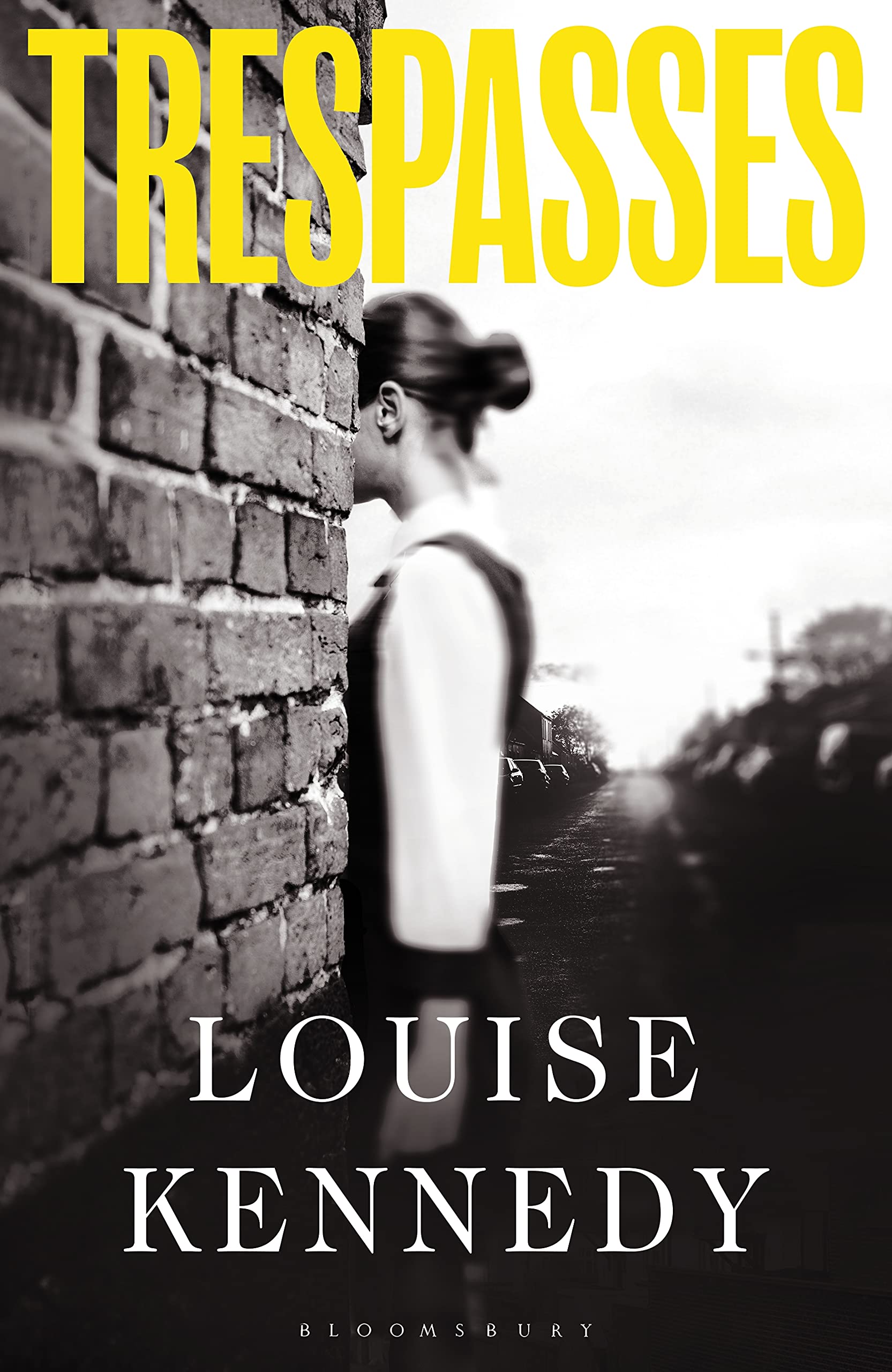
Trespasses by Louise Kennedy

Book Cover

Trespasses by Louise Kennedy was published in 2022 and it was shortlisted for the Women’s Prize for Fiction in 2023. The book begins in 2015 but swiftly moves back in time to Belfast of the 1970s.

Cushla is 24 and a Catholic primary school teacher, but she also helps out as a barmaid in the family pub. That’s where she meets Michael, he’s a 60 year old barrister who is happy to take on any legal cases, be they for Catholics or Protestants, including IRA members. Cushla is immediately attracted to him despite the age difference, religious difference and the fact that he is married.

Cushla is still living at home with her alcoholic mother, her brother Eamonn doesn’t realise how out of control their mother is. He runs the pub and is married with young daughters and he is totally unaware of his sister’s relationship with Michael.

As often happens with teachers of young children Cushla becomes involved with the family of young Davy, one of her pupils. He’s looked down on by the whole class because his mother is a Protestant, and as they live in a Catholic area she can’t hang washing out on the line as the charming neighbours pelt the clean clothes with shit. It means that her children’s clothes have absorbed all the smells of her cooking and mustiness as they take so long to dry indoors. Davy is a poor wee soul, looked down on by his classmates, and particular the nasty school priest, but Cushla befriends the family which only leads to more problems for them.

There’s only going to be one sort of ending to this tale, a sad one, but a very common situation back in those days.

I was a bit trepidacious about reading this book as I’m of an age to remember the beginnings of ‘The Troubles’  in Northern Ireland, and then the common bomb scares which disrupted simple shopping trips for years. Then there were the genuine bombs when we moved close to London in the late 1970s, but this was a good read.

I was puzzled by one thing though. Cushla’s lover’s name is Michael, a Protestant lawyer. As I grew up in the west of Scotland which at that time had a very similar Catholic/Protestant ‘tradition’, names were descriptive things and anyone called Michael would definitely have been a Catholic, so it seemed a strange choice for a Protestant by the author.

Thankfully there have been so many ‘mixed marriages’ over the last few decades that have gone a long way to the demise of that toxic sectarianism, in Scotland anyway.

Mr Mac and Me by Esther Freud – 20 Books of Summer 2024

Mr Mac and Me by Esther Freud was first published in 2014, by Bloomsbury. I had meant to read this book when it first came out, not ten years later. It’s one of my 20 Books of Summer.

It’s well known I think that Charles Rennie Mackintosh and his wife Margaret MacDonald Mackintosh moved from Glasgow to Suffolk when his career in architecture had ground to a halt.  As World War One progressed they got into trouble with the authorities as some of the locals decided that the strange couple with the odd accent (Scottish) must be spies. Esther Freud has woven a story around them, embroidering what had happened to them there and how it impacted on them, as seen through the eyes of Thomas Maggs, a young boy with a damaged foot, something that he has in common with CRM.

Thomas lives on the Suffolk coast, his father is a publican, he’s abusive as a father and husband, and of course he has a drink problem, so Thomas doesn’t have a good relationship with him. When Mackintosh and his wife arrive in the area Thomas is attracted to the couple who show an interest in his own drawings and befriend him.

The Mackintoshes have money problems and Mac can’t even sell his exquisitely painted botanical art, never mind get architecture commissions, to make matters worse there are problems within Margaret’s family so she has to be away in Glasgow at times.

I enjoyed this one although it is tinged with sadness as the war takes its toll of the locals. There’s some lovely writing, descriptions of flowers, scenery and seascapes.  But as you would expect The Glasgow School of Art also features and in the author’s acknowledgements at the end of the book she adds her own ‘heartfelt appreciation of the Scottish Fire and Rescue Service for the skill, courage and determination they showed in overcoming the blaze that raged through the Glasgow School of Art just as this book was going to press.’

Of course fire came back again for a second bite of that building, such a tragedy. The remains, just a shell, are still wrapped in plastic, waiting for some sort of decision. It’s a deeply depressing sight.


Balvenie Castle, by Dufftown, Moray, Scotland

We were out and about in the far north-east of Scotland for a few days a couple of weeks ago, and one of the many places that we squeezed into those three nights away was a visit to Balvenie Castle near Dufftown. It’s in the middle of nowhere up a quite scary steep and very narrow road, and when we reached the castle it was shut! It doesn’t open on Monday.

Balvenie Castle, by Dufftown, Moray, Scotland, Black Douglas

Anyway, we were undaunted as we were able to step over the fence easily to have a closer look, we kept well away from the back as per instructions, and as we’re Historic Scotland members we weren’t doing them out of any money.

Balvenie Castle, near Dufftown, Moray

We were only there for a few minutes.

Balvenie Castle, near Dufftown, Moray

I took the photo below through the gate, as you can see it has a nice barrel vaulted roof.

Balvenie Castle, near Dufftown, Moray, Scotland

Balvenie Castle was owned by a few prominent Scottish families in the past, including the notorious Black Douglases from 1362 to 1455. It’s a very scenic ruin, unfortunately the photo that I took of the farmland nearby came out too fuzzy to use. As ever, click on the photos if you want to see them enlarged.

Balvenie Castle, near Dufftown, Moray

I’ve just realised that this castle is actually owned by an absent American from Atlanta, Georgia! It is just managed by Historic Environment Scotland.


.