The Willow Tea Rooms, Sauchiehall Street, Glasgow

Last week we had a couple of days away over in the west of Scotland, and on one of the days we took the train to Glasgow, something that Jack used to do on a daily basis and I did at least once a week, it was a bit of a nostalgia trip, despite the trains being completely different. Anyway, we were aiming for The Willow Tea Rooms in Sauchiehall Street. They were designed by Charles Rennie Mackintosh, they had been fairly recently refurbished, and have now been taken over by the National Trust for Scotland.

The Willow Tea Rooms, Sauchiehall Street , Glasgow, Charles Rennie Mackintosh

As you can see from the photo below, the pedestrianised area of the street is having work done on it at the moment, the whole place is a mess and as usual there didn’t seem to be any actual work going on, you have to be quite determined to reach the tea room!

The Willow Tea Rooms, Sauchiehall Street, Glasgow, Charles Rennie Mackintosh

We were sitting right at the window but as you can see from the photo below they have it screened by curtains so you don’t see people going past, and they can’t see in.  It was a very busy Friday lunchtime so the place was packed downstairs, but the food was good.

Charles Rennie Mackintosh, The Willow Tea Rooms, Margaret Macdonald, Sauchiehall Street, Glasgow

The staff must be well used to people going around taking photos of the decor, as nobody batted an eyelid when Jack did that. I love the details, Mackintosh was quick to give his wife Margaret Macdonald the credit  for designing and working many of the textiles that feature in ‘his’ work

The Willow Tea Rooms, Sauchiehall Street, Charles Rennie Mackintosh, Glasgow

The Willow Tea Rooms, Charles Rennie Mackintosh, Glasgow, Sauchiehall Street

In the 1970s and 80s the tea rooom was shut and it was being used by Carrick the jewellery shop. They specialised in silver jewellery which was inspired by Mackintosh’s designs. It was more successful than many others and nowadays you can still buy some of the jewellery on Ebay and in ‘antique’ shops. There is an awful lot of ‘Mockintosh’ stuff around though which isn’t so pleasing to the eye – or my eye anyway.

The Willow Tea Rooms, Charles Rennie Mackintosh, Sauchiehall Street, Glasgow

Have you ever been in a tea room which actually had a bell on the table to summon assistance?  Everyone was very attentive so they weren’t really necessary.  Mind you I didn’t hear one actually being used!

The Willow Tea Rooms, Sauchiehall Street, Glasgow, C.R. Mackintosh

The photos above and below are of the second floor room which wasn’t being used at the time, it’s a sort of gallery and you can look down to the ground floor from there. There is another floor above that one which I suspect is used for special occasions like weddings – maybe.

Upper level The Willow Tea Rooms, Sauchihell Street, Glasgow Charles Rennie Mackintosh

Anyway, this visit was something that we had been planning to do for ages, then along came Covid and it was postponed yet again. We’ll go back for another visit sometime, the desserts were delicious!

Alcester, Warwickshire

I can hardly believe that it’s 12 years since we first visited the small town of Alcester in Warwickshire for the first time. We have a grandfather clock which was made there according to its face, and as we had never heard of the place we decided to go and have a look at it.

Alcester , Warwickshire, Tudor houses

We really liked the town, it had a lovely atmosphere so we weren’t surprised to discover that it had made it to the top of a survey of best places to live in in England. It’s full of chocolate box Tudor houses, which all seem to lean into each other as if they are holding each other up.

Alcester, Warwickshire, Tudor houses

Sadly on our recent visit the pub had obviously had a very serious fire in its roof space as you can see below, but it was being fixed, not pulled down as so many much more recent buildings have been. The building to the right of it looks much more modern but it might just have been modernised over the years, I suspect that originally most of the buildings in the centre of Alcester would have had thatched roofs.

Alcester , Warwickshire, Tudor houses

We had a look at St Nicholas Church. Some people had been hard at work creating this tapestry/needlepoint of some of the local buildings. I’m not sure what it had to do with religion but it’s very attractive anyway.

Alcester Church Tapestry

Alcester (pronounced Aulster) is quite close to Stratford-upon-Avon.

I have posted about it previously, here and here.


Visiting art exhibitions

This coming week we’re going to Edinburgh to visit a couple of art exhibitions before they close, the time seems to go so quickly nowadays. So we’ll be going to the City Art Centre which is just at the back of Waverley Railway Station to see the    Exhibition, and then on to the National Gallery on Princes Street to see The Printmaker’s Art from Rembrandt to Rego exhibition.

But soonish we hope to be travelling further afield, weather permitting, maybe even down to England, so I’ve been doing some research. There are plenty of places we haven’t visited before. As a good Scot I like to get my money’s worth, and as a member of the Scottish National Trust and Historic Scotland I/we can get into the English versions free too.  I’ll be happy to get recommendations from any of you who have enjoyed days out in any of them.

English Heritage Collections

National Trust Collections 


Dumbarton Castle – info boards

If you want to see some photos of the castle, including the Georgian part which I took back in 2018 on a blue sky day have a look here.

Dumbarton Castle, info board

There are plenty of information boards to read if you visit Dumbarton Castle. If you want to read them more easily click on the photos.

Dumbarton Castle, info board

The photo below was taken from inside the guard room which has only fairly recently been opened to the public.

Dumbarton Castle, guard room

Royal Progress, info board, Dumbarton Castle


Mary's Cause, Dumbarton Castle

Dumbarton Castle has had famous prisoners over the years, including William Wallace and Mary, Queen of Scots.  I believe that it was one of the many places that she managed to escape from. In fact she escaped from so many places that I suspect that it was a bit of a cat and mouse game which was being played on her.

Held Captive, Dumbarton Castle


Dumbarton Castle and environs

Dumbarton Football Club ground

Back in September Jack wanted to go to Dumbarton to watch a football match there, he’s a loyal supporter of Dumbarton Football Club – through thick and thin and at the moment it’s quite thin! Anyway, I’m not a huge football fan so I opted to visit Dumbarton Castle which is situated right at the football ground. As you can see below the info board names it Dun Breatann, Fortress of the Britons. Over the years the town which grew around the fort became known as Dumbarton, it’s a bit easier to say I suppose.

Dumbarton Rock info board

Although it’s called a castle it isn’t anything like Stirling or Edinburgh, but in its day it was one of the most important fortresses in Scotland. Ships sailed from here to France and elsewhere. Mary Queen of Scots sailed for France from the castle, she was also imprisoned here, and of course escaped. There have been lots of drawings of the area over the centuries and in some of them the patch of grass in the photo below has a house on it, it was demolished long ago. Behind the wall to the right are steps, when I was wee they used to say there was a step for every day of the year but now they say there are over 400. As a wee girl I tried to count them, but I always got a different tally.

Dumbarton Castle, Dumbarton Rock

And here are some of the steps in the photo below, these ones are right at the beginning and are possibly some of the steepest. It’s not a good place to visit if you aren’t good with stairs! On the other hand it will keep you fit.
Dumbarton Castle stairs, Dumbarton Rock

The photo below is of a small part of the rock face. The whole thing is a volcanic plug.

Dumbarton Rock face, Dumbarton Castle

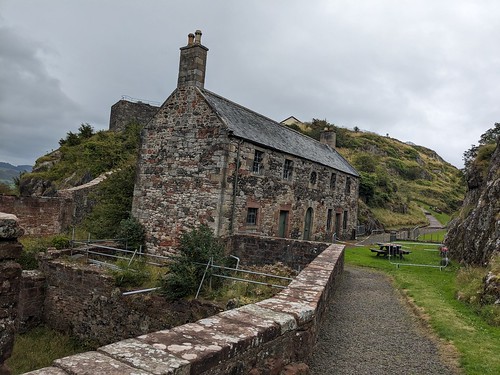
At the moment some areas are cordoned off. The building below is known as the French Prison because during the Napoleonic wars it was used to house French prisoners, it’s apparently going to be refurbished and will then be open to the public, it never has been in my lifetime.  The sunken area below with the metal bars in it is part of it too but is in much worse condition.

French prison, Dumbarton Castle


French Prison, Dunmbarton Castle

More rockiness!

Dumbarton Castle, Dumbarton Rock

There are still cannons in place. This has always been a very strategic place, at the confluence of the River Clyde and River Leven.  The Romans were here, and the Vikings and it’s amazing how often it’s mentioned in historical fiction.

Dumbarton Rock, Dumbarton Castle, cannons

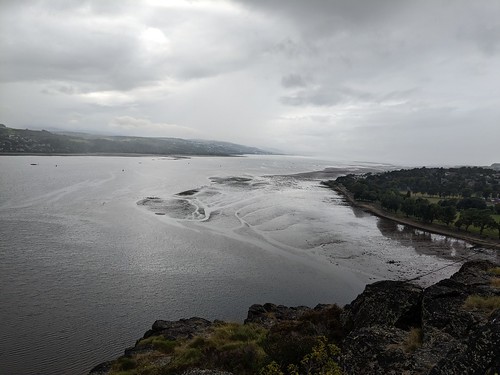
It was low tide at the River Clyde when I was there.

Dumbarton Castle, Dumbarton Rock, River Clyde


Dumbarton Castle, River Clyde

Below is a photo of some of the stairs seen from above. The small white building is a guard house and that hadn’t been open to the public before. Looking at this photo it strikes me that you need a head for heights!

Dumbarton Castle, Rock

Below is the River Clyde again. It’s a pity it was such a grey day as the views are spectacular when it’s bright.

River Clyde, Dumbarton Rock

Looking to the other side of the river in the photo below is a small part of the town, Dumbarton. I lived close to this area and it was my playground when I was a wee girl, but all of these houses and flats are new, sometimes the rivers pay them a visit!  The Sunderland aircraft factory took up a lot of the land where these houses are now.

Dumbarton

If you cast your mind back to when Prince Harry and Meghan Markle got married you might remember thet the Queen bestowed the Scottish title on them of Earl and Countess of Dumbarton on them. It was supposed to be an honour for the town I’m sure but they were unimpressed. It was expected that they would pay a visit to Dumbarton soon after they married as that’s what normally happens, but apparently (if you can believe the tabloids) the couple took it as an insult instead of the honour it was meant to be – something to do with the word ‘dumb’ apparently. Honestly, how daft can you get!


Aberdour Castle doocot (dovecote) in Fife

We visited Aberdour Castle one afternoon  last month, we hadn’t been there for years and it looked like quite a lot of work had been done in the gardens. Below is a photo of the dovecote – or as we say in Scotland the doocot (dookit). This is obviously a beehive type construction, they are various different designs but I think this is the most elegant kind. I would love to have seen the structure which was on the right hand side of the grass, it looks like it was a wall with pillars, going by the outline, but is long gone now.

Aberdour Castle, Doocot + grounds, Fife

As you can see, inside the doocot is ringed with stone shelves which have nesting niches for the pigeons to nest in – or doves if you want to be posh. They were important sources of meat for the castle inhabitants, especially during the winter months when hunting wasn’t so easy.

Aberdour Castle, Doocot interior

I’ll do another post about the castle soon.


The Royal Crescent, Bath

We did quite a lot of walking when we were in Bath, the Royal Crescent was one place we had to visit. It was quite  a hot day and there were lots of people relaxing on the patch of green which is opposite the Georgian houses. The crescent was designed by John Wood, the younger between 1767 and 1774. The photo below is a stitch of two photos I took on my phone.

Royal Crescent, Bath, a stitch

The stone that most of the buildings in Bath were built with is cream coloured, and apparently isn’t really ideal for house building, but over they years it has kept a lot of stonemasons busy, replacing blocks which were ravaged by the weather and would have become porous. I think it’s a type of sandstone.

Below is a photo of the right hand end of the crescent which Jack took on his camera. I’m sure if it had been on my phone I could have removed all of the people from it. Anyway, as you can see it’s quite a busy area. After  complaints from the residents about noise from traffic and particularly tourist buses with commentary, traffic has been restricted. I bet the residents of Edinburgh would love it if the same thing happened there. Traffic on cobbles makes life very noisy for them.

end of Royal Crescent, Bath, Georgian houses

I had been under the impression that Bath had avoided being bombed during WW2, but apparently it was bombed during what were called The Baedeker Raids – after the famous tourist guide books. Previously I had read that Hitler had wanted to keep Bath intact as he had plans to make it his British headquarters! Anyway, this crescent has featured in quite  a few films and Bridgerton, but Jack was not too impressed. He didn’t like the grassy patch of land opposite which was full of people. I can see that that might not be a great view for the people living in the houses. On the other hand most of the Georgian houses in Edinburgh have a road between them and the private gardens opposite which only the house owners  are able to get into, they’re well locked up, iron fenced and hedged around so you can’t even see in!

Anyway, if you visit Bath the crescent is definitely worth a look, it isn’t a long walk from the centre of the city.

The houses in the photo below are just to the left hand side of the crescent. As you can see, one of them has had a strange sort of balcony added on to it, instead of the more usual small cast iron balconies.  It looks a bit incongruous.

By Royal Crescent, Bath

Avebury, Wiltshire, England

Avebury Stones , Neolithic, Wiltshire, standing stones

We had no intention of visiting Avebury during our fairly recent trip down to the south west of England, but when we saw a roadsign which indicated we were staying just seven miles from Avebury we obvioulsy had to go there. You don’t have to pay to get into the fields but if you are parking a car then you pay for parking, I think it was £7, however – if you are a member of the National Trust or Scottish National Trust parking is free. Below is a photo of Jack beside one of the standing stones so you can see how enormous some are.

Avebury, standing Stones,Wiltshire+ J

We’ve been to visit a fair few standing stones but none as massive as these ones.  They’re also very rough  and don’t seem to have been worn down by the weather. I was also struck by the difference in the situations in the landscape. In Orkney you can stand in one of the neolithic stone sites and see two others in the distance, but in Avebury it seems that they wanted things to be hidden. Massive ditches have been dug out around the fields, it looks like that might have been done to keep people in those fields, escape wouldn’t have been easy, probably impossible. You don’t really get the idea of how deep this ditch/rampart is from the photo below.

Avebury Rampart , standing stones, Neolithic, Wiltshire

Avebury Rampart ,Neolithic, Wiltshire

For me that added to an atmosphere of unease and danger. This could of course be my imagination running rampant!

But I must admit that when I saw a few women leaning against the stones with both hands – for ages, emulating Claire  from Outlander, obviously hoping for a similar experience, I found it really funny.

Avebury, standing Stones , Neolithic, Wiltshire


Avebury, standing Stones, Neolithic, Wiltshire

Otherwise, Avebury is a lovely wee village with a few shops, pub and church.

Avebury, Thatched Cottage

And some very quaint houses.

Avebury,Thatched Cottage 3


Avebury house


Bradford on Avon, Wiltshire

Bradford on Avon Street, Wiltshire


Swan Hotel, Bradford on Avon

Bradford on Avon is a small town, hilly and quaint, and it wasn’t until our last morning there that we actually found time to explore it as we had been so busy going elsewhere. It’s a good base for touring the area.

Bridge tea rooms , Bradford on Avon

While I was doing a bit of research into the place I discovered that The Bridge Tea Rooms have won a ‘best tea room’ competition this year – and not for the first time, obviously we had to check it out. As you can see it’s housed in a medieaval building, you have to stoop to get through the door, even if you are small. It’s steeped in mock Victoriana kitsch, which might be what had attracted the competition judges, but it didn’t come up to the standards of any of the tearooms that we frequent in Scotland, where it’s normal to be given a choice of flavours of home-made jam with your scone. I could go a lot further but I’ll leave it at that! Possibly it won a competition for Victorian style tea rooms.

Bridge Tea Rooms, Bradford on Avon

Bridge Tea Rooms , Bradford on Avon

If you are into books and you are near the town you will definitely enjoy visiting the shop Ex Libris. Within about seven minutes I had found seven or eight books that I just had to buy.

If you  love rivers and bridges as I do it’s almost worth visiting the town just for a look at this ancient bridge. We enjoyed our visit but it’s a ‘once in a lifetime’ visit for us as it’s a long drive from home.

Bridge, Bradford on Avon,

Kennet and Avon Canal at Bradford on Avon, Wiltshire

On our recent trip down south we stayed for three nights at The Barge Inn at Bradford on Avon in Wiltshire. It’s a scenic small town and is well placed for exploring the area. As you would expect we were right by the canal which turned out to be interesting, although I am now absolutely sure that I never want to go on a canal holiday!

Barge Inn ,Bradford on Avon, Wiltshire


Canal + Barge Inn, Bradford on Avon, Wiltshiree


Kennet and Avon Canal , Bradford on Avon

It’s far too much like hard work and it seems that it’s the women who have all the heavy stuff to do, such as getting the lock gates open – while the men just pose about on the back of the barge with their hand on the rudder, watching. It’s the Kennet and Avon canal.

I was surprised that these two barges could get through the canal lock at the same time, below.

Kennet and Avon Canal, Bradford on Avon

We went for a bit of a walk along the canal and saw this lovely family of swans, it’s amazes me that they can stay so white when the water is so mucky (the adults).

Swans, Kennet and Avon canal, Bradford on Avon

I was surprised to see the remains of a World War 2 pill box by the side of the canal, I don’t know why because they still have them by railway lines in Fife. No doubt during the war the Home Guard would have been in them, ready to defend the area if any Nazis managed to reach the place. Luckily there was no invasion but everyone at that time was terrified that there would be, but determined literally to fight them on the beaches.

WW2 Pill box , Kennet and Avon canal, Bradford on Avon

WW2 Pill Box , Kennet and Avon canal, Bradford on Avon