The White Queen by Philippa Gregory

The White Queen by Philippa Gregory begins in 1464 when the York and Lancaster cousins are at more than daggers drawn. The king of the moment is Edward IV of York. It’s a well known tale of how he was waylaid by an older and beautiful widow Elizabeth Woodville, already the mother of two sons. Unlikely as it may seem, she managed to get the highly promiscuous Edward to actually marry her. Edward had been expected to make a lucrative marriage alliance with a foreign princess, probably French.  His choice of wife is very unpopular, particularly by Warwick, and the gossipers say that Elizabeth must have bewitched him in some way.  Elizabeth and Edward set about arranging marriages for her relatives with powerful families, much to the fury of courtiers who had been hoping to marry their offspring to them.

Eventually Elizabeth’s luck runs out and she’s forced to take sanctuary at Westminster and even has to give up her eldest (Grey) sons who are placed in the tower and probably murdered there. But according to Elizabeth she had substituted her eldest son with a page boy, and sent her son abroad, we’ll never know though.

I quite enjoyed this one but I think I’ll have a rest from historical fiction for a while. I was slightly put off because when I reached page 125 I was astonished to read Cecily’s favourite son being described as: ‘An utter numpty’. CLUNK I checked just to make sure and as I thought – the word ‘numpty’ was first coined in 1985, Glaswegian dialect, so it’s astonishing to read a character in 1470 using the word! That really should have been picked up by an editor, but Gregory should have realised it is a modern word.

A Flute in Mayferry Street by Eileen Dunlop

A Flute in Mayferry Street by Scottish author Eileen Dunlop was first published in 1976.

Marion and Colin Ramsay live with their mother in a Georgian house in Edinburgh’s New Town, their father is dead and life is difficult, there’s never enough money.  The house they live in has been in the Ramsay family for generations and their mother doesn’t really know too much about the history of the house. Everything in the house had belonged originally to the previous Ramsays.  Marion has left school, she had an accident and damaged her spine and is now paralysed. The doctors had been hopeful that given time her damaged nerves would mend, but it has been a few years now and she’s giving up hope and is sinking into a depression.  She has also become scared of being in the house on her own as she keeps hearing someone playing what sounds like a flute – in the empty house. She won’t go out in her wheelchair and her only friends are the lodgers, a young couple whose rent helps with the family budget.

The housework is proving to be never ending for Mrs Ramsay and she asks Colin to dust and sort through the books in the bookcase, it’s full of things that have just been stuck on the shelves too, and shouldn’t be there. Marion helps too and that’s when she finds an intersting letter dated 1914.  This leads to a bit of a treasure hunt although they don’t know what they’re looking for.  Marion is interested in life again.

The blurb on the back says:

A Flute in Mayferry Street has all the ingredients of a classic ghost story, mixed with the harsh realities of a life set apart, and its implications for those around. An inspiring tale of the magic of dreams and the power of the supernatural.

I really enjoyed it.


The Lady of the Rivers by Philippa Gregory

The Lady of the Rivers by Philippa Gregory was published in 2011. It’s part of the author’s fictional Three Cousins’ War series. I decided to read it after I read her essay about Jacquetta in the book which I reviewed here.

It begins in 1430 at the Castle of Beaurevoir near Arras and Joan (of Arc) has just been billeted there as part of the houshold, which includes Jacquetta who despite just being 15 or so has been married off to the much older Duke of Bedford,  Regent of France and uncle to the young English King Henry VI. It’s a marriage in name only as the duke just wants to use Jacquetta’s gifts.

Jacquetta is supposedly descended from Melusina, the river godess and can sometimes see the future, a dangerous trait to have when women in particular can easily be accused of being witches. There’s nothing that she can do for Joan when she herself is accused of witchcraft.

With the death of her husband Jacquetta is free to marry Richard Woodville, her husband’s squire, although they end up having to pay a fine because Jacquetta shouldn’t have married out of the aristocracy.

When they return to England they’re warmly welcomed by the king and so begins their life at the court, never an easy place to be but it has its compensations. Richard is made a baron and is given an estate, mainly because Jacquetta is a favourite with the queen.  It’s the royal couples worst habit, handing out goodies to courtiers for no good reason which incenses those who might be more deserving of notice. Jealousy and anger abound, it’s a recipe for disaster.

Jacquetta seems to have been some sort of superwoman as she had at least 14 children, would hardly have had time to get over one pregnancy before she was pregnant again and still managed to pack a lot into life, supporting the king. But war was never far away and changes mean danger.

I must admit that I had never even heard of Jacquetta until recently, it’s really sad the way strong women have been overlooked by historians. Although this is a work of fiction the author has done plenty of research and woven an entertaining story around what is known.

Bradford on Avon, Wiltshire

Bradford on Avon Street, Wiltshire


Swan Hotel, Bradford on Avon

Bradford on Avon is a small town, hilly and quaint, and it wasn’t until our last morning there that we actually found time to explore it as we had been so busy going elsewhere. It’s a good base for touring the area.

Bridge tea rooms , Bradford on Avon

While I was doing a bit of research into the place I discovered that The Bridge Tea Rooms have won a ‘best tea room’ competition this year – and not for the first time, obviously we had to check it out. As you can see it’s housed in a medieaval building, you have to stoop to get through the door, even if you are small. It’s steeped in mock Victoriana kitsch, which might be what had attracted the competition judges, but it didn’t come up to the standards of any of the tearooms that we frequent in Scotland, where it’s normal to be given a choice of flavours of home-made jam with your scone. I could go a lot further but I’ll leave it at that! Possibly it won a competition for Victorian style tea rooms.

Bridge Tea Rooms, Bradford on Avon

Bridge Tea Rooms , Bradford on Avon

If you are into books and you are near the town you will definitely enjoy visiting the shop Ex Libris. Within about seven minutes I had found seven or eight books that I just had to buy.

If you  love rivers and bridges as I do it’s almost worth visiting the town just for a look at this ancient bridge. We enjoyed our visit but it’s a ‘once in a lifetime’ visit for us as it’s a long drive from home.

Bridge, Bradford on Avon,

My Brother’s Keeper by Tim Powers

My Brother’s Keeper by Tim Powers has just recently been published and Jack was sent a copy of the book for review in ParSec, He thought that I would be interested in reading it as it involves the Bronte family. I did quite enjoy it, especially at the beginning. It eventually took me a bit out of my usual orbit – no bad thing now and again I suppose. The book is well written and apparently the author is regarded as one of the founders of Steampunk.
The history of the Bronte family is well known and the author has taken the facts and written a fantasy/horror tale around them. The family is down to just the three sisters and Branwell, plus Patrick the father. They’ve all had their time away from The Parsonage and are back home, things hadn’t gone well for any of them and Branwell has been taken over by his addiction to alcohol. While he was away in London (on a three day bender) he had somehow been sought out by people who knew who he was although he didn’t know them. They damaged his hand and recruited him unwillingly as a – werewolf!!

It turns out that he wasn’t the only one in the family to be targeted, it has been going on for two generations, and their father Patrick has been trying to keep werewolves and ghosts at bay for years, hence his habit of firing bullets at the church every morning!

The blurb on the back says:

Though the future will celebrate Charlotte, Emily and Anne, right now they are unknown,, their genius concealed. In just a few short years they will all be dead, and it will be the middle sister Emily’s chance encounter with a greviously wounded man on the moor that sets them on the path to their doom.

For there is an ancient pagan secret haunting the moors, a dark inheritance in the family bloodline and something terrible buried under an ogham-inscribed slab in the church. Not only are their lives at stake, but their very souls.

I ended up quite enjoying the book although I’m not at all into werewolves, ghosts and dark magic. It was a wee bit spooky that the book features Sulis Minerva, just after we had seen her image at the Roman Baths in Bath though.

It was an apt read for the Halloween season.


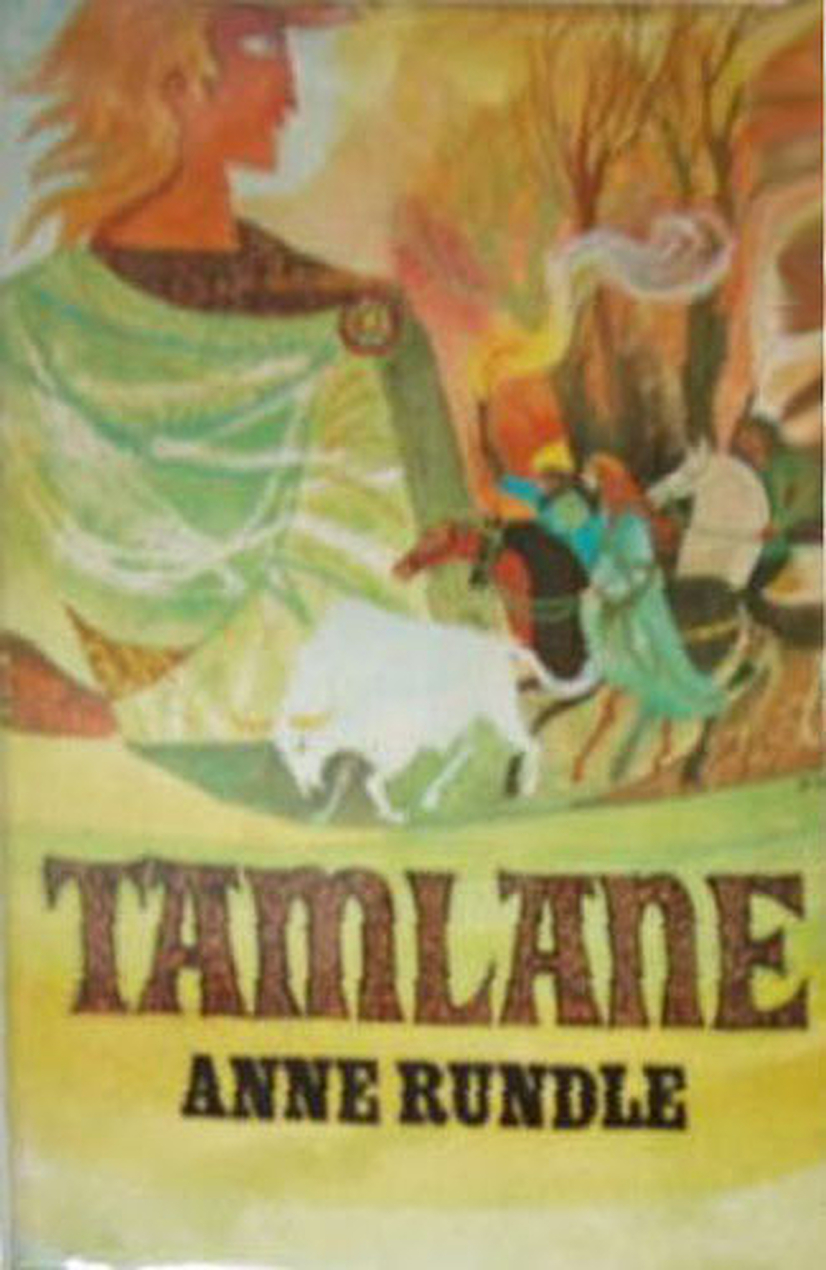
Tamlane by Anne Rundle

Tamlane by Anne Rundle was first published in 1970. The setting is Halloween/Hallowmas in the Scottish Border country.

Seonaid was born at Hallowmas, it’s her 17th birthday and she’s the daughter of  a Border Chieftain.  Her mother died on the night she was born and she’s looked after by her nurse Anna who has warned her never to wander far from her home at Hallowmas as it’s the night the spirits are abroad.

Anna is preparing for the Hallowmas/birthday gathering when Seonaid asks her if she can ride out on her horse, but Anna says she must take Wat with her, he’s part  of the household. But Seonaid is determined to get away on her own and she manages to do so by duping him, and so begin all her troubles.

She finds what she thinks is a talisman in the woods. When she meets a tall young man Seonaid assumes that it’s his talisman and he is looking for it, but when she offers it to him he seems afraid of it and backs off. His name is Tamlane and Seonaid can’t stop thinking about him. As people born on Hallowmas have the second sight she wonders if he was real, or did she imagine him? The Hallowmas gathering ends in disaster which starts a feud between families and more disaster. Seonaid has to fight with elves and fairies.

This is a fantasy which is loosely based on the folk tale Tam Lin

It was a good Halloween read, although not particularly a happy read. I had completely forgotten that when I was a wee girl we called the face masks we wore at Halloween  ‘false faces’. It brought back the memory and even the smell of them – not at all a nice smell, but I quite enjoyed the book which I must admit I bought because I liked the cover design.

Secret Water by Arthur Ransome

Secret Water by Arthur Ransome was first published in 1939.  It’s the eighth book in the Swallows and Amazons series and the setting is islands just off the  Essex coast.

A planned sailing trip with their father has to be postponed when he is called away on naval duty.  The children are desperately disappointed so to make up for it their father maroons them on an island and tells them to map the whole area naming any geographical  areas of interest, creeks and islands.There is a farm nearby so at least they’ll have access to fresh milk.  As ever though they’re well off for food and equipment and in no time they’re all set up in their camp. Bridget, the baby of the family, has been allowed to take part in a family adventure for the first time.

The whole place is very tidal and the mudflats appear and disappear, making it a dangerous place to be sailing around, but almost immediately they make friends with a local who can give them tips on how to cope with the tides. They name their new friend ‘the Mastodon’ as they had seen his giant footprints in the mud before they met him and had speculated as to what had made such large prints. He wears ‘splatchers’ which are like huge snow shoes but specially for walking on the mudflats safely.

It turns out that the Mastodon is part of another gang of child sailors who call themselves Eels, and the others aren’t keen on joining up with the newcomers, but of course everything works out fine in the end.

I didn’t enjoy this one as much as the books which are set in the Lake District, probably because I really dislike mudflats, and the children were always dripping with mud. There was no mention of smell, but I could smell those mudflats, because they always stink – not pleasant.


Samuel Johnson’s birthplace, Lichfield

After we visited Lichfield Cathedral we had a swift look around the town and walked across the historic market place. where according to the blue plaques quite a lot has gone on over the centuries, including poor souls being burnt at the stake in the 1550s, during Mary Tudor’s reign.

It looks like neither Jack or I managed to take a photo of the house from the outside but you can see it on their website here.

When we visited the member of staff, probably a volunteer,  was very friendly and helpful. I managed to buy a couple of books there, but nothing Johnson or Boswell related. The only such book I have read in the past is Journal of a Tour to the Hebrides, definitely entertaining.

Samuel Johnson of dictionary fame was born in this house which was built by his father. The bottom of the house is a bookshop and gift shop, but you can wander all over the rabbit warren of a house which has plenty of interest on show, related to Johnson. It also has a bureau bookcase  which belonged to James Boswell and came out of his family home Auchinleck House in Ayrshire, Scotland.

Samuel Johnson , birthplace Lichfield

James Boswell stands in one corner of the marketplace.

James Boswell, Lichfield marketplace,

At the other side of the marketplace stands Samuel Johnson, overlooking his birthplace.

Samuel Johnson, Lichfield ,marketplace

I believe that the photo below is of the room that Johnson was actually born in.

Samuel Johnson , Johnson's birthplace


Samuel Johnson , birthplace

Johnson left a large part of his estate to his manservant Francis Barber who had been born into slavery.

Samuel Johnson, Francis Barber, slavery, Lichfield

Samuel Johnson’s birthplace in Lichfield is definitely worth a visit – and amazingly it’s free although they will obviously be thankful for a donation. They also had a copy of Johnson’s Dictionary on display which you could thumb through to see his definitions of words.

Samuel Johnson  Dictionary, birthplace, dictionary


Limbo Lodge by Joan Aiken

Limbo Lodge by Joan Aiken was published in 1999 and it’s part of her Dido Twite series, coming after The Wolves of Willoughby Chase, but I don’t think it’s really necessary to read this series in strict order.

Dido had been about to sail for the Port of London when the ship’s captain had been ordered to find Lord Herodsfoot and pick him up too. So they had to sail to the island of Aratu also known as the Island of Pearl Snakes. As they approach the island all of the cockroaches abandon ship as they’re the snakes’ favourite food.and they can smell them on the island.

Lord Herodsfoot has already left the island, bound for New Guinea and Australia, he’s searching for a game called Fish, Prawn, King Crab – it’s what he does.

As they try to track him down they get involved with all sorts of witchcraft, gods and natives who abandon girl babies. It’s a good read.

The Ipcress File by Len Deighton # The 1962 Club

The Ipcress File by Len Deighton is I suppose what could be described as being charmingly dated. It was the first spy novel by the author. I wondered how many readers would be flumoxed by this:

Getting Keightley to tell one the punch line immediately was like trying to get an aspirin without first removing the cotton wool. 

I’m sure you have to be a certain age!

Anyway, I enjoyed this one although as usual with spy novels you’re  (I’m) never quite sure what’s actually going on.

The Cold War is in full swing and the book’s unnamed protagonist has just recently been transferred from a military intelligence unit to one within the British intelligence services, reporting directly to the British Cabinet. Top biochemists are disappearing, it’s presumed they’ve been abducted by the Russians. There have been eight top rank disappearances within six and a half weeks. Who is masterminding it all?

I can’t say too much about the plot, but it features brainwashing, the CIA, a neutron bomb test, kidnap, mental torture and class distinction as the working class protagonist from the north of England is unimpressed by what amounts to the ‘old boy network’. There’s a wee bit of romance thrown into the mix too.

Len Deighton was inspired  to write this first spy novel because as an 11 year old he had had the experience of having as a neighbour a woman (Anna Wolkoff) who had been arrested as a spy. She had been a White Russian emigree but had ended up spying for the Germans during World War 2. Deighton witnessed her arrest by MI5 in 1940.

The Ipcress File was made into a film in 1965 and a TV series was loosely based on the book in 2022.