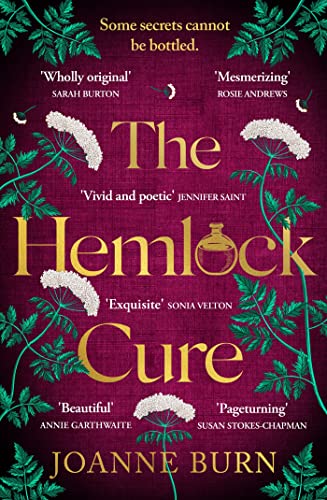
The Hemlock Cure by Joanne Burn 20 Books of Summer 2024

The Hemlock Cure by Joanne Burn was first published in 2022 by Sphere. The setting is Eyam in  England’s Peak District  in 1665/66. Apparently I’ve been pronouncing that village name wrongly for decades, it should be ‘Eem’. This is a book which I borrowed from the library, so it wasn’t on my original list of 20 Books of Summer, but I realised that I had inadvertently added three books to that list which I had already read, so I substituted this book for one of them.

Mae is the surviving daughter of Wulfric, a herbalist/apothecary and religious zealot, unhappy about the introduction of the new Book of Common Prayer by the king. Mae is keen to become her father’s apprentice but she’s kept busy with housework.  Her mother had died not long after she had given birth to a dead son. Isabel Frith is the local midwife and herbalist. Wulfric despises Isabel and seems to think that she caused his wife and son’s death, hinting at witchcraft. Unknown to Wulfric Mae is being taught herbalism by Isabel. He has taken on a young man as his apprentice, so Mae’s hopes for her future are dashed.

Obviously The Plague features in the book, but not to any huge extent, as does homosexuality. It was an enjoyable read.


Mayland Hall by Doreen Wallace – 20 Books of Summer 2024

Mayland Hall by Doreen Wallace was published in 1960. It’s one of my 20 Books of Summer. I had only just read a review of a Doreen Wallace book when this one popped up in a secondhand bookshop, otherwise I may not have bought it, but I’m glad that I did.

The setting is East Anglia, the Sculpher family makes a living from travelling around farms and woodlands of the area, cutting down any trees that the landowners want to be felled. It’s difficult work and the young women of the family are expected to do their fair share of felling too. They all live in ‘vans’ and the younger ones sleep under them, it’s a tough and spartan life.  One of the daughters is apt to lie down in a ditch with any man she can find, and those children are just seen as part of the future workforce by their grandfather. But one night Maud, another daughter doesn’t come home, she has legged it with one of the gentry. Sculpher is incensed.

The focus switches to Mayland Hall where Daniel and Mary Gooderham live.  The Sculphers do occasional work for them. The Gooderhams are ‘county’ people, an ‘old’ family and well-respected. They don’t have a huge amount of ready money but over the years they have built up more and more stocks of land, so they are land wealthy. In their society primogeniture rules, but Daniel’s elder brother had died in World War 2. He had been the one to get the expensive education while younger brothers just went to the local school. Apparently any daughters were also sent to expensive schools, to make them more likely to find a wealthy husband in the future! Janey, the daughter-in-law has cousins who are ‘honourables’ like the Mitfords and it has gone to her head, she’s a horror.

This was a good read, full of social history now as it is 64 years since it was written. It features the Gooderhams worrying about the new Death Tax when Daniel dies, and what they had to do to avoid it. This was something that a Labour government had brought in, in an effort to redistribute wealth. It reminded me that the Death Tax is often mentioned in Angela Thirkell’s books too.

Hop Scot by Catriona McPherson

Hop Scot by Catriona McPherson (Last Ditch series) was published by Severn House (Canongate Books) in 2023. I picked this one up recently from the New Arrivals shelf in my local library. I enjoyed the author’s previous Dandy Gilver series which is set in the 1920s/30s. This series is contemporary and unfortunately I’ve found it rather late because when I started to read it I realised that this one is sixth in the series, but I don’t think it’s really necessary to read them in order, although I wish I had.
Lexy Campbell is living in California but she’s travelling to Scotland to spend Christmas with her parents, and the Last Ditch Motel extended family is accompanying her. They’ve never been to Scotland before and they’re all geared up to spend their time in Dundee, but there has been a last minute change of plan and they all end up being driven to the pretty village of Yule not far from Edinburgh to spend Christmas at Mistletoe Hall. Lexy’s parents have bought it intending to run it as a posh B&B – after a lot of refurbishment.

This is a good mystery with lots of humour and quirky characters. I’ll have to go back to the beginning of the series though to get to know them all better. A lot of the humour revolves around the differences between American and Scottish society.

The blurb on the back says: Deadly secrets, berry rustlers, skeletons and a snowy Christmas Eve in the booze aisle at Tesco; the last Ditch crew won’t forget their Scottish holiday in a hurry.

On balance I preferred the Dandy Gilver series, for the setting.

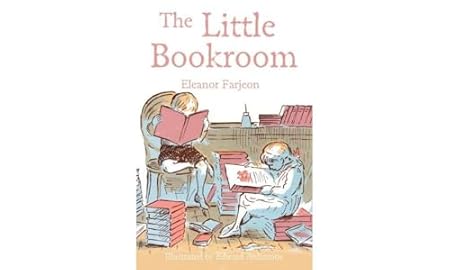
The Little Bookroom by Eleanor Farjeon – 20 Books of Summer 2024

The Little Bookroom by Eleanor Farjeon was first published in 1955, it is illustrated by Edward Ardizzone. It’s one of my 20 Books of Summer. This book won the Carnegie Medal.

There’s an Author’s Note at the beginning of this book, she explains that the house she grew up in was filled with books everywhere but there was one room which was called The Bookroom which housed ‘a motley crew of strays and vagabonds, outcasts from the ordered shelves below’. There was so much dust in that room it made her eyes smart, but it was still her favourite place to be. I must say that the whole house sounds like a wonderful place to grow up in.

Anyway, this is a book of charming short stories, suitable for children of all ages. some of them feel quite traditional in the fairly tale mode, and others are really different. I can see why it won the Carnegie Medal in 1955.

I’m doing well with 20 Books of Summer. I’ve read 14 so far, but still have four or five to review.

a flat place by Noreen Masud

a flat place by Noreen Masud was published in 2023 and it has been shortlisted for several prizes. It’s described as a memoir and Masud writes about her love of flat places, something which she first realised when she was being driven to school in Pakistan every morning by her mother. She longed for her first sight of a flat expanse of land which they passed by, it was something that her sisters didn’t even notice.
Later when family problems led her Scottish mother to leave Pakistan and take her daughters to live in Fife, where she had grown up, Masud went on to visit other flatlands such as Ely in Cambridgeshire, Orford Ness in Suffolk, Morecambe Bay, Newcastle Moor and Orkney, and here she writes of her experiences. Her love of stones, particularly hag stones, is something that I can understand, but where scenery is concerned I’m not so keen on flat vistas. In fact my definition of a good High Street is one where I can stand in it and look up and see soft, rolling green hills, which for me are comforting and enveloping. I remember reading somewhere years ago that the wide skies and flat scenery of Norfolk were thought to contribute to the higher than usual suicide rates in the county!

Masud can’t get away from her childhood traumas, she had grown up cloistered in one room with her mother and three sisters, except for when she went to school. She was in a strange position of not being part of the community that she is growing up in, not even being able to speak Urdu very fluently. Her father was a doctor and he wanted his daughters to grow up speaking English with no hint of a Pakistani accent.

Masud is still haunted by her upbringing, she was lucky in that her father regarded his four daughters as being his sons, and so was keen on them having a good education, but on the other hand he was still wedded to the more traditional morals of his own upbringing. It seems to have been a bit of a toxic mixture. In the end he cared more about what the neighbours/extended family thought than about his own family, luckily for the author and her mother.

I must admit that I learned quite a few things while reading this one, it’s so much more than a memoir. I’m sure it will win more prizes. I’m also sure that I read about this book on a blog, but of course I can’t remember whose it was. Thank you anyway.

There’s one flat land that I visited which I feel Noreen Masud would relish. When we visited Lindisfarne in Northumberland some years ago I watched several pilgrims walking across the the tidal mudflats to the Holy Island and the ruins of the monastery. Although not in the least bit religious I did think that it looked like it might be a good experience – if messy.

Noreen Masud is now a lecturer in 20th century literature at the University of Bristol.

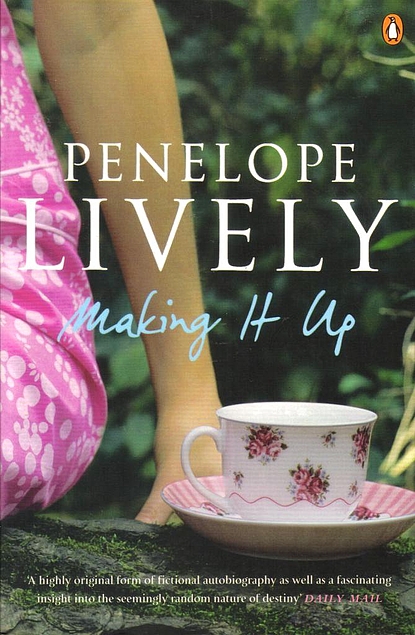
Making It Up by Penelope Lively – 20 Books of Summer 2024

Making It Up by Penelope Lively was first published in 2005. It’s one of my 20 Books of Summer.  This book is an exercise in ‘whatiffery’ something which we all indulge in from time to time I’m sure. What would have happened if I had taken another path in life, all those decisions that we take – or don’t take. It’s a really good read.

The blurb on the back says: Taking moments from her own life and asking ‘what if?’, Penelope Lively constructs fictions about possibilities and alternative destinies.

As you would expect she starts off with a story about her childhood, Mozambique Channel. Born in Egypt, she was caught up in WW2, when it looked like the Germans were going to be heading for Cairo, the civilians that could get on ships did so and sailed for South Africa, but the journey was a dangerous one.

In Imjin River the what if is about her husband who had been due to be sent to Korea as war had broken out there while he was doing his National Service.

Transatlantic is the one which spoke to me most I think as it is about leaving your own country to live elsewhere, and how that impacts on your life and experiences.

Other stories have the titles  – The Albert Hall, Comet, Number Twelve Sheep Street, The Temple of Mithras and Penelope.

These ‘what ifs’ are entertaining, but I found the explanations and the backgrounds which Lively has written for each one to be even more interesting.


Dissolution by C.J. Sansom – 20 Books of Summer 2024

Dissolution by C.J. Sansom was first published in 2003 and it’s the first book that I’ve read by the author, in fact it was only when I read his Guardian obituary when he died in April that I realised that I had almost certainly missed out on some really good reads. I think I did borrow one of his Shardlake books from the library before, but realised that it was part of a series, but never did get around to getting the first one, until now. I really enjoyed it.

The setting is England in 1537. It’s the year after Anne Boleyn’s execution and Henry VIII is beginning to dismantle the large network of monasteries that have managed to accumulate huge riches over the years. Henry is determined to strip them of their wealth and Thomas Cromwell has sent a young man to St Donatus Monastery to investigate their finances, but he is found dead there, he has been beheaded in the kitchen, and Cromwell sends Matthew Shardlake and his young apprentice to investigate the murder.

When they start to question the monks they soon realise that they are very far from being holy men, or even good men, the place is awash with sin, but which of them is a murderer?

This is an atmospheric read with a long snowstorm adding to the sense of menace as the monastery turns into a prison for Shardlake and his apprentice, trapped with  a murderer on the loose.

This was another of my 20 Books of Summer.


Six in Six – 2024 Edition


Jo at The Book Jotter is hosting Six in Six again and I’ve decided to take part,  it’s an enjoyable look back at what I’ve been reading over the first six months of the year. Joanne always suggests lots of possibilities of categories and I’m taking advantage of most of her suggestion.

Six authors new to me:

Rachel Ferguson  – A Footman for the Peacock

The Life and Death of Harriett Frean by May Sinclair

Charles Spencer – Killers of the King

Lin Anderson  – The Wild Coast

Flora Fraser – Pretty Young Rebel

Forest Silver by E.M. Ward


Six books that took me by the hand and led me into the past:

The Revolt of the Eaglets by Jean Plaidy

Sword at Sunset by Rosemary Sutcliff

The Winter List by S.G. MacLean

Across the Barricades by Joan Lingard

The Secrets of Blythswood Square by Sara Sheridan

A Footman for the Peacock by Rachel Ferguson


Six books from the non fiction shelf:

Notes from Walnut Tree Farm by Roger Deakin

Holloway by Robert Macfarlane

Pretty Young Rebel by Flora Fraser

The Salt Path by Raynor Winn

Landmarks by Robert Macfarlane

Women and Power by Mary Beard


Six books by Scottish authors:

The Redemption of Alexander Seaton by Shona MacLean

Green Willow’s Secret by Eileen Dunlop

The Fall of Kelvin Walker by Alasdair Gray

The Tenement by Iain Crichton Smith

Young Mungo by Douglas Stuart

Squeaky Clean by Callum McSorley


Six vintage crime books:

Uncle Paul by Celia Fremlin

Suddenly at His Residence by Christianna Brand

Green for Dander by Christianna Brand

Someone from the Past by Margot Bennet

Somebody at the Door by Raymond Postgate

Post After Post Mortem by E.C.R. Lorac


Six book titles containing female names:

Consider the Lily by Elizabeth Buchan

Harriet Said by Beryl Bainbridge

Madame Claire by Susan Ertz

Eustacia at the Chalet School by Elinor M. Brent-Dyer

Dimsie Grows Up by Dorita Fairlie Bruce

The Life and Death of Harriet Frean

Thank you Jo for hosting this, it’s always useful to have a look back.  I’ve been reading a lot of historical fiction over the past six months, more than usual I think. For the rest of 2024 I plan to mix things up a bit more, but reading plans often ‘gang agley’  – as we all know!


A Footman for the Peacock by Rachel Ferguson

A Footman for the Peacock by Rachel Ferguson was originally published in 1940, but was reprinted by Dean Street Press in 2016. It’s A Furrowed Middlebrow Book.

Sir Edmund Roundelay and his extended family, including his three elderly unmarried sisters, live in a stately pile called Delaye. It’s the beginning of World War 2 and everyone is expected to ‘do their bit’ which for the Roundelays means housing a large number of children and their teachers in the unused rooms of the house.  Lady Evelyn Roundelay is having a tough enough time coping with the running of the house as it is, the rules will have to be got around. For the first time the Roundelays are having to deal with people who have been given unexpected status due to their war work, it’s a bit of a knock to their sense of entitlement, but not for long.

In the past the Roundelays had been harsh employers, literally running their young footmen to death so that they could run ahead of their carriage to clear the way for it as they drove through villages, but there are still members of staff who are descendants of past servants working in the household, there hasn’t been much in the way of social movement.

This was an enjoyable read, the blurb on the back says that it was “controversial when first published in the early days of World War II, due to its treatment of a loathsome upper-crust family dodging wartime responsibility. It can now be enjoyed as a scathing satire of class abuses, a comic masterpiece falling somewhere between Barbara Pym and Monty Python.”

It was one of my 20 Books of Summer reads.

The Other Queen by Philippa Gregory – 20 Books of Summer 2024

The Other Queen by Philippa Gregory is one of my 20 Books of Summer. It was first published in 2008. I had sworn that I wasn’t going to read any more books about Mary, Queen of Scots for quite a long time – if ever – or any more books by Philippa Gregory for that matter as I think she has some unusual theories on historical facts, but heigh-ho. It was the fact that this one features Bess of Hardwick which drew me in, she was surely one of the most fascinating women of the Tudor period.

The date is 1568 and Bess is on her fourth husband, the Earl of Shrewsbury, she has worked her way up from nothing to the aristocracy, with her three previous husbands leaving everything to her, she’s a very wealthy woman, but obviously wanted status too.

Unfortunately Queen Elizabeth I is looking for a place to lodge Mary, Queen of Scots and she decides to use Bess and her husband as suitable jailors. Queen Mary has an enormous retinue which she refuses to whittle down and for her everything must be of the best. Queen Elizabeth is determined not to pay any money over to the Shrewsburys and the whole of the cost of keeping Mary and her many hangers-on and followers in the lap of luxury causes tension within the marriage. Bess sees her fortune diminish by the week and it looks like she’ll even lose her beloved Chatsworth to pay the debts, she has had to put the building of Chatsworth on hold over the years of Mary’s captivity but even worse than that, William Cecil, Elizabeth’s spymaster is trying to link Shrewsbury, and possibly even Bess, with Catholic plots to rescue Mary from captivity. They might end up being executed.

Bess realises that like many men her husband has been the target of one of Mary’s charm offensives, and the fool has completely fallen for Mary.

I enjoyed this one although I was somewhat puzzled when on page 9 Mary describes Elizabeth as ‘that red-haired bastard’.  It’s unlikely that she would ever have done that considering that Mary had red hair too. However, according to Philippa Gregory she had lovely long black hair! That is just plain wrong and I can see no reason why Gregory would do that, particularly as their are numerous paintings of Mary and her red hair, and of course all the contemporary descriptions of Mary and her red or golden red hair.

This is the sort of thing which had put me off from reading more by this author, it seems she just likes to be different for the sake of it.

If you are interested you can click the link to my Hardwick Hall blogposts, it’s quite a few years since we visited, I hope we can go back there sometime in the future though as I loved it. Argh, that post was written in 2012.

Also if you are interested in Bess of Hardwick you might want to read the book by Mary S. Lovell

There are some more photos on that blogpost.