The Runaway Summer by Nina Bawden – 20 Books of Summer

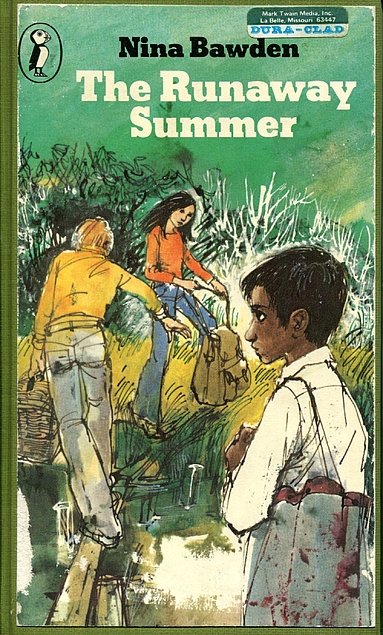
The Runaway Summer by Nina Bawden was first published in 1969 and it’s one of my 20 Books of Summer. The book is/was aimed at older children.

Mary’s parents are getting divorced and during the school holidays she has been sent to live with her Aunt Alice and grandfather who live on the coast, while everything is sorted out. Mary is premanently angry about the whole situation, she has no friends in the area and she knows that she’s behaving very badly towards Aunt Alice and Grandfather, but annoyingly they are very understanding, which only makes Mary feel worse!

In a fit of rage Mary runs out of the house and heads for the sea front where she gets into more trouble as she’s so angry she decides to steal some sweets, but her shoplifting has been seen by young twin sisters who have run away from their older brother Simon. He’s the eldest of a large chaotic family and their father is a policeman!

On one of her trips to the beach Mary watches a small boat coming towards it, when it reaches the shingle two dark men jump out and help a young boy out too. It all seems strange, none of them are dressed for a trip in a boat and they have suitcases, when they get on the beach the boatman sails off again. The young boy has a damaged arm and as the men make their way along the beach, he’s left behind and Mary can see that he’s crying.

But in no time the men are picked up by the police, and Mary decides that she must help the young boy and hide him from the authorities, but she’ll need help from Simon.

As you would expect fromm Nina Bawden this is a really well-written book, but I found myself checking the details about when it was first published and I must say that I find it fairly depressing that she was writing about illegal immigrants in small boats – and it’s still a huge problem and very much in the news 55 years later.

It turns out that Krishna had been flying from Kenya to London to stay with his uncle, but there was a deadline to do it legally and due to plane delays he had missed it, and so began all his troubles.

My  20 Books of Summer list is here. This is the sixth book that I’ve read on the list.


The Secrets of Blythswood Square by Sara Sheridan – 20 Books of Summer 2024

The Secrets of Blythswood Square by the Scottish author Sara Sheridan is one of my 20 Books of Summer reads, and it was a really good one.

The book begins at Calton Hill in Edinburgh in 1846. Rock House stands right at the base of the hill and it’s owned by David Octavius Hill, the pioneer in photography. A lot of the photography work is done by two young women, cousins Jessie and Ellory, with Ellory being very much the underdog. It’s a tough life. When a philanthropist makes it possible for Ellory  to set up on her own she immediately takes herself off to Glasgow where she plans to open up her own photography business. She has far more business sense than the stuffy Hill, and has more talent and flair for artistic composition. She’s determined to make a go of it.

Meanwhile in Glasgow Charlotte has just lost her father, a wealthy businessman, and is now alone in the world with only her father’s servants for company.  When she meets Ellory the two are drawn to each other, despite the difference in status. It turns out that Charlotte isn’t as well off as she had expected, there’s a mystery to what has happened to a large investment that her father had made, and according to his will she’ll have to share half of what money there is with whoever lives in Helensburgh House, wherever that may be. But it seems that there’s very little actual money available, Charlotte thinks she’ll have to sell her family home and get rid of the servants.

This book involves the infighting of the Church of Scotland factions which had split up into the Free Church – The Great Disruption – and the protests that went on when the one time slave Frederick Douglass was giving lectures in Scotland and elsewhere, and trying to shame the churches to hand back the money which they had been given by slave owners over the years, something that they never did.

Sara Sheridan weaves actual historic people into her fiction books, such as the escaped slave Frederick Douglass, and her historical notes at the back of her books are not to be missed. I enjoyed this one just as much as the only other book by her that I’ve read, The Fair Botanists.

I must admit that when I read the title of this book I had assumed that the story would involve the notorious Victorian Madeleine Smith who lived there and was accused of poisoning her ‘gentleman friend’ so it was a nice surprise to discover that the storyline was completely different.

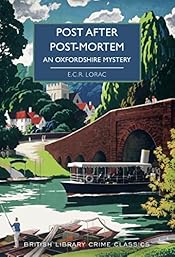
Post After Post-Mortem by E.C.R. Lorac – 20 Books of Summer

Post After Post-Mortem by E.C.R. Lorac is subtitled An Oxfordshire Mystery. It was first published in 1936 but this edition was published by British Library in 2022. It has an introduction by Martin Edwards.

Mrs Surray and her professor husband have lived in their home for 25 years and she particularly loves the place and its garden. Their five adult children are all arriving for the weekend to celebrate their mother’s birthday, they’re a talented bunch, all successful writers of some sort, they’re all academically high-fliers and writers of various sorts. It should be a perfect weekend of celebration, but shockingly one of the ‘children’  doesn’t survive the night.

It looks like an open and shut case and at the inquest the coroner is happy to come to the obvious conclusion, however, with hindsight the evidence doesn’t really add up, and so begins a search for clues, with CID Robert Macdonald given the job of investigating.

I enjoyed this one – up to a point. I really didn’t like any of the members of the Surray family, they were all too up themselves/self regarding for my liking, Macdonald the detective was the only really likeable character, but the mystery itself was decent.

The Fall of Kelvin Walker by Alasdair Gray – 20 Books of Summer

The Fall of Kelvin Walker by the Scottish author Alasdair Gray was first published by Canongate Publishing in 1985. It’s a very short read at just 140 pages. It’s one of my 20 Books of Summer.

Kelvin Walker has left his home town of Glaik, a bit of a rural backwater, for the bright lights of swinging London of the 1960s. He’s determined to make a success of his life in double quick time, despite having no qualifications, he has only worked in his father’s shop since the age of 15. He had discovered the local library in Glaik and had been impressed with Nietsche who had released him from his fear of God as he didn’t exist, an entity that Kelvin felt had watched his every move, just as his father did.

Kelvin plans to pretend that he is Hector McKellar, the one person from Glaik who has become famous, he works in television. He hopes that the name will get him interviews and that he’ll be able to blag his way into a well-paid position.

Kelvin has terrific confidence in his abilities, but he quickly realises that life in London is very alien to anything he has experienced before. He’s saved from having to sleep on a park bench by a young woman who takes him back to the room that she shares with her boyfriend who is an artist. They’re bemused by Kelvin’s plans, he just doesn’t know how things work, but Kelvin is undaunted.

I’ve read a few books by Gray over the years, this is the one that I’ve enjoyed most, it’s described as being Calvinist slapstick. If you add the letters ‘it’ to Glaik you get the Scots word glaikit which means idiot, foolish.

The blurb on the back says:

‘The first major Scottish writer since Walter Scott’ – Anthony Burgess

‘Gray’s work is bawdy and exuberant. Here is an original and talented writer plainly in his prime’ – Robert Nye in the Guardian.


The Redemption of Alexander Seaton by Shona MacLean – 20 Books of Summer

The Redemption of Alexander Seaton by Shona MacLean  (S.G. MacLean) was first published in 2008. It’s one of my 20 Books of Summer.
The setting is the town of Banff, Scotland in 1626. It’s 10 o’clock at night and two whores are searching the pockets of a man that they have found lying in the street, but they find nothing. When they realise that the man is ill, not just drunk, they drag him to the schoolhouse where the teacher lives, hoping that he will be able to help the man, but they didn’t stay to speak to the teacher, they were worried about getting involved. In the morning the man is found dead, and it seems he must have been poisoned.

The teacher – Alexander Seaton – had trained for the ministry, but he had been denounced as a sinner, unfit for the job, when the dead body was found he was obviously going to be under suspicion.

Seaton sets about investigating the death, it’s a time of witch hunts and extreme religious fervour, a dangerous mixture.  I really enjoyed this one, it is very atmospheric. Maps feature in the storyline, apparently at that time maps were rare and most people had never seen one, so anyone in possession of one is suspect. I must admit that it’s something I hadn’t really thought about

Eustacia Goes to the Chalet School by Elinor M. Brent-Dyer – 20 Books of Summer

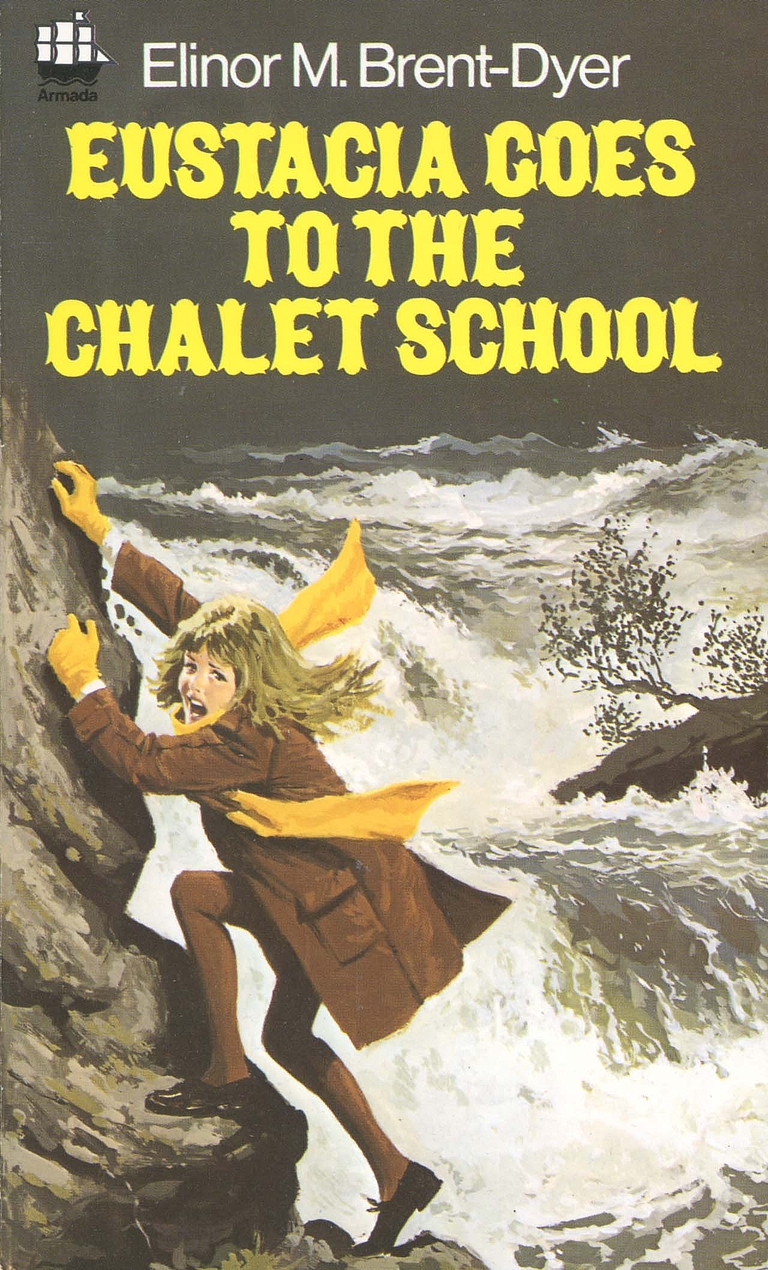
Eustacia Goes to the Chalet School by Elinor M. Brent-Dyer was first published in 1929.
Eustacia has never been to school before, her father had been a professor of Greek and her mother a doctor, they had not made a good job of bringing her up, and by the time she was a teenager she was a rather superior little prig.

When both of her parents died fairly suddenly Eustacia only had two people in her life, her Aunt Margery as her guardian and uncle Edmund as trustee, and it’s decided that she’ll go to boarding school – the Chalet School of course.

When Eustacia gets there she makes herself very unpopular from day one. She’s a prig and a sneak, two things that most schoolgirls detest, as do the teachers. The girls are intent on pulling her down several pegs. Eustacia can’t stand it and decides to run away, over the mountains!

Of course she has an accident which means a long recuperation. With visits from staff and girls Eustacia is a changed girl. When Eustacia is happy to call herself Stacie it’s seen as an improvement by the headmistress, they didn’t like her ‘sister’ Eustacia at all.

There are a lot of books in this Chalet School series, and they are still being written by different authors. I suspect that I will not be reading them all, but will probably just read up to just after the war years – I’ll see how it goes. They’re an enjoyable read, for me anyway.

The Legend of Sleepy Hollow by Washington Irving

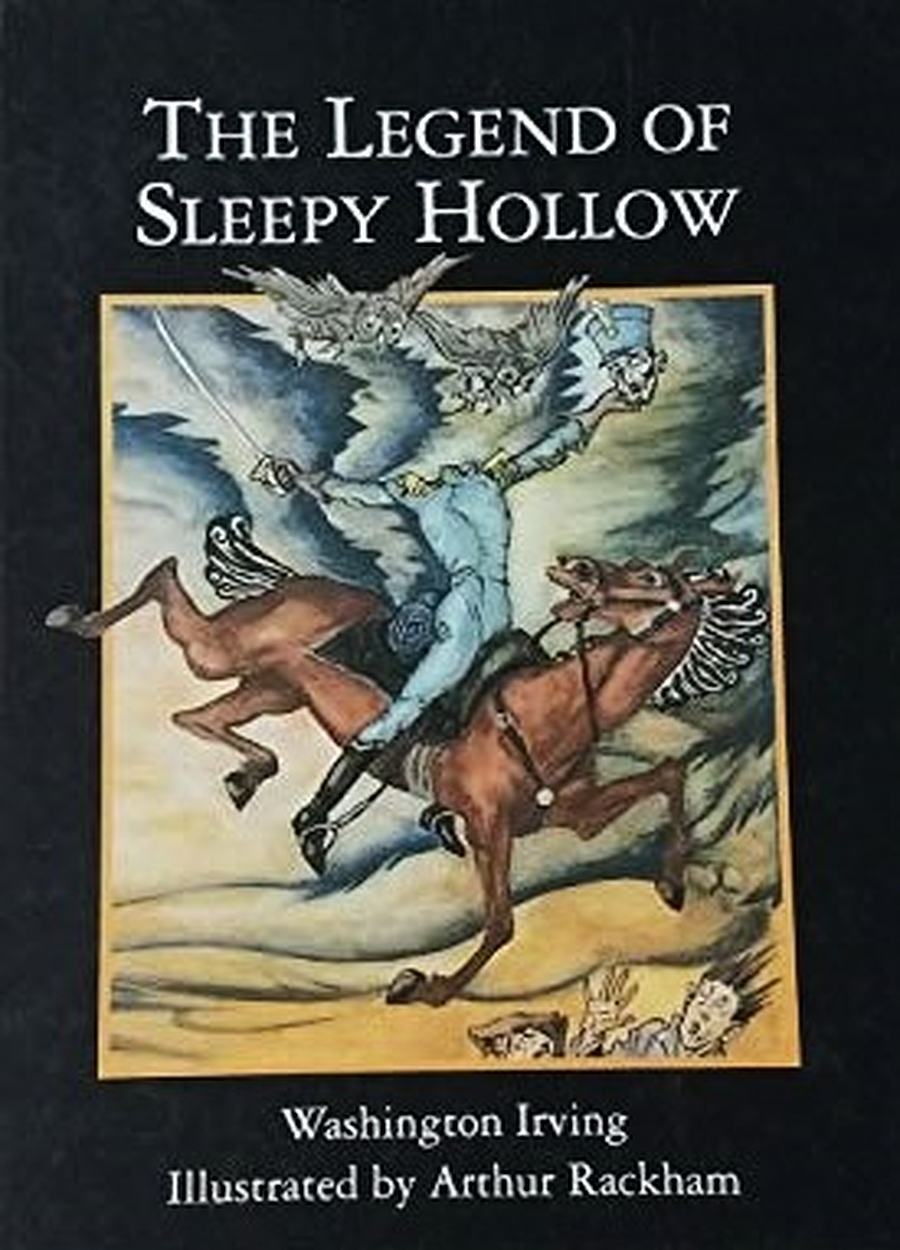
The Legend of Sleepy Hollow, a short story by Washington Irving was first published in 1820. I bought my secondhand copy of it very recently, for all of £2 and it’s illustrated by Arthur Rackham, he did that in 1928. I really like his style and have quite a few books illustrated by him. Washington Irving travelled around Europe and seems to have collected European fairy tales, which he rewrote with an Amercan setting.

I don’t think I had ever read this story before, I think I would have remembered if I had because the female character is a Katrina. The setting is a little valley which had originally been settled by Dutch people. A drowsy, dreamy atmosphere seems to permeate the place.

Ichabod Crane is the schoolmaster in Sleepy Hollow, he’s in love with Katrina van Tassel, a farmer’s daughter. Abraham von Brunt (Brom Brunt) is also in love with Katrina and he and his friends play pranks on Ichabod.

They tell him the tale of a headless horseman who haunts the area, and of course Ichabod ends up being chased by it.  After that he’s never seen again!


The Wrench by Primo Levi

The Wrench by Primo Levi is a quick read at just 171 pages. It’s unlike anything else that I’ve read by the author, which I must admit was a bit of a relief as I wasn’t in the mood for reading about the horrors that he experienced in concentration camps during World War 2. The Wrench has the title The Monkey’s Wrench in America. The book was written after Levi had retired from his work as a chemist at a paint factory.
There are only two main characters in this book, Faussone and the autobiographical chemist. They’re both working in a very remote part of Russia. Faussone is a rigger and he has plenty of tales to tell of his work experiences all over the world, always in remote places.  Each experience takes the form of a short story, they’re all loosely connected. The job of a rigger is to construct cranes and other large mechanical structures. The riggers are the first to arrive at any project, sometimes moving in to places that had been home to animals previously. Problems occur of course, but they’re there to be solved, which they are.

I found this one to be entertaining. Faussone is obviously happy to have a new audience for his tales, he’s by far the most garrulous one.

The blurb on the back says: ‘One of the sanest, most experienced and wisest books I’ve ever read’ Douglas Dunn, Glasgow Herald.

‘Transforms molecules and ballbearings into romantic fairy-tales’ VOGUE

Bernard Levin of The Times wrote at length about it on the back, and he seems to have loved it.

The Wrench was originally written in Italian and was translated by William Weaver, very successfully I think.


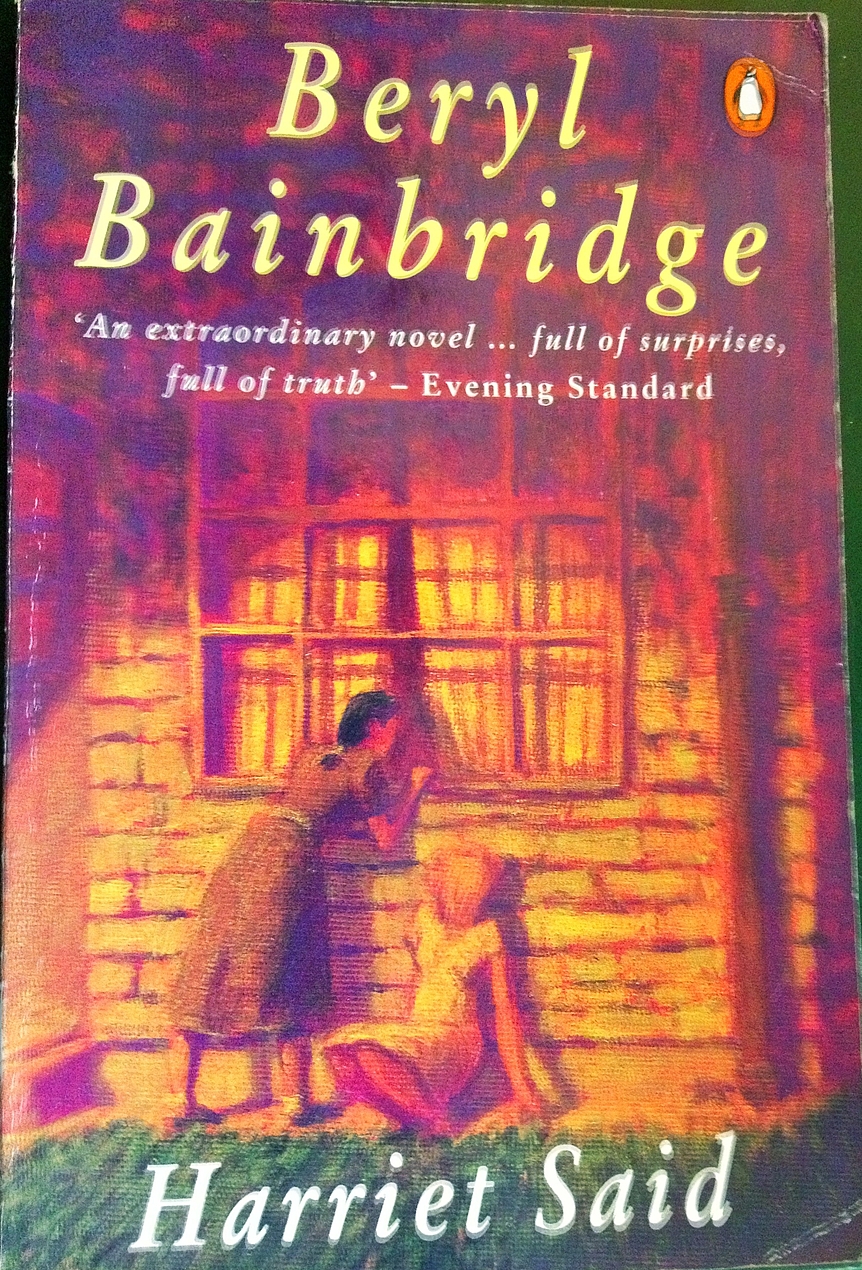
Harriet Said by Beryl Bainbridge

Harriet Said by Beryl Bainbridge was first published in 1972. I find that Bainbridge books are either hit or miss, and for me this one was definitely a miss.

The tale is narrated by a 13 year old girl who is home from her boarding school for the holidays. She had been sent away from home when her parents found that she had been writing ‘dirty’ things in her notebook. At boarding school she learned of even more dirty things to write about. She is very easily led – by her best friend Harriet. It transpires that Harriet is the one who tells her what to write in her notebook, but of course it is all in the handwriting of the unnamed narrator.

Harriet of course is no friend to the narrator, she’s just a user and as the narrator was at a local private school before she was sent to boarding school she is lonely, which is presumably one of the reasons why she puts up with the ghastly Harriet.

They’re out to get experiences, and write about them in the notebook.  Mr Biggs becomes a target for them, he is in late middle age and is unhappily married, they decide to have some fun, the plan being that he will end up being humiliated, but things go badly wrong,  This is really a horror story, the whole thing gave me the creeps, I didn’t enjoy any of it but I ploughed on to the end anyway, luckily it’s only 152 pages long.

The blurb on the back from The Telegraph says: ‘An extremely original and disconcerting story ….. Miss Bainbridge’s imagination is dark …. her landscapes reek and threaten, and her images smell of corruption.’

Apparently this was Bainbridge’s first novel and it was rejected by several publishers. While I was reading it I was reminded of the Parker/Hulme teenage murderers case in New Zealand which you can read about here, and indeed it transpired that Bainbridge used that case as a basis for this book, Hulme eventually became the author Anne Perry.


Women and Power by Mary Beard

Women and Power by Mary Beard was published in paperback form in 2018, it’s based on two lectures which Beard gave in the LRB Winter Lecture series, the first one in 2014, prior to the Me Too movement.

As you would expect she links the mysogyny in our culture to Greek and Roman literature. The first recorded example of a ‘man’ telling a woman to shut up was Telemachus when he told his mother Penelope to go back to her weaving and let the men get on with the important things of life.  Women’s high-pitched voices couldn’t be tolerated. She points out the similarity nowadays to women’s voices not being heard  – or being ignored, showing the Riana Duncan cartoon of men and one woman around a board room table, the caption is: ‘That’s an excellent suggestion , Miss Triggs. Perhaps one of the men here would like to make it’

The Me Too movement features in the second edition of this book. With women being silenced, or just not believed or taken seriously.  Beard points out that in the Metamorphoses Philomela was raped and had her tongue cut out so she couldn’t tell anyone what had happened to her, but Philomela wove her horrific experience into a tapestry, and so denounced her rapist. It’s more difficult for women nowadays I think!

She does mention ‘mansplaining’, something that I suspect all women have been victims of, despite having far more exerience than the ‘explainer’ – I know I have.

Worryingly she suspects that countries which have more female MPs than male ones might be proof that the real power doesn’t lie within the parliament. I must admit that I didn’t realise there were such countries, and I suspect she is correct.

Anyway, this is a very interesting read, despite it being a very slim book at  just 115 pages.

There was no mention of something that I think is very dangerous for women. That’s the treatment of women at the hands of the medical profession. Women are dying needlessly because they aren’t being taken seriously when they have health problems. Too often they are seen as just another menopausal or paranoid  female, even by female doctors.  Women often get very different care, often no care at all, just told to go away, there’s nothing to worry about,  until they literally can barely move and they are dead a few weeks later, as happened to a neighbour of mine – and I could go on and on as that wasn’t the first time something like that had happened. I know that strictly speaking a different sort of power, but it still leads to women being victims.

Back to Mary Beard, I always look forward to her being on TV, but this is the first book that I’ve read by her, I’ll look out for the others now.