Queen Macbeth by Val McDermid

Queen Macbeth by Val McDermid was published in 2024 and I borrowed a copy of it from the library. In this book McDermid puts forward her version of Shakespeare’s Macbeth, but written from Gruoch’s (Lady Macbeth’s) perspective.

Shakespeare fed us the myth of the Macbeths as murderous conspirators. But now Val McDermid drags the truth out of the shadows, exposing the patriarchal prejudices of history.

Gruoch is married to Gille Coemgain a chief in what is now the Inverness area of Scotland, he’s the Earl of Moray and is a bit of a brute. Gruoch is in danger because she hasn’t become pregnant and Gille is getting impatient,  obviously Gille Coemgain wants a son. Her days are numbered, and she knows it.

When the very handsome Macbeth arrives to visit his cousin Gille, Gruoch is instantly attracted to him, but apart from that he could be the answer to her problem. In this version the ‘three witches’ are Gruoch’s companions, a seer, a healer and a weaver.

This is a very slim volume at just 134 pages, very different from Val McDermid’s usual style and subject, but still a good read, I really enjoyed it.

This book is part of a series called Darkland Tales published by Polygon. Others in the series are:

Rizzio by Denise Mina

Hex by Jenni Fagan

Nothing Left to Fear from Hell by Alan Warner

Columba’s Bones by David Greig


The Long Room, the Library of Trinity College, Dublin – a jigsaw puzzle

We got this jigsaw puzzle as a Christmas present, and the minute I looked at it I knew it would drive us nuts. This was possibly the most difficult puzzle that we have ever done and at one point quite early on – I nearly gave up on it. It looks like a beautiful room though and after we got about a third of the way through it it started to seem possible.

Jigsaw, The Long Room, Trinity College, Dublin

We have quiet a queue of puzzles to do so I’m going to have a few days off and then begin one that we got last year, The Salt Path – an Angela Harding design and of course it’s the cover of the book of the same name.

Castle Richmond by Anthony Trollope

Castle Richmond Book Cover

Castle Richmond by Anthony Trollope was published in 1860, the setting is mainly County Cork, Ireland, at the time of the potato famine of 1846 – 47.

Castle Richmond is owned by Sir Thomas Fitzgerald, he’s wealthy with adult children, a son Herbert and two daughters. His wife, Lady Fitzgerald, had been married previously, but her husband had died in France apparently and Sir Thomas had set his lawyers to find evidence of his death before marrying. The eldest son is expected to inherit the estate and all that goes with it, and as was usual with  wealthy Irish landowners Herbert  hadn’t been trained in any profession for that reason. He has fallen in love with a local lass, Lady Clara, the young daughter of an impoverished but ‘aristocratic’ widow and they plan to marry. Unfortunately Lady Clara had been very briefly attached to Herbert’s cousin Owen Fitzgerald not long before. Her mother had put a stop to that as Owen didn’t have enough money for her liking, but more importantly she rather fancies the young man for herself despite him being years younger than her, young enough to be her son really. It’s a tricky situation especially as Owen is determined not to give up Clara.

When Sir Thomas begins to be visited by some English ne’er do wells – a father and son – Sir Thomas’s health takes a turn for the worse, something is obviously worrying him but he is keeping it to himself.  Eventually he has to admit the reason for the visitors arriving, the worst has happened and it seems that Lady Fitzgerald’s first husband is still alive, which means that the children are all illegitimate and of course Herbert will not inherit anything at all, they will be penniless and homeless on the death of Sir Thomas – and cousin Owen will inherit the estate.

I did enjoy this book although some parts of the plot are predictable – see above, apparently it wasn’t one of Trollope’s  more popular books. Parts of it are about the potato famine, I imagine that may not have been popular with readers but it is I’m sure a very authentic portrayal of those times, and it’s desperately sad.  There’s also quite a bit of Protestant/Catholic antagonism with Trollope being more sympathetic to the Catholics, which won’t have gone down well with many readers.

There are some light moments though, when Herbert’s aunt is trying to persuade him to become a church minister, with an eye to him being a bishop:

Aunt Letty was strong for the Church. A young man who had distinguished himself at the University so signally as her nephew had done, taking his degree at the very first attempt, and that in so high a class of honour as the fourth, would not fail to succeed in the Church.

Who knew that there was such a thing as a fourth class degree?!

This is the first Trollope with an Irish setting that I’ve read. Related titles with a similar setting are

An Eye for an Eye

The Kellys and the O’Kellys

The Landleaguers

The Macdermots Of Ballycloran

I might get around to those ones – sometime.

It seems that I read An Eye for an Eye back in 2015 and I blogged about it then. That’s the advantage of blogging as I just had a vague memory that I might have read it, well it was about ten years ago.


Seaton Delaval Hall, Northumberland

Seaton Delaval Hall is a National Trust property in Northumberland which we visited back in October when we went on a north of England road trip. Parts of the house are really just a shell as there was a fire there in 1822, there was some reconstruction work done but  there is no furniture in that part.

Seton Delaval Hall, Northumberland, National Trust

The rest of the house is grand though, I liked the staircases, there are two like this one. below. I took this from the bottom looking up.

Seton Delaval staircase, Northumberland , National Trust

We walked along this colonnade to get to the habitable part of the house.

Seton Delaval Colonnade, National Trust, Northumberland


Seton Delaval Corridor, National Trust, Northumberland

Some unusual wall decorations in the shape of mirrors and eyes which reminded me of Elizabeth I’s dress which was embroidered with eyes – and ears too.

Eyes and mirrors , Seton Delaval Hall, Northumberland, National Trust

There’s a portrait of Henry VIII and …

Henry VIII , Seton Delaval, Northumberland, National Trust

Catherine Parr is close by.

Catharine Parr, Seton Delaval, Northumberland, National Trust

I think that the National Trust uses the property as a sort of repository for many of their treasures. There are some cabinets like the one below, displaying early porcelain.

China cabinet, Seton Delaval, Northumberland, National Trust


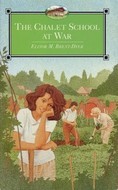
The Chalet School at War by Elinor M. Brent-Dyer

The Chalet School at War by Elinor M. Brent-Dyer was first published in 1941 as The Chalet School Goes To It.

The Chalet School at War Book Cover

This one begins with The Chalet School on the move again. They had fled the Austrian Tyrol after getting into ttrouble with the local  Nazis. Guernsey in the Channel Islands seemed like a good place to set up their new school!! Of course that wasn’t for long and with the Germans looking like breathing down their necks again they move on to mainland Britain.

Plas Howell on the Welsh/English border has been offered to them for use as a school. It’s a large and very grand house, beautifully decorated, much too good to be used as a school but otherwise ideal. After a dangerous journey across the English Channel the girls reach Plas Howell.

Gwensi Howell isn’t happy at all, she’s 13 years old and has lived at Plas Howell for the last nine years along with her older step-brother and his godfather. But Ernest her brother has had to join his ship and his godfather has gone. Gwensi had been educated by a governess, but she is to be part of the Chalet School now, she’s not used to other girls at all and doesn’t want to share her home with a lot of strangers.

Surprisingly Gwensi settles in fairly quickly, and she turns out to be a bit of a fan of boarding school books, and a few of them are name checked in the book, presumably Brent-Dyer was kindly mentioning some of her author friends.

With wartime food shortages looming the girls become keen gardeners and learn a lot, but as often happens in schools it’s the fourth year girls who cause a lot of trouble and angst.

I was particularly pleased that Jo appears in this book – along with her baby triplets. I’m not sure how far I’ll go with this series. It’s interesting that the books were written at the actual time of the war, but I might not go any further than the 1960s with the books. They are still being written by writers/fans who are continuing with the series.


The Dundee Tapestry Exhibition, V&A Dundee

While we were at the V&A in Dundee to see the Kimono Exhibition we also had a look around the ‘Dundee Tapestry’ exhibition which is free. All of the ‘ tapestries’ which are actually embroideries tell the history of Dundee over the years. In years gone by Dundee was called the Jam, Jute and Journalism city and the embroidered panel below depicts a lot of the characters from the Beano and Dandy comics, read by children of all ages for decades and published by DC Thomson. Oor Wullie is at the top of the panel which also features Denis the Menace (the original)  with his dog Gnasher of course, Beryl the Peril and Granpaw from The Broons. There were some young Japanese women looking around this exhibit while we were there and one of the attendants was giving them a bit of a ‘spiel’ about it, but annoyingly she said Oor Willie, which drives me nuts as it’s definitely Oor Wullie, for some reason they anglicise it – to seem posh I suppose.

Dundee  Tapestry, V&A Dundee, embroidery, D.C. Thomson

Dundee Tapestry ,V&A Dundee, C Thomson

The Royal Research Ship Discovery which carried Scott and Shackleton on their First Antarctic expedition is berthed right next to the V&A. She was built in Dundee and it was only fitting that she should return there when she became a museum. It’s well worth a look around it. Otherwise the panel below is about  the many other scientific discoveries from Dundee.

Dundee Tapestry, V&A Dundee

Dundee Tapestry, info board, scientific discoveries, V&A Dundee

But it’s not all about the past, an Eden Project is planned for Dundee in the future and the panel below focuses on the nine environmental guilds which it’s hoped will help Dundee’s future to flourish.

Dundee Tapestry, V&A Dundee

Dundee Tapestry, V&A Dundee, embroidery

This is just a few of the panels, there’s been a lot going on in Dundee over the years, particularly in the computer games industry, so it’s quite a large exhibition with 35 panels which I think is permanent, but it might not be. Some of my photos didn’t come out at all for some reason, but you can read more about the exhibition here.


Escape in Darkness by Kathleen Fidler

Escape in Darkness by Kathleen Fidler was first published in 1961 and was aimed at readers aged 10+. Although Fidler was born in England she moved to Edinburgh when she married and seems to have thrown herself into Scottish society. She was known for her meticulous historical research.

In 1600 King James VI (or James I if you are English) had been attacked by some members of the Ruthven family, meaning to murder him and seize his crown, but they had failed. Unsurprisingly since then James had vowed to ‘stamp out the name of Ruthven forever.’

Thirteen years later in Holland, young James Ruthven’s father has been killed in a duel, before he died he said that his heart must be buried at Culross Abbey in Fife, so his sister Barbara eventually travels to Scotland to carry out that task, along with her nephew James Ruthven’s son. If the king discovers that they are there, they’ll be done for.

This is an entertaining adventure tale which also gives a lot of information about the social history of the times as well as the commercial history of Fife which involved coal mining in very dangerous situations, such as under the River Forth, accessed via a moat in the middle of the river, an innovation. It was a miserable life for ordinary people with the miners being worse off than slaves really.

As it’s Fife accusations of witchcraft were inevitable,  the Fifers of the day were very keen on accusing people of witchcraft – especially incomers – or anyone they didn’t like. This was another very local book for me, very much enhanced by my experiences of visiting Culross. I’ve written a few posts about Culross over the years,  between 2012 and 2020 which you can see here if you’re interested.


SHAKESPEARE The World as Stage by Bill Bryson

SHAKESPEARE The World as Stage by Bill Bryson was published by Harper Press in 2007, it’s part of their EMINENT LIVES series. It’s very different from the other books that I’ve read by Bryson, where he seems to aim for a laugh a page. This is quite a serious book, but of course the downside is that so little is known about Shakespeare, but he manages to do away with some of the ‘facts’ that others have promoted over the centuries. So despite Bryson being able to delve into historical papers  – something that I’m always envious of, there are no real revelations, if anything his famous last will seems even more mysterious than before.

I did learn a lot about the history of the various theatres in London though, and some of the people involved with them. Thankfully Bryson is not one of those strange people who determinedly believe that just about any ‘upper class’ male in Shakespeare’s lifetime wrote the plays, and he swiftly deals with the crazy theories. There are some people who seem to think that anyone who wasn’t an aristocrat would have been barely able to read, never mind be well educated. No doubt they are the same people who believe that a school cannot be a good one – unless you pay richly for being allowed to be part of it. Obviously a nonsense.

This is a quick read at just 200  pages, which includes the bibliography. I enjoyed it.


Kimono Exhibition, V&A Dundee – part 3

This is the last of the Kimono Exhibition photos that I took last week at the V&A Dundee.

Kimonos have been used by film costume designers, such as the one Alec Guinness wore in Star Wars. These are by various modern designers.

Kimono Exhibition, V&A, Dundee


Kimono Exhibition, V&A, Dundee

The white/cream kimono in the photo below is a bridal kimono. The bride starts out the day in this colour and by the time the ceremony is performed she is in a red kimono like the one in the photo.

Kimono , V&A Dundee, Japanese

The kimonos below are by fashion designers who have updated the traditional kimono designs. Kimonos have been used for stage wear by musicians. David Bowie famously wore what was regarded as a kimono but was really more akin to a Chinese tunic I think.

Kimono , V&A Dundee, exhibition

Kimono, V&A Dundee, Japanese

Lastly the kimono in the photo below was a gift to a member of British royalty in the 1960s.

V&A Dundee, exhibition, Kimono, Japanese

Kimono , V&A Dundee, exhibition, Japanese

I doubt if this was ever worn by royalty but the one below was. Rock royalty anyway. It belonged to Freddie Mercury. He was fond of kimonos for stage and party wear.

Kimono worn by Freddie Mercury