
 Operation Sippacik by Rumer Godden was published in 1969. The setting is Cyprus. Rumer Godden was on holiday there when she was told the story of a brave donkey and she decided to write it.
The men of the 27th Battery Royal Artillery were part of a United Nations force who were in Cyprus as part of a peace keeping force, trying to stop the Greek and Turkish Cypriots from killing each other.
Sippacik is a very small donkey which is owned by a small boy called Rifat, he had witnessed the donkey’s birth and had a strong bond with her, so when Rifat’s grandfather sold the donkey to the British Army Rifat was not happy, but money was scarce, particularly as Rifat’s father was not around to help on the family farm. Rifat’s father has been a bit of a local hero, but he had been taken away by the Greek Cypriot police.
Rifat has been dodging school and when the soldiers realise that they can’t cope with the donkey’s awkward temperament it’s arranged for Rifat to live at the army camp and look after Sippacik. They get involved in a dangerous adventure.
This book was probably aimed at ten year olds, it’s entertaining and educational. I bought it just because it was written by Rumer Godden. She seems to have been inspired to write wherever she went on holiday, or moved to. In her old age she moved to Scotland to live to be close to her daughter, and I was impressed by the way that she obviously threw herself into the culture of Scotland and even managed to write in dialect in her book for children The Dragon of Og.
 A Christmas Card by Paul Theroux was published in 1978. This is one of the books that I was reading to try to get me into the mood for Christmas, but so far non of them have been exactly what I expected, anyway, this was still a good read, certainly a very quick read at just 73 pages and is probabbly aimed at older children really. It’s very slightly spooky. It has some black and white illustrations by John Lawrence.
 Robinsheugh by Eileen Dunlop was first published in 1975. The setting is the Scottish Border Country, but it begins in London’s King’s Cross Station where Elizabeth has just boarded a train bound for Scotland. She’s not at all happy, her parents are going to America for months and Elizabeth had been desperate to go with them, but it couldn’t be afforded and Elizabeth is having to go to stay with her aunt, a historian who usually lives in Oxford but at the moment she’s doing research at Robinsheugh into the family that lived there during the 18th century.
 October, October by Katya Balen was published in 2020 and it won the
  The Witch’s Brat by Rosemary Sutcliff was published in 1970. The setting is England in the reign of Henry I. Lovel is a young lad, just eleven years old, and his grandmother has just died. She had been the local healer and herbalist so she had been tolerated in the village. But Lovel was born with a crooked back and his mother had died when he was born, his father is dead too, so he’s all alone in the world and the villagers hound him out. They think that his crooked back means he must be a witch.
 The Serial Garden by Joan Aiken is The Complete Armitage Family Stories. I must admit that I had never read any of this series, nor even heard of them, but what a delight they are. Joan Aiken had such a wild imagination and a great sense of humour, these stories although aimed at younger readers, like all well written books are entertaining for all ages. I got the impression that writing these stories was the author’s happy place, and that she must have been very attached to the characters. It turns out that the family was based on her own family, she told the stories to her younger brother and the children featured in the stories were based on their older brother and sister who were away at school.
 The Stronghold by Mollie Hunter was first published in 1974 and it is a Carnegie Medal Winner.
 Cue for Treason by Geoffrey Trease was first published in 1940 but my copy is a Puffin reprint which was published in 1965.
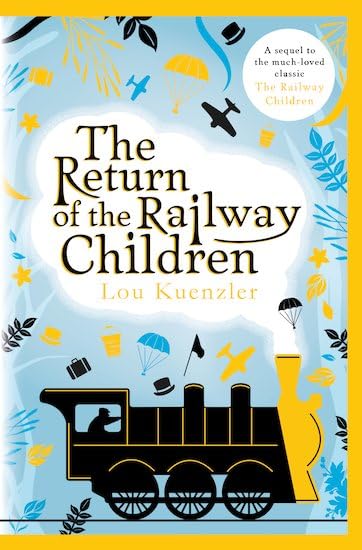 The Return of the Railway Children by Lou Kuenzler was published in 2018 and is of course a sort of sequel to E. Nesbit’s The Railway Children which was first published in 1906. I’m often quite wary of sequels like this but as this one has a World War 2 setting I thought it was worth giving it a go. I’m glad I did.