The Big Six by Arthur Ransome – The 1940 Club

The 1940 Club is hosted by Karen of Kaggsy’s Bookish Ramblings and Simon of Stuck in a Book.

For my second 1940 Club book I decided to read The Big Six by Arthur Ransome. The setting is the Norfolk Broads, East Anglia. Some of the dialogue is written in a sort of cod Norfolk accent, which I found slightly annoying at times but got used to it. I lived in East Anglia for a few years.

In this one Pete, Joe, Tom and Bill are enjoying themselves messing around on the river in their boat The Death and Glory. They’re waiting for some other members of The Coot Club to join them, the club was set up to protect nesting birds as at this time bird egg collecting is a popular hobby and not against the law. The children try to educate an elderly man as to why there were no bitterns about now, he couldn’t see that it was because he and others had shot them all!

But someone is going around casting off boats up and down the river and causing mayhem. Fingers are being pointed at the children as the culprits and the whole village seems to have turned against them, even their fathers aren’t sure of their innocence!

As you can imagine this puts the boys in a horrible situation especially when the local policeman Mr Tedder is convinced they are guilty, despite having absolutely no evidence against them, and he doesn’t even bother to carry out an investigation himself.

Things go from bad to worse when shackles are stolen out of a boatyard and immediately Mr Tedder blames the boys and he’s determined to send out a summons to them all.

The other members of The Coot Club Dorothea and Dick arrive and Dorothea immediately gets down to looking for clues as to who the real culprits are. She’s methodical, writing everything down and forming her own Scotland Yard which is where the title of the book comes from, although originally it was the so-called Big Five detectives who formed the actual Scotland Yard.

Mid way through the book the boys have a trip down the river to do some fishing and this was a relief from the uncomfortable atmosphere of the village they had been berthed at. It was a relief to me too as it was quite grim when everyone had turned against the Coot Club, even the far-flung members of the club were against them, or their parents had banned them from the club. I have to say that it was rather obvious who the baddies were.

So this one isn’t a favourite of mine although there is a bit of humour right at the end, however it shows that Ransome was keen to promote the preservation of wild birds, something that wasn’t foremost in people’s minds at the time I’m sure.
The Little White Horse by Elizabeth Goudge

The Little White Horse by Elizabeth Goudge was first published in 1946 and it won the Carnegie Medal for that year. I wee while ago I decided to start a personal project to try to read as many of the Carnegie Medal winners as I can get a hold of. This literary award was set up in 1936, to be awarded to the best book for children or young adults each year.

The setting is Moonacre Manor in England’s west country where 13 year old Maria Merryweather has been sent after the death of her parents. She’s accompanied there by her governess Miss Heliotrope and is welcomed there by her cousin Sir Benjamin Merryweather whom she had never met before. He’s rather large and old and wears a ‘cauliflower’ powdered wig, but he’s very kind and in no time Maria feels completely at home despite there being many mysterious goings on at Moonacre. It’s all a bit fairy tale-ish as to begin with Maria never sees anyone, but clothes and food appear in her room mysteriously.

But not everything is perfection at Moonacre. The people in the village are being menaced by strange dark men living in the woods who steal their sheep, won’t allow them near the beach and trap rabbits and hares which they know is illegal and gets Sir Benjamin into trouble as the traps are on his land.

This is a charming read with lots of lovely unusual characters, including the dogs Sir Wrolf and Wiggins and a mysterious white horse.

I think that the author had a whale of a time thinking up all the unusual names of her characters, the writing is silvery with descriptions, and like most British books written during WW2 and up to the mid 1950s when the country was stuck in strict and punishing food rationing, the book is just full of descriptions of food and feasts. I suppose if you couldn’t actually get the food to eat, reading about it was the next best thing.

Warrior Scarlet by Rosemary Sutcliff

Warrior Scarlet by Rosemary Sutcliff was first published in 1958 and the setting is the Bronze Age around the English South Downs, which to my Scottish mind should really be called Ups as they are hills.

This is quite a domestic tale really as there are no wars or long adventures, but it’s still an enjoyable read.

Drem is a young boy looking forward to getting his scarlet warrior cloak and his mother is busy weaving scarlet coloured fabric, but his grandfather is less than encouraging. The trouble is that Drem’s right arm is badly damaged and he isn’t able to use it at all. When Drem overhears his grandfather saying that Drem will only ever be any good for looking after the sheep, the young boy is devastated. Before becoming a warrior the young boys have to kill a wolf using a spear, it doesn’t seem likely for Drem, but when he reaches the right age he’s determined to join the others in The Boys’ House where they’ll be training to be warriors.

There’s a lot more to this book, including a wee bit of romance and as ever with Rosemary Sutcliff the writing is lovely. The book is aimed at older young people but is well worth reading as an adult.

Little Plum by Rumer Godden

Little Plum cover

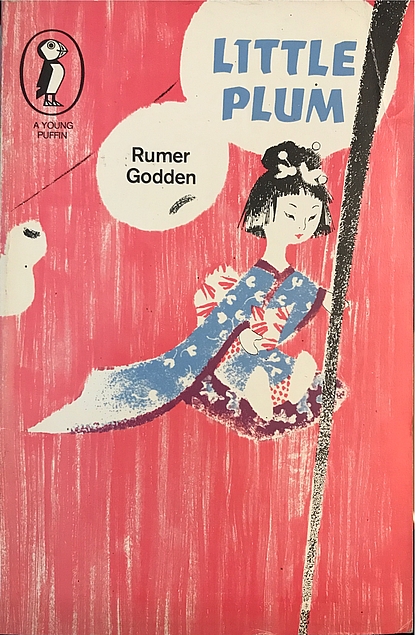
Little Plum by Rumer Godden was first published in 1963 but my copy is a 1975 reprint by Puffin books.

This is a lovely relaxing read, especially if you want to get away from the depressing TV news.

At just 135 pages long and aimed at readers aged seven and over (I’m very much over!!) the story features two Japanese dolls called Miss Happiness and Miss Flower. The dolls had been sent by Great-Aunt Lucy as a Christmas present to Nona who had lived in India until recently when she had been sent to live with her Fell cousins and their parents in England. The dolls had helped Nona settle into her new life, where she shared a bedroom with her cousin Belinda.

They were fascinated by the very large house next door which has been very grand but it had been empty and for sale for years so looks neglected and dirty. When a sold sign appears and builders arrive to renovate the house they’re agog.

Belinda is particularly fascinated by Gem, a girl about her own age. Gem is very different, mainy because she is being looked after by her very strict aunt while her mother is in hospital. Gem doesn’t know how to play – unless it’s her piano. When Belinda spies another Japanese doll in Gem’s bedroom she’s outraged that Gem doesn’t play with the doll or look after her. Belinda begins a campaign against Gem, really trying to get her attention. This involves mad escapades from Belinda which put her in real danger, not that at her age she really recognises that. She’s quite a wee girl!

The book is illustrated by Jean Primrose, just pencil drawings but they’re charming.

Elsie Piddock Skips In Her Sleep by Eleanor Farjeon

Elsie Piddock Slips In Her Sleep by Eleanor Farjeon was first published in 1937, but my copy of the book was published by Candlewick Press in 1997. It is illustrated by Charlotte Voake and it’s a cute wee volume measuring just 7.5 inches by 4.5 inches (19 by 11.5 cm) with just 61 pages.

This is a bit of a fairy tale. Elsie Piddock lives in Glynde under Caburn where a lot of other little girls live too, and they mainly survive on bread and butter because their mothers can’t afford much more for them to eat. That doesn’t stop them from having fun though and as Elsie grows up she hears the older girls skipping after school, she’s looking forward to being old enough to join them out there.

When Elsie starts to practise skipping using her father’s braces her mother realises that it’s something she’s really good at, she has potential to be a champion skipper, so they buy her a proper skipping rope. Everyone’s amazed at Elsie’s skipping prowess and by the time she was seven years old even the fairies had heard of Elsie and her skipping. Andy Spandy (truly!) the Skipping Master teaches Elsie new ways of skipping and before long she’s better than any of the fairies.

The local hill Mount Caburn is the venue for skipping and years later the land is under threat from a greedy new landowner, he intends to build a factory there, but he doesn’t bargain on having to deal with the by now 109 year old Elsie.

This is a lovely tale for all ages.

Stormsearch by Robert Westall

Stormsearch by Robert Westall was first published in 1990, my copy is a Puffin book. Previously I had only read The Machine-Gunners by this author. Stormsearch wasn’t quite as good, in my opinion anyway.

Tim and his sister are staying with their aunt and uncle in Cornwall over the school holidays. They live close to a beach so Tim and Tracey have a sandcastle building competition, during the digging they strike something hard. At first they thought it might be an old mine from the war, then maybe an old barrel, but it turns out to be a very old model of a sailing ship, in reasonable condition although the sails have rotted away.

Uncle Geoff is thrilled to bits with it and he sets about finding out more about it, he knows that he should be able to track down information on it – and who it belonged to originally.

The blurb at the back says:

A compelling story of obsessions, family hatred and adventure, which it is, and it’s entertaining holiday time reading for not too young readers.

The File on Fraulein Berg by Joan Lingard

The File on Fraulein Berg covr

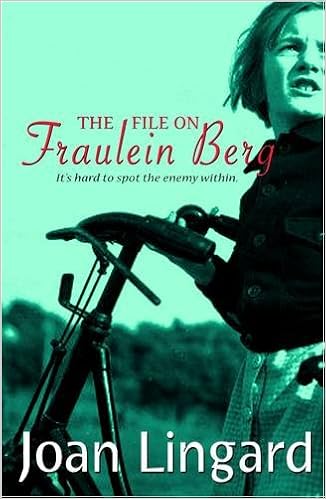
The File on Fraulein Berg by the Scottish author Joan Lingard was first published in 1980, but the setting is mainly Belfast, Northern Ireland in 1944. The war has been dragging on for three years and there seems to be no end to it. Earlier in the war the Belfast shipyards had been targeted by German bombers but more recently that had quitened down. Actually with the neutral country of Ireland being just a few hours over the border, life seems to be a lot easier than on mainland Britain where the inhabitants are struggling under the strict ration system which makes life difficult, with food and clothing being scarce.

Three schoolgirls Kate, Harriet and Sally are great friends. They’re all keen readers of spy fiction and when a real German called Fraulein Berg arrives at their school to teach them their imaginations run riot. The girls are convinced that Fraulein Berg is a spy and take it in turns to follow her everywhere, even standing across the road from her flat for hours on end, and writing everything down in notebooks. They’re really persecuting her, determined to uncover her as a spy, but it’s obviously deeply unpleasant for Fraulein Berg.

Apparently there was a lot of smuggling going on across the Ireland/Northern Ireland border and the girls get involved in a bit of that when they travel to Dublin by train with Mrs McCabe and Auntie Nell, it’s quite a funny interlude.

This is well written as you would expect from Lingard, but the ending is very predictable, it’s probably supposed to be to the reader, but the book also throws some light on what life was like for people during those times, it’s an enjoyable and interesting read.

The Sign of the Black Dagger by Joan Lingard

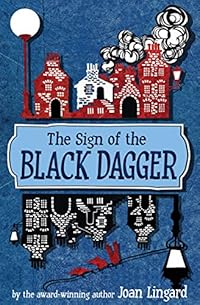
THe Sign of the Black Dagger by Joan Lingard was first published in 2005. I borrowed this one from the library as when Lingard died recently I realised that I haven’t read many of her books and I should rectify that as she was a Scot. Typically the local library system doesn’t have many books available to borrow as in Fife the people who run the libraries (they aren’t librarians) corrall all the books by locals in their reserve stock – and they don’t let anyone borrow them!

Anyway, back to the book. The setting is Edinburgh where Will and Lucy, a young brother and sister live in a very old house in the Royal Mile which has been in the family for generations. Their father disappears suddenly and they discover that there are people after him. Their mother discovers that he has money problems, which he has been hiding from everyone, he has never been a good businessman.

While searching the house Will and Lucy discover an old journal secreted in a hole in a wall. It has been written by another William and Louisa/Lucy, ancestors of theirs, and their father has had similar problems. Both men are being pursued by men determined to get the money that they’re owed.

The experiences of both related families, with about two hundred years in between them, feature the children mainly, with the mothers in the background having had no idea that their family life was in danger.

I enjoyed this one, it was interesting to see how the authorities dealt with those in debt two hundred years ago in Edinburgh, and as ever I like it when I know the setting well, as I do, but there is a useful map if you don’t know Edinburgh’s Old Town.

Visitors from England by Elisabeth Kyle – 20 Books of Summer 2022

Visitors From England by the Scottish author Elisabeth Kyle was published in 1941, but my copy is a 1962 reprint.

Peter and his sister Margot are having to spend their holidays in Scotland, with complete strangers. Their mother is seriously ill and is in a nursing home back in England and their father is already dead. They’re not looking forward to being away from home, but Mrs MacDonald who they’ll be staying with has a son around the same age as Peter. Alec isn’t looking forward to spending his holidays with the visitors, he suspects that they’ll ruin his holidays and that they’ll not want to do the sort of things that he enjoys doing. Basically he thinks they’ll be southern softies!

Peter isn’t any better as he tells his sister that as Alec is a Scot he’s bound to be tough. Their assumptions are quickly ‘scotched’ though as the brother and sister are more than willing to follow Alec down a cliff and on to the beach. In the distance they see old Morag. Years ago she had survived a shipwreck, The Silver Horn had been her father’s ship and Morag was the only survivor, ever since she has been talking about the treasure that’s in her father’s old cabin, and hoping that she’ll be able to retrieve it somehow.

This one’s an entertaining tale of friendship with a bit of an adventure thrown in, and some interesting characters who span the class divides.

Gemma Alone by Noel Streatfeild – 20 Books of Summer 2022

Gemma Alone by Noel Streatfeild was first published in 1969 and it’s the first in a series of four.

Gemma has gone to live with her cousins as her mother is an actress and is working in America. Gemma has done quite a lot of work as a child actress herself in the past, but she’s determined to make the transition to adult acting, something that doesn’t often happen.

She’s at a drama school, along with some of her cousins who want to be dancers, singers or composers. When Gemma is offered a part in a pantomime she’s thrilled to bits, but her mother isn’t so happy about it, it’s a come-down as far as she is concerned. Gemma is furious and refuses to speak to anyone when she is told that she can’t take the part, she thinks that any stage work is better than nothing.

This was quite an enjoyable read but I can imagine that it would be very popular with youngsters who are star-struck or stage-struck. I don’t think I will go out of my way to get any more of the series though.

This does let young people know that they should be able to follow their own dreams rather than do things to please their parents who might have a very different future mapped out for their offspring.