Cheerfulness Breaks In by Angela Thirkell

I needed another trip with Angela Thirkell down Barsetshire way and I thought this book would hit the spot, and it did. First published in 1940, the Second World War is just beginning to change everybody’s lives with lots of the young men joining the various armed forces and the ones not in uniform feeling guilty for having reserved occupations which are keeping them safe from harm for the moment.

Rose Birkett, the beautiful but dim daughter of the headmaster of Southbridge School, is swanning down the church aisle at last, after several failed engagements which had driven her parents mad with worry and has caused mayhem within the school as she worked her way through the junior masters. At last they are going to get rid of her. Rose has met her match in the Royal Navy, in the shape of Lieutenant Fairweather, who seems to be able to take command of Rose and navigates her through her foul and dispiriting experiences unperturbed.

As usual there are quite a few romantic matches before the end of the book, some of them amazingly hasty but such was life at that time as young folks ‘carpe diemed’ like crazy in case there was no tomorrow for them.

The villages are inundated with cockney children who have been evacuated there along with their colonies of head lice!

Even in 1940 the East European refugees were obviously an annoyance to the locals, which makes it seem quite up to date, given the recent changes in Britain’s demographics and the large amounts of Poles/Lithuanians and the like which now make up part of our population.

As it says on the cover – England is on the brink of war, but the people of rural Barsetshire are not down-hearted.

There’s plenty of humour as well as romance. The only complaint I have is that the book does end very abruptly. In fact the last chapter is called – story without an end. It left me feeling that I wanted to go on and read the next Thirkell book immediately but, I don’t have that one – typical, I have about five of her later books. I’m going to have to buy Northbridge Rectory.
Private Enterprise by Angela Thirkell

Where do I go when I want a bit of comfort reading? West Barsetshire circa 1947 of course courtesy of Angela Thirkell. In Private Enterprise we’re back hobnobbing in the homes of the Mertons and Brandons and all the well known families of the county, where the villages have names like Winter Underclose, Winter Overcotes, Eiderdown, Little Misfit and Worsted.

As ever they’re all bound together by a mutual hatred of the bishop and his wife and any strangers in their midst are regarded as ‘good eggs’ if they too have a dislike of everything to do with the bishop and his palace.

Mrs. Arbuthnot is a young widow who has come to live in the county and Colin thinks he’s in love and makes a nuisance of himself and a new vicar has arrived and is in need of a wife too.

Otherwise the talk is all of the Labour government and Them in general and food and clothes rationing is a hot topic with the government putting bread on the ration. World War II has been over for more than a year but living conditions are getting worse for the people of Britain. Any so called luxuries which are being made in Britain are being sold abroad to try to pay off the country’s debts. If you want to know more about rationing you can read about it here or see a video. It continued until 1954.

Does any of this remind you of anything?! The talk is all of austerity, austerity – just as it is now. I’m convinced that politicians of every type just want to control the general population and to that end they like to whip up consternation and panic, whether it’s about bread or as it is today – petrol.

Anyway, I’ve sort of strayed away from Private Enterprise, if you enjoy books about life in Britain in the 1940s then you’ll like this book. There’s plenty of humour and worldly wisdom and romance thrown in too.

Ankle Deep by Angela Thirkell

This is one of the books which I bought on our fairly recent road trip to England when I managed to buy four Thirkell books, three of them at the Cambridge market. I can’t remember if Ankle Deep was one of those ones, anyway I do know that I pounced on it thankful to get anything by Thirkell which I haven’t read. When I started reading it I was a bit shocked at the state of it because it’s an ex-library book from Enfield, London – of all places. I love books to be pristine, even after I’ve read them but my copy of Ankle Deep looks like it might be possible to get TB from it. It’s the sort of thing which I would normally handle with long tongs, but I steeled myself and dived into it.

This is the first novel which Thirkell wrote and to begin with I was a wee bit disappointed when I realised that this isn’t one of her Barsetshire books because I really do find those ones to be such a scream, but it wasn’t long before I found myself getting totally caught up in the world of
Fanny, Arthur, Valentine, Aurea et al.

Aurea is a young married woman who moved to Canada after her marriage but she has left her husband and children in Canada while she pays a visit to her parents in London. Aurea is not happy in Canada and is no longer in love with her husband so when she meets Valentine Ensor, a young divorced man about town who spends his time entertaining ‘charmers’ by the score, she falls for him in a big way, but it’s all very chaste and funny.

Fanny’s husband Arthur had been an old flame of Aurea’s and Fanny is determined to throw them together again, mainly so that she can play the field more thoroughly than usual, she normally has a string of admiring males tripping around her. She’s one of those life and soul of the party people, a flibbertigibbet if ever there was one. She plans to find a new wife for Valentine, despite the fact that she introduced him to his first wife, who turned out to be madly promiscuous.

Ankle Deep was published in 1933 and I think Angela Thirkell was really using her own ‘set’ as copy, I’m sure quite a few of her friends would have recognised each other and maybe not been too keen on their own portrayal in the book.

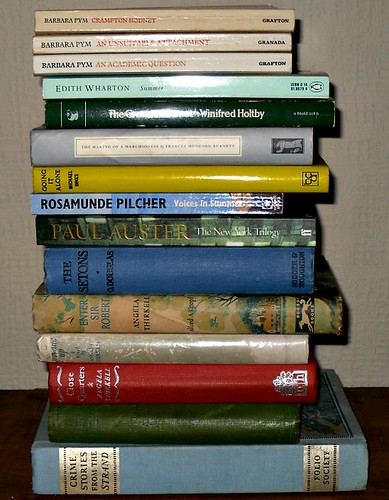
I hope if you fancy reading this book you’ll manage to get a copy which is a lot less manky than mine is. I’m not giving you a close view of it, I’m not that cruel but if you want you can see it second from the bottom of this pile, which was my book haul from our trip in October.

October 2011 books

Crampton Hodnet by Barbara Pym

I haven’t read anything by Barbara Pym for about 30 years, I started reading her books in 1977 when Lord David Cecil said that she was a modern day Jane Austen, so obviously I had to give her a go like many other people, and I wasn’t disappointed.

She began to write Crampton Hodnet in 1939 just after the outbreak of war but war work got in the way and so it wasn’t actually published until 1985, after Barbara Pym had died.

I suppose a lot of the ingredients of Barbara Pym books are similar to Jane Austen’s – vicars, tea parties, humour, splendid spinsters, worried wives, bright young things, annoying relatives, bitchiness and gossip. Most of all though it’s the sharp observation of human beings which I like. Anyway it all adds up to an entertaining read which is set mainly in Oxford.

It was just what I needed to make me laugh after my exasperating experience with the character of Charity in the previous book which I read.

The Provincial Lady Goes Further by E.M. Delafield

I bought this 1942 edition of the book in the Callander bookshop which according to Carolyn is called King’s Bookshop. We didn’t manage to get back over that way during the summer holidays which are now at an end. How can six weeks flash past so quickly?

Anyway, this one is also written in diary form and I always find books like that very quick reads. As the title says it’s more or less the further adventures of the provincial lady but now she has some money due to the success of her previous publication. As often happens, instead of the money being used to solve the family money problems and placate the bank manager, it’s used to rent and furnish a flat in London. The bank manager is not amused but Robert, her husband is so laid back about everything and he seems to be quite confident that his wife will be able to keep earning more money through her writing. The PL thinks that Robert isn’t really interested in anything – she could be right about that.

Both children are packed off to boarding school leaving the Provincial Lady free to gallivant around London and meet up with her friends there. Pamela Pringle is very ‘fast’ and is on her fourth surname since the PL first met her as a young woman. Pamela is well on her way to her third divorce and is using our PL as her alibi whilst pursuing and being pursued by hordes of young men. All very daring for 1932, which is when this book was first published!

The Provincial Lady is still having problems finding servants for her house as it’s situated in the country and servants don’t want to live out in the Sticks. It’s a look into a time when you went to Boots the Chemist to change your library books, never went out without a hat and had your shoes re-covered to match your evening dress.

She’s still getting herself into plenty of amusing scrapes and the usual sort of trouble with the children when they’re not at school.

I’m looking forward to reading more books by E.M. Delafield as they’re a good laugh, and as I’m getting to the stage where I’m sometimes wary of switching on the news because it seems that there is no good news nowadays, and a good laugh is often sorely needed!

Peace Breaks Out by Angela Thirkell

This book was first published in 1946 and as you would expect from the title it’s 1945 and the war in Europe is just about to come to an end. You would think that it would be a time of celebrations and relief but in truth the people are all a bit unnerved by this new situation as they’ve become used to war and all pulling together and having one common enemy. Everyone is worried about the future and how things are going to change.

I really enjoyed this one though and all the young people are getting nicely paired off with each other. Even David Leslie, the charismatic but ‘bone-selfish’ favourite of Miss Bunting is being ‘managed’ by one of his many old flames. It’s mainly light-hearted and humorous but it has the odd passage in it which I’m sure had a lot of readers of that time shouting ‘hear hear’ when they read them. Like:

A very horrid rumour of more peace was floating about in Barchester and indeed about all England for a few days before Anne’s visit, filling everyone with deep misgivings about trains and more especially about the grocer and bread. Public opinion was divided, some saying They would certainly have peace on a Tuesday so that one could get the rations done on Monday, others saying that they knew for certain that the King had asked for peace to happen on Friday, so that everyone could have a long weekend. Yet others, and these a very large class including all the housewives of England who had been working for sixteen or seventeen hours a day ever since the war began, looking after children and aged relatives, standing in queues, walking a mile to the bus and taking an hour to get to the nearest town only to find that the whelk oil or chuckerberry juice or whatever it was they were told their children must have wasn’t in and it was two hours before the bus went back and anyway they had been given the wrong certificate, slaving at W.V.S. in their meagre spare time, suffering evacuees, taking in lodgers because their husband was getting only army pay now, cooking for everyone, firewatching, being wardens, being mostly too tired to eat, seeing Italian and German prisoners of war riding happily about the country in motor lorries while they pounded along on bicycles against wind and rain or lugged heavy baskets on foot, seeing mountains of coal and coke at the prisoner of war camps while they were down to two hot baths a week and very little soap for the washing and the laundry only coming irregularly every three weeks, seeing Mixo-Lydian and other refugees throwing whole loaves into the pig bin and getting the best cuts at the butcher’s, keeping their children nicely dressed while they got shabbier themselves every day, too driven to consider their looks, unable to have their houses properly repaired, having to be servile to tradesmen and in many cases to tip them in money or kind, seeing one egg in eight weeks with luck, in a state of permanent tiredness varied by waves of complete exhaustion, yet never letting down anyone dependent on them; this great, valiant, unrecognised class, the stay of domestic England, all knew that THEY would burst peace on them whenever it was most inconvenient and went about their shopping listlessly, waiting for the tiger to spring.

Whew – that’s what I call a rant, and it’s just as well that the people then didn’t know that things were going to get even worse, and rationing was going to carry on right into the 1950s because Britain was having to send food to Europe, when they didn’t even have enough for their own population. Then of course there was the debt of more than one variety which was owed to the U.S. The monetary one was only paid off a couple of years ago!

Anyway, if you ever see an Angela Thirkell book, and you enjoy books which are set in the 1930s and 40s, do yourself a favour and snap it up.

The Diary of a Provincial Lady by E.M. Delafield

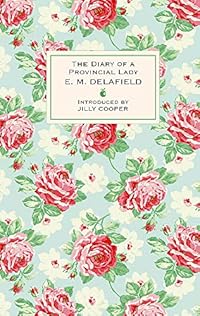
The Diary of a Provincial Lady cover

E.M. Delafield is one of those authors who until very recently I wouldn’t have dreamt of reading, and it’s all thanks to book bloggers that I am now.

This one was first published in 1930 but my copy is a Virago with an introduction by Jilly Cooper. Despite the fact that the book is over 80 years old the whole thing is immediately recognisable, the situations and characters are just the sort of thing that I find myself getting involved in, (minus the servants problem) exasperating things, but when you read about them happening to other people it’s all so funny.

The diary starts off on November 7th and the Provincial Lady – we are never told her name, is struggling with her indoor bulbs and bowls and wondering where she should put them, cellar or attic. Joan Kyler and I were both doing that not so long ago, and there’s about 5,000 miles between us. In fact the whole diary is a sequence of events which are common to most of us, especially if you have children or cats. The cats have unexpected kittens, the children generously give you measles, although in my case it was chicken-pox at the age of 35, toes to scalp!

Thankfully I haven’t had the experience of having to pawn jewellery to pay bills, but then I suspect that a pawnbroker wouldn’t be interested in my rings. On the other hand I have always resisted the temptation to take myself off to the south of France! In that respect it did remind me of Elizabeth’s German Garden (which is mentioned in the book) when Elizabeth merrily orders two hundred rose bushes whilst the household finances are obviously very precarious.

Robert, the husband is such a typical awkward and maddening one, but then he has his moments, although few, when he’s worth his weight in gold. This is a comfort read if ever there was one, something for the times when you can’t bear to watch the news any more. A good laugh!

My copy of the book has a cover which has been designed by Cath Kidston. I know she’s all the rage and it does fit in with the feel of the book but I grew up with wallpaper like this on my bedroom in the 1960s and I was mightily glad when it was covered up by an orange dinner plate sized pattern around about 1970. I know, there’s no accounting for it!