In a Summer Season by Elizabeth Taylor

In a Summer Season by Elizabeth Taylor was first published in 1961.

In a Summer Season cover

Kate Heron is a wealthy middle aged English woman, married for the second time to Dermot, a handsome and much younger Irishman. Her first husband had died and Dermot had been mooching around the house when her husband was ill, despite the fact that the husband didn’t like him. The friends from her first marriage obviously don’t approve of Kate’s remarriage and so she ends up spending her time accompanying Dermot to the pub. He drinks far too much and gambles too, he’s shiftless, sticking at no job for more than a few weeks and now seemingly not even looking for work, but Kate is besotted with him, it seems she’s in lust with him which is un-Taylor like, although it’s a good long time since I read any of her books so I may be mis-remembering.

I began this book thinking it wasn’t as good as I had remembered Elizabeth Taylor’s other books to be but ended up enjoying it nonetheless. I think the lust put me off for a wee while!

There’s a book which is mentioned often in this one called The Spoils of Poynton by Henry James, but I kept thinking to myself – if only Kate had read Elizabeth von Arnim’s book Love – she would have known not to marry a much younger man. Of course now I’m going to have to read the Henry James book.

Elizabeth Taylor’s books are beautifully written and should be read closely so as not to miss the little details, such as the family aversion to charm bracelets and the type of woman who wore them.

Kate’s children Tom and Louise and various other characters, not forgetting Aunt Ethel all add up to a good read.

There’s a Guardian article Rediscovering Elizabeth Taylor, if you’re interested.

The Guardian Review

I’ve been so busy over the weekend and yesterday that it wasn’t until this morning that I had time to sit down and read Saturday’s Guardian review. I thought I would share a few of my favourite articles, just in case you haven’t seen them.

Perfect Wives in Ideal Homes: The Story of Women in the 1950s by Virginia Nicholson was reviewed by Tessa Hadley here.

Top turrets. Gothic or fairytale castles are everywhere in fiction. Jessamy Taylor chooses 10 favourite fortresses. You can read it here. My favourite real Castle is Stirling Castle but I’ll have to think about fictional ones.

There’s a new exhibition on at the V&A of Alexander McQueen’s designs. You can read about it here. I’d love to go to London to visit several exhibitions but the thought of actually staying in London is more than I can contemplate, oh for that beam me back to my own bed at night gadget!

And finally, Poldark by Patrick Gale which you can read here.

I managed to watch Poldark yesterday on the iplayer. I’m one who loved the original series and then adored the books and I wasn’t impressed with the new choice of actor to play the part of Ross Poldark, nor did I think that the choice of the new Demelza was up to much, for one thing she’s far too tall, just not waif-like as she should be. I’m usually a big fan of Phil Davis of (shake me up Judy fame) but for me he doesn’t cut it as Judd, he and Prudie are far too clean looking, you could just about smell the original Judd through the TV, and the Phil Davis grumbling isn’t a patch on the original. I also don’t think they’re being historically accurate as a lot of folding paper money was being waved about, but I’m sure that the story begins before paper money was introduced, Winston Graham made a point of writing about that in one of the books.

I’ll continue to watch it though, because I love Cornwall, but I’m not even sure about that, I don’t think that all of the filming was done in Cornwall, which is a shame as the buildings there are so like Scottish buildings, grey and solid stone. Buildings in Gloucestershire and Wiltshire are just not going to look right. I’ve no doubt though that there’ll be a whole new generation of fans, many of whom will name their first son Ross – just as before.

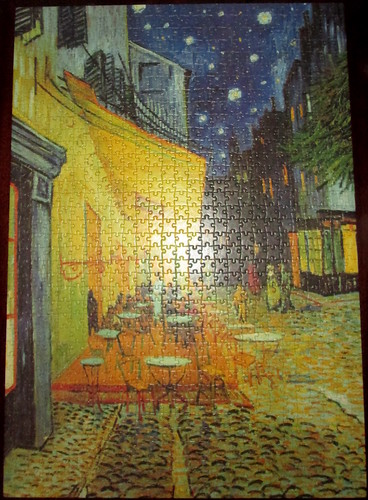
Not Starry Starry Night – Vincent van Gogh

As it’s Burns Night tonight I made the vegetarian haggis from the recipe which was in the Guardian earlier in the week. You can see it here. I’m not inflicting a photo of my version as haggis is never appetising looking but it tasted good anyway. I changed it slightly, substituting soy sauce for the Marmite as I hate the stuff and I added more pulses in the shape of haricot and cannellini beans. I also halved the quantities as there are only the two of us around the table nowadays, but I still have plenty leftover – so no cooking required tomorrow, luxury!

Below is a photo of the 1000 piece jigsaw puzzle which we began about a week ago when the weather was really cold and we were just semi hibernating. It didn’t take us as long as I thought it would. The worst part was definitely the road/pavement at the bottom of the picture, the cobble stones. I originally thought it was Starry Starry Night (or The Starry Night) but it isn’t. It’s The Cafe Terrace at Night.

jigsaw puzzle

Now when you are reading or saying van Gogh remember to pronounce the ‘gh’ properly – a lovely guttural sound as in the word ‘loch’ – none of this Vincent van Go nonsense! In fact the first G should be guttural too.

I’m now searching for another jigsaw puzzle which I bought recently, it’s of a British Rail poster of The Trossachs. I tidied it away before Christmas and now I can’t find it, don’t you just hate when that happens. That’s my excuse for preferring clutter, at least then I know where everything is!

Have you seen the Laurel and Hardy film which is about a disaster which befalls Ollie when Stan starts a jigsaw puzzle – hilarious.

Vegetarian Haggis

It’s coming up to that time of the year again – Burns Night, and the maker of my favourite vegetarian haggis seems to have given up making them, I can only find their normal haggis in the supermarkets. I tried another maker and it was not a good experience, it had red kidney beans in it and they were really hard – a bit of a worry as they didn’t seem to have cooked.

I intended making up my own recipe but in today’s Guardian I spotted a recipe for vegetarian haggis and it’s more or less what I was going to do anyway, although I must admit that I wouldn’t have thought of putting black treacle into it.

Anyway, if you are also looking for a vegetarian haggis recipe, have a look here.

In the accompanying article Felicity Cloake says that the main flavour in haggis is offal, I don’t agree, in any haggis I have had the main flavour has been the pepper/spices. That’s why I decided long ago to stick to the veggie type as the flavour is very similar and you don’t feel squeamish at the thought of what is inside it!

Wolf Hall and Beyond – the Guardian

On Wednesday the BBC will be televising Wolf Hall so it has been in the news recently and the Guardian has Wolf Hall and Beyond as the front page of yesterday’s Review section. If you’re interested you can read John Mullan’s article here. I haven’t read any of her books apart from Wolf Hall and Bring Up the Bodies but I really want to read her earlier work now. In fact there are quite a lot of interesting articles in this week’s Review, see if there’s anything you fancy reading about here.

I know that quite alot of people collect the old Ladybird books nowadays, I’m not one of them but I must admit that they are very nostalgic. There’s an article about them here. There has been a hundred years of Ladybird design, you can have a look at the Guardian gallery here.

If science-fiction is your thing then you might like to read author Eric Brown’s reviews of up and coming books here.

Some Bookish Links

It has been a couple of days now since we go the news that P.D. James had died at the age of 94. The Guardian has lots of articles on her which you can read here, the most recent being the My Hero column which today is written by Val McDermid about Phyllis Dora James. I think her decision to only use her initials was a good career move as apparently men prefer to read books by men and a lot of people assumed that P.D. was a man. I don’t think women are so bothered about the gender of authors.

In fact Goodreads has come up with the fact that readers in general prefer to read books which have been written by their own gender. I think I read more books by men than women though, what about you? I’ll have to have a count of this year’s authors. You can read the Guardian article here.

It’s the time of the year when people look back and decide which books were their favourites of the year. You can read what a lot of authors have plumped for here.

The BBC are making a new version of E.F. Benson’s Mapp and Lucia books, I just can’t imagine that they will be able to improve on the Geraldine McEwan, Prunella Scales line up and who could replace Nigel Hawthorne as Georgie? Well Anna Chancellor is playing Lucia apparently. Miranda Richardson is Mapp, Mark Gatiss is Major Benji Flint and Steve Pemberton will be playing Georgie Pillson. I’m sure I’ll be watching but I don’t think it’ll be as good somehow.

You can read more about some of the shows which are going to be shown around Christmas here.

I loved the Paddington Bear books although I was quite old when I got around to reading them, in fact it was only when I was reading them to my own kids that I discovered what fun they are. You can read an article about Paddington and the new film version which has just been released here. I think they should have special late night viewings of this film as I want to see it – but not with a whole load of kids who will probably cry and generally be a distraction. Or maybe I should just wait until it comes on TV.

If you’re into doing quizzes and Paddington Bear then you might want to have a bash at this one.

I don’t know about you, but I’ve perfected a very good hard stare of my own over the years. It’s one of the necessities of life!

The Assassination of Margaret Thatcher: August 6th 1983 by Hilary Mantel

On Saturday the Guardian review published Hilary Mantel’s new short story about the assassination of Margaret Thatcher, if you’re interested you can read it here.

Mantel was inspired to write the story after catching a glimpse of Thatcher from her window. You can read about it here. She had some difficulties in working the whole thing into a short story and when she managed it it was sold to The Telegraph for tens of thousands of pounds apparently. Obviously the subject matter doesn’t appeal to your average right-wing Telegraph reader. So the Guardian published it instead.

Now the Conservatives are complaining that the short story should never have been published, and there are talks of involving the police. It seems that nowadays we are not to be allowed to even think about things which might possibly upset some people on the extreme right. You can read about Hilary Mantel’s reaction here.

Thinking about doing something doesn’t come close to actually doing it, neither is writing about it. If it were I would have spent most of my life in jail!

Scottish Independence and Trident

Scottish referendum photo

As you can see from the photo above, the empty shop which was taken over by the NO campaign for their HQ has an upstairs neighbour who is very definite that they are voting YES. I found it amusing anyway but I don’t suppose the NO people are too chuffed about it.

Last night we had the second televised debate between Alex Salmond and Alistair Darling on TV. I watched it even although I’m getting fed up with the whole thing, it has been such a long campaign. I think Salmond won the debate easily but I have heard others say the opposite, there’s no accounting for people’s perceptions I suppose.

Anyway the Guardian’s Simon Jenkins has been writing about the referendum here. The article is specifically about Trident and what would happen to it if Scotland votes YES for independence.

I grew up just a stone’s throw away from Faslane and Coulport and at one point my father even worked at Coulport, but it’s always been a place I’ve hated, the very existence of nuclear weapons is abhorrent but when they are on your doorstep it sort of concentrates the mind. Apart from anything else the Gare Loch, where the Trident submarines are based is such a place of beauty, well it would be if it didn’t have miles and miles of razor wire circling it.

I’ve always wanted to sweep the weapons of mass destruction away and replace them with tourists and holidaymakers. It would be superior to anything in the Lake District, there could be the usual outdoor activities, such as sailing and scuba diving, no noisy speed boats or jet skis please!

I’ve actually had the unnerving experience of being on an enjoyable hill walk when I stumbled across an ominous looking air vent in the hillside. Because those hills have been hollowed out to allow for storage of nuclear weapons!

If I had my way those hollow hills could be used for all sorts of peaceful activities. Indoor climbing could take place and all sorts of games and entertainments. It would be a great place to shelter when the weather was bad, or the midges were too annoying.

Trident is the reason that President Obama changed his mind on the Scottish Independence referendum. Originally he said that it was up to the people of Scotland to decide. Then obviously his advisers got to him and explained that Scotland was the home of the Trident missiles, the only ones in Europe and as such apparently required for the ‘safety’ of the world!

I would just get rid of the lot of them but seemingly that would not be on the cards. It has been suggested that the base could be moved to Portsmouth. I wonder how the good people of Portsmouth would feel about that. Apparently there are about 260,000 people living around that area, including Devon, it’s presumably more than that, but still not close to the much larger amount of people living near the Scottish bases.

Simon Jenkins mentions: Where will the submarines and their warheads go if not in Scotland? The wild, unpopulated Scottish lochs are not easy to replicate in England or Wales. Honestly, I had to laugh when I read that. The loch which is home to Trident is a very short distance from Glasgow, one hour by road – at the most. As Glasgow is the biggest centre of population in Scotland at over 600,000 people in the city itself and there are plenty of medium sized towns in the area too it can hardly be described as a ‘wild and unpopulated area.’ Maybe Simon Jenkins should have a look at places before he writes articles about them, then he would have more of an idea of their ‘wildness’ or otherwise.

From the Guardian

In this Saturday’s Guardian Review section the author of Madame Doubtfire, Anne Fine, talks about her hero Robin Williams, you can read the article here.

Elsewhere, in the Guardian Weekend magazine there’s an article by the author Esther Freud. I haven’t read anything by her and after reading the article I doubt if I ever will. Her new book is called Mac and Me and the ‘Mac’ is actually Charles Rennie Mackintosh. I can’t help thinking that this book must have been put together in tearing haste to take advantage of Mackintosh having been in the news recently.

Freud briefly owned a cottage in Suffolk which she discovered had been an inn which Mackintosh had stayed in at some point, talk about tenuous links!

I have no idea what Esther Freud’s writing is like but given that she states towards the end of the Guardian article that the Glasgow School of Art was Mackintosh’s one and only project, I certainly don’t think anything of her research skills. Mackintosh may not have been a prolific architect but he definitely designed more than one building. There’s the Scotland Street School in Glasgow and Hill House in Helensburgh as well as a few houses in England and of course House for an Art Lover was built posthumously in Glasgow’s Bellahouston Park.

Such glaring mistakes make me wonder if Freud’s success in writing is solely because of that name ‘Freud’ with so many well known Freud relatives it certainly can’t be a disadvantage anyway. Not so much standing on the shoulders of giants as scrambling up the ankles of your ancestors. It makes me wonder why her editor didn’t point out just how wrong she was or do the editors at Bloomsbury not actually do any editing?

Standing in Another Man’s Grave by Ian Rankin

I borrowed Standing in Another Man’s Grave from the library and I enjoyed it so much that I was sorry that I didn’t have any unread Rebus books in the house so that I could continue enjoying his company. The book was first published in 2012. Rebus has been forced into retirement but he really doesn’t have any other life outside the police and the pub, particularly Edinburgh’s Oxford Bar.

So he has joined a cold case unit, technically a civilian unit but located within the Edinburgh Police HQ at Fettes Avenue. He would prefer to be doing his old job though and it looks like the cold case unit might even be closed down completely. There are parts of the job which he really enjoys, opening files and sifting through any evidence and old newspapers. Basically they need to solve a high profile case to make the high heidyins think the unit is worthwhile keeping going.

Rebus ends up liasing with the police and working with his old colleague Siobhan Clarke again, a partnership which for me really works. The police might have thought he was past his use by date but he’s a better detective than any of the youngsters involved, they don’t even care about not contaminating murder scenes. I had a good idea of the way this story was going from about half way through but that didn’t spoil my reading experience.

Rebus isn’t everybody’s cup of tea but he’s a favourite with me, I think a lot of the character is bound up with Ian Rankin’s personality too and this book was influenced by the fact that several of Ian Rankin’s friends had died around the time he was writing it. In fact he lost a close friend just 6 months or so ago – the author Iain Banks and this seems to have contributed to his decision to take a year off from writing. In yesterday’s Guardian Rankin wrote about Banks in the My Hero section, you can read it here. So we’ll have to wait longer than usual for his next book. Will Rebus be shelved once and for all or will he find his way back onto the police force? I do hope that we haven’t seen the last of him.

I read this one for the Read Scotland 2014 Challenge, it was my 15th and I’ve already read the 16th, which was a children’s book by Mary Stewart, but more of that later.