No Resistance by Evelyn Anthony

No Resistance by Evelyn Anthony was first published in 1967, but at somepoint the title seems to have been changed to The Rendezvous, – so confusing. I remember way back in the 1970s I devoured these books which are mainly set in wartime, often spy stories. I had no idea that this was the first such book which Anthony had written, despite having had a lot of books published before this one, they were all historical fiction. I don’t recall ever reading any of those ones – have you?

In No Resistance a young female French resistance agent Terese Masson has been arrested by the Gestapo. She’s interrogated by Colonel Alfred Brunnerman who employs psychological techniques to get information, but she knows that eventually he will have to hand her over to the torturer, if Brunnerman’s techniques fail.

She’s terrified, but at the same time very attracted to Brunnerman. Years later Brunnerman and Masson meet up in America where they have both settled. Brunnerman has changed his name and nationality to dodge prosecution, as a Nazi originally and latterly to foil the Israeli execution squads which are tracking down ex-Nazis.

This is the type of romance full of suspense which I find to be very enjoyable.
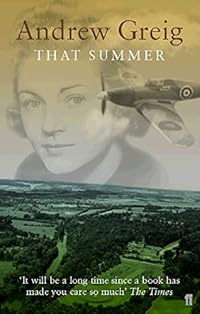
That Summer by Andrew Greig

That Summer cover

That Summer by Scottish author and poet Andrew Greig was first published in 2000 and it’s the first book which I’ve read by him, it won’t be the last though. Luckily my library has all of his books.

The title refers to the summer of 1940 when World War 2 was just beginning to hot up after a period of unreal quiet, referred to by all as ‘the phoney war’.

The setting is mainly England although at one point the main character Len is posted to Scotland for a short time. There are four main characters: Leonard Westbourne is a young fighter pilot and his friend Tadeusz is a Polish fighter pilot who is much more experienced, in all ways really. Tad is a devil for the women, as apparently the Poles were, according to my dear old friend Marjorie who fell in love with one (the last love of my life she said) who was based in Kelso in those dark days, but I’m wandering off the subject.

Len and Tad team up with the two friends Maddy and radar operator Stella who both must be a bit crazy to be going out with fighter pilots given their life expectancy, but then there was danger everywhere and you had to live for the day.

Jack gave me this book after he had read it saying that he thought I would like it, he thought it was very good and you can read his more professional review of it here.

At first I thought it was a bit slow but I really got into it and my only gripe was that as the story is told in the words of the main characters it wasn’t always instantly obvious who was ‘speaking’.

Otherwise this book is a very good depiction of what it must have been like to be ‘one of the few’ in the Battle of Britain and to be involved with them.

The blurb on the front says, ‘It will be a long time since a book has made you care so much.’ – The Times

In fact during the 1970s I worked with a woman who had been a radio operator in communication with fighter pilots during the war, hearing everything that was going on up there, no fun at all and it makes you wonder how people managed to just get back to normal life after years of listening to such things. But they did and those young women who were stationed near Blackpool only wobbled when London was pasted and they couldn’t get in touch with their families down there. I wonder if my generation would have been as stoical?

This is another one read for the Read Scotland 2014 challenge.

The Four Graces by D.E. Stevenson

The Four Graces cover

The Four Graces are the daughters of the Reverend Grace, a country vicar in an English village. Mr Grace is a widower and his four grown up daughters are ‘doing their bit’ for the war effort; the story takes place in a year during World War 2.

First published in March 1946 but obviously written when war was still ongoing, in the Far East anyway, it’s a deliberately light-hearted tale of family life and sisters in particular. D.E.Stevenson didn’t want to write about the depressions of Total War, she wrote about the inconveniences of war and of course that perennial problem of rationing.

Adeline, the youngest sister, doesn’t really feature much as a character as she is in London most of the time, in one of the services. But she manages to foist a most ghastly person on the family. Aunt Rona (by marriage) has been bombed out of her home in London and Addie tells Rona that she will be made welcome at the vicarage. Well most sisters would have been up in arms at that because Rona makes life at the vicarage very uncomfortable, especially as she has obviously decided to become the next Mrs Grace. But it does give D.E. plenty of opportunity to have some fun at her expense.

The book is light entertainment but it does flag up actual situations which people found themselves in in wartime. Such as the woman who had grown to love her wee evacuee as if he were her son. When his mother decides that as London is no longer in danger from Hitler’s bombs she writes asking for her son to be sent back to his family home. But the boy was never cherished at home and she just wants him there as he is now old enough to be of use to her. The evacuee’s surrogate mother is desperate to hold on to him and give him a good start in life, something he won’t get in his biological home.

This was a situation which did happen and I know one man who was heart-broken to have to go back to the city and leave his country home and family when hostilities stopped. He kept up contact with them all their lives though.

So, this is a good comfort read, but is true to life as it was at that time.

Stevenson was of course Scottish, indeed a relative of Robert Louis Stevenson, and I read this one for the Read Scotland Challenge. I think that’s my ninth one.

The Headmistress by Angela Thirkell

The Headmistress was first published in 1944, in fact my copy is a first edition hardback, not that I’m bothered about such things but I do prefer hardbacks to the modern paperbacks.

This one mainly involves the Belton family, they’ve fallen on hard times and are unable to afford to live in their large home. Luckily the Hosiers’ Girls’ Foundation School has rented the property for the duration of the war, however long that may be, and the Beltons have taken up residence in a smaller house which is situated more conveniently in the village.

I did enjoy this one although it didn’t feature much in the way of food rationing information, it was mainly clothes coupons which seemed to be a worry. I really like all the social history side of these books but there’s plenty of humour too.

The character of Heather Adams starts off as ghastly annoying schoolgirl and by the end has begun to transform into an almost likeable young woman. But it’s Miss Sparling, the headmistress of the school who as a newcomer has caught the eye of more than one of the local gentlemen, there always has to be some romance after all.

Friendships are forged when people realise that they have a hatred for the same person, everything else is forgotten about when the Bishop or Miss Pettinger rear their ugly heads. Those characters manage to unite people against them. This seems so realistic to me, I’ve definitely experienced the most unusual combinations of people who have bonded over a mutual dislike.

This storyline must have spoken to so many of the original readers of the book as the younger members of the families are all being sent off overseas and are really not expecting to be coming home again. In reality that was exactly what was happening in every community in the UK and elsewhere of course.

I could be doing without the Mixo-Lydian/Slavo-Lydian nonsense but I suppose that was reflecting the animosity between some of the many Eastern European refugees who were finding there way to the UK during the war. I think that the Mixo-Lydians must have in reality been Romanians as they have ‘escu’ endings to their surnames.

This was another enjoyable visit to Barsetshire, mainly with the Belton family who are the descendants of the Beltons who featured in Anthony Trollope’s book The Belton Estate.

Fortunes of War by Olivia Manning

Olivia Manning’s Balkan and Levant Trilogies are probably better known as Fortunes of War as that is what the BBC serialisation was named. The first three books were published separately between 1960 and 1965 as :

1. The Great Fortune
2. The Spoilt City
3. Friends and Heroes
and later published in one big volume as The Balkan Trilogy.

As you can see an audio version is available.

The sequel is The Levant Trilogy which was published in three volumes between 1977 and 1980 as:

1. The Danger Tree
2. The Battle Lost and Won
3. The Sum of Things.

If you’re at all interested in World War II you’ll love these books. I read them all in 2008, just before I started blogging and I don’t even have any notes on them but I thoroughly enjoyed the books and they’re written so well I was finished them in no time at all, which was the only disappointing thing really.The writer Anthony Burgess said that they were, “The finest record of the war produced by a British writer.”
Can’t say fairer than that can you?

I remember that I loved watching the BBC serialisation but for some reason it’s never been re-shown, unless I’ve just missed it somehow. It starred a very young Emma Thompson and Kenneth Branagh. I think it was only the second thing that I’d ever seen Emma Thompson in, the first programme was by the BBC again and it was called Tutti Frutti. It was ages ago now and again it doesn’t seem to have been re-shown. But at last, it’s out in DVD.

It was set in Scotland and also had Robbie Coltrane and Richard Wilson in it. I remember it was very funny and is just the sort of thing that they should have on now in these dark and gloomy days. Emma Thompson was able to do a very good Scottish accent. Her mother is the Scottish actress Phyllida Law.

I think I might just put the DVDs on my Christmas list, if my husband’s looking for any ideas!