The Shell Seekers by Rosamunde Pilcher

I’ve been meaning to get around to reading The Shell Seekers for absolutely donkey’s years but I was really surprised to see that it is number 50 in the BBC Top 100 Books list.

Does anybody fancy joining in reading The Shell Seekers together and having a bit of a chat about it, possibly on November the 30th, which is St Andrew’s day! If so, let me know.

This book would fit in with any Scottish challenges, personal or otherwise, that are going on at the moment. Although Rosamund Pilcher was born in England she has lived in Scotland (Dundee) for most of her adult life. The Shell Seekers was a best seller when it was first published in 1987 and has been translated into lots of languages. It’s particularly popular in Germany, my childhood German pen-pal is a big fan of the book. Which was a surprise to me because it is set in London and Cornwall from World War II until the present day (1987).

It’s a bit of a doorstop at 509 pages but I think it’ll be easy reading and the end of November seems quite far away at the moment. No doubt it will gallop up to us in a flash though.

School Holidays

It’s the first week of the two week long autumn school holiday here but we still have the builder doing his stuff all over our house so we haven’t been able to do anything exciting.

The weather has kept him back a bit because you can’t do cement work if it is too cold but at least it has been fairly dry for days now and we’re hoping that tomorrow will be the last day of the scaffolding and mess.

Looking on the bright side, no gallivanting around the countryside has meant that I was able to read May Sarton’s The Small Room in a couple of days. I read slowly compared with most people I think, but due to the fact that I don’t go out to work I can usually devote at least a couple of hours each day to reading.

At the moment I’m reading a Richmal Crompton Just William book, which I should probably have read when I was about 10 but I think that William at War is for children of all ages and I’m going to be starting on Ian Rankin’s Rebus book Let it Bleed shortly.

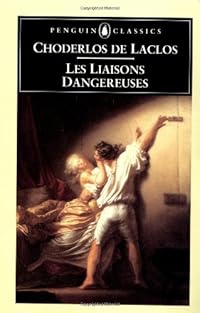
Les Liaisons Dangereuses by Choderlos de Laclos

Les Liaisons Dangereuses cover

Again I have to thank The Classics Circuit for introducing me to this book and French Literature in general. I would never have chosen this book to read had it not been for the CC and its participants.

The fact that this is an epistolary book was a bit off-putting to me but I didn’t have any problems with it at all. I was lucky enough to have the time to read the book in four days so it may have been more confusing if I had been picking it up and putting it down for weeks on end.

It was first published in Paris in 1782 and was regarded as outrageous, consequently it sold out within a few days.

It’s the story of two French aristocrats, the Marquise de Merteuil and the Vicomte de Valmont, who use and manipulate the lives of their supposed friends, young and old. In the course of entertaining themselves in this way they cause mayhem in the lives of all concerned.

The main female character, the Marquise de Merteuil is portrayed as being the most dangerous of the pair, positively poisonous. Plus ҫa change – as they say!

Anyway, I enjoyed it and I’m hoping to be able to see the film soon, which has Colin Firth playing the part of Valmont. I’m wondering how I’ve managed to miss seeing it!

Library Loot

I had a ‘phone call from the library yesterday to let me know that the Willa Cather book that I had requested was waiting for me, so I sauntered up there in the afternoon and of course I had to take out just a few books more. I ended up coming home with these:

An omnibus by Ian Rankin containing Let it Bleed, Black and Blue and The Hanging Garden. Judith, Reader in the Wilderness is planning to read Let it Bleed, and we’re intending to have a bit of a chat about it.

The Willa Cather book is Death Comes for the Archbishop – lots of people have recommended this one.

A Persephone book by Winifred Watson called Miss Pettigrew Lives for a Day. This will be my first Persephone read. According to the sticker on the book this is now a major film, but I haven’t seen it.

And because it’s coming up for Hallowe’en and lots of people have enjoyed it, particularly Stefanie, So Many Books and Jane GS, (Reading,Writing,Working,Playing), I decided to take out Dracula. I really hate the blood spattered cover but it’s about time that I got around to reading it and I’m hopeful that it’s going to be a lot better than The Seven Jewels by Stoker.

House renovation

Oh My God. Whit’s happenin’ tae oor hoose?

Well, it’s having a bit of a face lift, so I’ve been busy over the past 3 or 4 days, having to move precious plants and such. Luckily it’s the best time of the year to do that and they should survive with no problems.

Our house was built in 1903 and although the front of it is a traditional Scottish double-fronted bay-windowed design (rooms either side of the front door), the back of it is a bit more unusual, with the kitchen sticking out in the centre, with the dining-room window and study window on either side. I think about 1/2 an inch of the stone surface has worn away in the last 107 years, which is fine as the stone blocks are more than 18 inches deep.We needed to have the old mortar scraped out from between the stonework because over the years the stone wears down with the weather and the mortar ends up sticking slightly above the stone. This means that water can get down behind the blocks of stone and cause dampness and if the stone gets very wet and then it freezes then the stones can split and crumble, which is very expensive to rectify.

As with all work like this, the worst thing is the preparation and it has taken our builder days of hammering to remove the old mortar and he is also removing the chimney from what was the old scullery/wash house and is now our kitchen, because they often get damp when they aren’t being used.

The main chimneys are also in need of re-pointing and the cement seal between the slates and the edges of the roof are also being sorted out. We’ve been meaning to get around to that since we moved here over 20 years ago but good and experienced workmen aren’t easy to come by.

Although the upstairs has been built into the roof and eaves, it isn’t an extension, this is a traditional Scottish design and I suppose in England it would be described as being a cottage, but downstairs the ceilings are very high and have ornate cornicing and ceiling roses, which cottages don’t have.

So, as you can see, it’s all going on here and I’m being kept busy boiling the kettle for cups of tea and distributing the chocolate biscuits. You’ve got to treat your builders well!

My husband has taken advantage of the scaffolding to reach the upstairs windows to paint them. I hate all of the windows in this house because the previous owners removed the lovely original Victorian sash windows and replaced them with horrible double-glazing. To me, old houses with new windows always look like they’ve had their eyes poked out, but it would cost at least £30,000 to have sash windows again so we won’t be doing that.

At the moment I’m just really happy to be getting all this necessary work done before the winter sets in, but I’ll be ecstatic when the builders pack up and we can have the place to ourselves again. Stand by for more photographs next week!

Bookcovers

When I was visiting my local library the other day I noticed that they had put up a new display of book-cover posters. In particular, Aldous Huxley’s Brave New World caught my eye, very deco-ish.

Anyway I thought I would have a look around the internet to see how much the posters cost. And the answer is: Quite a lot unless they’re in the sale, which you will see if you take a look here.

Mind you, I don’t even know why I bothered looking because all of our walls are more than well covered already so we have no space for anything that might have taken my fancy.

Still it was quite a nice walk down memory lane. I’m sure that I had the nursery version of Alice in Wonderland that they have, but sadly I couldn’t find the Hansel and Gretel which I loved when I was wee and which I’ve been looking for ever since my mum gave it away.

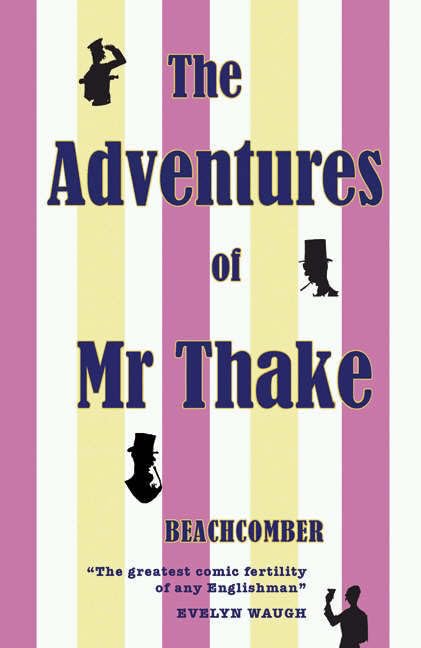
The Adventures of Mr Thake by J.B. Morton

The Adventures of Mr Thake cover

The cover of this book has on it “The greatest comic fertility of any Englishman” Evelyn Waugh. The book is by
J.B.Morton aka Beachcomber who was a columnist for the Daily Express newspaper for nearly 60 years. Morton had been in the army during the First World War but when he got shell shock he was moved to Intelligence. Anyway his experiences made him cultivate a great sense of humour, I suppose as a survival technique, and he started writing a comical newspaper column in 1919.

Mr. Thake is an English upper class twit and the book consists of letters which he has written to Beachcomber from wherever he is at the time, be it Monte Carlo or Maidstone.

I don’t think that I actually laughed out loud at any time, which I definitely have done with some of Evelyn Waugh’s comical writings. I would describe the book as being mildly diverting in its daftness.

I borrowed this book from my local library.

Scottish words: greetin’ faced nyaff

To be more precise, the phrase that you usually hear people say is – greetin’ faced wee nyaff. Everybody knows that wee means small I suppose, but in this case it doesn’t really have anything to do with the actual size of the person, it’s just to add to the insult.

Greetin'(g) means moaning or crying.

A nyaff is a contemptible, annoying person. Nowadays they would be described in English as being a ned or a bit of a lowlife.

So, there you have it! Ya greetin’ faced wee nyaff a commonly heard insult in Scotland.

Robinson Crusoe/Alexander Selkirk

This is one of those books that I’ve been thinking about reading for absolutely years but I still haven’t got around to it. But I do wish that I had made a note of every book which I’ve ever read which mentions Robinson Crusoe in it. I’m sure it’s been name-checked in at least 5 of the books which I’ve read recently, it just keeps cropping up. Has anyone else noticed this? The detective in The Moonstone by Wilkie Collins was obsessed by Crusoe.

Anyway, Alexander Selkirk was the real life man whom Daniel Defoe based the story on and he came from the nearby fishing village of Lower Largo in Fife. This is the statue which they have of him as a memorial.

In the Wikipedia article it states that Selkirk asked to be put onto the island because he had doubts about the sea-worthiness of the ship that he was on, but the local version is somewhat different.

Apparently Alexander was a ‘greetin-faced nyaff’, in English that is a moaning, annoying, contemptible person. So the whole ship’s company couldn’t stand listening to him any longer and decided that they had to get rid of him, and deposited him on the uninhabited island of Mas a Tierra/Juan Fernandez, which is 400 miles west of Chile. This seems much more likely to me, especially since he ran off to sea in the first place because his unruly behaviour had got him into trouble locally when he was a youngster. A career as a privateer was obviously preferable to having to go before the kirk session and be punished. Nowadays the island is known as Robinson Crusoe’s Island.

As it happens, Selkirk was lucky not to be on his ship as it actually did sink with the loss of most of the crew and those who survived were thrown into a Chilean jail and left to rot there. You can read more about Selkirk’s life here.

I quite like the fact that it’s all very low key. No museum or anything, I don’t suppose there’s much that they could have in one anyway. It would amount to a map and a goat skin!

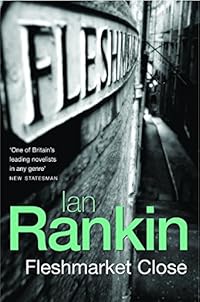
Fleshmarket Close by Ian Rankin

Fleshmarket Close cover

Ian Rankin is another local author as he was born in Cardenden, Fife just a few miles from where I live and I thought it was about time I got around to reading something by him. The Rebus books have been dramatised for tv and I always watch them. I usually stick to vintage crime books but I did really enjoy this one.

Set in Edinburgh of course, and it’s nice to be able to drive and walk around the place in your mind if you know the city. Detective Inspector John Rebus’s police station has been closed down and the resulting reorganisation means that Rebus doesn’t even have a desk in his new station. It’s a big hint from the top brass that they want him to retire but Rebus has no intention of doing so.

When a murder victim is discovered in Knoxland, a rough housing-scheme, Rebus and his side-kick Siobhan have the task of finding out who he is before they can even start to find the murderer. During the investigation they uncover an illegal immigrant operation and the whole thing becomes quite convoluted with several different crimes being looked into.

Amongst other things, this is a book about the terrible plight of asylum-seekers and their exploitation. But it isn’t all doom and gloom and there are flashes of dry comedy here and there.

Ian Rankin does seem to have a thing about half-moon glasses. I’m sure that there were three minor female characters in this book who were described as being about 50 and wearing half-moon glasses. I haven’t seen anyone with those for absolutely years.

It’s a fairly large book at 399 pages but it flows easily so it didn’t take long to read. I tried to read Rankin’s first book years ago and I gave up because, if I’m remembering correctly, it was cliched and I didn’t like the style at all. However I heard recently that Ian Rankin described his earlier work as not being great, so I thought I should give him another go. I’m glad I did and I will read more of his work now.

You might want to take a look at his official website here.

According to the blurb his books are bestsellers on several continents and have been translated into 22 languages. He lives in Edinburgh now!

On a personal note, I just wish that he hadn’t given the housing estate the name of Knoxland because that was the name of the primary school that I went to. It was supposed to be THE school in the west of Scotland town that I grew up in, so has completely different connotations for me.