Recycled jumper

Recycled jumper

At last, I managed to get around to sewing up the jumper which I knitted last year using wool from an old ripped out jumper. I was really just practising to get back into the way of it again. I used to be quite an expert knitter but I gave up when I had my children because I just didn’t have the time or the concentration to do it.

As you can see the wool is a really dreary grey colour, but grey wool always makes me laugh as it reminds me of my granny. She thought that grey cardigans were useful for wearing around the house. Well I know what she means now as she had a Victorian house, as I have now, and they aren’t half dusty but I don’t suppose it shows up against grey!

This jumper was knitted mainly in rib but there is a panel in the middle of reversed stocking stitch. I don’t know why I did that other than that I was just following the pattern, but I don’t really like reversed stocking stitch.

Anyway, I used the Stitchcraft pattern, it’s a 1953 magazine which I bought from ebay. I adapted it slightly so there aren’t so many buttons in my version.

Honestly, it’s quite a normal shape but I photographed it on my bed and obviously it wasn’t flat enough!

I’ve discovered that knitting wool seems to have become really expensive since I last bought some over 20 years ago but I got some reasonably priced stuff, from ebay again and I’m hoping to do something a bit more attractive next time.

Good Behaviour by Molly Keane

Good Behaviour cover

I really enjoyed the previous books which I’ve read by Molly Keane (M.J.Farrell) which were Two Days in Aragon (1941) and Devoted Ladies (1934). Good Behaviour was published very much later, in 1981 and was short listed for the Booker prize.

The book is set in Ireland and the character of Miss Aroon St Charles is so obnoxious in the first few pages that she might put some people off the book altogether but the story takes you back to Aroon’s childhood and development, showing what had contributed to the forming of Aroon’s character.

The St Charles family is an Anglo-Irish one, of landed gentry living at Temple Alice in much reduced circumstances but unwilling to change their habits. They expect the local tradesmen to support them in their lifestyle with no thought of ever paying any bills sent out to them and convinced that people are trying to rob them when they just want to be paid.

Of course at the same time they are looking down their noses at everyone, confident that they are superior to them all. Being a female and a rather large one at that, Aroon has a bad time of it with her mother constantly denigrating her.

It says a lot for Molly Keane that she managed to write an enjoyable book even although there are hardly any likeable characters in it. The mother is a very recognisable type to me, maybe it’s a Celtic trait in mother/daughter relationships, where girls just have no value in the family at all, except as unpaid servants. I hope it has changed for the better nowadays.

The local ‘nobs’ neglecting to pay their bills also rang true as I know that the ‘high class’ grocers in my home town went bankrupt in the 1970s because the customers who regarded themselves as better than the rest of us refused to settle their accounts, literally for years.

Anyway, I did end up enjoying Good Behaviour and at 245 pages it was a very quick read.

Gothic Tales by Elizabeth Gaskell

I thought that I had already read just about everything by Gaskell but on my last visit to my local library this one was sitting on the ‘new books’ shelf, so I had to borrow it.

This is a collection of nine short stories, although two of them are long enough to be described as novellas. I think that most writers hone their skills on short stories and I quite enjoy them. Sometimes the stories stick in your mind for 20 or 30 years, but I don’t think that will be the case with any of the stories in this book.

One of the novellas is called Lois the Witch and is the story of the Salem ‘witches’. I’m wondering when the first fictionalised version went into print.

Some of them are what I would call ‘fireside tales’ which would have been brought out and dusted down from the mind of the resident family tale teller on dark winter nights. I’m sure every household had one, even in more recent times (it was my mother in our family). They certainly have a feeling of folk lore about them, but I have read quite a few Celtic folk tales in my day.

Which brings me to what I found to be the most interesting thing about the stories, which was the language used. Elizabeth Gaskell uses quite a few words which are still used north of the border in Scotland. But I had an interesting comment from Joan in Pennsylvania about the phrase ‘redd up’ which Elizabeth Gaskell used, it means to tidy up or clean up. It seems it’s used by people from all different ethnic backgrounds there, but particularly by those of Dutch/German descent. Wherever it originated from I’m happy knowing that it continues to be used and makes the language richer. In future I’m going to ‘redd up’ instead of tidy up.

Anyway, I’m glad that I read Gothic Tales but I much prefer Gaskell’s longer works. If you want to read more about her work you might like to pay Austenprose a visit as a celebration of the 200th anniversary of Gaskell’s birth is being marked by people reviewing her work.

Hunterian Museum, Glasgow

This is a bit of a linky-fest for places of interest around the west-end of Glasgow. More parts of Glasgow will be featured at a later date.

It’ll be the school autumn holidays soon, so I was having a look to see what we could do in Glasgow during them. We usually like to visit The Hunterian Museum at Glasgow University. It’s always interesting even although it’s very small, and it’s free!

It’s just a short walk from Kelvingrove Museum, which is my favourite museum and art gallery – in fact it’s a home from home for me.

At the moment they are celebrating Black History Month at the Hunterian but there are exhibitions in other parts of the country too, if you can’t manage to get there.

The Hunterian Museum is tucked away at Glasgow University but the Hunterian Art Gallery is easier to find and is just a few minutes’ walk from the museum. There are always interesting art works on display but my favourite bit is the Charles Rennie Mackintosh part, where they have reconstructed an interior.

After that we’ll have a stroll along Byres Road ending up at the Botanic Gardens, which Michelle really enjoyed on her recent trip to Glasgow. A Son of the Rock has some nice photographs of the glasshouses there, which you can see here.

Sadly the Glasgow Museum of Transport closed recently and is moving to the new riverside setting. I’m sure that it’ll be great when it’s finished but I will really miss the old place, which was very handy, being just across the road from Kelvingrove.

So, that will be the most important parts of the west-end of Glasgow visited, unless you’re into shops. Byres Road leads you from Kelvingrove all the way to the Botanics and there are plenty of independent shops of interest.

Newest addition

My brother is 63 and that’s quite a lot older than me, and he and his wife had just about given up hope of being grandparents. But here she is at last, baby Juliette, the latest addition to the extended family.

She weighed in at a healthy 8 lbs 7 oz (3840 grams). Definitely worth waiting for!

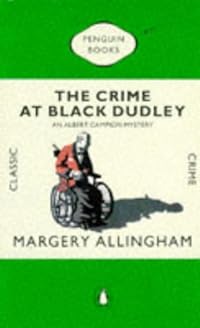
The Crime at Black Dudley by Margery Allingham

The Crime at Black Dudley cover

This book was much better than the last Margery Allingham which I read. It’s the first book which she wrote featuring Albert Campion as a character, and it really annoys me that she has written him with a ‘silly falsetto voice.’ There’s nothing more guaranteed to put you off a man, so I try to pretend that she didn’t write that.

This is the well-loved country house weekend sort of crime thriller/ adventure story and I’m not going to say much more about it other than that I really enjoyed it. I know that at least one other blogger (Danielle) has it on her nightstand waiting to be read.

There is an engaged couple in this book and at one point the man decided that he wouldn’t allow his fiancee to participate in the action on the grounds that it would be dangerous. It just about had me bouncing my head off the wall, but the book was written in 1929 and to be honest, men got off with behaving like that a lot more recently too.

Apparently she wrote Campion as a parody of Dorothy Sayers’s Lord Peter Wimsey. I wonder how well that went down with Sayers? They lived very close to each other in Essex in the 1930s. Sayers in Witham and Allingham was near White Notley, with just one train station in between them.

They were well known to the station staff and would often be on the same train going to nearby London, but according to one biography which I read years ago they didn’t pay much attention to each other.

In the 1970s I lived in Braintree, the next station along and at that time they were still using the 1930s carriages, just exactly as they are im Miss Marple. On my way to work in Witham I used to wonder if I was sitting in a seat which they had sat in, but on second thoughts, they would probably have been in the First Class section.

I seem to remember that Peter Davison was quite good in the role of Campion in the tv series.

Campion Complete Collection cover

Scottish words: redd up

Redd up is a phrase which you don’t hear much nowadays, which is a shame. It means to tidy up or clean up. It’s usually used to describe the tidying of a house or garden.

The last time I heard it being used it was a man saying that he had ‘redd up’ the noticeboard in a school. Well, notice boards are usually in need of a good redd up as they’re often crowded with out of date information.

I was surprised to read the phrase in a story by Elizabeth Gaskell the other day, although I probably shouldn’t have been. Michelle from the north of England recently informed me that the word ‘hen’ is still used there and I had thought it was only used in Scotland until then.

I’m now wondering if these words were originally Scottish but just expanded into the north of England with people moving there from Scotland for work. Or have they just continued to be used for a longer time here.

The Elizabeth Gaskell story which it was used in is The Crooked Branch and it was first published in 1859. It has been reprinted as a Penguin Classic in Gaskell’s Gothic Tales.