Chatsworth House, Derbyshire

I’ve been wanting to visit Chatsworth House for years but we’d never even been to Derbyshire. After seeing some of the countryside on the BBC’s Countryfile programme recently we decided that we wouldn’t put it off any longer. Of course Debo Devonshire has been on TV recently too with her most recent book and I’m about to start re-reading some of Nancy Mitford’s books. We set off last Wednesday morning and stayed overnight near Sheffield, another place we hadn’t been to.

We drove into Chatsworth early on Thursday morning, and honestly if I had been a weeping kind of a woman I would have wept. Instead of seeing that beautiful house in all its glory the whole front of the house was swathed in plastic which had scaffolding behind it. What a disappointment! Anyway, such is life and I have to say that apart from that Chatsworth is a fantastic day out. You can see some of the plastic in this photo of the back of the house. The Cavendishes have taken advantage of the scaffolding and tours of it are on at the moment. We were tempted but after spending a long time walking about the grounds and the house we were too tired to take on the scaffolding too!

Chatsworth House

The grounds were designed by ‘Capability’ Brown in the 1760s, for some reason I learned quite a bit about him in history when I was at school, it was great to be in one of his creations.
This is a photo of one of the many ponds/water features.

Pond in grounds, Chatsworth House

This is the rockery which is on a really massive scale, the trees are a big feature of the landscape and are beautiful, I must admit that I’m not very far from being a bit of a tree hugger.

Rockery, Chatsworth House

Can you see that there are two darker rectangles of greenery high up on this hill? I’m fairly sure that they are the letters ER which have been seeded in a contrasting green plant there to show the Cavendishes’ allegiance to the Queen but at the moment they don’t look too clear. Maybe they will flower.

Background hills from garden, Chatsworth House

This photo is of a seating area which is above a grotto, it’s quite a climb up there but it’s worth it.

Grotto above pond in grounds of Chatsworth House

I took loads of photos, inside and out, so there are a lot more to come. Obviously the house is a thriving business and a lot of people are being employed there and although I don’t have anything against the National Trust, I still think that a visit to Chatsworth is enhanced by the fact that the family is so involved with the running of it all. They don’t seem to have missed out on many business opportunities along the way although I have to say that as a keen gardener I was disappointed with the garden centre. They could make masses of money selling plants which have been propagated from their plants even if they employed a gardener just for that purpose they would generate far more money than his or her annual wages would cost. When we were there the only plants on offer were a couple of roses, lavender and heuchera (boring old Palace Purple).

I really wanted some plants for my garden as a souvenir of Chatsworth but I didn’t get anything at all. Maybe they normally have a better selection and I was just unlucky.

If you’re planning on visiting Chatsworth you should devote a whole day to it as there’s so much to see. If I were local I would definitely buy a season ticket to the grounds as it’s such a beautiful place to have a picnic or just go for walks. When we were there it was very busy, about half of the visitors seemed to be fellow Scots and the rest of them English, where were all the foreign tourists?

I bought two books in the shop there – a Chatsworth Guide Book and a massive chunkster called Letters Between Six Sisters, the Mitfords obviously, and I think it’ll be very interesting but very awkward to read.

More soon!
I’m Back

I scheduled a couple of posts before we set off for a few days away travelling. I had intended doing some blogging while we were on the road but ended up being so completely knackered with all the walking that we did that I didn’t even open my Netbook.

We couldn’t manage to get away any earlier which is a bit of a shame because as we were just wandering with the intention of booking into B&Bs which we liked the look of we ended up having to come home earlier than we expected to because there was no room at the inn – any inn! It seems that everybody is holidaying at home this year and of course this is the most popular weekend for starting holidays in England. Next time we’ll be booking ahead because it’s not so easy to be footloose and fancy free as you might think. I can see why mobile homes are so popular.

I’ve got loads of photos to sort out but hopefully I’ll be able to show you some sights of Derbyshire soon. Firstly that huge pile of stately home with Pride and Prejudice links, Chatsworth House!

Dysart, Fife, Scotland

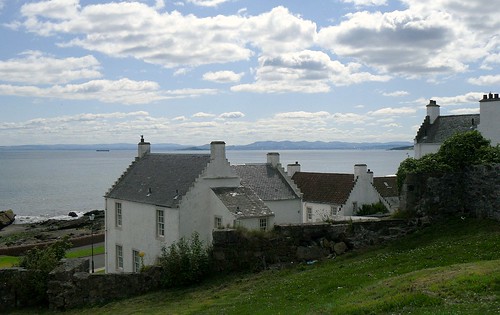
Last Saturday was a beautiful day here in Fife so we decided to take a look around Dysart which is just a couple of miles along the coast from Kirkcaldy. It’s an ancient burgh and there are still quite a few really old houses standing, and indeed still inhabited. The houses in the photo below are fairly typical of old houses on the east coast of Scotland. The design of the gables and roof is known as crows steps.

Pan Ha' Dysart

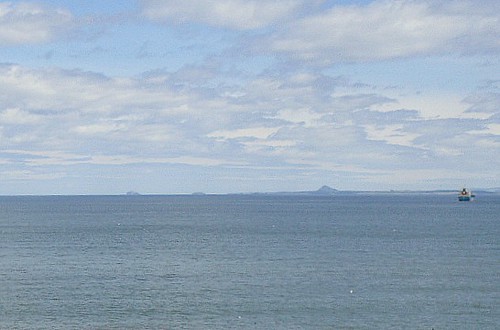
The view below is what the people living in those houses see from their front windows and it’s a view of the Bass Rock, it’s the rock on the left hand side, you’ll probably have to click to enlarge it. In reality it’s quite visible especially if the sun is shining on it because it’s now inhabited by thousands of seabirds, mainly puffins I think and their you know what makes the rock white. They used to put prisoners on the island which was probably worse than a death sentence as the North Sea is wild there most of the time.

Bass Rock and North Berwick Law

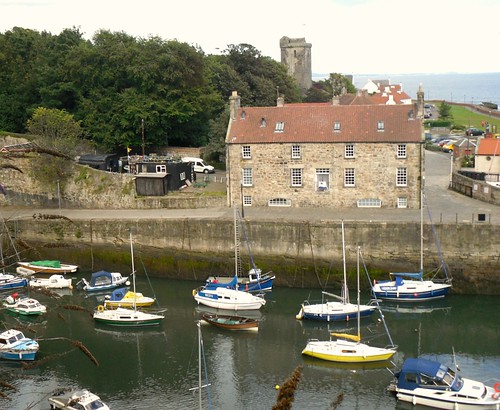
This photo is of the harbour master’s house which is now a bistro. It was lying quite derelict for years but at least now it’s being used for something. Quite a lot of money had to be spent on it, you know what old buildings are like when they aren’t used. They seem to lose the will to exist very quickly.

Dysart Harbour Master's House

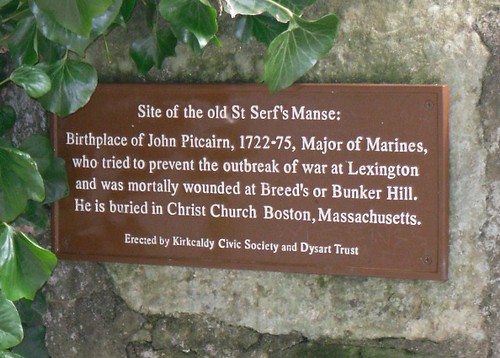
Now, I must admit that I’d never even heard of John Pitcairn before last Saturday. But he seems to be quite famous in Boston, Massachusetts – historically anyway! I’m not at all sure if information on this plaque is correct. He seems to have died at the Battle of Bunker Hill. His death was painted by John Trumbull in his painting The Death of General Warren.

Plaque to John Pitcairn, St Serf's Tower, Dysart

It has taken us about 25 years to get around to visiting this place, we always seem to ignore what’s on our doorstep!

The Daughter of Time by Josephine Tey

I’m trying to work my way through all of the Scottish writer Josephine Tey’s books and this is one which I’d been looking forward to getting a hold of as so many people seem to have enjoyed it. And I’m another one.

Detective Alan Grant is going mad with boredom, stuck in a hospital bed flat on his back with only the cracks in the ceiling to scrutinise. Embarrassingly, he had fallen through a trapdoor whilst chasing a criminal and had badly broken his leg.

When his actress friend Marta tries to think of ways which he can entertain himself she suggests that he could try to solve a historical mystery and she later brings him a sheaf of prints of historical portraits to whet his appetite. Grant thinks that he is good at ‘reading’ people’s personalities from their faces and it’s the portrait of Richard III which intrigues him. It doesn’t look like the face of a man who would have his small nephews murdered.

Grant decides that that is the mystery which he is going to look into and after he exhausts the text books which he is given it’s his young American visitor, a student called Brent Carradine who helps him to get further with his research.

As I said, I enjoyed this one which was quite different from her other books and considering that Grant is immobilised throughout the book he still manages to be an interesting character.

It is obvious to us all that history is written by the winners so any historical accounts have to be taken bearing that in mind. Tey gives quite a few examples of this and in particular she complains that the Scottish covenanters have been given a bit of a white-wash job over the years. She says that none of them were put to death despite the fact that everyone thinks that they were. She says that they were guilty of sedition as if that is something really heinous. But sedition is just talking against the government! Hands up anyone who has done that in the past – yes all of us, if we have half a brain!

Tey also glosses over the fact that being transported (sent to the penal colonies in Australia) was more or less a death sentence. Many of the prisoners died on the voyage and most of the others died of fevers shortly after getting to Australia.

One of my ancestors was transported to Australia for- yes you guessed it – sedition, and he only survived 7 months there. So it’s just as well that he and his wife exchanged mourning rings before he left. They knew that they would never see each other again.

Anyway, if you like vintage crime, you’ll probably enjoy The Daughter of Time which was first published in 1951.

Robinson Crusoe by Daniel Defoe

I’ve had this Daniel Defoe book in my house for over 30 years and it’s one of those lovely wee dark blue leather bound books but luckily the print is quite good so it’s easy on the eyes. I’ve been avoiding reading it mainly because I’ve seen numerous TV adaptations but over the last couple of years I’ve been struck by how many authors have mentioned Robinson Crusoe in their own books, it must get the most name checks of any book surely. It was the detective in Wilkie Collins’s The Moonstone who was most keen on reading it though and he seemed to find everything he needed in Robinson C.

Anyway, first published in 1719 and as you would expect, the writing seems quite archaic at first but I got used to it and ended up quite enjoying it. Everybody knows the story probably, if Robinson had been a dutiful son he would have taken his father’s advice and lived a sedate middle-of-the-road life as his father had noticed that those were the happiest of people. Being young and looking for adventure Robinson sailed off looking for excitement and he found it. He eventually ends up being taken as a slave but after years of slavery he manages to escape on a ship only to be shipwrecked and ending up being the only survivor of it when he manages to reach a nearby island.

Luckily he was able to swim back out to the ship and rescue lots of useful things to help him to survive – tools, some seeds, rum, sailcloth, guns and gunpowder – in fact he was fairly well stocked with the necessities of life. The island had a reasonable amount of edibles so I like to think that I could have managed as well as he did in the same circumstances.

The only thing that he doesn’t have is human company although he does have a dog and some ship’s cats. Robert Louis Stevenson thinks that the part where Robinson finds a human footprint in the sand as one of the most unforgettable scenes in English literature. Even although he later discovered that the island was used as an occasional ‘picnic area’ for a tribe of cannibals it was the scenes involving wolves in snowy mountains when he gets back to Europe which I found to be the most scary.

I did find the many descriptions of how he made pallisades around his cave a wee bit tedious but I’m glad that I’ve read it at last.

Daniel Defoe was born plain Daniel Foe and he decided to stick the De on to it to make himself seem aristocratic, that’s always a sign of a ‘dodgy’ person. And indeed Defoe was actually an English spy who took up residence in Edinburgh and infiltrated Scottish society and became an adviser to committees of the Scottish Parliament and the Church of Scotland. The English government had given orders to make sure that Scotland joined itself to England, for one thing Scotland had a ‘great treasury of men’ which England wanted to use.

Afterthe deed was done Defoe had the grace to admit that he had been wrong. He had apparently thought that Scotland would become more prosperous joined to England but of course the opposite was the outcome and poverty and unemployment became much worse.

Defoe wrote Robinson Crusoe whilst he was living in Edinburgh and it’s thought that he got the idea from the true story of Alexander Selkirk from Lower Largo in Fife who had been marooned on the island of Juan Fernandez near Chile which has since had a change of name to Robinson Crusoe Island.

Jacobean Embroidery Updated

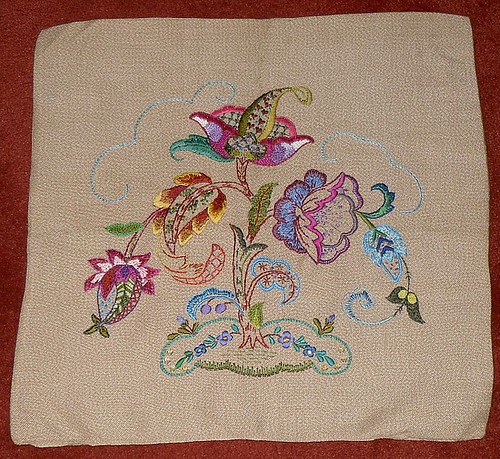
 Jacobean Embroidery

As you can see I’ve finished embroidering the linen cushion cover which I started some weeks ago and I’m quite pleased with it. I like the really bright colours which are a feature of this sort of 1930s Jacobean design. It should brighten up a grey day and we certainly get plenty of them!

It was absolutely yonks since I had done any embroidering like this. I’ve been doing cross stitch and tapestry/needlepoint projects more recently but I must admit that I really enjoyed doing this kind of embroidery again and I now have a few more similar projects that I’m dying to get stuck into.

At first my stitching was quite dodgy really but I think that I improved as I progressed with it and I hope that the next thing I do will be better. I’m going to try using a finer needle with the hope that I’ll be able to manage more delicate stitching then.

Forth Bridges from the river

At the risk of being repetitive – here are some more photos of the bridges. I took these ones when we went on a boat trip over to Inchcolm. As you can see I took this photo from the stern of the boat. I wanted to get both bridges in the same photo.

Both Forth Bridges 2

I took this one just as we were going under the road bridge, you can just see a bit of it.

Both Forth Bridges 1

This photo is of the underside of the scary road bridge. You can see why it’s scary because it’s see through and it’s a bit disconcerting to be able to see the water far below you as you drive across. Drivers tend not to notice it as they’re concentrating on the road ahead but I know quite a few people who are nervy as passengers because of the design.

Forth Road Bridge

If you look closely you can see some of the bridge workers in their orange overalls hanging over the side having a look at the boat as we sailed under them. They’ve got a great view but rather them than me because if they fall off they have no chance of surviving!

Forth Bridge

Click on the photos if you want to enlarge them.

Trip to Inchcolm in the Firth of Forth

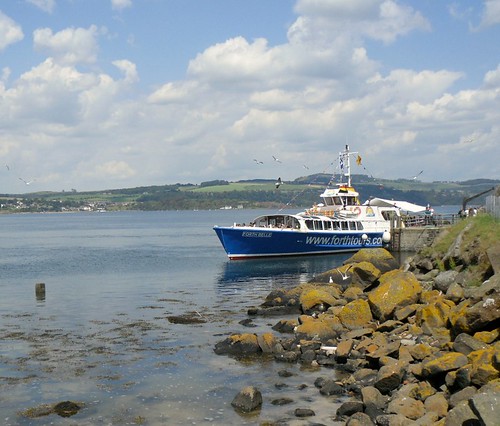
You know what it’s like, somehow you just never get around to doing the touristy things which are on your own doorstep. So when we saw that the weather was going rapidly downhill towards the end of the week we thought we would seize the last good day and take that trip to Inchcolm which we’ve been putting off for about 25 years. King David I founded a priory which became an abbey in 1235. Apparently they’re the best preserved monastic buildings in Scotland. This is the boat which we went on, I was surprised at how fast it could go but the captain was really good and slowed the boat down for people to take photos of seals and puffins.

Forth Belle at Inchcolm

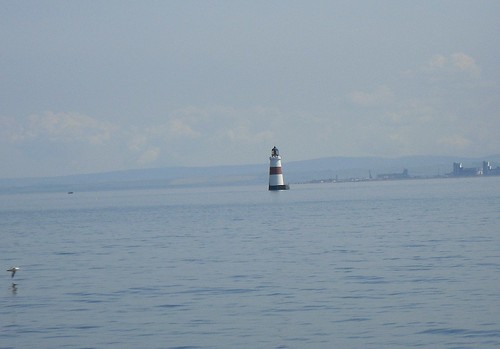
It was a good trip and the water was very calm. I particularly enjoyed going underneath the two bridges. We went past Oxcar lighthouse which was built by the ‘Lighthouse Stevensons’, Robert Louis and D.E. were from the same family. You can see Leith (Edinburgh’s port) in the background.

Oxcar Lighthouse 2

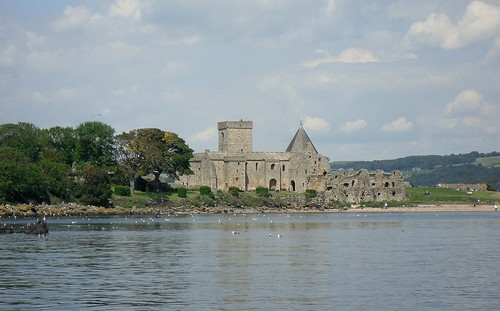
And this is our destination Inchcolm Abbey, on one of the five islands in the Forth.

Inchcolm Abbey from Forth

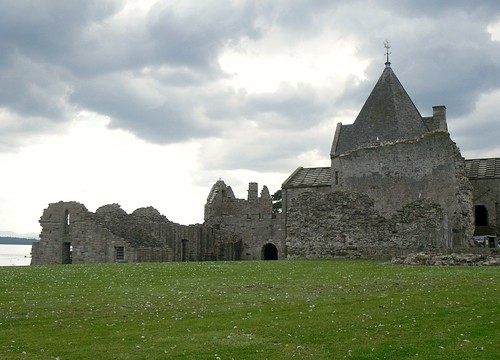
This is the abbey from on the island, as you can see it’s a ruin but there’s still a lot to see and parts of it are quite intact. If you have the notion you can get married in the abbey, I suppose its different and for some reason people are always looking for unusual venues.

Inchcolm Abbey from Island

The island has been used for defensive purposes in the last two wars and at one point there were 500 soldiers garrisoned on it but most of the barracks have been demolished although you can still see the gun emplacements. The Forth Bridge was the target of the very first German bombing raid of World War II but of course they didn’t even manage to damage it, although they kept trying.

We tried to walk around the whole of the island but had to give up because the seagulls are nesting at the moment so the adult birds are particularly aggressive and it was beginning to resemble a scene from The Birds so we had to turn back.

Another great day out but if you are thinking of taking the trip make sure that you check the weather forecast first. We had a beautiful afternoon there but if it had rained it would have been pretty miserable as there isn’t really anywhere to shelter on the island. It must be really wild when the wind is roaring but I quite fancied the idea of staying on the island, there is a wee house there which is inhabited, presumably by a caretaker who must tend the plants and cut the grass, what a great job!

It was great sailing under the two bridges but I’m leaving those photos for another post!

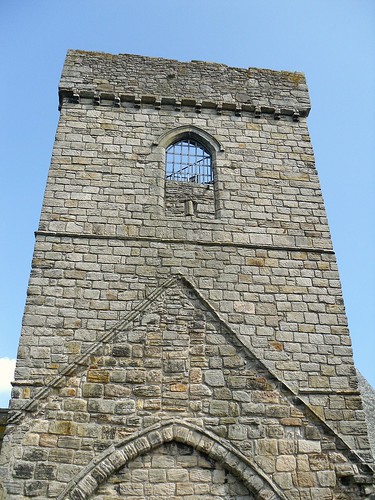
Meanwhile here’s the Abbey tower.

Inchcolm Abbey tower

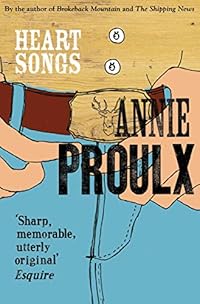
Heart Songs by Annie Proulx

Heart Songs cover

Heart Songs is a compilation of eleven short stories which are all set in the depths of rural New England. It’s hill and wood country so hunting, shooting and fishing feature in most of the stories. This is quite alien to me because although angling is supposedly the most popular hobby in the UK hunting is not popular at all. Guns are just not a part of our culture and it isn’t possible just to go into a wood and shoot something, you need permits and if someone sees a person with a gun nowadays then they are likely to call the cops.

A lot of the stories are about rich city people who have moved into a poverty stricken area and are really playing at being good old country folks. They tend be summer inhabitants only or they give up and leave for the city again after a year or so. The new people are treated with disdain by Proulx so I suppose they’re a pet hate of hers. They’re similar to the people in Britain who buy second properties in rural areas in the UK and so make it impossible for the locals to buy anywhere to live. Let’s face it, that annoys the hell out of us all! Universally, they seem to look down their noses at anyone not from a city. It has to be said though that some of the rural folks in Heart Songs are peculiar to say the least and there’s one woman who has slept with her half-brother! So possibly these stories aren’t for those of us who are a wee bit squeamish about such things or don’t fancy the idea of men going about shooting animals.

But, I love Proulx’s descriptions, the first story begins: Hawkwheel’s face was as finely wrinkled as grass-dried linen, his thin back bent like a branch weighted with snow.

People breathe air as heavy as wet felt – that’s not something which I’ve ever experienced but I can imagine what it must be like now. I think some people think that descriptions equal ‘purple prose’ but I like to know what people, places and objects look like.

I loved The Shipping News and I really enjoyed these short stories too. Previously I had only read Fine Just the Way it is-The Wyoming Stories and now I only have Close Range in the house still to read, that’s the one which has Brokeback Mountain in it and I was less than impressed with the film so I’m going to leave it a while before reading that compilation.

I’ve read that some people really dislike Annie Proulx’s writing style. Is she one of those love them or hate them writers?

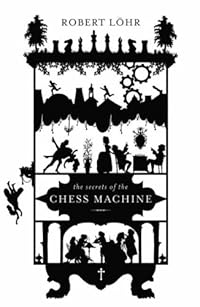
The Secrets of the Chess Machine by Robert Lohr

The Secrets of the Chess Machine cover

This book was translated into English by Anthea Bell in 2007 and was first published in German in 2005. It’s based on a true story and it’s a historical adventure set in Vienna in 1770. This is Robert Lohr’s first foray into novel writing, he has been a journalist and a screenwriter previously. Lohr has taken the known facts about the chess machine and woven a story around them.

Baron Wolfgang von Kempelen is a talented chap, in the past he has translated things for Empress Maria Theresia and has designed bridges and planned new settlements. But he’s very ambitious and he has the idea that if he builds a thinking machine which can play chess and beat everyone, then he will become very rich and famous and then be given lots of contracts and so make even more money.

So Kempelen and his assistant build an automaton in the shape of a Turk playing chess, but of course it’s just a con trick and he needs a wonderful human chess player who can fit inside the machine. Tibor Scardanelli is an Italian dwarf who is an outcast with no friends and he has been earning a living by playing chess for money. He always wins and Kempelen talks Tibor into becoming the Turk’s ‘brain’ and secreting himself inside the machine whilst Kempelen and his assistant Jacob tour the major cities of Europe with it.

I quite enjoyed this book and although it’s been about a week since I finished it, it’s still fresh in my mind which can’t always be said of books. Some are almost instantly forgotten, or just about anyway!
There’s a lot going on in it, murder, romance of a sort and intrigue but I can’t say that I was chewing at the bit to get back to it whenever I put it down. I think that the fact that there’s really only one likeable character in it is a bit of a problem.

There is an epilogue and author’s notes which tell what happened to the Mechanical Turk after the events in the book. Sadly the machine ‘died’ in a fire at the Chinese Museum in Philadelphia in 1854.

The Turk

My great blogpal Joan Kyler in Philadelphia kindly dragged her husband to the above sign to photograph it as she knew I would be interested in it. Joan isn’t exactly enamoured with Philly so it’s no surprise to her that the chess playing machine met its fate there! At least they haven’t completely forgotten it.