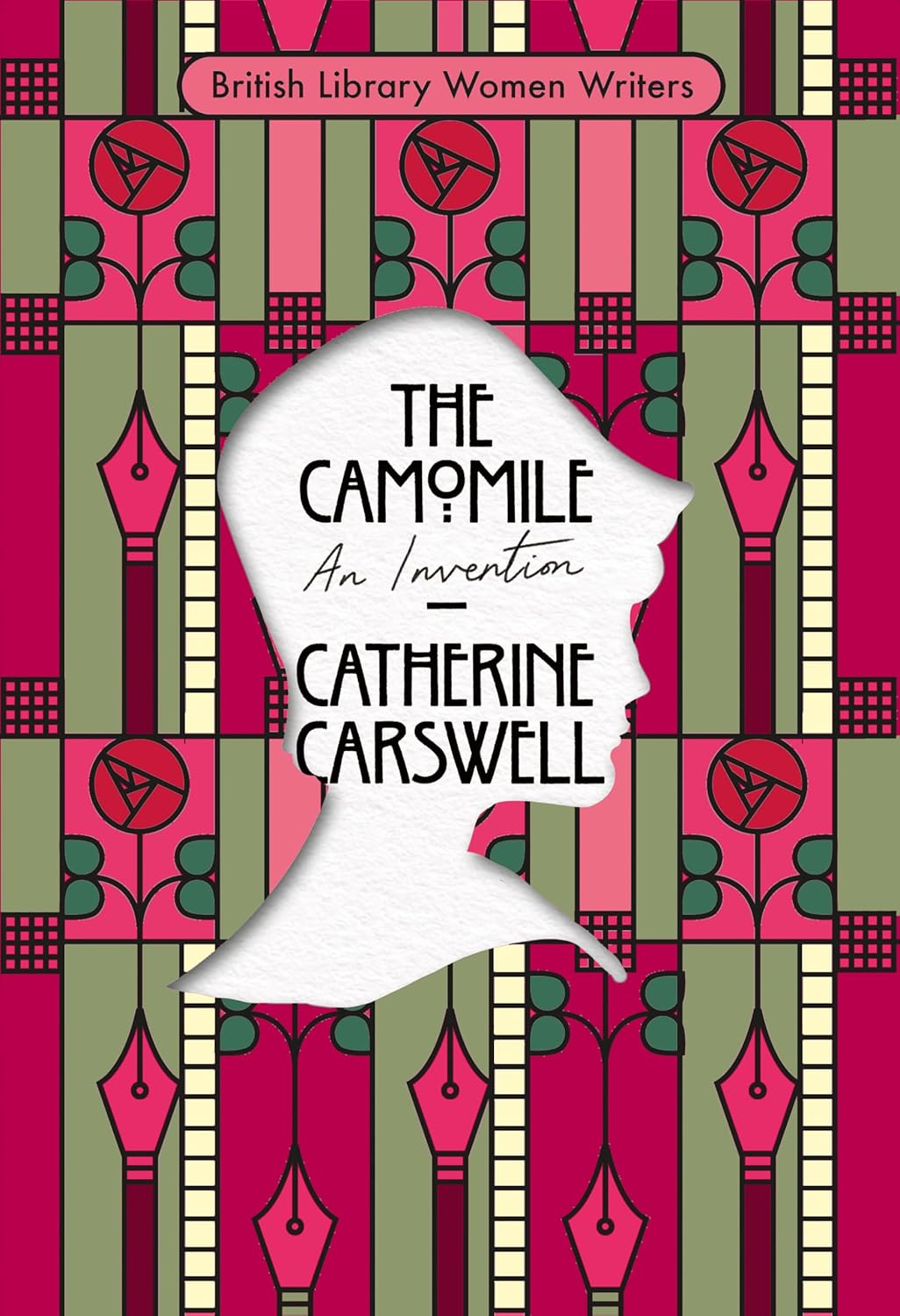
The Camomile by Catherine Carswell

The Camomile by the Scottish author Catherine Carswell was first published in 1922 but it has just been reprinted by British Library in their Women Writers series.

The blurb on the back of this book says: Set in early twentieth-century Glasgow, this effervescent novel is widely considered a fictional counterpart to Virginia Woolf’s essay ‘A Room of Ones’s Own’. In fact this book predates that essay by quite a few years.

Ellen Carstairs lives with her brother Ronald and her Aunt Harry who is a keen Christian, but Ellen gets no peace at home to do the writing that she wants to do. She is having to give piano lessons to help out financially, but worse than that her aunt is always coming in and out of her room to chat, and to try to persaude her to go to the very many religious meetings that she attends.

Ellen’s solution to the problem is to rent a room just off Byres Road in Glasgow’s west end, supposedly as a place to teach her pupils but really as a refuge from her aunt, and to get on with her writing, she has great ambition.

The book begins with a letter to her friend Ruby, they had spent time together studying music in Germany, after that it moves on to journal in style. Ellen moves from a not long out of school girl, writing of the crushes she had had on teachers to a young woman contemplating her future and weighing up her options. After a bit of a whirlwind romance and engagement some red flags have been spotted by her and it seems that she’ll have to think again.

This was a bit of a slow start for me but I ended up really loving it, there is some Glaswegian in it but really not much at all and it’s very easily understood I think. There’s quite a bit of humour as Ellen is a close observer of those around her, and the middle class society of Glasgow was quite a rich seam.

The Camomile has an interesting Afterword by Simon Thomas of  the blog Stuck in a Book.

I was sent a copy of this book by British Library, for review. I appreciated their Mackintosh – ish book cover design.


Dunino Den, Fife

I had heard about Dunino Den in Fife years ago but it was only when I saw some photos online of the place that I decided it was time to go and check it out myself. I must say I found it a bit of a strange place.

Dunino Church , Fife

The ‘den’ is situated at the back of Dunino church (above), there’s a path down through the grass and woodland which leads to a sunken area, a small burn (stream)  flows through it but you are surrounded by quite high rock faces, some of which have been carved over the years.

We had the place to ourselves but it is obviously popular with people, probably quite an eclectic bunch as there are some Christian symbols if you look hard, a faint Celtic cross to the left of the large LC below.

Dunino Den, Fife, Cross carving

But it’s thought that this place was used as a place of worship and possibly sacrifice by the Druids.

Dunino Den, Fife

But there are also ‘offerings’ to whatever, in the shape of stones, flowers and candles. I was particularly unnerved by the pottery figure of a headless woman in the photo above. Was she just accidentally broken or was it a deliberate offering of some sort?  I found the place to be a bit spooky, but it has obviously been used for centuries, possibly as a place of worship during the Scottish Reformation, but the land above the rockface which has ancient stairs cut into it also has a rock with a footprint cut into the stone, usually a sign that a king/chieftain has been there, and beside it there’s a sort of natural stone basin which was full of water.

You can see the bottom of the stone steps in the middle background of the photo below.

Dunino Den , Fife

The burn was very low, slow and sludgy considering how much rain we had had.

Dunino Den , Fife

Dunino Den , Fife

Dunino Den, Fife

Below is the sort of natural stone pond.

Dunino Den, pool, Fife

And the rock below by the pool has some faint cup and ring marks (maybe) and what looks like part of a footprint. This actually a very dangerous place to stand by as it is situated above the other photos and is close to the edge of the rockface, it would be very easy to step over the edge, especially as it is overgrown with ferns at the edge.

Dunino Den, ring marks, Fife

Right by the stone above is the well worn stone steps down to where the other photos were taken, we didn’t go down the steps though, they looked too dangerous, there is a path through the woodland which is much safer.

Dunino Den Steps, Fife

I don’t remember seeing it but it seems there’s a face carved into one of the rock walls. The photo below is from the website in the link above.

So that’s Dunino Den, a bit of a strange place which goes way back in time, no doubt some believe there are fairies living there, or some other sorts of spirits, I’m sure there are plenty of theories about it. I’m glad we visited it at last, but I don’t know if I want to go back. It’s not far from St Andrews, if you are interested in visiting it.


Sir John Lavery exhibition

A few weeks ago we travelled in to Edinburgh to visit the Sir John Lavery exhibition at the Royal Scottish Academy. His painting below is of Edinburgh’s Princes Street with the Scott monument and castle rock domineering – as they do. The exhibition is strangely titled An Irish Impressionist, because Lavery has always been regarded as being Scottish as although he was born in Ireland he was orphaned very young, aged five I think,  and moved to Scotland to be brought up by an uncle. Sadly the exhibition isn’t free, unless you are a ‘Friend’. It costs between £5 and £19 apparently, but we are Friends of the Galleries.

Princes Street, Edinburgh, Sir John Lavery

Below is his “View from the Canal” which was actually the River Kelvin. This was at the International Exhibition at Glasgow’s Kelvingrove in 1888.

A View from the Canal Kelvingrove

Evening Tangier – below.

An Evening in Tangier, Sir John Lavery

The painting below is called The Intruders but whether it refers to the geese or the children is anybody’s guess.

The Intruders, Sir John Lavery


Woman on Horse, Sir John Lavery

Coast defence below has a lot of reflections in it. It dates from his time as a war artist.

Coast Defence, Sir John Lavery

Below is Hendon 1917.

Hendon 1917, Sir John Lavery

I realy like the one below which is of the main building at the 1888 International Exhibition. Electricity was used for public illumination in Scotland for the first time there.

The Glasgow International Exhibition

As my great friend Joan remarked – his style is reminiscent of John Singer Sargent.


Alison’s Highland Holiday by Sheila Stuart

Alison’s Highland Holiday by Sheila Stuart was published in 1946. This one was a real blast from the past for me although I didn’t remember anything about the story, I know that I read this ‘Alison’ series when I was about ten years old and I absolutely loved the books. In fact I told my mother that when I grew up I was going to live in a wee white cottage in the Highlands. That never came to pass.

In Alison’s Highland Holiday, brother and sister Niall and Alison Campbell are aged 15 and 13, the youngest of four children who have been orphaned in recent years. They’ve just travelled north from Edinburgh by train to Sutherland, to stay with their Uncle  George over the school summer holidays. It’s an idyllic place for them as there’s a great salmon river nearby and the two of them adore fishing.

Sadly the new laird who owns the river has told their uncle that he has guests staying with him and he wants them to have the river to themselves while they are there. Niall and Alison are so disappointed, they know that they daren’t poach because their uncle would be furious with them. They’ll have to spend their time hill walking and doing a bit of fishing for tiddlers in a small burn.

While out walking by the river they meet a strange girl, Neill is impressed by her as she’s able to swim in the river.  It turns out that she’s also spending the school holidays in the area. Her name is Shona and she’s a bit of a wild one, she seems to think that rules are made to be broken.

I enjoyed the setting but as the youngsters had fishing competitions I did wonder about the amount of young fish that they were catching, there was going to be a serious lack of fish in the future in that river! It’s changed times in Scottish rivers now as you have to put anything you catch back in.

I had quite a few of the books in this series when I was a youngster but my mother gave them away when she decided I had grown out of them. Annoyingly they are now quite difficult to obtain and so are quite expensive when they do turn up.


The Safekeep by Yael van der Wouden

The Safekeep by Yael van der Wouden was longlisted for The Booker Prize 2024.The book is set 15 years after the end of World War 2, in Overijssel, a rural area in northern Netherlands.

Isabel’s mother has died fairly recently and she’s living in the family home which has been inherited by her brother Louis. Her brother Hendrik has already moved out and lives with Sebastian. Isabel is a rather sour young woman  who lives a boring and grim life with just a young maid for company. She uses her mother’s favourite crockery only once a week, it’s kept for good. Her world is turned upside down when Louis brings a young woman to the house, he’s apparently engaged to Eva and he wants her to live in the house while he is abroad working. Eva couldn’t be more different from Isabel who until then had been in charge of the house. Eva insists on sleeping in the dead mother’s bedroom, despite Isabel’s complaints. She’s lazy and untidy and Isabel hates her, when things begin to disappear from the house Isabel is suspicious.

Surprisingly the relationship between Eva and Isabel takes a wild change, and in chapter 10 it looks like Louis has been cast aside for Isabel. You might know that I can always do without the bedroom action in books, but I suppose it is required in this one. I was glad when that part was over with though!

This book is about the  war and its aftermath, and how Dutch people just got on with their lives after it, giving no thought to the Jewish people who in some cases had been supplanted by non Jewish Dutch families in their homes. This is a well written book which seems to have been written in English as there is no mention of a translator, but there are a few clunky bits. On occasion people startled instead of were startled or started. Perhaps that is an Americanism. I’m sure that there’s mention of a rung on the stairs instead of a step on the stairs, but Dutch staircases resemble ladders so much I can see how that could happen.

As it happens I know the town of Zwolle which is the setting of the book, it’s not far from my brother’s house, and I know how tough a time the people had there during WW2. Most of the men had been taken away to work for the Germans in their factories, making munitions and such, slave labour. The men who managed to escape had to live wild in forests in freezing weather, and the Germans starved the entire country and stole everything they could. I can understand why some might want to keep any advantage they could when the war came to an end.

The Coorie Home by Beth Pearson

The Coorie Home

The Coorie Home  –  Beautiful Scottish Living by Beth Pearson was published in 2019, possibly as a sort of reply to that Scandinavian Hygge book that was around about then, but this one is more intense.

I borrowed the book from the library and I did think that I would probably just dip into parts of it, but I read it cover to cover, it’s an interesting read which is informative and also attractive, with lots of eye candy type photographs.

For anyone looking for Scottish made homewares or arty crafty things there are plenty of pointers to help you track things down, and there are even some Scottish recipes. The contents are wide ranging, I really enjoyed it. The photographs are by Ciara Menzies and the book was published by Black and White Publishing.

I must say that the only time I’ve heard the word ‘coorie’ is in that Scottish phrase ‘coorie doon’ often said in the past  (I’m not sure about nowadays) to children at bedtime meaning ‘snuggle down, get comfy and cosy.’


Duff House, Aberdeenshire

We’ve been doing a lot of travelling around over the summer, and I haven’t blogged about most of our visits to places. It was back in July that we travelled up to the north-east of Scotland to Aberdeenshire for a few days and one of the places we went to was Duff House, doesn’t it look fab?! You can read about it here.

Duff House , Aberdeenshire

Over the years it has been used as a private home, a hotel, sanatorium and prisoner-of- war camp. It was designed by William Adam, father of Robert. As often happens, the owner William Duff and the architect fell out and the house was never completed to the original plans. The house was built between 1735 and 1740.

Apparently I took 44 photos of the inside of the house, I’ll just inflict a few of them on you. Below is the library which might have looked entirely different in its heyday as the owners of the house decided that they didn’t want to live there, they had a better house! They gave the house away but sold most of the contents, so it has been furnished from elsewhere.

Duff House Library , Aberdeenshire

Duff House Library , Aberdeenshire

The dining room.

Duff House , Dining Room, Aberdeenshire


Duff House, Aberdeenshire


Duff House bedroom, Aberdeenshire

Duff House, Aberdeenshire

The house is now in the care of Historic Scotland and is part of the National Galleries of Scotland so it has a great collection of art. It’s well worth going to see even although it is fairly far flung from most people in the UK.

The architect William Adam lived in Kirkcaldy, just a stone’s throw from where we used to live, but someone in ‘authority’ at the council way back decreed that the Adam house should be demolished – and so it was – there is now just a boulder where the house was with a sign on it saying Gladney House was here! This is how it looked.


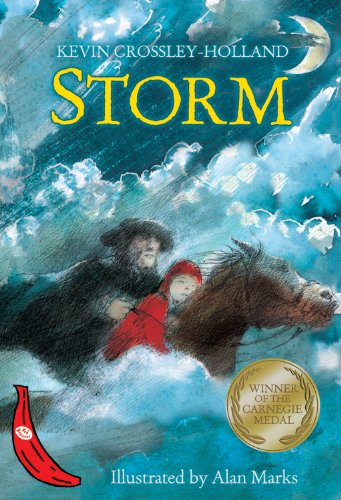
Storm by Kevin Crossley-Holland a Carnegie Medal winner

Storm by Kevin Crossley-Holland won the Carnegie Medal in 1985. I have a bit of an ongoing personal project going, to read as many of these medal winners as I can. This one has been utilised as a Reading Ladder book, presumably some sort of educational tool. This has whittled the pages down to just 46 and as it’s heavily illustrated it’s a very quick read indeed, and unlike any of the other Carnegie Medal winners that I’ve previously read.
Annie is a young girl who lives with her parents in a remote country area, her much older sister Willa is married and living in a town three bus journeys away, but she is going to be having a baby soon, and her husband who works away from home isn’t able to get home in time for the birth. It’s almost Christmas and Willa makes the journey to her parents’ house.Despite the age difference the sisters get on well, and Willa is able to tell Annie the details of a local ghost story about a man who had been murdered by highwaymen near the ford – hundreds of years ago.

Three days later a terrific storm arrives, and it looks like Willa’s baby is determined to arrive too, but the phone lines are down so they can’t get through to the hospital.

Annie is sent out into the storm to fetch the local doctor, she’s frightened of meeting the ghost, but a horseman picks her up and takes her to the doctor’s house, and all is well.

I think that this book has been somewhat shortened, edited to fit the Reading Ladder. It’s a well written story, and I like the illustrations which are by Alan Marks, but I’m not sure about pushing ghost stories onto children, so I find it to be a strange choice for the Carnegie Medal. I hope their teachers tell them that ghosts aren’t real!

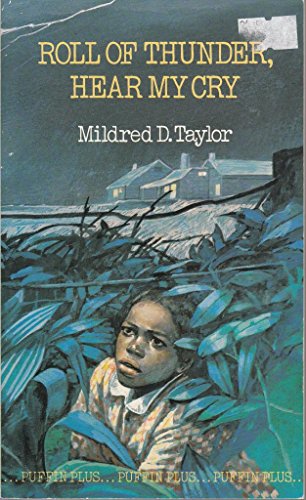
Roll of Thunder, Hear My Cry and Let the Circle be Unbroken by Mildred D. Taylor

Roll of Thunder, Here My Cry and Let the Circle be Unbroken by Mildred D. Taylor were published in 1976 and 1981 in the USA.  I read editions from the Puffin Plus series. Thanks Jennifer for these ones, I hadn’t even heard of the author before.

The first one begins in 1933 in America’s deep south. Mississippi.  It’s a tough time for farmers but particularly for black farmers, but the Logan family are a bit better off than most of their neighbours who are only sharecroppers. The Logans actually own their land, but the wealthy white landowner who owns the land adjoining theirs is determined to get their land for himself.

Cassie Logan is the only girl in her family, she has three brothers and lives with her parents and her grandmother. Her father is having to work away from home for most of the time though, so that he can earn money on the railroad, that money pays the annual tax which is due on his land.

Life is difficult for the children too, just getting to school in the morning is a nightmare as they have to walk on what is often a muddy track, having to try to dodge the white children’s bus as the driver is determined to splash them with mud while the white children cheer. Life for the black people is just one humiliation after another, but it’s the night riders (Ku Klux Klan) who terrify the black people. Just a rumour of ‘disrespect’ from a black person could end up with them being lynched or burnt out. Cassie has a lot to learn, and none of it makes sense. This one won the Newbery Medal.

Let the Circle be Unbroken is set two years later. Things are even worse for the black people now, the Depression is biting deeper and the ‘solutions’ put forward by the government are only making things worse, especially for sharecroppers. Granger, the main white landowner is conning the Logan family out of money which was due to them from the government and Cassie’s mother has lost her teaching job.

Mr Morrison has become part of the Logan household, he’s over seven feet tall and Cassie’s father won’t worry so much about his family while he is away on the railroad work. But it’s young T.J. Avery who gets into big trouble. He’s a young black neighbour and is rather full of himself. When a couple of white lads befriend him you just know it’s going to end in tears.

Stacey Logan, the eldest son decides that he is going to leave and find work elsewhere, but he just runs off and they hear nothing from him, everyone fears the worst.

These are both really good reads, if somewhat depressing, as in some ways things don’t seem to be getting a lot better for the black people in the deep south of the US.

Niebert Windmill, Netherlands

The Niebert Windmill is still used for grinding flour, and you can watch it being ground, then buy some of it for your baking.

Interior , Niebert Windmill, Netherlands

This is a very tall windmill, I think there are six staircases inside it and we went up them all. In the Netherlands most stairs resemble ladders, they are incredibly steep, even within private homes, often it feels safer to go down them backwards as then you can hold on to the step as well as the handrail.

Interior Stairs, Niebert Windmill, Netherlands

The windmill is part working mill and part museum. You can watch flour being ground in some Scottish mills too, but ours are run by water power so don’t feature sails.

Stairs, Niebert Windmill, Netherlands

Nieder windmill view, Netherlands

It was incredibly windy up there and although I’m not usually bothered by heights, this was scary as the fence  is very small and it felt too easy to get blown over it. I didn’t stay there long! Somehow in the photo it doesn’t look at all high but six ‘ladders’ can’t lie! The flag is the Groningen state flag.

Nieder windmill, view from platform Groningen flag

Stairs , Nieder windmill, Netherlands

Platform , Nieder windmill, Netherlands