Madame Claire by Susan Ertz

Madame Claire by Susan Ertz was first published in 1923 but my copy is a Penguin Books from a boxed set of facsimiles of the first ten Penguin books, published to mark Penguin’s 50th anniversary. I got this one from a secondhand bookshop so I don’t have the other nine books in the set. It cost me all of £2.

I really enjoyed this book, Madame Claire seemed such a sensible and wise elderly woman, named Madame Claire by her adult grandchldren, but Lady Gregory to more formal people. She is a widow.

After Madame Claire’s son Eric married she opted to give up her large house and move into a small suite in a Kensington hotel.  She sensibly refused to move into her son and daughter-in-law’s home.  Claire  has had no contact with her daughter Connie for many years, since the recently married Connie had run off with a famous musician.  Claire has also had no contact from her husband’s best friend Stephen for almost twenty years, he had rashly asked her to marry him too soon after her husband’s death, and her refusal had sent him off in a huff. So when she unexpectedly gets a letter from him she’s happy to renew the friendship.

Connie also resurfaces, and the grandchildren Judy and Noel hare off to France to see her, they’re agog to meet this aunt who had “thrown her hat over the mill” all those years ago

As ever, I’m not giving a blow by blow account of the book which has various plots, a plethora of flawed characters, and a lot about the unfairness of society and its perceived constraints. With age Claire has garnered insight into the behaviour of her family members and others. I have to say that I was incensed that Gordon, the eldest grandchild would inherit everything while Noel his younger brother would have to shift for himself, despite losing an arm in WWI, and of course Judy will get nothing as she’s expected to make a good marriage! I hate unfairness.

I’ll definitely be looking for more books by Susan Ertz.


The Willow Tea Rooms, Sauchiehall Street, Glasgow

Last week we had a couple of days away over in the west of Scotland, and on one of the days we took the train to Glasgow, something that Jack used to do on a daily basis and I did at least once a week, it was a bit of a nostalgia trip, despite the trains being completely different. Anyway, we were aiming for The Willow Tea Rooms in Sauchiehall Street. They were designed by Charles Rennie Mackintosh, they had been fairly recently refurbished, and have now been taken over by the National Trust for Scotland.

The Willow Tea Rooms, Sauchiehall Street , Glasgow, Charles Rennie Mackintosh

As you can see from the photo below, the pedestrianised area of the street is having work done on it at the moment, the whole place is a mess and as usual there didn’t seem to be any actual work going on, you have to be quite determined to reach the tea room!

The Willow Tea Rooms, Sauchiehall Street, Glasgow, Charles Rennie Mackintosh

We were sitting right at the window but as you can see from the photo below they have it screened by curtains so you don’t see people going past, and they can’t see in.  It was a very busy Friday lunchtime so the place was packed downstairs, but the food was good.

Charles Rennie Mackintosh, The Willow Tea Rooms, Margaret Macdonald, Sauchiehall Street, Glasgow

The staff must be well used to people going around taking photos of the decor, as nobody batted an eyelid when Jack did that. I love the details, Mackintosh was quick to give his wife Margaret Macdonald the credit  for designing and working many of the textiles that feature in ‘his’ work

The Willow Tea Rooms, Sauchiehall Street, Charles Rennie Mackintosh, Glasgow

The Willow Tea Rooms, Charles Rennie Mackintosh, Glasgow, Sauchiehall Street

In the 1970s and 80s the tea rooom was shut and it was being used by Carrick the jewellery shop. They specialised in silver jewellery which was inspired by Mackintosh’s designs. It was more successful than many others and nowadays you can still buy some of the jewellery on Ebay and in ‘antique’ shops. There is an awful lot of ‘Mockintosh’ stuff around though which isn’t so pleasing to the eye – or my eye anyway.

The Willow Tea Rooms, Charles Rennie Mackintosh, Sauchiehall Street, Glasgow

Have you ever been in a tea room which actually had a bell on the table to summon assistance?  Everyone was very attentive so they weren’t really necessary.  Mind you I didn’t hear one actually being used!

The Willow Tea Rooms, Sauchiehall Street, Glasgow, C.R. Mackintosh

The photos above and below are of the second floor room which wasn’t being used at the time, it’s a sort of gallery and you can look down to the ground floor from there. There is another floor above that one which I suspect is used for special occasions like weddings – maybe.

Upper level The Willow Tea Rooms, Sauchihell Street, Glasgow Charles Rennie Mackintosh

Anyway, this visit was something that we had been planning to do for ages, then along came Covid and it was postponed yet again. We’ll go back for another visit sometime, the desserts were delicious!

The Chalet School in Exile by Elinor M. Brent-Dyer

The Chalet School in Exile by Elinor M. Brent-Dyer was first published in 1940 by Chambers, but my copy is an abridged paperback Armada. I don’t have that many of the hardbacks as they tend to be overpriced, in my opinion.

Anyway, this one is quite different from previous books as the location of the Austrian Alps became distinctly uncomfortable when the local Nazis started to flex their muscles. A simple walk by some of the girls in the school’s surroundings leads to a dangerous encounter with locals who call the Gestapo, accusing the girls of being spies.  Before the Gestapo come calling the girls attempt an escape into Switzerland and safety, it’s a terrifying journey, but they have no choice.

Meanwhile – back at the Chalet School it has become obvious that the school needs to find a new home. The German pupils go home, as do some others. So much school equipment will just have to be abandoned.

This is a very different read from the others I’ve read in this series as it involves spies and a chase across the Alps.  A new school will have to be started up elsewhere, and Guernsey is chosen as the new location!!

As this book was published in 1940, the same year that the Nazis invaded the Channel Islands including Guernsey, I’m intrigued. What made Brent-Dyer choose Guernsey for the new school location? Possibly by the time the book was published Guernsey had already been over-run. Anyway, they are obviously going to have to move the school yet again. This was an enjoyable romp.

Towards the end of this book there’s a shock for Jo who is now married. I suspect that the birth of triplets was seen by many readers to be very far-fetched, but I knew a woman who did give birth to triplets, naturally, it was pre test tube babies, and the mother was over 40!

There was an article in today’s Guardian about adults reading books for Young Adults which you can read here. Apparently 74% of Young Adult fiction readers are adults. If writing is good I don’t think there is an age category, it’s for readers of all ages to enjoy.

I started reading the Chalet School books again as it’s so long since I read them, they’re a real nostalgia kick for me, not that I can actually remember much about them. But the ambience seemed cosmopolitan to the ten year old me.

Branklyn Garden, Perth, Scotland

Last week we drove to Perth to visit Branklyn Garden again, it’s a lovely National Trust for Scotland location.

Branklyn Garden , Perth, Scotland

It was a lovely warm (ish) sunny (ish) day, well it didn’t rain, and the rhododendrons were looking their best.

Branklyn Garden, Perth


Branklyn Garden , Perth


Branklyn Garden, Perth


Branklyn Garden , Perth

This garden was donated by John and Dorothy Renton, a couple who had designed the two acre hillside garden after building their house on the plot in 1922.

Branklyn Garden , Perth


Branklyn Garden , Perth

In the photo below you can just see the house which I think is privately rented now. There is a cafe of course, with a ‘sitooterie’ where you can have your coffee and cake at a table outside .

Branklyn Garden , Perth

This place is well worth a visit if you like gardens and plants, photographs never do the place justice. They also have  a lot of plants for sale, many of which have been propagated from plants in the garden. That’s very unusual, most places just buy plants in from somewhere, which just isn’t the same at all.

Offshore by Penelope Fitzgerald

Offshore by Penelope Fitzgerald was first published in 1979 and this book won the Booker prize that year. I’m often puzzled by the books that win prizes and that’s the way I feel about this book, but I must say that I haven’t read any of the books which were short-listed for the prize that year. Suffice to say that I wasn’t too impressed by this one, it isn’t terrible but it’s just nothing earth-shattering, or even that entertaining. I’m left wondering if it was the slimness of the volume at just 140 pages which endeared it to the judges!
Offshore is set in the 1960s in a community of houseboat dwellers, berthed on the tidal  River Thames at Battersea Reach. They’re an eclectic bunch of people who all share a love for the boats they are in, despite most of them being in a poor state of repair. The boats are all close together, some linked by gangplanks to the one next to them. The boat owners go by the name of their boats.

Nenna is a young mother of two daughters, the father has left them, but Nenna expects him to come back – sometime. Nenna is lax about her daughters, she’s often in trouble because she’s happy for the girls not to attend school, but the nuns and priest definitely aren’t. Nenna had bought their boat Grace with all the money that they had while her husband was working abroad, and she had given him the impression that she had bought a substantial house at a good London address.

Maurice is always up for a party, but he has a sinister ‘friend’ who uses his boat to hide stolen goods in it. Harry is obviously a ‘baddie’ but he has a hold over Maurice, because Maurice is a male prostitute, and Harry could get him imprisoned at any time just by calling the police.

Dreadnought is up for sale, but is about to sink at any moment. There are a few others, all with their own problems. The most engaging characters are Nenna’s young daughters Martha and Tilda who have more maturity and sense than both their parents, and have a lucrative if dangerous hobby of recovering goodies from ancient boats which had sunk years before with cargoes such as de Morgan tiles in their holds.

The ending is not conclusive, it depends on how optimistic the reader is I suppose. I found it dissatisfying.

My garden in Fife

Amazingly it was a blue sky day on Wednesday and we had absolutely no rain at all, but that east wind was still blowing, and a friend told me that she had had to scrape ice off her windscreen in the morning, when I was sensibly still in bed.

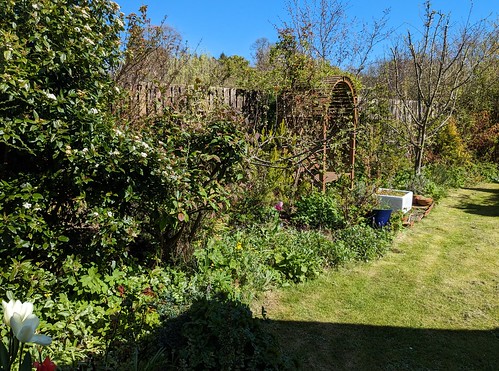
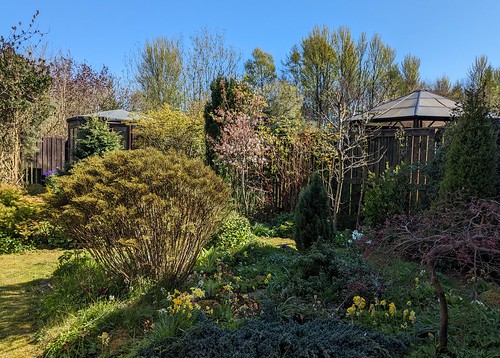
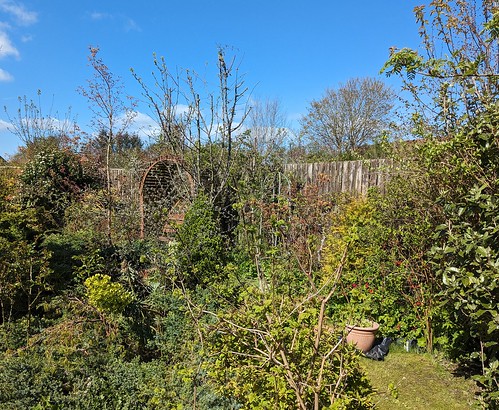
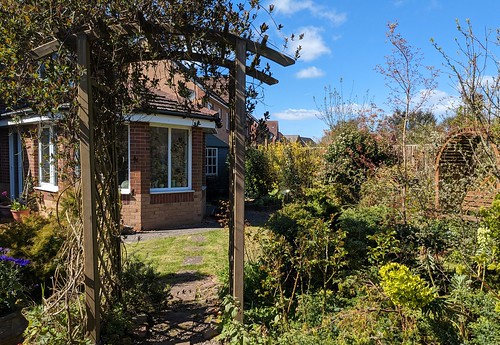
Anyway, I went out to take some photos of the back garden. Things are beginning to green up.

my Garden, Scotland


my Garden , Scotland


my Garden , Scotland


my Garden , Scotland


my Garden, Scotland

That big shrub to the left of centre in the photo above is going to have to be moved as it blocks my view from the kitchen window of nicer things, such as the pieris, I did not think it was going to grow so large and is not amenable to pruning. Such is life.

My phone tells me that tomorrow it will be four degrees celsius colder than it was today so it’ll be 8 celsius tomorrow, that’s 46.6 F,  colder with the wind no doubt. It’s a very slow start to Spring.

Killers of the King by Charles Spencer

I decided to read Killers of the King by Charles Spencer when it was mentioned by the author S.G. MacLean as one of the books that she had found interesting when she was doing her research for one of her Seeker books. Luckily I was able to borrow it from the library. I was slightly disappointed when I got my hands on it as I had imagined it to be a sumptuous glossy hardback, but it is a normal format paperback, with just eight pages of photographs/illustrations. No doubt there is a similar hardback edition. However, it’s a really interesting book and is well-written.

There were fifty-nine men who were mad or crazy enough to put their name to King Charles I ‘s death warrant and with the eventual restoration of the monarchy it was open season on them all. Almost half of them had died in the intervening twelve years, but almost immediately the hunt was on for the survivors, with one of them being murdered just three weeks later.

They had had some warning because with the unexpected death of Cromwell who had named his son Richard as his successor, it must have been obvious to everyone who knew Richard that he would never be up to the job. Soon there was talk of bringing Charles II home from his exile, and he was obviously going to punish the regicides. Most of them left the country, but some of them were persuaded to go back home, with promises of mercy, which turned out to be lies.

Charles Spencer decided to write this book because he thought that Charles I was an execrable ruler in his final years. However, I don’t think he came close to being as bad as Cromwell was, and he obviously intended to take over as king himself from the beginning.

“It is striking how many fascinating and notable figures colluded to end his life. They deserve in my view to be remembered with respect for their sacrifices: this book is my tribute to them.”

I think they never wanted a Stuart dynasty in the first place – too Scottish or should I say not English enough,  and  too close to Catholics for their liking. There were just too many greedy men who resented their family not being top dogs, but with Cromwell the whole country suffered. Well, that’s my opinion anyway.

You can see a Wiki image of his death warrant here.

The Bookseller of Inverness by S.G. MacLean

The Bookseller of Inverness by S.G. MacLean was published in 2022, I found it to be a cracking read, in fact it would make a great film.
Iain MacGillivray had been one of the many Jacobites on Drumossie Moor, Culloden in 1746, and one of the few to get away with his life, although badly wounded, he had feigned death.  It was a terrible time with the Redcoats running amok, pillaging, killing the wounded, and generally causing mayhem and despair within the local communities as they raped and murdered. Six years on and Iain has a bookshop in Inverness where he just wants to put it all behind him, and have nothing to do with the Jacobite cause. But the cause comes to him.

A mystery customer comes to his bookshop, he’s searching for a particular book but refusing to give any information at all, he’s going through all the books one by one. At the end of the day Iain has to practically throw the stranger out so that he can shut the shop, but when he opens it up the next morning he finds the stranger dead, his throat had been cut by a sword with a white cockade on its hilt – a Jacobite symbol.

Iain is surprised to discover that his Jacobite sympathies have resurfaced, and the behaviour of most of the Redcoats in the local barracks only strengthens his feelings.  Someone is settling scores, and it transpires that there’s another Jacobite plot afoot.

This was apparently a Times Audio Book of the Week with the comment that ‘This slice of historical fiction takes you on a wild ride.’

If you do read any books by S.G. (Shona) MacLean you should make sure that you read the Author’s notes at the end of the book. They’re always fascinating, her family background is steeped in the Scottish Highlands, where she still lives, and her uncle was the thriller writer Alistair MacLean. Shona MacLean obviously takes after him.


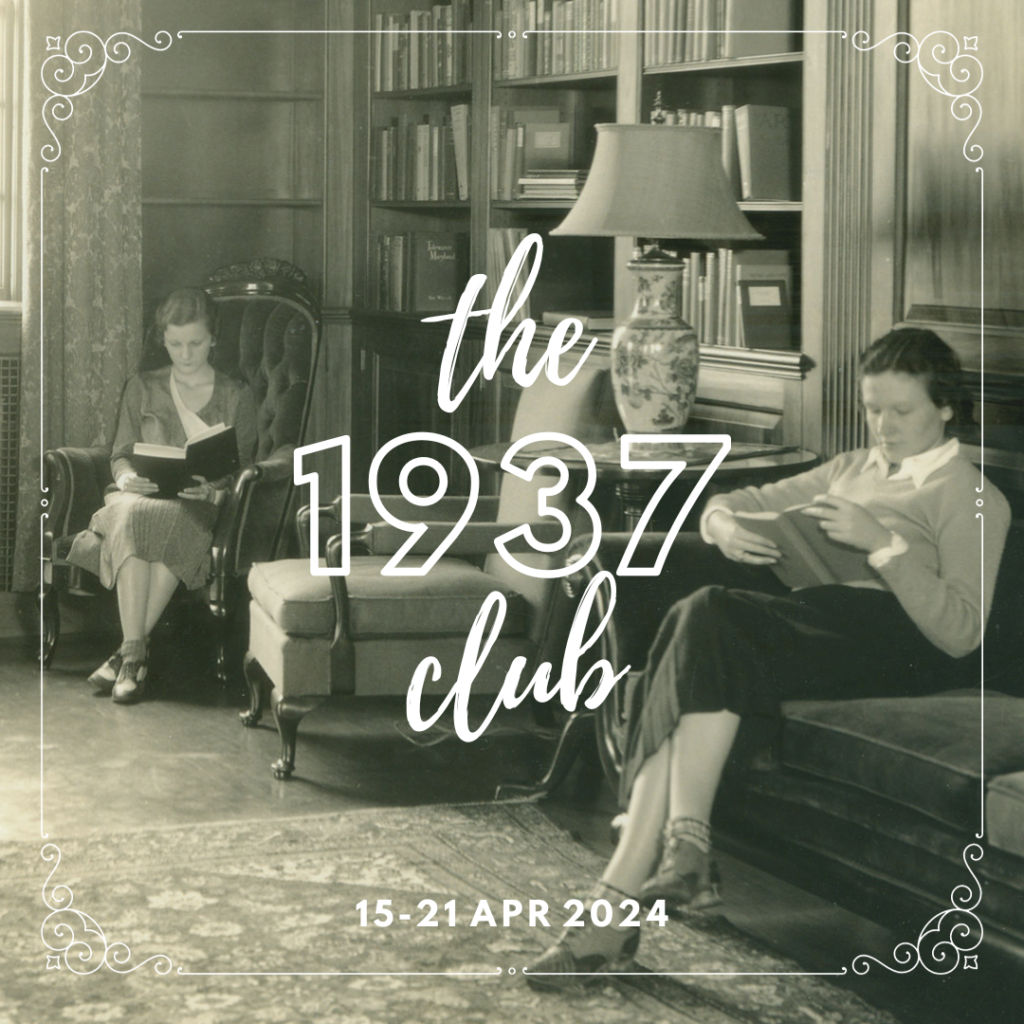
Theatre by W. Somerset Maugham – The 1937 Club

I was having a tough time finding a 1937 book to read that I hadn’t already read, until I realised that I had a copy of Theatre by W. Somerset Maugham in a Far and Wide omnibus edition. I really liked it, he was such a good writer. The 1937 week is hosted by Simon at Stuck in a Book and Karen at Kaggsy’s Bookish Ramblings.

In Theatre, Maugham, as a successful playwright was writing about a subject that he knew well. Julia and Michael are married and have become a celebrity couple over the years, with Michael concentrating on the business side of things as he realised that he didn’t have the talent to become a successful actor, unlike Julia.  Michael is supposedly the best looking man in the country, which is what drew Julia to him in the first place, but they weren’t married long before Julia realised that he was a tight-fisted, narcissistic bore.

Julia is never off the stage, she’s always acting out her emotions, or the emotions that she thinks correct for the occasion, she’s completely artificial but seems to fool everyone, or so she thinks. It comes as a shock to her in her middle-age that others have been judging her, and she has been found to be wanting.

There’s obviously a lot more to the book than I’ve said, if you get the chance you should give it a go. I’m already planning to read another by Maugham soon.

The result – number 8

The Classics Club spin number has been chosen and it’s number 8 which means that by the 2nd of June I’ll be reading and reviewing The Wrench by Primo Levi. It’s a slim volume at just 170 pages which is good as I have so many unread books in my piles.

Next month  (May) I’ll no doubt be adding to the piles as the Christian Aid book sale week in Edinburgh can’t be ignored as I always find several books there that I just have to buy, although I shouldn’t.