20 Books of Summer

I’m going to be taking part in 20 Books of Summer again this year. It’s hosted by Cathy at  746 Books,  and it’s quite flexible, you don’t have to read 20 books, it can be less, but I’m usually well able to read 20 books during June, July and August.

Below is a list of the books I intend to read, but some of them might change.

1. The Wrench by Primo Levi (for The Classics Club)

2. The Other Queen by Philippa Gregory

3. Snow Country by Yasunari Kawabata

4. Post After Post-Mortem by E.C.R. Lorac

5. The Redemption of Alexander Seaton by Shona MacLean

6. Gideon Ahoy by William Mayne

7. Mr Mac and Me by Esther Freud

8. Dissolution by C.J. Sansom

9. The Secrets of Blythswood Square by Sara Sheridan

10. Where the World Ends by Geraldine McCaughrean

11. Mayland Hall by Doreen Wallace

12. The Little Bookroom by Eleanor Farjeon

13. The Runaway Summer by Nina Bawden

14. Making It Up by Penelope Lively

15. The Mermaid and Mrs Hancock by Imogen Hermes Gowar

16. Five Children on the Western Front by Kate Saunders

17. Gaudy Night by Dorothy L. Sayers

18. The Hazelbourne Ladies Motorcycle and Flying Club by Helen Simonson

19. The Hemlock Cure by Joanne Burn

20. The Fall of Kelvin Walker by Alasdair Gray

It’s quite an eclectic list I think, there’s only one which is a re-read for me, Gaudy Night.  It should be a good summer of reading!


Mrs Ames by E.F. Benson

Mrs Ames by E.F. Benson was first published in 1912. I love his Mapp and Lucia series and I think this one was a sort of dry run for those ones, he hadn’t quite honed his talent for replicating the atmosphere of a small town and it’s supposed foremost inhabitants. So it’s not as blatantly hilarious and sarcastic, but it’s still well worth reading.

The town is called Riseborough and it’s the sort of place where the retired and comfortably off men go to their club straight after breakfast, while their wives go to the shops do the shopping and hear any local gossip.

Mrs Ames is the queen bee, and her social gatherings lead the way for all the others, she likes to try different things and set new fashions. ” In appearance she was like a small, good-looking toad in half-mourning; or to state the comparison with greater precision, she was small for a woman, but good-looking for a toad.” She’s over 55 and at least ten years older than her husband.  Mrs Ames only makes social calls to Dr Evans and his family because Mrs Evans is a sort of cousin to the local aristocrat, who is also loosely related to Mrs Ames.

Mrs Evans is in her late 30s but looks ten years younger and has both Mr Ames and Henry the son hankering after her.  Worse than that it looks like she intends to knock Mrs Ames off her social throne.  But the older woman is more than a match for her young relative.

This was a good read, amusing and sometimes sad, a true reflection of the Edwardian lifestyle that E.F. Benson was witnessing at the time,  in the town of Rye in Sussex where he lived for many years.

The Japanese Garden at Cowden – The Zen Garden

Zen garden, The Japanese Garden at Cowden, Scotland

A couple of weeks ago we decided to go to The Japanese Garden at Cowden again, it was a sparkling day and it was the first time we had really felt any warmth this year, and we were really enjoying our visit, but it’s obviously not for everyone as we heard a fairly youngish woman complaining bitterly that she had paid a lot of money to get in and there was hardly anything to see! She said that loudly as she walked quickly past what I think is a beautiful, if small Zen garden, and she didn’t even glance at it. Oh well, it takes all sorts I suppose.

Zen garden, The Japanese Garden at Cowden, Scotland

Zen garden, The Japanese Garden at Cowden

Japanese garden design seems to incorporate a lot of moss, which is something I’m going to have to embrace in my own garden I think after all the wet weather has encouraged it so much.

But nothing is perfect, I’m sure that in Japan a Zen garden wouldn’t have a redwood and lots of various mature conifers in the background, but I can see why the designer decided to leave them in situ.

We enjoyed the afternoon there anyway, although I must admit that we took advantage of this month’s Gardeners’ World magazine offer. It seemed steeply priced at almost double the normal cost, it was £9.99 but came with seeds and a 2 for 1 ticket entry into lots of famous gardens all over Britain. After visiting this garden we’re already quids in.


Recent book purchases

For some reason the usual Christain Aid book sale at St Andrew’s and St George’s didn’t go ahead this year, but the three day Holy Corner, Morningside book sale did go ahead, and despite it all being within one small church hall I did manage to find some books that I wanted to buy.

Books May 24

New York 1930 by Robert A.M Stern, Gregory Gilmartin, Thomas Mellins

Saint Petersburg and its environs

Mrs Ames by E.F. Benson

O Caledonia by Elspeth Barker

The Legend of Sleepy Hollow by Washington Irving illustrated by Arthur Rackham

The New York book is a massive tome with loads of photos and information on Art Deco architecture and design.

The Saint Petersburg book is a good reminder of our visit to the city some years ago.

I’m a big fan of E.F. Benson’s Mapp and Lucia books (and the original TV series)  so I had to buy Mrs Ames.

I have a lot of books which have been illustrated by Arthur Rackham, so I couldn’t pass up on The Legend of Sleepy Hollow.

It is of course just more books added to the TBR piles, but I couldn’t NOT buy them, and it was for a good cause.

Jack also bought books, but only two. The Changeling by Robin Jenkins and Highland Pack by Neil Gunn.


Petronella Oortman’s dollhouse, The Rijksmuseum

Last year we visited the Rjksmuseum in Amsterdam for the first time, it was amazingly busy, despite having to pay quite a lot to get in when such places are free in the UK.

The photos below are of a dollhouse which was never meant to be a toy. It was owned by a woman, Petronella Oortman.  She was a wealthy woman and she spent a large amount of money on her miniature house, which is actually quite large. It’s fitted out beautifully. Having a house like this was the equivalent of a man having a cabinet of curiosities.

The doll’s house is huge. I couldn’t fit it all in one picture so the one below is a stitch of two

Petronella Oortman's Doll's House  (stitch)

Such was the Doll’s House’s fame that someone painted it. The painting hangs on a wall nearby

Painting of Petronella Oortman's Doll's House

It’s a very popular exhibit so I wasn’t able to spend as much time looking at its nine rooms as I would have liked, mind you I could have looked at it all day.

Another fairly large doll’s house belonged to another Petronella! Petronella Dunois

Petronella Dunois's Doll's House 2

A closer view of upper portion

Upper Part, Petronella Dunois's Doll's House


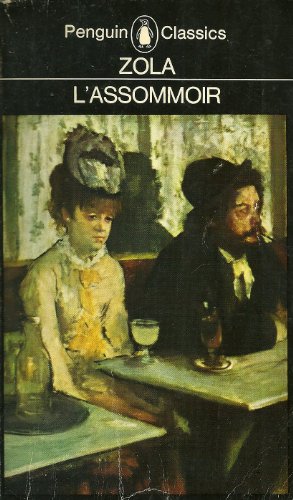
L’Assommoir (The Drunkard) by Emile Zola

L’Assommoir by Emile Zola was first published in 1876. It’s the seventh book in his Rougon Macquart series.  My copy of the book is a Penguin Classic, published in 1985, it was translated by Leonard Tancock. I think he made a really good job of it.

The story begins with the young mother Gervaise waking up and realising that her partner Lantier hasn’t come home overnight – for the first time – she’s desolate. The couple had got together when Gervaise was just 14 and Lantier 18 and Gervaise had their first child when she was 14. They moved to Paris from the countryside when Lantier came into some money, and they had lived the high life until the money ran out. He leaves Gervaise, runs off with a local woman and cons Gervaise into pawning her clothes before he goes, so she’s left with the clothes she stands up in, he even took the pawn tickets.

In truth he’s no loss though, Gervaise can get on better without him and eventually she takes up with Coupeau, a roofer, and they get married and have a daughter, Nana. Gervaise is a hard working laundress and dreams of having her own laundry, she’s able to save money but just as it looks like she’ll be able to become her own boss Coupeau has an accident, falling off a roof. Gervaise is determined to nurse him herself, not trusting the doctors in the hospital, it’s a slow recuperation but a bit of a miracle that he has survived at all. However, all of the money has been used up by the time he is able to get out of bed, but worse than that, his whole personality has changed.

Coupeau’s previous strong work ethic has evaporated, he had enjoyed lazing in bed, has probably lost his nerve anyway, roaming about on roofs doesn’t have the same appeal to him now. Worst of all is that he has gone from hardly drinking alcohol at all to meeting up with old workmates in bars and drinking the day away. But Gervaise never complains, she’s far too easy going.

She does get her dream though as she manages to borrow money from a neighbour whose son is sweet on Gervaise, and it isn’t long before her laundry business is doing very well, she’s good at her job. Nobody is perfect though and Gervaise is concerned with what others think of her, she has a kind nature but she also likes to show off and is generous to people, which all costs money. Food is her downfall, she loves to cook delicacies and a party is more like a Roman feast, with everyone stuffing themselves and drinking wine until they throw it up. But she ends up owing money to all the shopkeepers and she is keeping Coupeau in money, he has no intention of working, but has turned into a drunkard.

Things go from bad to worse when Lantier turns up again and moves in with them – well – he is the father of her sons, but you can imagine what the neighbours thought of that situation. Gervaise now has two men to feed, clothe and keep in alcohol. It all ends in tears of course.

So that’s the bare bones of the book, there are a lot more ins and outs. It’s a great read although grim. I’m reading this series all out of order which I don’t think is really a problem, but this one features the childhood of Etienne – of Germinal fame, and of course Nana. I didn’t mean to take so long to get around to reading more by Zola, hopefully I’ll get around to another one next month.

 

Perth Museum, Scotland

We visited the new Perth Museum a couple of weeks ago, it’s mainly for local interest I think and was opened because what had been an Edwardian concert hall was no longer fit for purpose, so it lay there, rotting and unused. Some thought the building should be demolished, but it has been repurposed, successfully. The big attraction is the Stone of Destiny which has been taken from Edinburgh Castle, but we had seen that before so didn’t bother with it, you had to book a ticket for a time slot . I took the photo below of the Pullar’s dye works and cleaners. It reminded me that in one of her books Deborah Devonshire mentioned that they used to send their evening gloves to this place to have them cleaned, and it was so famous the address was just PULLARS, PERTH. I think the building itself is one of those Edwardian, on the cusp of Art Deco, designs.

Art Deco Pullars, Perth, Scotland

The St Madoes standing stone was dug up from a field where it must have lain for years undisturbed, hence it being in unweathered condition, I think some of the designs on it look a bit Mackintosh-ish.

St Madoes stone, Perth Museum, Scotland

The swords were all found locally, possibly gifts for a river god, but there were so many battles around the Perthshire area they could just have been lost in battle. When I read a book about Montrose fairly recently I was amazed by how many villlages in Perthshire Montrose had ridden into that I had visited. Places where battles had been fought in the Civil War, or Wars of the Three Kingdoms as it now seems to be called.

Swords, Perth Museum, St Madoes

More finds, including an amazing leather shoe.

metal stuff ,shoe, Perth Museum, Scotland

In 1633 King Charles I did actually visit Scotland, and they had a bit of a do for him.

King Charles 1, Perth Museum, Scotland

Below is one of the costumes from that dance. I imagine it was a bit more colourful back in its day.

River dance , Perth Museum, Scotlandgarment

King Charles’ surcoat apparently, below.  There must have been a contrasting silk fabric showing through the slashes originally I think.

King's surcoat, Perth museum, Scotland

These neolithic carved stone balls which must have taken ages to make are a mystery, they’ve been found in lots of places in Scotland, but what were they used for?

Stone Balls, Perth museum, Scotland

There was a ‘Unicorn’ exhibition on the top floor of the museum, but that had to be paid for separately and as neither of us are much into unicorns we didn’t bother to visit it.

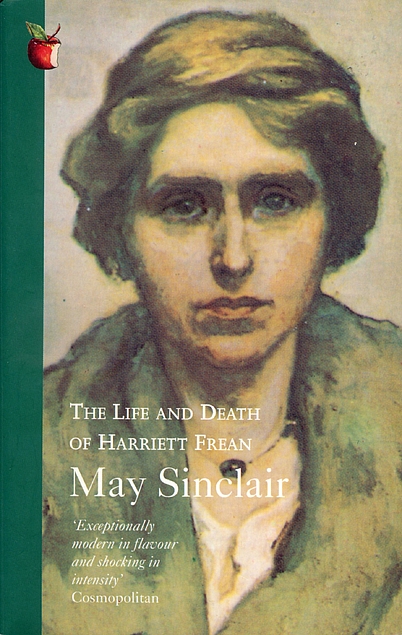
The Life and Death of Harriett Frean by May Sinclair

The Life and Death of Harriett Frean by May Sinclair was first published in 1922 but my copy is a Virago Press reprint from 1980. It has an introduction by Jean Radford. Although this book has 184 pages it has massive print so in reality I doubt if it would even be 60 pages with normal sized print.

The blurb on the back says: Ironic, brief, intensely realised, The Life and Death of Harriett Frean is a brilliant study of female virtue seen as vice, and stands with the work of Virginia Woolf and Dorothy Richardson as one of the great innovative novels of this century.

Harriett Frean has been born into a comfortable Victorian household. An only child she has been rigidly brought up to always do the right thing, no matter what. The upshot of that is that when she falls for Robin, her best friend Priscilla’s fiance, and Robin falls for Harriett she refuses to  go with her heart much to Robin’s sorrow, and his marriage goes ahead. Harriett is sure that she has done the right thing, and when her mother finds out she praises her self-sacrificing daughter. But her action ends up having a domino effect which ruins Priscilla’s life as well as Robin’s, and Harriett’s as she never moves on from her upbringing, never matures and has thoughts of her own. Never questions the attitudes of her parents. Harriett’s mother is such a fine upstanding member of society that she throws out the maid when she gets pregnant and feels no remorse when the baby dies.

Harriett  holds her parents in such high esteem that it comes as a shock to her when years later one of her childhood friends tells  Harriett that her father’s bad financial advice had led to the ruin of her father and others in the community.

As an old lady, when new neighbours move in across the road Harriett holds herself aloof from them, she’s sure her parents wouldn’t have approved of the family. Seven years later she discovers that the father of that family had a similar position to her father in society, but for them it’s too late to become friends.

Her father is Hilton Frean and she is amazed when that name is met with a blank stare when she had expected to be shown great respect. Time has marched on, but Harriett had never left her childhood.

I can’t say that I really enjoyed this one, for me there were no likeable characters,  I was glad that it wasn’t a long read.

I bought my copy of th ebook in a charity shop recently and I really bought it because it was a Virago in really good conditon, but I didn’t look inside it, I wish I had because somebody had scribbled thoughts all over it,  and about half of the book had been underlined – so annoying.

Bannockburn

We visited Bannockburn recently, a place we had never been before, it’s not far from Stirling. The famous battle was fought there in 1314 although there’s no actual archeological evidence of the battle now, the geography of the battle was known as it was the bogginess of the terrain and Bruce’s knowledge of it which led to the Scottish victory. There’s now a visitor centre there, but the statue in the photo below of Robert the Bruce by Pilkington Jackson was placed there in 1964. I have to say that modern day sculptors seem to have lost the art of sculpting,  this one is really good.

Robert the Bruce , Bannockburn, Stirling, Scotland, battlefield

There’s also a rotunda below, with a massive flagpole which dates from Victorian times although the rotunda is much more modern.

Rotunda + Flag, Bannockburn, battlefield, Scotland

Inside the actual visitor centre we enjoyed a really informative talk by Callum, who certainly knows his subject. He used cards to explain where each army was and pushed them around as they moved around the battlefield. There were also animated films which Jack thought were a bit amateurish looking, but I really liked them, there were two dimensional  figures which had a feeling of puppets the way they moved, I thought it was quite artistic.

Bannockburn Tableau, Bannockburn visitor centre

The articles on display are all reproductions as there are no archaeological finds in the area at all. As the soldiers in the Scottish army weren’t actually paid they were given permission to pick over the battlefield and take anything away that they wanted, it would have been picked clean, anything which had been missed would have sunk into the bog over the centuries.

This is the view down to the area where the battle took place.

Bannockburn Today

If you happen to be interested in the battle there’s a good You Tube animation of it below. The narrator is somewhat strange, there are some mistakes in pronunciation of basic words such as Scone which should not be pronounced like the baked scone, but should rhyme with ‘boon’ and incursion doesn’t have two ‘s’ sounds, plus the spelling is all American, but I suppose that’s me nit-picking.