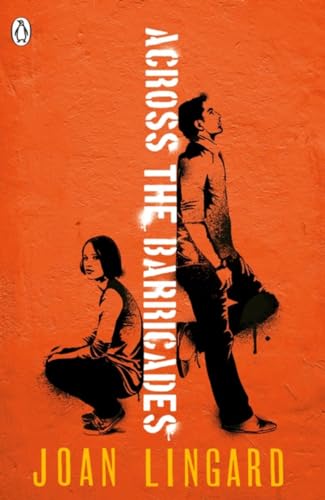
Across the Barricades by Joan Lingard

Across the Barricades by Joan Lingard is the second in her Kevin and Sadie series, it was first published in 1972.

Although Kevin and Sadie lived just a short distance from each other, they both come from different worlds and so hadn’t seen each other for years when they bumped into each other in Belfast town. In the previous book The Twelfth Day of July they had obviously quite fancied each other, but with Sadie being a Protestant and Kevin a Roman Catholic they couldn’t even be friends.

Now they’ve both left school and are working, so when they realise that they’re still keen on each other they decide to keep their relationship a secret, easier said than done. Kevin ends up getting badly beaten up by his one time best friends, and he loses his job.

Both families are adamant that they’ll have to give each other up and it looks like the end of the road for the couple, but when one of Sadie’s old teachers realises what has been going on he allows them to meet up at his house. He lives in a different part of Belfast, a quiet middle class area, it seems like a safe place to be, but – not for long.

This is a great read, I couldn’t help thinking that at the time it was written it was quite a brave thing to write about.  Things were going from bad to worse in Belfast and Northern Ireland in general, and the violence was moving on to England and even in Scotland it was quite common for the department store that you were shopping in to be evacuated because of a bomb threat. I’m looking forward to reading the next one in this series. Into Exile.

20 Books of Summer

I’m going to be taking part in 20 Books of Summer again this year. It’s hosted by Cathy at  746 Books,  and it’s quite flexible, you don’t have to read 20 books, it can be less, but I’m usually well able to read 20 books during June, July and August.

Below is a list of the books I intend to read, but some of them might change.

1. The Wrench by Primo Levi (for The Classics Club)

2. The Other Queen by Philippa Gregory

3. Snow Country by Yasunari Kawabata

4. Post After Post-Mortem by E.C.R. Lorac

5. The Redemption of Alexander Seaton by Shona MacLean

6. Gideon Ahoy by William Mayne

7. Mr Mac and Me by Esther Freud

8. Dissolution by C.J. Sansom

9. The Secrets of Blythswood Square by Sara Sheridan

10. Where the World Ends by Geraldine McCaughrean

11. Mayland Hall by Doreen Wallace

12. The Little Bookroom by Eleanor Farjeon

13. The Runaway Summer by Nina Bawden

14. Making It Up by Penelope Lively

15. The Mermaid and Mrs Hancock by Imogen Hermes Gowar

16. Five Children on the Western Front by Kate Saunders

17. Gaudy Night by Dorothy L. Sayers

18. The Hazelbourne Ladies Motorcycle and Flying Club by Helen Simonson

19. The Hemlock Cure by Joanne Burn

20. The Fall of Kelvin Walker by Alasdair Gray

It’s quite an eclectic list I think, there’s only one which is a re-read for me, Gaudy Night.  It should be a good summer of reading!


Mrs Ames by E.F. Benson

Mrs Ames by E.F. Benson was first published in 1912. I love his Mapp and Lucia series and I think this one was a sort of dry run for those ones, he hadn’t quite honed his talent for replicating the atmosphere of a small town and it’s supposed foremost inhabitants. So it’s not as blatantly hilarious and sarcastic, but it’s still well worth reading.

The town is called Riseborough and it’s the sort of place where the retired and comfortably off men go to their club straight after breakfast, while their wives go to the shops do the shopping and hear any local gossip.

Mrs Ames is the queen bee, and her social gatherings lead the way for all the others, she likes to try different things and set new fashions. ” In appearance she was like a small, good-looking toad in half-mourning; or to state the comparison with greater precision, she was small for a woman, but good-looking for a toad.” She’s over 55 and at least ten years older than her husband.  Mrs Ames only makes social calls to Dr Evans and his family because Mrs Evans is a sort of cousin to the local aristocrat, who is also loosely related to Mrs Ames.

Mrs Evans is in her late 30s but looks ten years younger and has both Mr Ames and Henry the son hankering after her.  Worse than that it looks like she intends to knock Mrs Ames off her social throne.  But the older woman is more than a match for her young relative.

This was a good read, amusing and sometimes sad, a true reflection of the Edwardian lifestyle that E.F. Benson was witnessing at the time,  in the town of Rye in Sussex where he lived for many years.

Recent book purchases

For some reason the usual Christain Aid book sale at St Andrew’s and St George’s didn’t go ahead this year, but the three day Holy Corner, Morningside book sale did go ahead, and despite it all being within one small church hall I did manage to find some books that I wanted to buy.

Books May 24

New York 1930 by Robert A.M Stern, Gregory Gilmartin, Thomas Mellins

Saint Petersburg and its environs

Mrs Ames by E.F. Benson

O Caledonia by Elspeth Barker

The Legend of Sleepy Hollow by Washington Irving illustrated by Arthur Rackham

The New York book is a massive tome with loads of photos and information on Art Deco architecture and design.

The Saint Petersburg book is a good reminder of our visit to the city some years ago.

I’m a big fan of E.F. Benson’s Mapp and Lucia books (and the original TV series)  so I had to buy Mrs Ames.

I have a lot of books which have been illustrated by Arthur Rackham, so I couldn’t pass up on The Legend of Sleepy Hollow.

It is of course just more books added to the TBR piles, but I couldn’t NOT buy them, and it was for a good cause.

Jack also bought books, but only two. The Changeling by Robin Jenkins and Highland Pack by Neil Gunn.


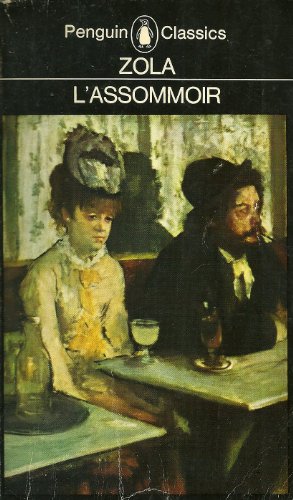
L’Assommoir (The Drunkard) by Emile Zola

L’Assommoir by Emile Zola was first published in 1876. It’s the seventh book in his Rougon Macquart series.  My copy of the book is a Penguin Classic, published in 1985, it was translated by Leonard Tancock. I think he made a really good job of it.

The story begins with the young mother Gervaise waking up and realising that her partner Lantier hasn’t come home overnight – for the first time – she’s desolate. The couple had got together when Gervaise was just 14 and Lantier 18 and Gervaise had their first child when she was 14. They moved to Paris from the countryside when Lantier came into some money, and they had lived the high life until the money ran out. He leaves Gervaise, runs off with a local woman and cons Gervaise into pawning her clothes before he goes, so she’s left with the clothes she stands up in, he even took the pawn tickets.

In truth he’s no loss though, Gervaise can get on better without him and eventually she takes up with Coupeau, a roofer, and they get married and have a daughter, Nana. Gervaise is a hard working laundress and dreams of having her own laundry, she’s able to save money but just as it looks like she’ll be able to become her own boss Coupeau has an accident, falling off a roof. Gervaise is determined to nurse him herself, not trusting the doctors in the hospital, it’s a slow recuperation but a bit of a miracle that he has survived at all. However, all of the money has been used up by the time he is able to get out of bed, but worse than that, his whole personality has changed.

Coupeau’s previous strong work ethic has evaporated, he had enjoyed lazing in bed, has probably lost his nerve anyway, roaming about on roofs doesn’t have the same appeal to him now. Worst of all is that he has gone from hardly drinking alcohol at all to meeting up with old workmates in bars and drinking the day away. But Gervaise never complains, she’s far too easy going.

She does get her dream though as she manages to borrow money from a neighbour whose son is sweet on Gervaise, and it isn’t long before her laundry business is doing very well, she’s good at her job. Nobody is perfect though and Gervaise is concerned with what others think of her, she has a kind nature but she also likes to show off and is generous to people, which all costs money. Food is her downfall, she loves to cook delicacies and a party is more like a Roman feast, with everyone stuffing themselves and drinking wine until they throw it up. But she ends up owing money to all the shopkeepers and she is keeping Coupeau in money, he has no intention of working, but has turned into a drunkard.

Things go from bad to worse when Lantier turns up again and moves in with them – well – he is the father of her sons, but you can imagine what the neighbours thought of that situation. Gervaise now has two men to feed, clothe and keep in alcohol. It all ends in tears of course.

So that’s the bare bones of the book, there are a lot more ins and outs. It’s a great read although grim. I’m reading this series all out of order which I don’t think is really a problem, but this one features the childhood of Etienne – of Germinal fame, and of course Nana. I didn’t mean to take so long to get around to reading more by Zola, hopefully I’ll get around to another one next month.

 

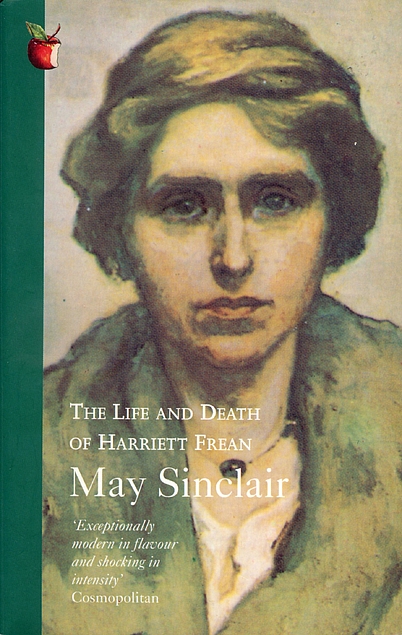
The Life and Death of Harriett Frean by May Sinclair

The Life and Death of Harriett Frean by May Sinclair was first published in 1922 but my copy is a Virago Press reprint from 1980. It has an introduction by Jean Radford. Although this book has 184 pages it has massive print so in reality I doubt if it would even be 60 pages with normal sized print.

The blurb on the back says: Ironic, brief, intensely realised, The Life and Death of Harriett Frean is a brilliant study of female virtue seen as vice, and stands with the work of Virginia Woolf and Dorothy Richardson as one of the great innovative novels of this century.

Harriett Frean has been born into a comfortable Victorian household. An only child she has been rigidly brought up to always do the right thing, no matter what. The upshot of that is that when she falls for Robin, her best friend Priscilla’s fiance, and Robin falls for Harriett she refuses to  go with her heart much to Robin’s sorrow, and his marriage goes ahead. Harriett is sure that she has done the right thing, and when her mother finds out she praises her self-sacrificing daughter. But her action ends up having a domino effect which ruins Priscilla’s life as well as Robin’s, and Harriett’s as she never moves on from her upbringing, never matures and has thoughts of her own. Never questions the attitudes of her parents. Harriett’s mother is such a fine upstanding member of society that she throws out the maid when she gets pregnant and feels no remorse when the baby dies.

Harriett  holds her parents in such high esteem that it comes as a shock to her when years later one of her childhood friends tells  Harriett that her father’s bad financial advice had led to the ruin of her father and others in the community.

As an old lady, when new neighbours move in across the road Harriett holds herself aloof from them, she’s sure her parents wouldn’t have approved of the family. Seven years later she discovers that the father of that family had a similar position to her father in society, but for them it’s too late to become friends.

Her father is Hilton Frean and she is amazed when that name is met with a blank stare when she had expected to be shown great respect. Time has marched on, but Harriett had never left her childhood.

I can’t say that I really enjoyed this one, for me there were no likeable characters,  I was glad that it wasn’t a long read.

I bought my copy of th ebook in a charity shop recently and I really bought it because it was a Virago in really good conditon, but I didn’t look inside it, I wish I had because somebody had scribbled thoughts all over it,  and about half of the book had been underlined – so annoying.

Madame Claire by Susan Ertz

Madame Claire by Susan Ertz was first published in 1923 but my copy is a Penguin Books from a boxed set of facsimiles of the first ten Penguin books, published to mark Penguin’s 50th anniversary. I got this one from a secondhand bookshop so I don’t have the other nine books in the set. It cost me all of £2.

I really enjoyed this book, Madame Claire seemed such a sensible and wise elderly woman, named Madame Claire by her adult grandchldren, but Lady Gregory to more formal people. She is a widow.

After Madame Claire’s son Eric married she opted to give up her large house and move into a small suite in a Kensington hotel.  She sensibly refused to move into her son and daughter-in-law’s home.  Claire  has had no contact with her daughter Connie for many years, since the recently married Connie had run off with a famous musician.  Claire has also had no contact from her husband’s best friend Stephen for almost twenty years, he had rashly asked her to marry him too soon after her husband’s death, and her refusal had sent him off in a huff. So when she unexpectedly gets a letter from him she’s happy to renew the friendship.

Connie also resurfaces, and the grandchildren Judy and Noel hare off to France to see her, they’re agog to meet this aunt who had “thrown her hat over the mill” all those years ago

As ever, I’m not giving a blow by blow account of the book which has various plots, a plethora of flawed characters, and a lot about the unfairness of society and its perceived constraints. With age Claire has garnered insight into the behaviour of her family members and others. I have to say that I was incensed that Gordon, the eldest grandchild would inherit everything while Noel his younger brother would have to shift for himself, despite losing an arm in WWI, and of course Judy will get nothing as she’s expected to make a good marriage! I hate unfairness.

I’ll definitely be looking for more books by Susan Ertz.


The Chalet School in Exile by Elinor M. Brent-Dyer

The Chalet School in Exile by Elinor M. Brent-Dyer was first published in 1940 by Chambers, but my copy is an abridged paperback Armada. I don’t have that many of the hardbacks as they tend to be overpriced, in my opinion.

Anyway, this one is quite different from previous books as the location of the Austrian Alps became distinctly uncomfortable when the local Nazis started to flex their muscles. A simple walk by some of the girls in the school’s surroundings leads to a dangerous encounter with locals who call the Gestapo, accusing the girls of being spies.  Before the Gestapo come calling the girls attempt an escape into Switzerland and safety, it’s a terrifying journey, but they have no choice.

Meanwhile – back at the Chalet School it has become obvious that the school needs to find a new home. The German pupils go home, as do some others. So much school equipment will just have to be abandoned.

This is a very different read from the others I’ve read in this series as it involves spies and a chase across the Alps.  A new school will have to be started up elsewhere, and Guernsey is chosen as the new location!!

As this book was published in 1940, the same year that the Nazis invaded the Channel Islands including Guernsey, I’m intrigued. What made Brent-Dyer choose Guernsey for the new school location? Possibly by the time the book was published Guernsey had already been over-run. Anyway, they are obviously going to have to move the school yet again. This was an enjoyable romp.

Towards the end of this book there’s a shock for Jo who is now married. I suspect that the birth of triplets was seen by many readers to be very far-fetched, but I knew a woman who did give birth to triplets, naturally, it was pre test tube babies, and the mother was over 40!

There was an article in today’s Guardian about adults reading books for Young Adults which you can read here. Apparently 74% of Young Adult fiction readers are adults. If writing is good I don’t think there is an age category, it’s for readers of all ages to enjoy.

I started reading the Chalet School books again as it’s so long since I read them, they’re a real nostalgia kick for me, not that I can actually remember much about them. But the ambience seemed cosmopolitan to the ten year old me.

Offshore by Penelope Fitzgerald

Offshore by Penelope Fitzgerald was first published in 1979 and this book won the Booker prize that year. I’m often puzzled by the books that win prizes and that’s the way I feel about this book, but I must say that I haven’t read any of the books which were short-listed for the prize that year. Suffice to say that I wasn’t too impressed by this one, it isn’t terrible but it’s just nothing earth-shattering, or even that entertaining. I’m left wondering if it was the slimness of the volume at just 140 pages which endeared it to the judges!
Offshore is set in the 1960s in a community of houseboat dwellers, berthed on the tidal  River Thames at Battersea Reach. They’re an eclectic bunch of people who all share a love for the boats they are in, despite most of them being in a poor state of repair. The boats are all close together, some linked by gangplanks to the one next to them. The boat owners go by the name of their boats.

Nenna is a young mother of two daughters, the father has left them, but Nenna expects him to come back – sometime. Nenna is lax about her daughters, she’s often in trouble because she’s happy for the girls not to attend school, but the nuns and priest definitely aren’t. Nenna had bought their boat Grace with all the money that they had while her husband was working abroad, and she had given him the impression that she had bought a substantial house at a good London address.

Maurice is always up for a party, but he has a sinister ‘friend’ who uses his boat to hide stolen goods in it. Harry is obviously a ‘baddie’ but he has a hold over Maurice, because Maurice is a male prostitute, and Harry could get him imprisoned at any time just by calling the police.

Dreadnought is up for sale, but is about to sink at any moment. There are a few others, all with their own problems. The most engaging characters are Nenna’s young daughters Martha and Tilda who have more maturity and sense than both their parents, and have a lucrative if dangerous hobby of recovering goodies from ancient boats which had sunk years before with cargoes such as de Morgan tiles in their holds.

The ending is not conclusive, it depends on how optimistic the reader is I suppose. I found it dissatisfying.

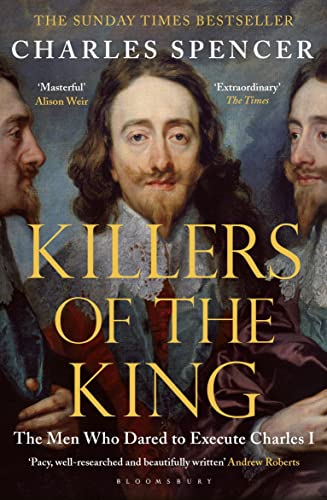
Killers of the King by Charles Spencer

I decided to read Killers of the King by Charles Spencer when it was mentioned by the author S.G. MacLean as one of the books that she had found interesting when she was doing her research for one of her Seeker books. Luckily I was able to borrow it from the library. I was slightly disappointed when I got my hands on it as I had imagined it to be a sumptuous glossy hardback, but it is a normal format paperback, with just eight pages of photographs/illustrations. No doubt there is a similar hardback edition. However, it’s a really interesting book and is well-written.

There were fifty-nine men who were mad or crazy enough to put their name to King Charles I ‘s death warrant and with the eventual restoration of the monarchy it was open season on them all. Almost half of them had died in the intervening twelve years, but almost immediately the hunt was on for the survivors, with one of them being murdered just three weeks later.

They had had some warning because with the unexpected death of Cromwell who had named his son Richard as his successor, it must have been obvious to everyone who knew Richard that he would never be up to the job. Soon there was talk of bringing Charles II home from his exile, and he was obviously going to punish the regicides. Most of them left the country, but some of them were persuaded to go back home, with promises of mercy, which turned out to be lies.

Charles Spencer decided to write this book because he thought that Charles I was an execrable ruler in his final years. However, I don’t think he came close to being as bad as Cromwell was, and he obviously intended to take over as king himself from the beginning.

“It is striking how many fascinating and notable figures colluded to end his life. They deserve in my view to be remembered with respect for their sacrifices: this book is my tribute to them.”

I think they never wanted a Stuart dynasty in the first place – too Scottish or should I say not English enough,  and  too close to Catholics for their liking. There were just too many greedy men who resented their family not being top dogs, but with Cromwell the whole country suffered. Well, that’s my opinion anyway.

You can see a Wiki image of his death warrant here.