The Salt Path by Raynor Winn

The Salt Path by Raynor Winn was published in 2018 and everybody seemed to be reading it then – which is why I wasn’t. I actually bought a jigsaw puzzle of the book cover fairly recently, the artist is Angela Harding and I really like her style.

Raynor and Moth Winn had been married for 32 years when they were told that he was terminally ill with a neurological condition, days after that devastating news their long legal battle to stop their home and business from being repossessed came to an end and they were suddenly homeless. With nowhere to live they decided to go on a long walk along the South West of England Coast Path, it was something they had always wanted to do anyway. They wild camped most of the time and had to live on £48 a week benefits, which for some reason dwindled to about £30 a week fairly quickly.

Another reason why it has taken me so long to get around to reading this one is that I thought it might be a bit depressing, at times it is as they encountered more and more problems along the way, but there are uplifting moments, as well as the frustrating ones when I asked myself – ‘how could they have been so stupid?’ from time to time.

Moth’s health fluctuates, but mainly the walking regime seems to have helped his condition. There’s some humour and some serious comments on the horrendous problem of homelessness in the UK, which those in power make sure is very much under-reported. Winn also mentions that she and her husband didn’t get Legal Aid for their legal problem despite them having no money. It’s totally bizarre that millionaire Boris Johnson allegedly (according to the newspapers) DID get Legal Aid recently. How is that possible?

I quite enjoyed this book which has some lovely descriptions of scenery and nature and interesting characters met along the way, but mainly I was glad that we visited Cornwall about 30 years ago as the coastal towns seem to have been swamped by visitors nowadays, and it’s sad when so many houses which should be family homes have become businesses rented out for holiday homes. It’s almost as bad in the east coast of Scotland too.

I think her book Landlines features a walk along a Scottish pathway, so I might eventually read that one.

The Book of Beginnings by Sally Page

The Book of Beginnings by Sally Page was just published last year and it’s a Sunday Times best seller, I tend not to read many best sellers, I read about this one on a blog recently though and decided to get it from the library. I’m really glad that I did as it ended up being an uplifting read.

Jo had recently been dumped by James, her boyfriend of six years. It’s only then that she realises that nobody else liked him, but she had been besotted with James and had neglected old friends to be with him and his even more obnoxious cronies. What is worse is that Jo had been desperate to start a family and now she feels time running out for her, she’s in her late 30s and James had been several years younger than her. As they had worked at the same company it seemed a good idea to leave that job, and Jo travels to London to help out at her uncle’s stationery shop while he is in hospital. It’s a place that she has fond memories of as she used to help her uncle there during school holidays.

The work, stationery bits and pieces, and the customers she meets in the shop begin to have a healing effect on Jo, especially two of them who become close friends, despite them being quite a bit older.  One of them Jo has recognised from the TV news, Ruth is a runaway vicar – what is she running from?  Malcolm is over 70, but is still haunted by a decision he had made in the past.  He also has an interest in Highgate Cemetery which is nearby, and his project draws the three of them into close companionship which begins to heal them all.

I really enjoyed this one.


The Tenement by Iain Crichton Smith

The Tenement by the Scottish author Iain Crichton Smith was published in 1985. I must admit that I was a bit disappointed by it as there aren’t really any likeable characters, until almost right at the end.  The tenement of the title is past its best, it’s over 100 years old and hasn’t been well maintained over the years. There are six flats within the building and over the years there has been quite a lot of coming and going and nowadays the inhabitants don’t mix with each other much. The setting is a small coastal town in Scotland.

Mrs Miller has lived there the longest, she had been widowed early in her married life and she’s now 80 and drinks a lot. Mr Porter’s wife dies and it’s only then that he realises how unhappy he had made her by the decisions he had taken over the years, he only appreciates her after her death.

Mr Cameron beats his wife up every weekend, and nobody does anything about it.

I found this book to be quite a miserable read, which might be entirely my fault as somehow I was expecting something completely different. I think the only other books with the setting of a tenement building is the funny and heart-warming ‘McFlannels’ series by Helen W. Pryde. I got the impression that Crichton Smith didn’t think much of the type of people who lived in tenements. According to Wiki elderly women and alienated individuals were common themes in his writing. He was however predominantly a poet.

Depite being born in Glasgow his widowed mother moved to the Isle of Lewis when he was only two years old. I was amazed to read that Crichton Smith had become an English teacher and taught in Dumbarton around the time that I was at school there. I can only presume that he taught in the local boarding school for boys.

Uncle Paul by Celia Fremlin

Uncle Paul by Celia Fremlin was first published in 1959 but has just been reprinted by Faber. It’s subtitled Welcome to the Nightmare Summer Holiday.

Meg is the youngest by far of three sisters, but it seems that she is the one who has to come to the rescue of her sisters who are feckless and disorganised (Isabel) and highly strung (Mildred).

Isabel has rented a caravan in an English coastal resort, but she sends Meg a telegram which says that Mildred needs help, please come.

Meg’s newish boyfriend isn’t keen for her to go as he feels that she’s always having to sort out her sisters’ problems, which she is. But Meg can’t ignore the call for help and when she gets to the holiday resort – Southcliffe – she is amazed to discover that Mildred has rented the very cottage which she had spent her honeymoon in years earlier, when Meg was just a little girl of six.  In fact ‘Uncle Paul’ as Meg had called her brother-in-law had been arrested for the murder of his previous wife while they were at that cottage.

This was a really enjoyable read which had for me a couple of surprising twists at the end.


Pretty Young Rebel by Flora Fraser

Pretty Young Rebel  The Life of Flora MacDonald by Flora Fraser was published by Bloomsbury recently, I borrowed it from the library. I hadn’t read anything by Flora Fraser before but apparently she is an award winning biographer, and I can see why.

About half of this book is set in the Highlands/Islands of Scotland and I must say that considering everyone knows that ‘Bonnie Prince Charlie’ did escape to safety the author manages to convey an atmosphere of tension, fear and danger. I don’t think I had realised before that it was Flora MacDonald’s step-father who had volunteered her for the job of helping the prince to escape. A job that no doubt none of the men wanted to do because if caught they would definitely have been executed.

I was impressed by the behaviour of the prince, he seems to have been brave and stoical, despite the hellish weather conditions that had to be endured during his long and hazardous journey before his escape.

I must admit though that it was the second half of the book which I was most interested in reading because it was only a few years ago that I realised that Flora MacDonald had emigrated to North Carolina – but had gone back home again after a few years.

Sadly Flora hadn’t chosen wisely when it came to getting married, her husband Allan was a complete liability, not that she ever seems to have complained about him. In theory he was a good bet, he was well educated  and certainly had good prospects, but his business plans always failed. He ran through all of Flora’s money and ended up being heavily in debt to many people.  With so many people in the Highlands and Islands emigrating to America Flora and Allan decided to join them.  Again Allan wasn’t wise in his business dealings, but what was worse was that the fighting between Crown and ‘rebels’ wasn’t long in arriving at their door and Allan had plumped to support King George. He went around gathering support on that side from other Highland emigrants and when a lot of the men ended up being killed both Allan and Flora were very unpopular with the widows and families.

After that ‘the rebels’ started attacking their farm and stealing anything they fancied including all the farm tools and household goods. It was time to go home to Scotland, which they did, with almost nothing to their name, and having to rely on the charity of old friends. Still,  Flora seems not to have been bitter about things, but maybe she just kept her thoughts to herself!

Anyway, this was a great read by an author who has in the past won prizes for her biographies.

Library Haul

I got notification from my local library that six books which I had reserved were waiting for me to pick them up. Of course I didn’t expect them all to arrive at the same time, and honestly at least half of them meant nothing to me, they must have been late night blog recommendations!

Library Haul

I remembered that two of them were for the 1937 Club which is in April.

The Gift by Vladimir Nabokov (1937)

The Years by Virginia Woolf (1937)

The Salt Path by Raynor Winn (I’ve been swithering about reading this one for a while)

The Book of Beginnings by Sally Page (a Sunday Times bestseller – not my normal fare)

Uncle Paul by Celia Fremlin (vintage crime)

Three Women and a Boat by Anne Youngson ( a BBC Radio 2 book club pick)

I’ve already finished reading The Book of Beginnings, which features a stationery shop. I’m sure that was what attracted me to it, and I really enjoyed it. Have you read any of these books?


K.M. Peyton – obituary

I have to admit that I was surprised when I saw the author  K.M. Peyton’s obituary in The Guardian this morning, mainly because I had just assumed that she had died years ago, she was 94 years old.  I loved her Flambards books and the 1979 TV series which was based on them.  I must admit that I hadn’t realised that she wrote a lot more books than those ones over the years. I don’t recall seeing any others on my trawls around second-hand bookshops.

To another subject  –  last week.

I suppose it had to happen, but after managing to dodge COVID for four years it caught up with us last week, after what had been the quietest week we had had for about a month. We only went to the library and the supermarket, both of which were really quite empty. Anyway, we survived and after three really horrible days of constant headache, coughing and exhaustion the symptoms eased off and we’re just about back to normal now.

The variant that we got obviously managed to dodge the vaccination as Jack had only got his booster last month, I wasn’t eligible, but he was just as ill as I was. I’ve been told that it is people who had managed to stay COVID free who are getting it now, apparently it was inevitable. It wasn’t a great start to the new year but I suppose it could have been worse! In one way it’s really good as with the imminent arrival of our second grandchild at least it menas that we don’t have to worry about passing it on to the new baby when it arrives as we should be immune for a while now.


Notes from Walnut Tree Farm by Roger Deakin

Notes from Walnut Tree Farm by Roger Deakin was published in 2008. It’s a selection of his diary entries/research notes and thoughts which had been written over several years, compiled into one year. This book is a sort of homage to Deakin I suppose, he died quite suddenly and his friends were obviously bereft, this was a way of hearing more from him.

You get a real flavour of what Deakin was like and the way he lived his life, which seems to have been idyllic. He had lived in an ancient Suffolk farm for the last 30 years of his life, wild swimming in the moat, in fact he apparently popularised the modern interest in wild swimming. I got the impression though that the moat was more of a ditch, a common feature of East Anglian fields.

As you would expect, some entries are more interesting than others. Some are strange such as his observation that mallard ducks ‘seem incapable of ordinary fonder bird-love. With them it has to be a violent chase, wild pursuit, followed by an unceremonius ducking of the object of desire and a gang-bang.’

Well there’s a very simple reason for that as for some reason there are always far more male mallards than females, which he doesn’t seem to have noticed. In fact things are often made even worse as female mallards are sometimes drowned in the melee.

Unusually for an environmentalist Deakin was a big fan of cats, I suppose they were good company for him but they must have devastated the local bird population. He was quite againts dogs, reasoning that anyone taking a dog for a walk in the country was unlikely to see much in the way of wildlife, as dogs scared everything away,  they certainly scare rabbits away.

The blurb on the front says: ‘Marvellous, wonderful, lovely, remarkable ….. to be read and reread and treasured.’ Elizabeth Jane Howard

I borrowed this one from my local library.

Another World by Pat Barker

Fran and Nick haven’t been married all that long and Fran is coming to the end of her second pregnancy with Nick, but she also has Gareth, an older son by a previous relationship. At the beginning of the tale Nick is going to pick up his daughter Miranda. Her mother has had to go into a mental hospital, as she has had a break-down, she hasn’t coped with Nick’s infidelity and desertion at all well. The family is not a well blended one.
They also have to cope with the renovations in the old house they have bought. Scraping the old wallpaper off seems like it might be a bit of a bonding process, but when a portrait of the original inhabitants of the house is uncovered it spooks Fran, they look just like them, and not in a good way.

But Nick also has the stress of having to help his sister look after Geordie, their father who is 101 years old, and a survivor of the Somme. Although Geordie  survived the war the mental scars have never diminished, have blighted his life and now he is dying of cancer the memories are all coming to the surface.

Pat Barker is a really good writer but there were aspects of this book which were too much like my own father’s death, and that wasn’t something I would have chosen to re-visit.

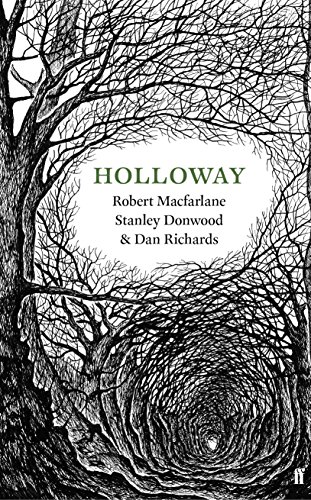
Holloway by Robert Macfarlane, Stanley Donwood and Dan Richards

Holloway by Robert Macfarlane, Stanley Donwood and Dan Richards is a short book, just 36 pages long, which was described as  A perfect miniature of a prose-poem of a book by William Dalrymple (Guardian). It was written in memory of Roger Deakin, the environmental and nature writer.

Macfarlane, Donwood and Richards travelled to the Chideock Valley in Dorset, in search of a particular holloway which features in Geoffrey Household’s book Rogue Male. A holloway is a sunken pathway, due to the make-up of the chalky soil there and the many generations of foot and hoof fall the land has dropped dramatically over the years. In the past such places have been used by people who were hiding out from the authorities, such as Roman Catholic priests in Elizabethan times.

Robert Macfarlane had previously gone on the same journey with his friend Roger Deakin, and this re-run was a sort of homage to their friend. It turned out to be a bit of a strange and slightly spooky journey, but it’s an entertainng informative read, with atmospheric illustrations by Stanley Donwood.  I borrowed this book from the library.