Operation Sippacik by Rumer Godden

Operation Sippacik by Rumer Godden was published in 1969. The setting is Cyprus. Rumer Godden was on holiday there when she was told the story of a brave donkey and she decided to write it.

The men of the 27th Battery Royal Artillery were part of a United Nations force who were in Cyprus as part of a peace keeping force, trying to stop the Greek and Turkish Cypriots from killing each other.

Sippacik is a very small donkey which is owned by a small boy called Rifat, he had witnessed the donkey’s birth and had a strong bond with her, so when Rifat’s grandfather sold the donkey to the British Army Rifat was not happy, but money was scarce, particularly as Rifat’s father was not around to help on the family farm.  Rifat’s father has been a bit of a local hero, but he had been taken away by the Greek Cypriot police.

Rifat has been dodging school and when the soldiers realise that they can’t cope with the donkey’s awkward temperament it’s arranged for Rifat to live at the army camp and look after Sippacik. They get involved in a dangerous adventure.

This book was probably aimed at ten year olds, it’s entertaining and educational. I bought it just because it was written by Rumer Godden. She seems to have been inspired to write wherever she went on holiday, or moved to. In her old age she moved to Scotland to live to be close to her daughter, and I was impressed by the way that she obviously threw herself into the culture of Scotland and even managed to write in dialect in her book for children The Dragon of Og.

Favourite 2023 reads

I kicked off 2023 by re-reading books, that’s something I rarely do, but I just wanted to wallow in something that I had previously loved, so I steeped myself in the Tudor books of Hilary Mantel again, it was bliss.

Wolf Hall by Hilary Mantel

Bring Up the Bodies by Hilary Mantel

The Mirror and the Light by Hilary Mantel

Then I moved on to new to me reads, most of which I owned but a few were from the library.

The Fortnight in September by R.C. Sheriff – an enjoyable family holiday with likeable people. The children are now young adults, times are changing but the future will be fine.

The Freebooters by Nigel Tranter – a light read with a good sense of location and humour.

The Madness of Crowds by Louise Penny –  it’s always a treat to be in Three Pines.

Gather Together in My Name by Maya Angelou – I decided to read her books when I watched a TV documeantary about Robert Burns and her love of his poetry. She seemed to be a lovely person.

Voices of the Dead by Ambrose Parry – more historical fiction but with an Edinburgh setting and featuring the history of medical advancements within the city in a mystery.

The Marriage Portrait by Maggie O’Farrell –  historical fiction with a twist.

The Shadows on London by Andrew Taylor – more historical crime but with a London setting. Very atmospheric.

A Flute in Mayferry Street by Eileen Dunlop – this year I’ve read a lot of books by Scottish authors, old and newish. I’ll be reading more by this new to me but old author.

A Confederacy of Dunces by John Kennedy Toole – a strange book which had me laughing out loud at times.

So there we go, that’s a round dozen books which might not be the best of the books I read over the past year but they are the most memorable.


Happy New Year!

Happy New Year to you all. I must say that I’ll be glad to see the back of 2023 as it’s been a sad one for us because people close to us have died unexpectedly. I suppose that’s life as you get older – or don’t!

Blog wise I must admit that I had lost some of my enthusiasm for blogging this year, I’ll see how it goes this year. I haven’t been blogging about places we’ve been visiting and it has all got very bookish, partly laziness I think as those posts are quick and easy to write. But one of the reasons I started ‘Pining’ was so that I could look back and be reminded of the places we had visited in the past.

Bookwise this year has been succesful although I have been reading quite a lot of YA books, trying to catch up on books I didn’t read when I was a youngster, a lot have been by Scottish authors, a lot have been recommended by other bloggers. Constance of Staircase Wit has pointed me in the direction of a lot of good children’s authors, some of which I may have read in the past, but although I read a lot as a child I can’t remember most of them.

Earlier this year I dropped out of Goodreads, I don’t like the Amazon links so I’m being a bit po-faced about it all.  I used to be in Library Thing years ago, I might take that up again, unless anyone can persuade me that I should avoid that too!

Anyway, it looks like I’ve read 125 books this year, not bad going I suppose, although with our weather being so bad (wet) throughout most of the year I haven’t been getting much gardening done so I thought I might have read more, mind you we have been doing some travelling and I didn’t read much then – too tired after all the daytime galivanting! It seems to me that I’ve read more historical fiction than usual, less vintage crime (for lack of books) but more books by Scottish authors. In 2024 I’d like to read more vintage crime, if I can get my hands on any.

I hope that your 2023 has been a good one and that 2024 will be even better!

The Happy Prisoner by Monica Dickens

The Happy Prisoner by Monica Dickens was first published in 1946.

Oliver North has been badly wounded in World War 2. He has had a leg amputated and his stump wasn’t healing well, the explosion has also damaged his heart, but he’s back at home now, although stuck in bed as he isn’t well enough to cope with the exercises required for his rehabilitation. It’s a frustrating situation for a previously healthy and active young man, but his bedroom becomes a bit of a hub for his family and he has an attractive  nurse, Elizabeth who attends to him.

It’s a farming community and Oliver hopes to eventually be able to take over the running of the family farm, but meanwhile all of his relatives are in and out of his room telling him of their problems, and he tries to advise them, not always successfully.

His sister Heather’s marriage is in trouble and the return of her husband who had been a prisoner in Japan has not gone well, and his tomboyish sister Violet looks like she’ll be making a disaster of a marriage too.

So it’s a time of upheaval for almost everyone in the family. The war has come to an end at last and people have to adjust to their new life, but there’s also a lot of comedy in this book and the author’s description of a beautiful moth on the first page had me hooked from the start.

I had first  read and enjoyed a few books by Monica Dickens (great-granddaughter of Charles) back in the 1970s, then a couple more over the last decade or so, so it was about time I got around to reading more.

Apparently she volunteered for the Samaritans and when she married an American and moved to the US she set up the first American branch of the Samaritans in Boston, Massachusets.


The Christmas Egg by Mary Kelly

The Christmas Egg by Mary Kelly was first published in 1958 but it was reprinted by British Library in 2019.

The setting is London and it begins just a few days before Christmas. Chief Inspector Nightingale and Sergeant Beddoes have been called to a poverty stricken flat in Islington. An elderly lady has died, she’s emaciated looking, and her ‘flat’ is really just one room. She didn’t even have  a proper bed to die in. It’s all very dirfferent from the life she was born into becaue she was a White Russian before the revolution and her name was Princess Olga Karukhin. She managed to escape from Russia with her son and a box full of goodies, jewels, porcelain, ikons, some Faberge, and she had hoarded them for years. But now she has been murdered and her box is empty.  It transpires that she had recently had her treasures appraised by a well-known firm of jewellers, it’s all a bit suspicious.

Olga’s grandson is a drunk. Ivan is well-known in the local pubs and to the police. He’s also apt to boast to everyone that he’s really a Russian prince and that he’s looking forward to getting his inheritance.

There’s a lot of action in this book and some likeable characters, it added up to an enjoyable read. There is of course an interesting Introduction by Martin Edwards.


A Christmas Card by Paul Theroux

A Christmas Card by Paul Theroux was published in 1978. This is one of the books that I was reading to try to get me into the mood for Christmas, but so far non of them have been exactly what I expected, anyway, this was still a good read, certainly a very quick read at just 73 pages and is probabbly aimed at older children really. It’s very slightly spooky. It has some black and white illustrations by John Lawrence.

The tale is told by the elder of two young brothers, Marcel who is nine years old. Louis is his younger brother (yes, that Louis). Their father had decided to take them to their home in Indian Falls to spend Christmas there, they’ve never been there before and driving through a blizzard is not the most sensible thing to do, inevitably they end up lost. As it’s  a very rural area and the few houses and businesses around are closed up for the season they’re in trouble, but eventually they see what seems to be a hotel or road house and stop to ask for help.

An ederly man invites them in, his name is Pappy apparently, and they end up staying overnight, but in the morning Pappy is nowhere to be seen, but he has left a Christmas card behind and they realise that the card is as good as a map, according to the boys’ father the building on it is an image of their holiday home, and they can just follow the road to it – which they do.

It’s Christmas Eve and the older boy, Marcel, notices that as night falls outside the Christmas card becomes dark too, and he has also noticed that there’s a tiny spot of light on the card which moves, he guesses that it’s Pappy moving around and he’s coming in their direction. Earlier when they had gone to cut down their Christmas tree Marcel had thought he had seen the strange man and he is nervous.

This is quite an atmospheric read, but all’s well that ends well.

I was just surprised that the author, Paul Theroux had written a book using his sons as the charaecters, like A.A. Milne did disastrously to Christopher Robin, but it doesn’t seem to have done Marcel and Louis any lasting harm, that we know of anyway.


Christmas Term at Vernley by Margaret Biggs

Christmas Term at Vernley by Margaret Biggs was first published by Blackie in 1951, but I read a 2012 reprint by Girls Gone By Publishers. It has a few black and white illustrations by W. Spence.

I enjoyed this one despite it not really having anything to do with Christmas, it’s just mentioned in passing close to the end of the book.

It begins at the home of Judy and Philippa (Phil) Fraser right at the end of the school holidays. Their two brothers are also at home and they’re preparing to go back to their boarding school too.

Vernley, in common with most schools has been split up into two ‘houses’ called Raleigh and Drake. Both Judy and Phil are in Drake which is regarded as the rather useless house, they’re the duffers. They never get enough points to win the end of year cup and they’re getting a bit despondent about it. Everyone in Drake is pessimistic about the situation which is half of the problem. They just don’t have the confidence that they can do as well as Raleigh at anything, and Raleigh in turn have a sense of entitlement and superiority.

In the past Phil has been a big part of the problem as she is a bit of a harum scarum and her exploits have led to Drake having points deducted. She’s constantly ‘turning over a new leaf’, but she just can’t help herself so gets into trouble again and again. Her eldest brother John thinks that Drake’s dire record is a bit of a slur on the family name and has a bet with Judy that Phil can sort herself out this time and help Drake to win the cup. She just needs to be encouraged.

This is the first book I’ve read by Margaret Biggs and I was particularly impressed with her dialogue between the schoolgirls. It all seems very authentic to me, with plenty of cheeky banter going on between the girls.  There were a couple of hockey matches which seemed long to me,  I was never keen on hockey, but no doubt if you were an enthusiastic hockey player in your schooldays then that would be a plus for you.


Stories for Winter and nights by the fire – British Library Women Writers

Stories for Winter and nights by the fire is a recent publication from British Library from their British Library Women Writers series. I must say that I’m not a huge fan of short stories as I prefer to get stuck into  a decent sized novel, but I really enjoyed this compilation, I don’t think there was a duffer in it – for me anyway. A few of the writers were completely new to me.
But some of the writers I regard as old friends, such as Elizabeth Bowen. Her story Ann Lee’s is about two women friends who visit a hat shop where one of them had bought a hat before. There’s too much to choose from and the time passes quickly with no hat decisions made, then a large man enters the shop and he’s obviously not welcomed by Ann Lee. This one had quite an abrupt ending which left me wondering – with a bit of a shiver – what happened in that shop after the women left? I wanted more really, and that’s my problem with short stories.

The other writers are: Edith Wharton, Mary Angela Dickens, Elizabeth Banks, Katherine Mansfield, Elizabeth Bibesco, Violet M. MacDonald, Kate Roberts, Shirley Jackson, Sylvia Townsend Warner, Elizabeth Berridge, Frances Bellerby, Elizabeth Taylor and Angela Carter.

I was lucky enough to be sent a copy of this book for review by British Library.


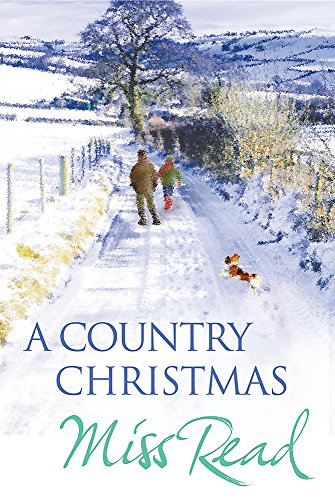
A Country Christmas by Miss Read

A Country Christmas by Miss Read is a compilation of short stories which have been published previously. The White Robin is the longest at around 140 pages , I suppose it would be called a novella.  It’s about the excitement in the village of Fairacre when an albino robin is sighted and makes its home close to the school playground. The children feed ‘Snowboy’  and look forward to the remote possibility of more albino robins next Spring.

Most of the stories are set in the village of Fairacre although there’s also an excerpt from one of the Caxley books.

The original publication dates range from 1951 to 1992, and those featuring the village school seem even older than the 1950s although I imagine that they are quite true to how things were in a rural school, probably more old-fashioned than a city school.  This is what makes the stories charming though, and the children’s behaviour and chat, and the teacher’s comments to them seem authentic, they’re certainly entertaining.

As ever there’s love, laughter, gossip and tragedy, but most of the stories have a Christmas or winter setting which I appreciated, despite our weather being freezing at the moment.

On a different subject, I was listening to BBC Radio 2 this morning, to a piece which is available to listen to in the BBC Sounds Archives. It dated from the 1950s and the interviewer was asking children what they wanted for Christmas. They hoped to get things like a sewing set, a doll and one wee lad wanted a pencil sharpener!!  How different from nowadays when kids expect to have things costing hundreds of pounds for Christmas!

BBC Archives  from 1966 can be seen below, children were asked to imagine life in the year 2000, but there are all sorts of things  available, although they might be blocked for people outside the UK.

Ryan’s Christmas by L J Ross

Ryan’s Christmas by L J Ross was published in 2020 and it’s the first book by the author that I’ve read. I chose it because of the title, but it might have been better if I had read one of her earlier books as she refers to several of them in this one.

Ryan’s Christmas has been inspired by several such previous books. DCI Ryan and his team of murder detectives are having a festive jaunt out in Edinburgh, but on the way home to Northumberland the weather is awful, they run into a snowstorm, then they run out of fuel. They’ll all freeze to death in the car overnight if they don’t find shelter.

Luckily they discover that they are close to Chillingham Castle, apparently it’s the most haunted house in England!  In fact the owners run ghost hunt weekends, so the staff are used to looking after guests, and they’re made welcome there.

You’ve guessed it – there’s a murder, but which of them is the culprit? With the telephone lines down and no mobile phone signal in the remote area there’s no easy way of getting help.

I enjoyed the setting of this book as it’s all familiar to me, that’s the way we drive when we visit friends in Sunderland, so I know Northumberland quite well, it’s a lovely area. For my taste though there was a wee bit too much romance going on in this book, but I realise that a lot of readers will enjoy that.  According to the blurb on the front  of the book L J Ross is a multi-million best selling author.  I’ll give another of her books a go sometime in the future anyway, but this one was just too much of an homage – or a cliche – for my liking.