Alison’s Highland Holiday by Sheila Stuart

Alison’s Highland Holiday by Sheila Stuart was published in 1946. This one was a real blast from the past for me although I didn’t remember anything about the story, I know that I read this ‘Alison’ series when I was about ten years old and I absolutely loved the books. In fact I told my mother that when I grew up I was going to live in a wee white cottage in the Highlands. That never came to pass.

In Alison’s Highland Holiday, brother and sister Niall and Alison Campbell are aged 15 and 13, the youngest of four children who have been orphaned in recent years. They’ve just travelled north from Edinburgh by train to Sutherland, to stay with their Uncle  George over the school summer holidays. It’s an idyllic place for them as there’s a great salmon river nearby and the two of them adore fishing.

Sadly the new laird who owns the river has told their uncle that he has guests staying with him and he wants them to have the river to themselves while they are there. Niall and Alison are so disappointed, they know that they daren’t poach because their uncle would be furious with them. They’ll have to spend their time hill walking and doing a bit of fishing for tiddlers in a small burn.

While out walking by the river they meet a strange girl, Neill is impressed by her as she’s able to swim in the river.  It turns out that she’s also spending the school holidays in the area. Her name is Shona and she’s a bit of a wild one, she seems to think that rules are made to be broken.

I enjoyed the setting but as the youngsters had fishing competitions I did wonder about the amount of young fish that they were catching, there was going to be a serious lack of fish in the future in that river! It’s changed times in Scottish rivers now as you have to put anything you catch back in.

I had quite a few of the books in this series when I was a youngster but my mother gave them away when she decided I had grown out of them. Annoyingly they are now quite difficult to obtain and so are quite expensive when they do turn up.


The Safekeep by Yael van der Wouden

The Safekeep by Yael van der Wouden was longlisted for The Booker Prize 2024.The book is set 15 years after the end of World War 2, in Overijssel, a rural area in northern Netherlands.

Isabel’s mother has died fairly recently and she’s living in the family home which has been inherited by her brother Louis. Her brother Hendrik has already moved out and lives with Sebastian. Isabel is a rather sour young woman  who lives a boring and grim life with just a young maid for company. She uses her mother’s favourite crockery only once a week, it’s kept for good. Her world is turned upside down when Louis brings a young woman to the house, he’s apparently engaged to Eva and he wants her to live in the house while he is abroad working. Eva couldn’t be more different from Isabel who until then had been in charge of the house. Eva insists on sleeping in the dead mother’s bedroom, despite Isabel’s complaints. She’s lazy and untidy and Isabel hates her, when things begin to disappear from the house Isabel is suspicious.

Surprisingly the relationship between Eva and Isabel takes a wild change, and in chapter 10 it looks like Louis has been cast aside for Isabel. You might know that I can always do without the bedroom action in books, but I suppose it is required in this one. I was glad when that part was over with though!

This book is about the  war and its aftermath, and how Dutch people just got on with their lives after it, giving no thought to the Jewish people who in some cases had been supplanted by non Jewish Dutch families in their homes. This is a well written book which seems to have been written in English as there is no mention of a translator, but there are a few clunky bits. On occasion people startled instead of were startled or started. Perhaps that is an Americanism. I’m sure that there’s mention of a rung on the stairs instead of a step on the stairs, but Dutch staircases resemble ladders so much I can see how that could happen.

As it happens I know the town of Zwolle which is the setting of the book, it’s not far from my brother’s house, and I know how tough a time the people had there during WW2. Most of the men had been taken away to work for the Germans in their factories, making munitions and such, slave labour. The men who managed to escape had to live wild in forests in freezing weather, and the Germans starved the entire country and stole everything they could. I can understand why some might want to keep any advantage they could when the war came to an end.

The Coorie Home by Beth Pearson

The Coorie Home

The Coorie Home  –  Beautiful Scottish Living by Beth Pearson was published in 2019, possibly as a sort of reply to that Scandinavian Hygge book that was around about then, but this one is more intense.

I borrowed the book from the library and I did think that I would probably just dip into parts of it, but I read it cover to cover, it’s an interesting read which is informative and also attractive, with lots of eye candy type photographs.

For anyone looking for Scottish made homewares or arty crafty things there are plenty of pointers to help you track things down, and there are even some Scottish recipes. The contents are wide ranging, I really enjoyed it. The photographs are by Ciara Menzies and the book was published by Black and White Publishing.

I must say that the only time I’ve heard the word ‘coorie’ is in that Scottish phrase ‘coorie doon’ often said in the past  (I’m not sure about nowadays) to children at bedtime meaning ‘snuggle down, get comfy and cosy.’


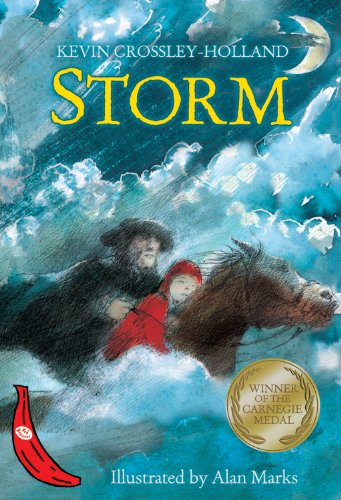
Storm by Kevin Crossley-Holland a Carnegie Medal winner

Storm by Kevin Crossley-Holland won the Carnegie Medal in 1985. I have a bit of an ongoing personal project going, to read as many of these medal winners as I can. This one has been utilised as a Reading Ladder book, presumably some sort of educational tool. This has whittled the pages down to just 46 and as it’s heavily illustrated it’s a very quick read indeed, and unlike any of the other Carnegie Medal winners that I’ve previously read.
Annie is a young girl who lives with her parents in a remote country area, her much older sister Willa is married and living in a town three bus journeys away, but she is going to be having a baby soon, and her husband who works away from home isn’t able to get home in time for the birth. It’s almost Christmas and Willa makes the journey to her parents’ house.Despite the age difference the sisters get on well, and Willa is able to tell Annie the details of a local ghost story about a man who had been murdered by highwaymen near the ford – hundreds of years ago.

Three days later a terrific storm arrives, and it looks like Willa’s baby is determined to arrive too, but the phone lines are down so they can’t get through to the hospital.

Annie is sent out into the storm to fetch the local doctor, she’s frightened of meeting the ghost, but a horseman picks her up and takes her to the doctor’s house, and all is well.

I think that this book has been somewhat shortened, edited to fit the Reading Ladder. It’s a well written story, and I like the illustrations which are by Alan Marks, but I’m not sure about pushing ghost stories onto children, so I find it to be a strange choice for the Carnegie Medal. I hope their teachers tell them that ghosts aren’t real!

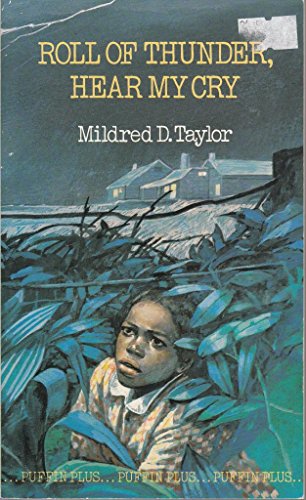
Roll of Thunder, Hear My Cry and Let the Circle be Unbroken by Mildred D. Taylor

Roll of Thunder, Here My Cry and Let the Circle be Unbroken by Mildred D. Taylor were published in 1976 and 1981 in the USA.  I read editions from the Puffin Plus series. Thanks Jennifer for these ones, I hadn’t even heard of the author before.

The first one begins in 1933 in America’s deep south. Mississippi.  It’s a tough time for farmers but particularly for black farmers, but the Logan family are a bit better off than most of their neighbours who are only sharecroppers. The Logans actually own their land, but the wealthy white landowner who owns the land adjoining theirs is determined to get their land for himself.

Cassie Logan is the only girl in her family, she has three brothers and lives with her parents and her grandmother. Her father is having to work away from home for most of the time though, so that he can earn money on the railroad, that money pays the annual tax which is due on his land.

Life is difficult for the children too, just getting to school in the morning is a nightmare as they have to walk on what is often a muddy track, having to try to dodge the white children’s bus as the driver is determined to splash them with mud while the white children cheer. Life for the black people is just one humiliation after another, but it’s the night riders (Ku Klux Klan) who terrify the black people. Just a rumour of ‘disrespect’ from a black person could end up with them being lynched or burnt out. Cassie has a lot to learn, and none of it makes sense. This one won the Newbery Medal.

Let the Circle be Unbroken is set two years later. Things are even worse for the black people now, the Depression is biting deeper and the ‘solutions’ put forward by the government are only making things worse, especially for sharecroppers. Granger, the main white landowner is conning the Logan family out of money which was due to them from the government and Cassie’s mother has lost her teaching job.

Mr Morrison has become part of the Logan household, he’s over seven feet tall and Cassie’s father won’t worry so much about his family while he is away on the railroad work. But it’s young T.J. Avery who gets into big trouble. He’s a young black neighbour and is rather full of himself. When a couple of white lads befriend him you just know it’s going to end in tears.

Stacey Logan, the eldest son decides that he is going to leave and find work elsewhere, but he just runs off and they hear nothing from him, everyone fears the worst.

These are both really good reads, if somewhat depressing, as in some ways things don’t seem to be getting a lot better for the black people in the deep south of the US.

20 Books of Summer 2024

I completed 20 Books of Summer, in fact I probably read getting on for 30 books in that time, but a few of them were for young adults so they were fairly quick reads. Only about half of the books that I read were on my original list. With requested books coming from the library I had to concentrate on those ones. I had an unusual fail when I got to about half way through Maugham’s Cakes and Ale as the chapters went back to the beginning and there was no sign of the last half of the book – so annoying!  My copy of the book is about 50 years old, it’s not the first time that I’ve had a problem like that. One of my old books has two halves of entirely different books in it. I thought it would be easy to get another copy of Cakes and Ale from the library, and it should have been but so far it hasn’t arrived.

So these are the books that I read and managed to review:

1. The Wrench by Primo Levi (for The Classics Club)

2. The Other Queen by Philippa Gregory

3. Snow Country by Yasunari Kawabata

4. Post After Post-Mortem by E.C.R. Lorac

5. The Redemption of Alexander Seaton by Shona MacLean

6. Gideon Ahoy by William Mayne

7. Mr Mac and Me by Esther Freud

8. Dissolution by C.J. Sansom

9. The Secrets of Blythswood Square by Sara Sheridan

10. Where the World Ends by Geraldine McCaughrean

11. Mayland Hall by Doreen Wallace

12. The Little Bookroom by Eleanor Farjeon

13. The Runaway Summer by Nina Bawden

14. Making It Up by Penelope Lively

15. The Mermaid and Mrs Hancock by Imogen Hermes Gowar

16. Five Children on the Western Front by Kate Saunders

17. Gaudy Night by Dorothy L. Sayers

18. The Hazelbourne Ladies Motorcycle and Flying Club by Helen Simonson

19. The Hemlock Cure by Joanne Burn

20. The Fall of Kelvin Walker by Alasdair Gray

Looking back it seems like a lot longer than three months since I read some of them. Five were by authors that I hadn’t read before:  William Mayne, Imogen Hermes Gowar, Doreen Wallace, Esther Freud and Yasunari Kawabata. I would probably read more books by all of those ones. The only author that I will probably avoid in the future is Philippa Gregory as her grip on known historical facts is poor, possibly deliberately so. When an author writes about Mary, Queen of Scots having black hair you have to wonder about them and all the other details within the books.

Anyway, June was a very wet month this year and July and August weren’t an awful lot better, I’m glad that I had plenty of books to keep me busy.

Thank you Cathy @ She Reads Novels for hosting this again.

Five Children on the Western Front by Kate Saunders – 20 Books of Summer

Five Children on the Western Front by Kate Saunders is a continuation of E. Nesbit’s book Five Children and It.  This book was first published in 2014.
It begins with a prologue set in London in 1905.  Cyril, Anthea, Jane, Robert and the Lamb had found the Psammead, a sand fairy, a desert god from the times before the ancient Egyptians. He’s a  cantankerous brown furry grump with a small stout body, eyes on stalks and long arms and legs, he usually lives in hot sand and any hint of dampness near him causes him terrible pain. He had been sleeping for years but the children decide to wake him up, the Psammead has the power to grant wishes. They ask him to take them to the future, somwehere quite near, and they end up in 1930, in the home of their old friend the Professor where they see some photos of themselves as they will be as adults, but they aren’t all in the photos, it’s a bit of a puzzle. Of course the older children are just the correct age to be involved in the First World War, and the Psammead whisks some of them to the Western Front.

I’m usually not all that mad keen on continuations written by a different author, but I think this idea really works, inevitably it is a bit sad, but realistic.

At one point (chapter 10) the children and the Psammead go to see the play Peter Pan. The Psammead is thrilled by it, especially when the audience is asked to clap if they believe in fairies. I was almost as thrilled as the Psammead. J.M. Barrie is a much underrated author nowadays.

You can read  Linda Buckley-Archer’s review of the book in The Guardian here.

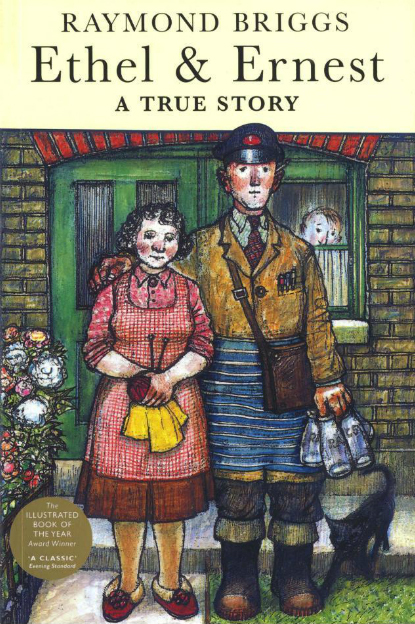
Ethel and Ernest by Raymond Briggs

Ethel and Ernest by Raymond Briggs  (of The Snowman fame) was published in 1998, it’s the biography of his parents’ lives and relationship and it’s a delight. At just 102 pages of mainly illustrations I read through it very quickly and then turned back to the beginning again to savour his charming and so detailed illustrations.

Ethel was working in service for two snooty looking women when she fell for Ernest who often waved to her as he cycled past her employers’ home. Ernest is a milkman and the two of them decide to get married and buy a home of their own. The illustrations show them looking around the empty house as Ethel wonders if they can afford it, and bit by bit you can see them gathering furniture and ‘stuff’ to make their quite large nest. Sadly after Ethel has a tough time giving birth to Raymond they are told to have no more children. Ernest says, but we wanted a proper family! It wasn’t to be.

Apart from all the landmarks in a couple’s life such as Ethel being thrilled to have a gas copper for washing the clothes in, there are also all the stand out moments such as the BBC announcing that we were at war in 1939. Then all the preparations involved in that, the gas mask, building an Anderson shelter in the garden, a Morrison’s shelter in the living-room, making blackout shutters and Raymond being evacuated to safety. Just as well as their home is badly damaged in a bomb blast.

This book starts in 1930 and ends in 1971 as Ethel and Ernest both die in that year. Obviously Raymond’s life appears in the book too. It’s a real love letter to both of his parents in their memory. They come across as being a lovely couple, so human and quite different from each other in outlook, with Ethel beinng a bit of a snob, as befits an ex ‘ladies maid’. Ernest is all for the working man.

I’m just amazed that in 1930 a milkman could afford to buy a large terraced Edwardian house with living-room, dining-room, four bedrooms, scullery, kitchen AND bathroom.  They lived in that house all their 41 years together. Apparently this book has been made into an animated film, that seems so fitting.

Human Croquet by Kate Atkinson

Human Croquet by Kate Atkinson is the second novel by the author and it was published in 1997.  I must admit that it’s a while since I read this one, I’ve put off reviewing it as although I like her writing I find it very difficult to write about. I now realise of course that I should have done it while it was clearer in my mind. As often happens in Atkinson’s books the action slips between different times, so this is a bit of a conglomeration of historical fiction, mystery, time travel and also has a 1960s setting in the village of Lythe which is very ancient.

Isobel is the narrator, she’s 16 and has a brother Charles. They have been abandoned by both their parents. Their mother apparently ran off with her boyfriend and their father couldn’t cope and left them, supposedly looking for their mother, but when he comes back seven years later he has brought a new wife with him.

It was their mother’s sister who looked after them, she had given up her home and moved in with them, and was a bit surplus to requirements when an actual step-mother arrived. Their grandmother is also part of the household. From time to time Isobel slips back to the Lythe of Shakespeare’s time.

The book is ful of Scottishisms, you would never know that Atkinson wasn’t born and brought up in Scotland. I believe she went to Edinburgh to study when she was 18 – and stayed, but according to an interview which appeared in the Guardian she regards herself as Yorkshire through and through!

Now 72, and having lived in Scotland for many years, she’s clear that this vision of Englishness – still cleaved to by nationalist politicians – is very much a south-of-the-border issue. Her own identity, she insists, lies in neither country: “I’m not English. I’m from Yorkshire. It’s different.” She left after she wrote Behind the Scenes at the Museum, “but when I die, open me up and Yorkshire will be carved on my heart”.

You can read the full interview with Alex Clark  here.

The Mermaid and Mrs Hancock by Imogen Hermes Gowar – 20 Books of Summer

The Mermaid and Mrs Hancock by Imogen Hermes Gowar was first published in 2018 and I think I’ve had it since then, waiting to be read, it’s one of my 20 Books of Summer. I must admit that I did have a few qualms at times about this book but I ended up really enjoying it. The qualms were because I’m one of those people that prefers to have the bedroom action in books staying in the bedroom with the reader staying on the other side of the door.

The book is set in 1785/86 and Jonah Hancock is a merchant and ship owner, he’s waiting for word of one of his ships to reach him, it’s always a fraught time as so many ships are wrecked and never heard of again. This time his ship has not arrived but its captain Tysoe Jones has, telling Jonah that he has sold his ship so that he could buy a ‘mermaid’. Jonah is dumbfounded but Tysoe explains that the oddity will make him a fortune as people will pay good money to see a mermaid. In truth it’s a dried up and ugly impish thing, but Tysoe is correct and people come from far and wide to see it.

Jonah Hancock had led a quiet and blameless  life for almost twenty years since his wife’s death in childbirth along with his baby son, but he is now catapulted into high society, a place of sex, sin and debauchery. Very young women are exploited by older women, who sell their bodies to wealthy men but the girls get nothing except clothes, board and lodging.

So bawds and bawdy houses feature in this book, some quirky but believable characters, and some problems which are still with us nowadays. The exploitation of young women, by other women as well as men. This was a good read though.