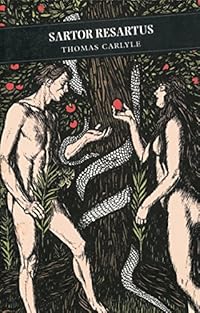
Sartor Resartus by Thomas Carlyle

Sartor Resartus cover

Stefanie at So Many Books got me thinking that I should read this book.
This is the first thing that I’ve ever read by Thomas Carlyle, which is a bit shameful really considering he lived and taught a stone’s throw from where I live. I had always thought that his writing would be very dry and boring, he sounded like one of those old Scots curmudgeons to me, but I was pleasantly surprised. There’s a lot of humour in Sartor Resartus which is apparently his protest against Materialism, and it only occasionally descends into thou-ing and thee-ing, which I can’t really be doing with. The title means ‘the tailor patched or remade’ and although it’s written about Professor Diogenes Teufelsdrockh (which translates as god-made devil-dung) a German from the University of Weisnichtwo who has written a Philosophy on Clothes with Carlyle as his editor or patcher, introducing Teufelsdrockh’s work to the British public. In reality Teufelsdrockh’s experiences are Carlyle’s.

Carlyle was born in the very small village of Ecclefechan in the south of Scotland and having been there to see his birthplace I can see why he wanted to leave, there’s just nothing there and in fact the name of the place sounds strange even to Scots. I can imagine that when he told people where he came from, nobody actually knew where it was, which is why he gave Teufelsdrockh’s town the name of Weissnichtwo, which translates as Know not where. That’s my theory anyway but Wikipedia doesn’t agree with me.

Although this book was written in 1832 it’s amazing, and sometimes quite depressing how little some things have changed. On page 93 he writes: His first Law-Examination he has come through triumphantly; and can even boast that the Examen Rigorosum need not have frightened him: but though he is hereby an Auscultator of respectability, what avails it? There is next to no employment to be had.

This was obviously Carlyle’s experience and the reason why he ended up teaching in Kirkcaldy which he managed to stick out for just a few years, which isn’t surprising as he wrote this:
Among eleven-hundred Christian youths, there will not be wanting some eleven eager to learn. Which is presumably why, like many a Scot before him, he left Scotland to find fame and fortune in London.

Okay, so I admit it, I haven’t quoted any funny bits, but they are there, honestly. One thing that really annoyed me about the book is the use of the word English, which is often used when the word should be British or even Scottish. This must have been an editor re-writing Carlyle as no Scotsman would have done it. The author Smollet is even described as English! Or was it Carlyle posing as an English editor? Who knows. The structure of the book is multi-layered, but if Carlyle did mean to write English when it should have been British or Scottish – then he took it too far.

Apparently Dwight Eisenhower kept a copy of this book with him from 1942-1945 while commander of AEF and noted ‘It is a wise man who has read this masterpiece and acts upon its call.’ Adolf Hitler was reading Carlyle’s biography of Frederick the Great in 1945. Carlyle’s distaste of democracy and his belief in charismatic leadership obviously appealed to Hitler. Well nobody’s perfect!

The powers that be in the shape of ‘the toon cooncil’ demolished the building which was the school that Carlyle taught in, and replaced it with a 1970s horror. So the only thing which I could photograph is the other side of the street, which they daren’t pull down as it is The Old Kirk and this is the street which Carlyle would have walked down every day on his way to work, and the view which he would have had from his classroom window.

Birthday Trip

First, many thanks for the birthday felicitations, folks. As it was a lovely bright day we prepared a picnic and went for a drive along the coast.

Just before we left our house I had a delivery of roses from Gordon and Laura, very naughty of them as they were just too extravagant. Must remember to skelp their legs when I see them!

We visited the East Neuk fishing villages of Largo, Pittenweem, Anstruther and Crail and then on to the university town of St Andrews. It’s a lovely wee very historical town and the only place that I would like to live in Fife. Unfortunately that’s impossible now as it is so expensive for property, mainly because of all the golf courses in the area. The University of St Andrews is celebrating its 600 birthday this year. Duncan, our eldest is the website editor there.

So after a nice wander around the town and a visit to Fisher and Donaldson the famous bakery, we headed for the bookshops. Then we travelled back to Anstruther as it was getting on for dinner time. We had the birthday meal on Wednesday in Kirkcaldy so dinner was very low key, fish and chips from the famous award winning chippy.

Apparently it was a popular destination for Prince William when he was a student at St Andrews a few years back, and he recommended it to his father, Prince Charles, who took Camilla there for fish and chips recently.

It was good but I don’t think it was the best that we had eaten, we had never sampled it before because the enormous queue had always put us off, but the queue did move fairly quickly. Next time we will try The Wee Chippy which got a very good write up in The Guardian.

Then we just went back home and ate our purchases from the cake shop. We all had strawberry Danish pastries and I couldn’t resist a coffee tower too. Yummy! Jack watched the FIFA World Cup while I had happy birthday ‘phone calls and watched a birthday DVD – One Foot in the Grave. Really funny, I nearly choked at a few points, so a good day was had by all.

Munduff near Scotlandwell

As you can see, we actually made it up to the top of Munduff despite the fact that it was a steaming hot day. The island in the middle of Loch Leven is where Mary Queen Of Scots was imprisoned. It looks tiny here but is actually quite big.

We nearly had the whole place to ourselves, there were just a few other people daft enough to tackle the climb, and of course there were the gliders.

The one on the left is a hang-glider. There were microlights too.

At one point I thought we wouldn’t make it, but with plenty of rests (collapses) along the way we managed it, with a lot of peching and panting. It took us about an hour and a half.

On one of our stops we calculated that it must have been 15 years since we walked these hills. That time we went up the Bishop Hill.

Unfortunately it was a bit too bright and some of the photographs came out a bit colour drained, I tried to darken them a wee bit.

At the top it was very windy but that was just what we needed to cool us down. The picture doesn’t give the true impression of how high up we were.

So if you find yourself near Scotlandwell or Kinnesswood in Perth and Kinross and you fancy a good hill walk, park your car at the side of the church and cross the road. Then walk down the hill a wee bit and there is a path with some steps leading up to Munduff and Bishop Hill.

I think that children from about the age of 12 should be able to tackle this walk. Get them away from the T.V. and computer and although they will probably moan all the way, they’ll boast about it to their friends.

Marjory Fleming (Pet Marjory)

I had thought that Marjory Fleming was just about forgotten now, plenty of people local to Kirkcaldy have never heard of her. So I was really surprised to discover that she was being discussed on Fleur Fisher Reads confessions of a Cornish bookworm – a lovely blog.I hadn’t heard of the Persephone book by Oriel Malet called Marjory Fleming but people seem to be enjoying reading it.

Fleur did reply to my comment that it sounds like I’m living in a lovely place so I think that Oriel has used her artistic licence as I would say that the Kirkcaldy area is one of the least scenic places in Scotland that I know of. It was probably very dirty and smelly when Marjory was living here too.

Marjory was happiest when she was living with her cousin in Edinburgh. Isabella encouraged Marjory to keep a journal, which she did until she died of meningitis when she was not quite 9 years old. I read it years ago and seem to remember that it was quite a charming but sad read given how quickly her life was over. She is buried in Abbotshall Churchyard, Kirkcaldy.

Probably nothing would ever have been known of her at all if it wasn’t for Sir Walter Scott who was a distant relative by marriage.

Abbotshall Church looks the same from the outside as it did when Marjory died in 1811 but internally it has been gutted and modernised, sometime around 1960 probably. Such a shame.

Heatherhall Woods, Fife

We had been planning on going on our first hillwalk of the season last Saturday but the bracing breeze from the north made us think again. It was freezing.

So we pointed the car towards Ladybank and ended up taking a walk around Heatherhall Woods which is a managed woodland owned by Fife Council. It’s a very tame walk and so I suppose it is good for people who want to take small children for a walk.

I can’t say that we saw much in the way of wildlife though. There are supposed to be red squirrels around there but the only thing we saw was a crow, and I heard a pigeon. It seemed bereft of wildlife even compared with our teeny wee back garden, which is usually teeming with birds.

But the trees are nice there, mainly pine trees which should suit red squirrels. I think they could maybe be doing with having some smaller trees for wee birds to perch on, although they do have silver birch.

Holly trees would be good for the birds. Ours is always stuffed full of them. You can’t see any birds as they are all hidden in it but they certainly like to make themselves heard.

I’m hoping that it will be warm enough to go up a hill soon. We’re definitely fair weather walkers.

Martyrs’ Monument, Edinburgh

Political Martyrs Monument

Political Martyrs Monument

This 90 foot high obelisk was erected in 1845 at Waterloo Place in Edinburgh. It commemorates William Skirving, Thomas Muir, Joseph Gerrald, Thomas Fyshe Palmer and Maurice Margarot who were known as the Scottish Martyrs. They were tried for sedition in 1793, with the judge telling the jury that sedition in this case meant violating the peace and order of society. In fact they were only campaigning for reform of the parliamentary system to give men over the age of 21 the vote, amongst other things.

They were found guilty and transported to Australia for 14 years. In 1794 they sailed from Portsmouth on The Surprise bound for Botany Bay. William Skirving, the one that I am most interested in as I think I am related to him, died of dysentery not long after reaching Australia. His wife and children were re-housed by a landowner in Kirkcaldy.

Thomas Muir and William Skirving

Falkland, Fife.

The village of Falkland in Fife is dominated by the Royal Palace of Falkland.

My photo is a stitch of two because I couldn’t get the whole Palace into the one frame. Shame about the red car.

The village and Palace are well worth a visit if you are in the area. It’s stuffed full of ancient history but it also played a part in more recent times with The Chapel Royal being used by the Polish Airborne Forces during World War 2, when they were stationed nearby. They were allowed to use it as there wasn’t an ordinary Roman Catholic Church in the vicinity.

I really liked the royal (real) tennis court. It’s the oldest one in Britain and was built for James V in 1539. When we were there , a match was actually taking place. It is a sort of cross between tennis and squash.

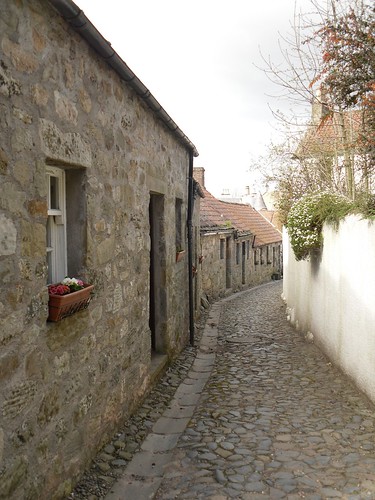
An ancient street in Falkland

The village itself is very quaint and has a variety of interesting houses. Some of them are absolutely tiny but people are still living in them today. I think they were probably inhabited by weavers originally.

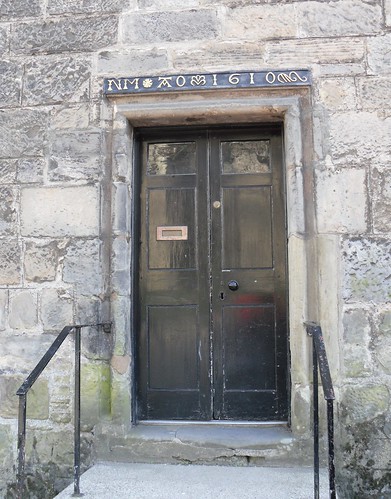
Doorway lintel, Falkland.

It was traditional to carve the initials of the original house owners as well as the date on the door lintel. This is known as a marriage lintel.

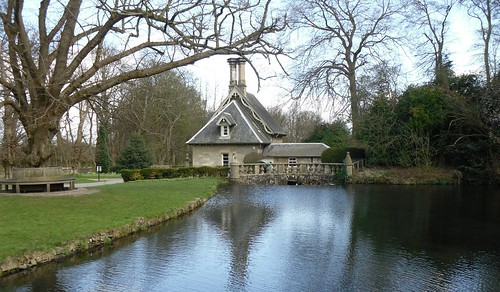
Gatehouse, Falkland estate.

Falkland Estate is on the outskirts of the village and has a very pretty gatehouse. As you can see there is a pond by the house. It’s usually full of ducks and moor hens but it was deserted when I took this photograph.

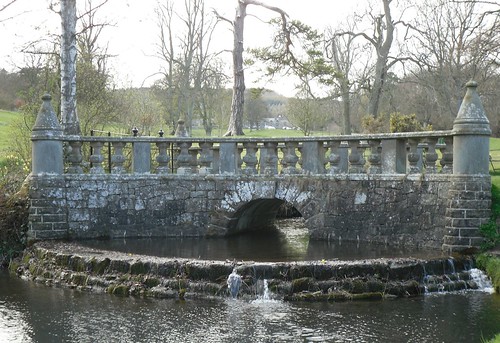
Stone bridge, Falkland estate

The lovely wee stone bridge just leads into a field. It crosses the burn (stream) which fills the pond. The burn continues its way from the pond and under the house. That is the one thing that puts me off the house. I would hate water running underneath my home, especially as it is a rushing torrent and noisy.

You can walk through the estate which has a very smart cricket pitch, which I think is probably a bit of a shock to English tourists, but cricket is actually quite popular in more rural areas. We’re just not very good at it.

The Old Course, St Andrews

We had a day out in St Andrews yesterday, making the most of a fleeting visit by that big orange thing in the sky.

I decided to take a photograph of the beginning (and end) of the Old Course. It really tickles me that there is a public pathway cutting straight across the fairway and people wander across it all the time. I suppose it must be a right of way otherwise it would have been got rid of long ago.

This place is a Mecca for golfers but it always embarasses me as I think it must be a horrible disappointment for them as the course itself is far from being a thing of beauty. It is really boring looking. I suppose if you are into golf then it is the history of the whole thing that gets to you. There is a museum of golf on the road behind the course.

I don’t play golf as I am strictly in the ‘Why ruin a good walk?’ camp, but local golfers of my acquaintance are equally unimpressed and have assured me that the best courses are around Gleneagles in Perthshire.

If you happen to live in Fife though you have plenty to choose from. Even teeny weeny villages have their own golf course.

King Alexander lll of Scotland Monument

This monument is situated at the roadside just north of Burntisland in Fife. It commemorates Alexander lll who fell off his horse and broke his neck near or at this spot.

He had been warned not to travel on such a dark and stormy night but he was a middle-aged man who was keen to get back to his new and much younger wife.

He was travelling from Edinburgh to Kinghorn and when he became separated from the other horsemen in his entourage, the accident occurred. You would think that they would have taken better care of the king.

There is a plaque by the side of the monument with an inscription in Scots lamenting his death.

I wonder if there were any conspiracy theories going around at the time. There certainly would be nowadays. His death brought on Edward I of England’s attempt to take over Scotland which led to the long set of wars to maintain Scottish independence involving William Wallace and Robert The Bruce.

The monument was erected to commemorate the 600th anniversary of Alexander’s death. As you can see it is in need of a bit of sprucing up, I think it suffers from being so close to the passing traffic.

We visited it on Sunday which was just two days after the 19th and I had expected to see a wreath there as they used to have a procession and a bit of a ceremony, but there wasn’t any sign of it. Maybe that custom has died out.

We walked to the monument from Kirkcaldy, taking the coastal path as far as Kinghorn. Then you have to go by the road to Burntisland.

It was a much longer walk than we had anticipated. We aim to walk for about an hour every day, just to keep in shape. However this took us over two and a half hours there and back, it probably works out at about 9 or 10 miles. We didn’t feel too bad considering it’s the first really long walk of the year.

Scottish words: Dreich

Dreich (dreech) has been popping up fairly regularly recently on the BBC weather reports and I’m sure by now it must be quite well understood by people in England. It means really grey, dull and dismal weather but I suppose you can use it to describe anything grey and depressing.

I’ve been quite impressed by the pronunciation of the forecasters, they are managing the ‘ch’ sound well, as in loch. It would be terrible if they said dreek.

Here are a couple of dreich photographs of the coast at Kirkcaldy. As it is like this and even worse most of the time, it is a mystery to me why anyone would want a sea view.

Kirkcaldy rollers

More Kirkcaldy dreich

There are always a few ships about but to me the most interesting thing is that this is the exact piece of the coast which the famous economist Adam Smith (1723-1790) looked out on from his home. Then the area was packed with sailing ships and it was the coming and going of the ships which set him thinking about economics, and led him to write The Wealth of Nations.