Gothic Tales by Elizabeth Gaskell

I thought that I had already read just about everything by Gaskell but on my last visit to my local library this one was sitting on the ‘new books’ shelf, so I had to borrow it.

This is a collection of nine short stories, although two of them are long enough to be described as novellas. I think that most writers hone their skills on short stories and I quite enjoy them. Sometimes the stories stick in your mind for 20 or 30 years, but I don’t think that will be the case with any of the stories in this book.

One of the novellas is called Lois the Witch and is the story of the Salem ‘witches’. I’m wondering when the first fictionalised version went into print.

Some of them are what I would call ‘fireside tales’ which would have been brought out and dusted down from the mind of the resident family tale teller on dark winter nights. I’m sure every household had one, even in more recent times (it was my mother in our family). They certainly have a feeling of folk lore about them, but I have read quite a few Celtic folk tales in my day.

Which brings me to what I found to be the most interesting thing about the stories, which was the language used. Elizabeth Gaskell uses quite a few words which are still used north of the border in Scotland. But I had an interesting comment from Joan in Pennsylvania about the phrase ‘redd up’ which Elizabeth Gaskell used, it means to tidy up or clean up. It seems it’s used by people from all different ethnic backgrounds there, but particularly by those of Dutch/German descent. Wherever it originated from I’m happy knowing that it continues to be used and makes the language richer. In future I’m going to ‘redd up’ instead of tidy up.

Anyway, I’m glad that I read Gothic Tales but I much prefer Gaskell’s longer works. If you want to read more about her work you might like to pay Austenprose a visit as a celebration of the 200th anniversary of Gaskell’s birth is being marked by people reviewing her work.

Hunterian Museum, Glasgow

This is a bit of a linky-fest for places of interest around the west-end of Glasgow. More parts of Glasgow will be featured at a later date.

It’ll be the school autumn holidays soon, so I was having a look to see what we could do in Glasgow during them. We usually like to visit The Hunterian Museum at Glasgow University. It’s always interesting even although it’s very small, and it’s free!

It’s just a short walk from Kelvingrove Museum, which is my favourite museum and art gallery – in fact it’s a home from home for me.

At the moment they are celebrating Black History Month at the Hunterian but there are exhibitions in other parts of the country too, if you can’t manage to get there.

The Hunterian Museum is tucked away at Glasgow University but the Hunterian Art Gallery is easier to find and is just a few minutes’ walk from the museum. There are always interesting art works on display but my favourite bit is the Charles Rennie Mackintosh part, where they have reconstructed an interior.

After that we’ll have a stroll along Byres Road ending up at the Botanic Gardens, which Michelle really enjoyed on her recent trip to Glasgow. A Son of the Rock has some nice photographs of the glasshouses there, which you can see here.

Sadly the Glasgow Museum of Transport closed recently and is moving to the new riverside setting. I’m sure that it’ll be great when it’s finished but I will really miss the old place, which was very handy, being just across the road from Kelvingrove.

So, that will be the most important parts of the west-end of Glasgow visited, unless you’re into shops. Byres Road leads you from Kelvingrove all the way to the Botanics and there are plenty of independent shops of interest.

Newest addition

My brother is 63 and that’s quite a lot older than me, and he and his wife had just about given up hope of being grandparents. But here she is at last, baby Juliette, the latest addition to the extended family.

She weighed in at a healthy 8 lbs 7 oz (3840 grams). Definitely worth waiting for!

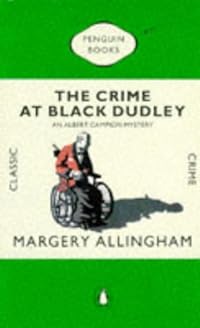
The Crime at Black Dudley by Margery Allingham

The Crime at Black Dudley cover

This book was much better than the last Margery Allingham which I read. It’s the first book which she wrote featuring Albert Campion as a character, and it really annoys me that she has written him with a ‘silly falsetto voice.’ There’s nothing more guaranteed to put you off a man, so I try to pretend that she didn’t write that.

This is the well-loved country house weekend sort of crime thriller/ adventure story and I’m not going to say much more about it other than that I really enjoyed it. I know that at least one other blogger (Danielle) has it on her nightstand waiting to be read.

There is an engaged couple in this book and at one point the man decided that he wouldn’t allow his fiancee to participate in the action on the grounds that it would be dangerous. It just about had me bouncing my head off the wall, but the book was written in 1929 and to be honest, men got off with behaving like that a lot more recently too.

Apparently she wrote Campion as a parody of Dorothy Sayers’s Lord Peter Wimsey. I wonder how well that went down with Sayers? They lived very close to each other in Essex in the 1930s. Sayers in Witham and Allingham was near White Notley, with just one train station in between them.

They were well known to the station staff and would often be on the same train going to nearby London, but according to one biography which I read years ago they didn’t pay much attention to each other.

In the 1970s I lived in Braintree, the next station along and at that time they were still using the 1930s carriages, just exactly as they are im Miss Marple. On my way to work in Witham I used to wonder if I was sitting in a seat which they had sat in, but on second thoughts, they would probably have been in the First Class section.

I seem to remember that Peter Davison was quite good in the role of Campion in the tv series.

Campion Complete Collection cover

Scottish words: redd up

Redd up is a phrase which you don’t hear much nowadays, which is a shame. It means to tidy up or clean up. It’s usually used to describe the tidying of a house or garden.

The last time I heard it being used it was a man saying that he had ‘redd up’ the noticeboard in a school. Well, notice boards are usually in need of a good redd up as they’re often crowded with out of date information.

I was surprised to read the phrase in a story by Elizabeth Gaskell the other day, although I probably shouldn’t have been. Michelle from the north of England recently informed me that the word ‘hen’ is still used there and I had thought it was only used in Scotland until then.

I’m now wondering if these words were originally Scottish but just expanded into the north of England with people moving there from Scotland for work. Or have they just continued to be used for a longer time here.

The Elizabeth Gaskell story which it was used in is The Crooked Branch and it was first published in 1859. It has been reprinted as a Penguin Classic in Gaskell’s Gothic Tales.

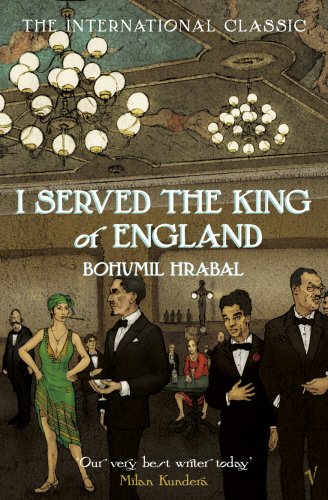
I Served the King of England by Bohumil Hrabal

I Served the King of England cover

This was a very quick read and the second book which I have read by the Czech writer Bohumil Hrabal. It’s set just before the German invasion of Czechoslovakia and is about the life of Jan Ditie who is a young waiter who had previously had the job of selling frankfurters at a railway station. That work had been much more lucrative due to him having a scam involving not being able to give people their change until the train was just drawing out of the station. Of course he was never quite able to reach their outstretched hands as the train sped off.

He isn’t all that happy with his new career as a waiter at the Golden City of Prague restaurant and he fantasizes about saving enough money to be able to visit the nearby brothel.

Ditie is trained for the job by a head waiter who had once served the king of England and never tires of repeating the fact. Later in the book it’s Ditie who repeats a claim to fame – I served the Emperor of Ethiopia.

Eventually Ditie falls in love with Lise, a German gym teacher and moves to a town above the mountains of Decin which is described as being the first breeding station for National Socialists, better known as Nazis.

The regime is not happy about Lise, a good German, wanting to marry a small Czech man, especially when she has the pick of a town full of good Aryan SS men. But they are eventually allowed to get married and a son is born. It’s at this point that the story goes a bit peculiar because the child turns out to be mentally retarded and as a baby he spends his time banging nails into floors all day with a hammer!

When the Nazis are defeated things take a turn for the worse for Ditie too.

It was a bit strange in parts and I didn’t enjoy it as much as Closely Observed Trains, but it was fairly entertaining.

Better Than Butter Tarts

I don’t think my tarts look particularly good because I didn’t have a deep enough tart tray and I should have made the pastry thinner, but they still tasted really good and I’ll know better next time.

I have to thank Niranjana for this recipe from Niranjana Brown Paper. You can see it here and view how the tarts should look! This one is from a cookery book for vegans. I didn’t know that vegans could eat margarine. Presumably butter can be used if you want but I just stuck with the marg.

The recipe calls for flax seeds and I managed to buy a sachet from Holland and Barrett health food store. It was very cheap for a 30g packet and I wouldn’t leave this ingredient out because I think it probably contributed a lot to the rich flavour.

I made the pastry from scratch but it’s a lot easier to just buy the frozen sweet shortcrust pastry. It tastes just as good, I think.

The next time I do this recipe I think I might put meringue on top just for a change because my pastry recipe uses 1 egg yolk, and I could use up the white in that way.

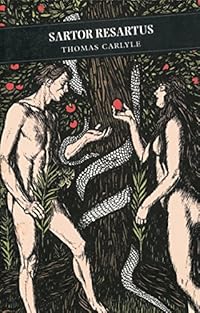
Sartor Resartus by Thomas Carlyle

Sartor Resartus cover

Stefanie at So Many Books got me thinking that I should read this book.
This is the first thing that I’ve ever read by Thomas Carlyle, which is a bit shameful really considering he lived and taught a stone’s throw from where I live. I had always thought that his writing would be very dry and boring, he sounded like one of those old Scots curmudgeons to me, but I was pleasantly surprised. There’s a lot of humour in Sartor Resartus which is apparently his protest against Materialism, and it only occasionally descends into thou-ing and thee-ing, which I can’t really be doing with. The title means ‘the tailor patched or remade’ and although it’s written about Professor Diogenes Teufelsdrockh (which translates as god-made devil-dung) a German from the University of Weisnichtwo who has written a Philosophy on Clothes with Carlyle as his editor or patcher, introducing Teufelsdrockh’s work to the British public. In reality Teufelsdrockh’s experiences are Carlyle’s.

Carlyle was born in the very small village of Ecclefechan in the south of Scotland and having been there to see his birthplace I can see why he wanted to leave, there’s just nothing there and in fact the name of the place sounds strange even to Scots. I can imagine that when he told people where he came from, nobody actually knew where it was, which is why he gave Teufelsdrockh’s town the name of Weissnichtwo, which translates as Know not where. That’s my theory anyway but Wikipedia doesn’t agree with me.

Although this book was written in 1832 it’s amazing, and sometimes quite depressing how little some things have changed. On page 93 he writes: His first Law-Examination he has come through triumphantly; and can even boast that the Examen Rigorosum need not have frightened him: but though he is hereby an Auscultator of respectability, what avails it? There is next to no employment to be had.

This was obviously Carlyle’s experience and the reason why he ended up teaching in Kirkcaldy which he managed to stick out for just a few years, which isn’t surprising as he wrote this:
Among eleven-hundred Christian youths, there will not be wanting some eleven eager to learn. Which is presumably why, like many a Scot before him, he left Scotland to find fame and fortune in London.

Okay, so I admit it, I haven’t quoted any funny bits, but they are there, honestly. One thing that really annoyed me about the book is the use of the word English, which is often used when the word should be British or even Scottish. This must have been an editor re-writing Carlyle as no Scotsman would have done it. The author Smollet is even described as English! Or was it Carlyle posing as an English editor? Who knows. The structure of the book is multi-layered, but if Carlyle did mean to write English when it should have been British or Scottish – then he took it too far.

Apparently Dwight Eisenhower kept a copy of this book with him from 1942-1945 while commander of AEF and noted ‘It is a wise man who has read this masterpiece and acts upon its call.’ Adolf Hitler was reading Carlyle’s biography of Frederick the Great in 1945. Carlyle’s distaste of democracy and his belief in charismatic leadership obviously appealed to Hitler. Well nobody’s perfect!

The powers that be in the shape of ‘the toon cooncil’ demolished the building which was the school that Carlyle taught in, and replaced it with a 1970s horror. So the only thing which I could photograph is the other side of the street, which they daren’t pull down as it is The Old Kirk and this is the street which Carlyle would have walked down every day on his way to work, and the view which he would have had from his classroom window.

Agatha Christie’s Secret Notebooks by John Curran

Agatha Christie's Secret Notebooks

This is a library book as I’m still managing to avoid actually buying more books until I make a serious dent in my TBR pile. In fact I had no intention of even looking at library books but when I returned some the other week I couldn’t resist having a look at the ‘new books’ shelves.

However, I think that if you are really into Agatha Christie then this might be a book that you would really want to own rather than just borrow.

John Curran is an archivist and he had the job of deciphering Christie’s private notebooks. Apparently her handwriting was terrible, and there were 73 of them to go through, so it was no mean feat.

It’s just interesting to see her jottings and ideas for various books, alternative endings and such.

The book includes two previously unpublished Poirot stories.