
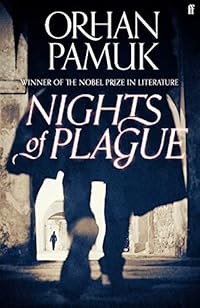
Nights of Plague by Orhan Pamuk has just been published but I was sent a digital copy for review via NetGalley. I must say that I was slightly depressed when I realised that it must be a massive book after being stuck on 1% for what seemed like a very long time. Anyway I clicked on for days and it wasn’t until well over halfway that I began to sort of get into it.
The setting is the Mediterranean island of Mingheria, the ‘Jewel of the Levant’ in 1900. The island is inhabited by Turks and Greeks, Muslim and Christian and there has always been a bit of tension between them, and when a plague arrives there’s suspicion and conspiracy theories galore with the two factions blaming each other for the disease. Did the plague arrive via rats from one of the Greek ships, or was it brought back by Muslims who had been on a pilgrimage?
The Sultan sends for a well-known quarantine doctor to deal with the epidemic. Dr Nuri Bey had recently married a Princess Pakize who had been locked up with her family for years, her uncle had imprisoned all the members of his family who might have threatened his rule. The doctor has a tough time trying to persuade people to take the quarantine seriously. The Greeks want to get off the island and lots of them manage it as the fishermen are more than willing to take them out under cover of darkness, even when there’s a blockade of warships to stop them from leaving.
There are a couple of romances going on, unusually between already married couples (for religious reasons I suppose) lots of history, a murder mystery and a lot about the Mingherian language which is on its last legs as most of the people who spoke it are dead and the young people speak either Greek or Turkish. It’s in an even worse position than Scots Gaelic, luckily Mingheria is an entirely imaginary place though!
I read this one on my Kindle and my heart sank when I realised how long the book must be as it was ages before I got to 2%. As with most long books it could have been improved by being shorter, I have a feeling that Pamuk wanted to get the history of the Ottoman empire written into a work of fiction, but it really didn’t work for me, it took me until 66% before I began to find it a bit interesting. The book was translated by Ekin Oklap and there were only a couple of clunky bits.
My thanks to the publisher and Netgalley for giving me the opportunity to read it.