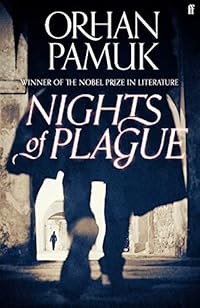
Nights of Plague by Orhan Pamuk

Nights of Plague by Orhan Pamuk has just been published but I was sent a digital copy for review via NetGalley. I must say that I was slightly depressed when I realised that it must be a massive book after being stuck on 1% for what seemed like a very long time. Anyway I clicked on for days and it wasn’t until well over halfway that I began to sort of get into it.

The setting is the Mediterranean island of Mingheria, the ‘Jewel of the Levant’ in 1900. The island is inhabited by Turks and Greeks, Muslim and Christian and there has always been a bit of tension between them, and when a plague arrives there’s suspicion and conspiracy theories galore with the two factions blaming each other for the disease. Did the plague arrive via rats from one of the Greek ships, or was it brought back by Muslims who had been on a pilgrimage?

The Sultan sends for a well-known quarantine doctor to deal with the epidemic. Dr Nuri Bey had recently married a Princess Pakize who had been locked up with her family for years, her uncle had imprisoned all the members of his family who might have threatened his rule. The doctor has a tough time trying to persuade people to take the quarantine seriously. The Greeks want to get off the island and lots of them manage it as the fishermen are more than willing to take them out under cover of darkness, even when there’s a blockade of warships to stop them from leaving.

There are a couple of romances going on, unusually between already married couples (for religious reasons I suppose) lots of history, a murder mystery and a lot about the Mingherian language which is on its last legs as most of the people who spoke it are dead and the young people speak either Greek or Turkish. It’s in an even worse position than Scots Gaelic, luckily Mingheria is an entirely imaginary place though!

I read this one on my Kindle and my heart sank when I realised how long the book must be as it was ages before I got to 2%. As with most long books it could have been improved by being shorter, I have a feeling that Pamuk wanted to get the history of the Ottoman empire written into a work of fiction, but it really didn’t work for me, it took me until 66% before I began to find it a bit interesting. The book was translated by Ekin Oklap and there were only a couple of clunky bits.

My thanks to the publisher and Netgalley for giving me the opportunity to read it.
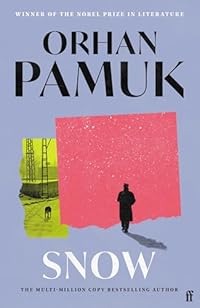
Snow by Orhan Pamuk – 20 Books of Summer

Snow by Orhan Pamuk was first published in the UK in 2004, was originally published in Turkey in 2002 and was translated by Maureen Freely. This is the thirteenth book that I’ve read from my 20 Books of Summer list and I put it on the list because it’s one of the many books in translation that Jack has bought over the years and I thought it was about time I gave some of them a go.

I must admit that I had a hard trudge through the first half of this book. The setting is Kars which is a remote city in Turkey, it’s where the poet Ka grew up, he has been living in Frankfurt for the last few years and he has returned supposedly to gather information to help him write an article for a German newspaper. The trouble for me was that the modern day Turkey kept getting in the way as everything at the moment in Turkey is the opposite of what it was in this book. Now the country is ruled by a supposedly fundamentalist Islamic leader. In Kars young women are beginning to cover their head with scarves and are even being banned from school and colleges if they refuse to remove their headscarves. There has been a spate of young women committing suicide, possibly because of the pressure to go bare headed but it might be because of the pressure their parents put on them to marry. Ka wants to investigate but he becomes embroiled with the political situation, the Islamists, army and the never changing plight of the Kurds feature. As the city becomes cut off due to the heavy snowfall there’s a clash between the political Islamists and the army. Ka had already witnessed a murder – it’s not a healthy place for him to be.

He has also fallen in love/lust with Ipec a beautiful woman that he has known since they were at school together so there’s romance of a sort here too. Strangely the author himself appears in this book towards the end, I’m told this is normal for a Pamuk book. Half-way through the book I thought I would probably give it three stars but by the end I upgraded it to four.

Edited to add:

One character more or less predicts the future in Turkey exactly as it is now when he says –

“If they don’t let the army and the state deal with these dangerous fanatics, we’ll end up back in the middle ages, sliding into anarchy, travelling the doomed path already well travelled by so many tribal nations in Asia and the Middle East.”

Bookshelf Travelling for Insane Times

I’m continuing with Judith at Reader in the Wilderness‘ meme Bookshelf Travelling for Insane Times which I’m really enjoying, particularly because I actually finished reading one of the books that I wrote about last Friday. This might be a great way for me to concentrate on reading my own books. Mind you the fact that all of the libraries are shut has helped too! I’ll be sharing my thoughts on Flowers in the Grass by Monica Dickens soon.

So this time around I’m again featuring just three books that have languished on various bookshelves of mine.

Dolittle

Doctor Dolittle and the Green Canary is a book for children written by Hugh Lofting, it’s quite a big series, written for children but suitable for all ages. The author illustrated his own books.

Snow by Orhan Pamuk belongs to Jack, Pamuk is one of his favourite authors but I’ve never read any of his books. I think it’s about time that I did.

The Century's Daughter

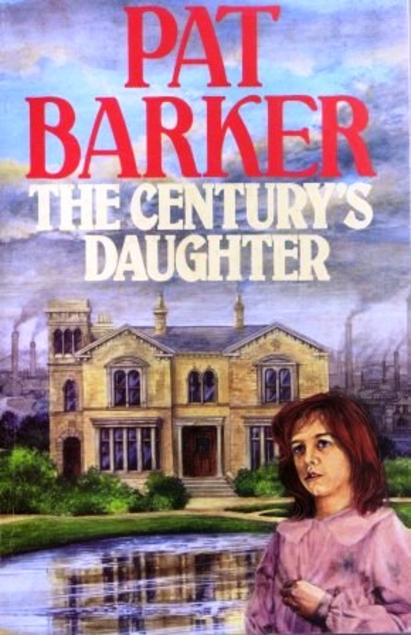
The Century’s Daughter by Pat Barker is one that I bought fairly recently. I’ve read a few books by Barker and really liked them, this one seems quite different though and it’s a Virago publication.